You.com search API pricing: $5 per 1,000 calls, and what else to compare

You.com's Web Search API costs $5 per 1,000 calls, and each call can return up to 100 results at the same price. Page content fetched live is $1 per 1,000 pages extra. New accounts get $10 of credit at sign-up and $90 more after verification, enough for 20,000 searches.
Short answer: You.com is the best value on this list when each call needs many results: 100 results cost the same $5 per 1,000 calls as 10, where Exa and Parallel charge about $91 to $97 for that depth. For 10-result searches, $5 is mid-market: Parallel's fast mode is $1 per 1,000 with page excerpts, Serper's packs are $0.50 to $1.00 for Google results, and Serpent API is from $0.03 per 1,000 searches — pay as you go, no subscription.
This page prices You.com's developer APIs, not its consumer chat plans. If you are comparing agent search APIs in general, our web search APIs for agents guide covers the wider field, and Tavily alternatives and Exa alternatives go deeper on those two. We sell a search API ourselves; every competitor price below links to that competitor's own page, read on 22 November 2026.
What does the You.com search API cost?
Five dollars per 1,000 Web Search calls, for anywhere from 1 to 100 results per call. That is the price on You.com's billing documentation and on its pricing page (You.com billing docs, You.com pricing). Billing is pay as you go from a credit balance, with optional auto top-up when the balance falls below a threshold you set.
| API | Price | Unit |
|---|---|---|
| Web Search | $5.00 | per 1,000 calls, 1–100 results each |
| Full page extraction with search | $1.00 | per 1,000 pages fetched live |
| Extract | $0.90 | per 1,000 URLs |
| Contents (deprecated) | $1.00 | per 1,000 pages |
| Answer | $5.00 | per 1,000 calls |
| Research: lite / standard / deep / exhaustive / frontier | $12 / $50 / $100 / $450 / $1,200 | per 1,000 calls |
| Finance Research: deep / exhaustive | $110 / $500 | per 1,000 calls |
The Web Search endpoint is POST https://ydc-index.io/v1/search. Its documented parameters include count (default 10, maximum 100), offset for paging, freshness (day, week, month, year or a date range), country, language and safesearch (You.com Web Search docs). Results come back in one results.web array, with news articles ranked in when a query has news intent, and each result carries a URL, title, description and snippets.
For very large volumes, the billing page says to contact sales for custom rates, and lists volume discounts, annual commitments and custom query-per-second limits as options. None of those prices is published.
What changed in 2026?
The price went down and the result tiers went away. You.com's announcement lists the old Web Search prices as $6.25 per 1,000 requests for 1–50 results and $8.00 for 50–100 results, replaced by a flat $5.00 for 1–100 (You.com: lower search API cost). The Contents API dropped from $10.00 to $1.00 per 1,000 pages at the same time.
The announcement's FAQ says usage from 12 March 2026 is billed at the new rates and that existing credit balances carry over unchanged. Third-party pages disagree with the official figures in smaller ways: ComparEdge's July 2026 cost guide puts Research Frontier above $2,000 against You.com's $1,200, and CostBench's October page says both “no free tier” and 100 free queries a day. Check the date on anything you read.
For buyers, the change matters most at depth. Under the old tiers, a 100-result call cost $8 per 1,000; it now costs $5, the same as a 10-result call.
How far does the free credit go?
About 20,000 searches. The billing docs say new accounts get $10 of API credit at sign-up and $90 more after account verification, $100 in total. At $5 per 1,000 calls, that is 20,000 Web Search calls, or about 16,700 if every call also fetches one page live.
The credit is a one-time start, not a monthly allowance, and the billing docs do not say when unused credit expires. Treat it as a generous trial: long enough to run a real agent workload for a few weeks and measure what you would spend.
You.com also documents a free MCP endpoint at api.you.com/mcp/free for calling live web search from an assistant. That suits personal use and prototypes; production traffic goes through the paid API key.
What do you pay for page content?
One dollar per 1,000 pages fetched live, on top of the search. The search docs describe an extraction option that returns either highlights or the full page as markdown or HTML for each result. The billing page prices the full-page add-on per page fetched live, and the March announcement's FAQ says each result includes full page content, so content that is not fetched live appears not to carry the charge; the pages I read do not spell out when a page counts as fetched live.
A worked example. An agent searches 10,000 times a month and reads the full text of three results per search. That is $50 for the searches and up to $30 for 30,000 live pages, so $50 to $80 a month. Compare that with Exa, which charges $1 per 1,000 pages per content type, or a SERP API for the search plus your own fetcher for the three pages.
How do you estimate a monthly You.com bill?
Multiply three numbers and add them up. The monthly bill is searches × $0.005, plus pages fetched live × $0.001, plus any Answer or Research calls at their own rates. Results per call do not enter the formula, which is what makes You.com easy to budget.
Three examples at list price:
- A support agent that runs 3,000 searches a month and reads no pages: 3,000 × $0.005 = $15. The $100 credit covers more than six months of that.
- A research assistant that runs 20,000 searches and reads two full pages per search: $100 for searches plus $40 for 40,000 live pages, $140 a month.
- A dataset job that pulls 100 results for each of 50,000 queries: 50,000 calls × $0.005 = $250, for up to 5,000,000 result rows. The same rows from a 10-result API would take 500,000 calls.
Two things move a real bill away from these estimates. Research calls are priced per call from $12 to $1,200 per 1,000, so one research call costs as much as about 2 searches on lite and 240 on frontier. And the billing docs do not say when credit expires, so if you top up a large balance, ask before you buy.
Set an auto top-up threshold below a week of usage, and log calls, live pages and research calls separately, so you can see which part of the bill is growing.
When is $5 per 1,000 a bargain?
When each call needs many results. Most agent search APIs price a call with 10 results and charge for every result beyond that; You.com charges the same for 100.
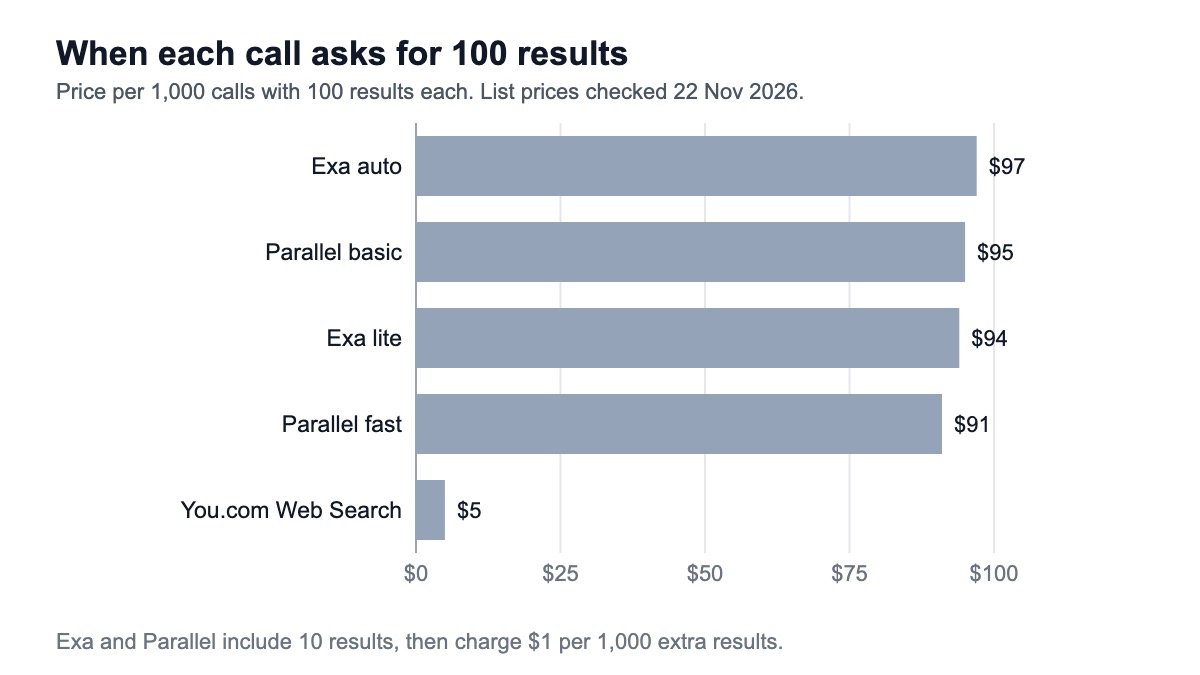
The arithmetic. Exa's base prices ($7 auto, $4 lite) cover the first 10 results, and each result above 10 adds $1 per 1,000 results (Exa pricing). A 100-result call therefore adds 90 × $0.001 = $0.09 per call, or $90 per 1,000 calls: $97 on auto and $94 on lite.
Parallel uses the same $1-per-1,000-extra-results rule on top of $1 (fast) or $5 (basic), giving $91 and $95 (Parallel pricing docs). Tavily caps max_results at 20, so a 100-result list is not available there in one call (Tavily search reference).
Who needs 100 results per query? Research agents that re-rank a long list, dataset builders, and anyone checking whether a domain appears anywhere in the top 100. If your agent reads the first five links, depth is irrelevant and the 10-result price is the one to compare.
How does it compare at 1K, 100K and 1M searches?
For 10-result searches at 100,000 a month, You.com's $5.00 sits in the middle of a range that runs from $0.03 to $7.92 per 1,000. The rules: free monthly allowances are subtracted; You.com's one-time $100 credit is not, because it does not recur; monthly plans are charged in full; prepaid packs use the pack that covers the volume.
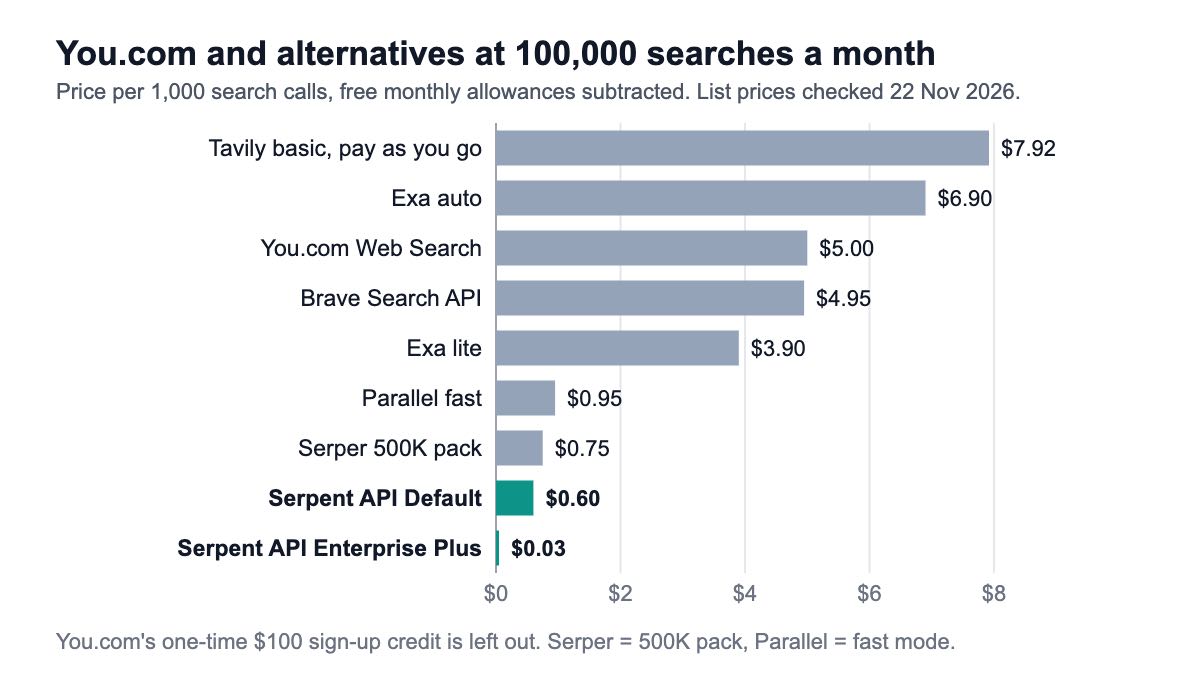
| Option | 1,000 a month | 100,000 a month | 1,000,000 a month | What you get back |
|---|---|---|---|---|
| You.com Web Search | $5.00 ($0 while the $100 credit lasts) | $5.00 ($500) | $5.00 ($5,000; custom rates on request) | Up to 100 results; snippets; optional page content |
| Tavily basic, pay as you go | $0 (1,000 free credits) | $7.92 ($792) | $7.99 ($7,992) | Up to 20 results; optional raw content |
| Exa lite / auto | $0 ($10 monthly credit) | $3.90 / $6.90 | $3.99 / $6.99 | Links; contents $1 per 1,000 pages |
| Brave Search API | $0 ($5 monthly credit) | $4.95 ($495) | $5.00 ($4,995) | Results from Brave's own index |
| Parallel fast / basic | $0 (free monthly allowance) | $0.95 / $4.95 | $1.00 / $5.00 | Links with page excerpts |
| Linkup | $0 (4,000 free queries) | $5.00–$6.00 | $5.00–$6.00 | Search modes from fast to deep |
| Serper | $1.00 rate, $50 smallest pack | $0.75 ($375 pack) | $0.50 ($1,250 pack) | Google results as JSON |
| Serpent API — Default ($10 deposit) | $0.60 | $0.60 ($60) | $0.60 ($600) | Results from Google, Bing, Yahoo, DuckDuckGo or Brave, your choice per call |
| Serpent API — Growth ($100 deposit) | $0.30 | $0.30 ($30) | $0.30 ($300) | |
| Serpent API — Scale ($500 deposit) | $0.20 | $0.20 ($20) | $0.20 ($200) | |
| Serpent API — Enterprise ($1,000 deposit) | $0.15 | $0.15 ($15) | $0.15 ($150) | |
| Serpent API — Enterprise Plus ($1,250 deposit) | $0.03 | $0.03 ($3) | $0.03 ($30) |
Sources for the rows: Tavily pricing, Brave Search API, Parallel pricing, Linkup pricing, Serper, and our pricing page. Our deposit is spendable balance and sets the price per 1,000.
At 1,000 searches a month, You.com's sign-up credit and the free monthly allowances elsewhere make every option free for a while. At a million, You.com's list price is $5,000 a month, the same as Brave and Parallel's basic mode, before any negotiated discount.
Which alternative fits which need?
Map the reason you are looking to the option that fixes it.
You need links and snippets at the lowest price: a SERP API
If your agent reads titles, URLs and snippets, a SERP API is the cheapest route. With Serpent API, a search is one call to GET /api/search/quick with q, engine (google, bing, yahoo, ddg or brave), country, language and freshness; one call is one charge, from $0.03 per 1,000 — pay as you go, no subscription. The standard search docs list every parameter, the SERP API page shows the response, and new accounts get 10 free calls. Serper sells Google-only prepaid packs from $0.50 to $1.00 per 1,000, valid six months; our Serper pricing explainer covers its rules.
You need page text with each result: Parallel or Exa
Parallel's fast mode is $1 per 1,000 searches with page excerpts, and its Extract API is $1 per 1,000 URLs. Exa's lite search is $4 and auto $7 per 1,000, with contents at $1 per 1,000 pages. Both charge for results beyond 10, so keep calls at 10 results unless you need more.
You need an independent index: Brave
Brave Search API's results come from Brave's own index, at $5 per 1,000 requests with $5 of free credit each month and up to 50 queries per second. Our Brave Search API coverage review looks at what that index includes.
You need a written, sourced answer: Answer APIs
You.com's own Answer API is $5 per 1,000 calls. Perplexity and Linkup sell answer-style search too; our Perplexity search API pricing breakdown covers Perplexity's version.
You need 100 results per call: stay on You.com
Nothing else here matches a flat $5 per 1,000 calls at 100 results. If depth is the reason you chose You.com, the alternatives above cost more, not less.
Which one should you pick?
- Deep result lists, 50 to 100 per query: You.com at $5 per 1,000 calls.
- A few thousand searches a month for a prototype: You.com's $100 credit, or any free monthly allowance. Don't pay yet.
- Links and snippets at volume: Serpent API, from $0.03 per 1,000, or Serper's packs for Google only.
- Page excerpts with each search: Parallel's fast mode at $1 per 1,000.
- Meaning-based search and full pages: Exa, $4 to $7 plus $1 per 1,000 pages.
- A million searches a month: ask You.com for a volume rate before you compare; the list price is $5,000.
For a side-by-side of link-based and content-based search for agents, read SERP APIs vs Tavily and Exa, and the web search MCP servers roundup if you want search inside an assistant.
How we checked this
On 22 November 2026 I read You.com's billing documentation, pricing page, Web Search documentation and its price-cut announcement (4 official sources), and the live pricing pages or docs of Exa, Parallel (2), Tavily (3), Brave, Linkup and Serper (9 more). Serpent's prices and parameters come from our own pricing page and docs.
For the gap check I opened the pages ranking for "you.com search api pricing": You.com's own announcement, pricing page and billing docs, ScrapeMeter's comparison (checked 7 October 2026, figures match the live page), CostBench (October 2026, contradicts itself on the free tier) and ComparEdge (July 2026, Research Frontier quoted above $2,000). Every cost here is arithmetic on list prices; no API calls were made for this article.
What I could not verify: when You.com credit expires; whether the $90 verification credit applies to every account type; You.com's volume discount levels; when a page counts as "fetched live" for the $1 per 1,000 add-on; whether Parallel's free allowance applies equally to fast and basic searches; Linkup's price per mode.
Price your agent's searches per call
Search results from Google, Bing, Yahoo, DuckDuckGo and Brave from $0.03 per 1,000 — pay as you go, no subscription. Start with 10 free calls.
Get Your Free API KeyExplore: SERP API · Playground · Docs · Pricing
FAQ
How much does the You.com search API cost?
$5 per 1,000 Web Search calls, for 1 to 100 results per call. Fetching full page content live adds $1 per 1,000 pages. The Answer API is also $5 per 1,000 calls, and the Research API runs from $12 to $1,200 per 1,000 calls depending on depth. Billing is pay as you go from a prepaid credit balance, with optional auto top-up.
Does You.com have a free API tier?
New accounts get $10 of API credit at sign-up and another $90 after verification, $100 in total, which covers about 20,000 Web Search calls. It is a one-time credit rather than a monthly allowance. You.com also documents a free MCP endpoint for calling web search from an assistant, which suits personal use and prototypes rather than production traffic.
Did You.com lower its search API price?
Yes. Its announcement lists the old prices as $6.25 per 1,000 requests for 1 to 50 results and $8.00 for 50 to 100, replaced by a flat $5.00 for 1 to 100 results. The Contents API fell from $10.00 to $1.00 per 1,000 pages. The FAQ says usage from 12 March 2026 is billed at the new rates.
How many results does a You.com search return?
Up to 100. The count parameter defaults to 10 and goes up to 100, and the price is the same whatever you choose. Results come back in a single web array with news mixed in when a query has news intent. Each result has a URL, title, description and snippets, and can include page content if you turn on extraction.
Is You.com cheaper than Tavily or Exa?
For 10-result searches, You.com's $5 per 1,000 is cheaper than Tavily's $8 pay-as-you-go basic search and Exa's $7 auto search, and dearer than Exa lite at $4. For 100-result calls it is far cheaper: Exa and Parallel charge $1 per 1,000 results beyond 10, which puts a 100-result call at $91 to $97 per 1,000 calls.
What is the cheapest alternative to the You.com search API?
For 10-result link-and-snippet searches, a SERP API. On the pages I checked on 22 November 2026, Serpent API starts from $0.03 per 1,000 searches on its Enterprise Plus tier and $0.60 on Default, and Serper's packs cost $0.50 to $1.00. For searches with page excerpts, Parallel's fast mode is $1 per 1,000.
Sources
You.com, official (checked 22 November 2026):
- You.com billing and credits
- You.com pricing
- You.com Web Search documentation
- You.com: lower search API cost announcement
Alternatives, official pricing and docs (checked 22 November 2026):
- Exa pricing
- Parallel pricing
- Parallel pricing docs
- Tavily pricing
- Tavily API credits
- Tavily search reference
- Brave Search API
- Linkup pricing
- Serper
Third-party pages (opened 22 November 2026):