Best Web Search MCP Servers, Compared on Price and Setup
The best web search MCP server is the one that returns the kind of result your assistant needs, takes your key in a header, and costs what your usage can bear. For Google results that is a SERP API's hosted server; for reading pages, Firecrawl or Exa; for free use, Parallel's keyless tier or a DuckDuckGo server.
Short answer: For cheap Google, Bing or Brave results in Claude Code or Cursor, use Serpent API's hosted MCP server (from $0.03 per 1,000 searches — pay as you go, no subscription). For reading and crawling pages, Firecrawl; for semantic search with page text, Exa. Light users of Claude Code may not need a server, since its built-in WebSearch tool covers occasional searches.
What does a web search MCP server actually do?
It gives your coding assistant a search tool it can call by itself. The Model Context Protocol is a standard way for a client such as Claude Code, Cursor or VS Code to discover tools on a server and call them; the current specification defines two transports, a local process over standard input and output, and Streamable HTTP for remote servers.
A search server wraps a search API. When the assistant decides it needs current information, it calls a tool such as web_search, the server calls its vendor's API with your key, and the results come back into the conversation. So the questions that matter are the same as for any search API: what comes back, how fresh and local it is, and what each call costs. MCP adds three of its own: whether the server is hosted or runs on your machine, how it takes your key, and how much of your context window its tool definitions use.
You may not need one at all. Claude Code ships a built-in WebSearch tool that, per its tools reference, returns result titles and URLs without fetching the pages, is capped at 200 calls per interactive session by default, and is not available on Amazon Bedrock. On the API, Anthropic's web search tool costs $10 per 1,000 searches plus tokens. An MCP server makes sense when you want a specific engine, country-level results, structured data such as People Also Ask, a lower price, or the same search tool in every client your team uses.
How do the servers compare?
Most of the major options are now hosted, which means one command and no local process. The table lists each server's official endpoint, how it takes a key, and what its search tool returns. Commands and URLs come from each project's own documentation on 20 November 2026.
| Server | Where it runs | How the key is passed | Search returns | Free use |
|---|---|---|---|---|
| Serpent API | Hosted: api.apiserpent.com/mcp | X-API-Key or Bearer header | Google, Bing, Yahoo, DuckDuckGo or Brave results as JSON | 10 free API calls on a new account |
| Brave | Local only (npx or Docker) | BRAVE_API_KEY environment variable | Brave index: web, news, images, video, local | $5 credit each month |
| Exa | Hosted: mcp.exa.ai/mcp, or local | OAuth, header, or ?exaApiKey= in the URL | Semantic search, page fetch | Anonymous use with rate limits; $10 monthly credit |
| Tavily | Hosted: mcp.tavily.com/mcp, or local | ?tavilyApiKey= in the URL, Bearer header or OAuth | Ranked pages with snippets; extract | 1,000 credits a month |
| Firecrawl | Hosted: mcp.firecrawl.dev/v2/mcp, or local | Bearer header; "never" in the URL | Search plus scrape, crawl and map | Keyless scrape, search and parse, rate-limited |
| Perplexity | Hosted: api.perplexity.ai/mcp, or local | Bearer header | Search, ask, research, reason | None listed |
| Parallel | Hosted: mcp.parallel.ai/mcp | None, OAuth, or header | Search, fetch, research | Keyless tools free at lower rate limits |
| SerpApi | Hosted: mcp.serpapi.com, or local | Bearer header, or key in the path | Google and other engines; extract | 250 searches a month |
| Linkup | Hosted: mcp.linkup.so/mcp, or local | Bearer header or ?apiKey= in the URL | Search, research, fetch | $20 monthly credit (work email) |
| Bright Data | Hosted, or local npx | ?token= in the URL | Search results plus scraping tools | 5,000 requests a month |
| Kagi | Hosted, or local uvx | KAGI_API_KEY or Bearer header | Kagi search and extract | None listed |
| DuckDuckGo (community) | Local only (uvx) | No key | DuckDuckGo results, page fetch | Free; 30 searches a minute by default |
Serper, a popular low-cost Google API, is not in the table because we could not verify an official MCP server for it on 20 November 2026. The fetch reference server from the MCP project is often listed alongside these, but it only reads URLs you give it; it cannot search.
What will it cost at your volume?
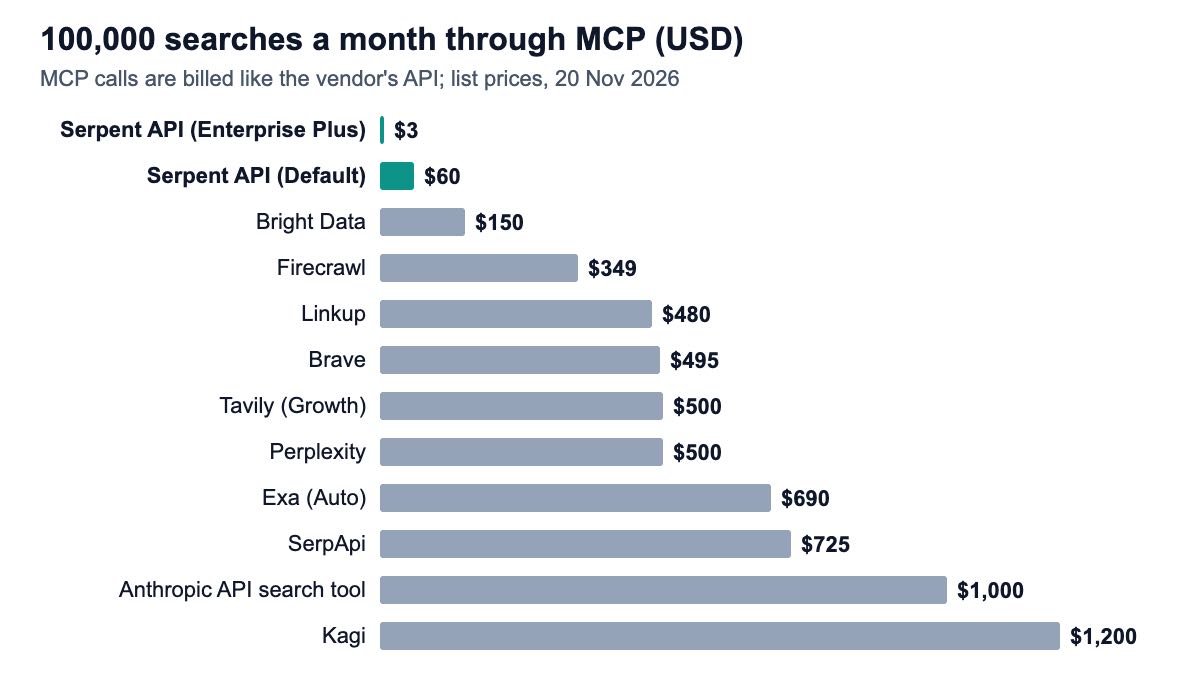
An MCP call costs exactly what the vendor's API call costs; the protocol adds nothing. On our server, listing the tools is free, per our docs. So the monthly bill is searches times price, and the spread is wide.
| Server | 1,000 a month | 100,000 a month | 1,000,000 a month |
|---|---|---|---|
| Serpent API, Default | $0.60 | $0.60 | $0.60 |
| Serpent API, Growth ($100 deposit) | $0.30 | $0.30 | $0.30 |
| Serpent API, Scale ($500 deposit) | $0.10 | $0.10 | $0.10 |
| Serpent API, Enterprise ($1,000 deposit) | $0.05 | $0.05 | $0.05 |
| Serpent API, Enterprise Plus ($1,250 deposit) | $0.03 | $0.03 | $0.03 |
| Bright Data | $0 (5,000 free) | $1.50 | about $1.31 |
| Firecrawl (2 credits per search) | $19.00 (Hobby plan) | $3.49 | $1.75 |
| Linkup | $0 ($20 credit) | $4.80 | $5.00 |
| Brave | $0 ($5 credit) | $4.95 | $5.00 |
| Tavily (basic search) | $0 (1,000 free credits) | $5.00 | about $7.70 |
| Perplexity (standard / Fast) | $5 / $1 | $5 / $1 | $5 / $1 |
| Parallel (basic / fast, keyed) | $5 / $1 | $5 / $1 | $5 / $1 |
| Exa (Auto) | $0 ($10 credit) | $6.90 | $7.00 |
| SerpApi | $25.00 | $7.25 | $3.75 |
| Anthropic API search tool | $10 + tokens | $10 + tokens | $10 + tokens |
| Kagi | $12 | $12 | $12 |
| DuckDuckGo (community) | $0 | $0, rate-limited | not practical |
Free monthly credits are subtracted, except Bright Data's 5,000 free requests, which we leave in (subtracting them lowers its 100,000 row to $1.43 per 1,000); monthly plans are charged in full, and overage rates apply past a plan's allowance. Our tier is set by the size of a deposit, not by monthly volume, which is why our rows are flat; the full rate card is on the pricing page.
For one developer, volume is rarely the issue. A heavy day of agentic coding might run a few hundred searches, and the free allowances above cover that on several servers. The numbers start to matter when a team standardises on one server, or when the same server also feeds an agent in production. At 100,000 searches a month the range runs from $3 to $1,200.
Where does your API key end up?
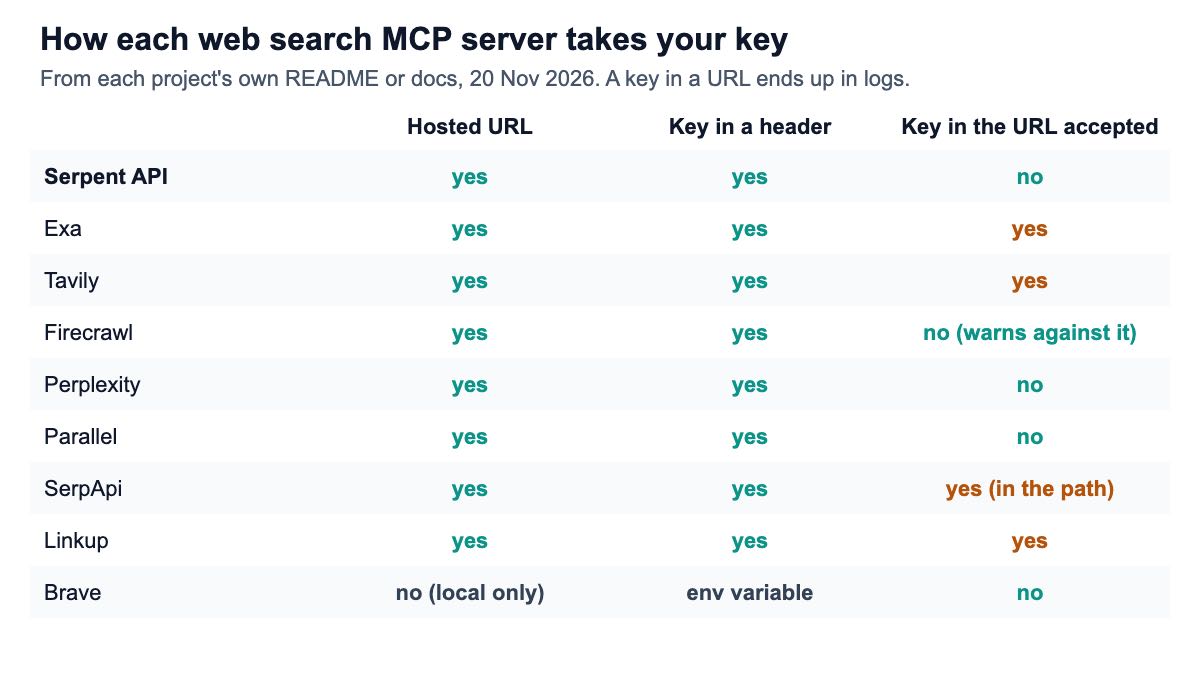
Pass it in a header whenever the server allows it. Several hosted servers also accept the key inside the URL, which is convenient for clients that cannot send headers, but a URL is written into logs along the way.
The vendors say so themselves.
SerpApi's README offers a key-in-the-path endpoint and warns that "a key in the URL path can appear in request logs, so prefer the header" (serpapi-mcp). Firecrawl's README is blunter: "Never put an API key in the server URL" (firecrawl-mcp-server). Tavily's quick-start command puts the key in the query string, though the same README also documents a Bearer header and OAuth (tavily-mcp). Exa accepts ?exaApiKey= and recommends OAuth (exa-mcp-server).
Two more habits help. Keep MCP config files that hold keys out of version control: in Claude Code, project-scoped servers live in a shared .mcp.json, while local and user scopes stay in your own ~/.claude.json, per the Claude Code MCP docs. And if you run a server locally over HTTP, check how it is protected; Brave's README notes that its HTTP endpoint is unauthenticated and should only listen on a trusted network.
Our hosted server takes the key as an X-API-Key header or a Bearer token, and our docs remind you that the config file holds the key in plain text.
How many tools will it add to your context?
Fewer than it used to matter, but still worth checking. Every tool a server exposes comes with a name, a description and a parameter schema, and a client without tool search loads all of them into the context window at the start of a session.
Claude Code now defers that work: with tool search, which is on by default, only tool names and server instructions load at the start, and full definitions arrive when Claude needs them (MCP docs). Other clients may still load everything. Firecrawl's full profile lists 34 tools and Bright Data's server enables about 30 by default, so in a client without tool search a single install can be a large share of your context.
Tool output matters too. Claude Code warns when a single MCP result passes 10,000 tokens and saves text results over 50,000 characters to a file. Search tools that return ten titles, URLs and snippets stay far below that. Tools that return whole pages do not, which is one reason to search first and read only the pages that matter.
Our server offers one tool per endpoint across web search, maps, YouTube, LinkedIn, Reddit and other data families. If you only want search, add ?services= to the URL with the families you want, as described in the MCP section of our docs, and the assistant sees only those tools. The search tools default to a compact result format with ten results.
The servers, one by one
Serpent API: best for cheap Google, Bing and Brave results
We sell this one, so read this entry with that in mind. Serpent API runs a hosted MCP server at https://api.apiserpent.com/mcp. Each tool takes the same parameters as its REST endpoint, so web_search accepts an engine (Google, Bing, Yahoo, DuckDuckGo or Brave), a country and a result count. Every tool call is billed exactly as the matching REST call, from $0.03 per 1,000 searches — pay as you go, no subscription.
claude mcp add --transport http serpent https://api.apiserpent.com/mcp --header "X-API-Key: sk_live_your_api_key"For Cursor, the same URL and header go in ~/.cursor/mcp.json; the snippet is in our docs. If you would rather build your own server around a search API, our build tutorial walks through it in Node.js.
Brave: best for an independent index, run locally
Brave's official server runs on your machine through npx or Docker and reads BRAVE_API_KEY from the environment. It exposes web, local, video, image and news search, an answers tool and an LLM-context tool. Brave's API costs $5 per 1,000 requests with $5 of free credit each month, which covers about 1,000 searches. There is no hosted endpoint, so every developer installs it locally.
Exa: best for semantic search with page text
Exa's hosted server at mcp.exa.ai/mcp works anonymously with rate limits, and its default tools search and fetch pages. Install it in Claude Code with claude plugin install exa@claude-plugins-official. Paid use costs $7 per 1,000 Auto searches and $4 for Lite, per Exa's pricing.
Tavily: best if your agents already use Tavily
Tavily's hosted server exposes tavily-search and tavily-extract, plus map and crawl tools. Its documented Claude Code command is claude mcp add --transport http tavily https://mcp.tavily.com/mcp/?tavilyApiKey=<your-api-key>; drop the key from the URL and run /mcp to sign in with OAuth instead. Basic searches cost $8 per 1,000 pay as you go and $5 on the Growth plan. Our SERP API vs Tavily vs Exa comparison covers when Tavily's output style is the right one.
Firecrawl: best for reading and crawling pages
Firecrawl's server is the most capable for page work: scrape, crawl, map and search, with keyless scrape, search and parse at rate limits. A search costs 2 credits per 10 results, and plans start at $19 a month for 5,000 credits (Firecrawl pricing). It pairs well with a cheaper search server when your assistant mostly needs to find pages and only sometimes needs to read them.
Perplexity: best for answers and research inside the editor
Perplexity's server offers search, ask, research and reason tools, and installs with claude mcp add --transport http perplexity https://api.perplexity.ai/mcp --header "Authorization: Bearer YOUR_API_KEY". Its Search API costs $5 per 1,000 requests, or $1 in Fast mode.
Parallel: best free start
Parallel's hosted server works with no key at all: search, fetch and a few other tools are free at lower rate limits, and signing in unlocks research and higher limits. Install with claude mcp add --transport http parallel https://mcp.parallel.ai/mcp. Keyed calls are billed at its API rates, $1 to $5 per 1,000 searches.
SerpApi: best for breadth of Google parsers
SerpApi's official server exposes one search tool for all of its engines plus extract, and installs with a Bearer header. It is the most expensive search server here at low volume: $25 for 1,000 searches on Starter, with 250 free a month (SerpApi pricing).
Linkup, Bright Data and Kagi
Linkup's hosted server offers search, research and fetch at about $5 per 1,000 searches with a $20 monthly credit for work emails. Bright Data's server bundles search with scraping tools; its search costs $1.50 per 1,000 successful requests with 5,000 free a month, and its documented hosted URL carries the token in the query string. Kagi's server searches Kagi's own results at $12 per 1,000 requests, the highest flat per-search rate here.
DuckDuckGo community server: best for zero cost
The duckduckgo-mcp-server project needs no key and installs with claude mcp add ddg-search uvx duckduckgo-mcp-server. It limits itself to 30 searches a minute by default. It is a community project rather than a DuckDuckGo product, so treat it as a convenience for personal use, not a dependency for a team.
Which one should you install?
You want current Google results while you code, cheaply. Install a SERP API's hosted server. Ours costs from $0.03 per 1,000 searches — pay as you go, no subscription — and also returns results from Bing, Yahoo, DuckDuckGo and Brave; SerpApi's covers more parsers at a higher price. Both take the key in a header.
You want results that do not come from Google or Bing. Run Brave's server locally; the monthly credit covers light use.
Your assistant reads documentation sites and changelogs. Add Firecrawl or Exa for page text, and keep a cheap search server for finding the pages. Our post on search use cases for coding agents has examples.
You just want to try it today, free. Parallel's keyless server or the DuckDuckGo community server, then switch once you know how many searches you make.
You work in Cursor and want no server at all. Our Cursor guide shows a rules-file approach that calls a search API directly.
For agents in production rather than in your editor, the same choice is about APIs rather than MCP servers; our guide to web search APIs for agents covers that.
How we checked this
Sources: 10 official READMEs and docs pages for the servers (Brave, Tavily, Exa, Firecrawl, Perplexity, Parallel, SerpApi, Linkup, Bright Data, the DuckDuckGo community server), Claude Code's tools and MCP documentation, Anthropic's web search tool docs, the MCP specification, and 9 official pricing pages, all opened on 20 November 2026. We also opened the five pages that rank highest for this query; three are published by companies that sell a web search MCP server, and each lists its own first.
Prices are list prices for a basic search; volume prices apply the rules stated under the cost table. We did not install or call these servers for this article, so this compares documented behaviour, not speed or result quality. What we could not verify: an official Serper MCP server, Kagi's account requirements for API access, and the exact free allowance on Perplexity's API.
Add live search to Claude Code in one command
Serpent API's hosted MCP server returns Google, Bing, Yahoo, DuckDuckGo and Brave results, billed like the REST API from $0.03 per 1,000 searches — pay as you go, no subscription. New accounts get 10 free API calls.
Get Your Free API KeyExplore: SERP API · Playground · MCP docs · Pricing
FAQ
What is the best free web search MCP server?
Parallel's hosted server is the easiest free option: it works without a key, and its search and fetch tools are free at lower rate limits. Exa's hosted server also works anonymously with rate limits. For no account at all, the community DuckDuckGo server runs locally and allows 30 searches a minute by default. Brave's $5 monthly credit and Tavily's 1,000 monthly credits cover light personal use too.
Does Claude Code have web search without MCP?
Yes. Claude Code has a built-in WebSearch tool that returns result titles and URLs, then reads pages with its WebFetch tool. An interactive session allows 200 WebSearch calls by default, which you can raise with an environment variable, and the tool is not available on Amazon Bedrock. An MCP server is worth adding when you need a specific engine, country targeting, structured results, or a lower price per search.
How do I add a web search MCP server to Claude Code?
For a hosted server, run claude mcp add --transport http <name> <url> --header "<header>: <key>". For example, Serpent API uses an X-API-Key header and Perplexity a Bearer token. For a local server, pass the command instead, such as claude mcp add ddg-search uvx duckduckgo-mcp-server. Add --scope user to make it available in every project.
Is there an MCP server for Google search results?
Yes, through SERP APIs. Serpent API and SerpApi both run official hosted MCP servers that return Google results as structured data, and Bright Data's server includes search engine results. We could not verify an official MCP server for Serper on 20 November 2026.
Is it safe to put my API key in an MCP server URL?
It works, but it is the weaker option. A key in a URL can be written into request logs by every system the request passes through. SerpApi's README warns about this and Firecrawl's says never to do it. Use a header or OAuth when the server supports it, keep MCP config files with keys out of version control, and replace any key that was ever shared in a URL.
Do MCP servers cost more than calling the API directly?
No. The servers we checked document billing each tool call like the matching API call, and our own docs state that listing tools is free. What can cost more is behaviour: an assistant with a search tool may search more often than you would by hand, so set a budget or watch your usage page for the first week.
Sources
Official server repositories and docs (checked 20 November 2026):
- Brave Search MCP server
- Tavily MCP
- Exa MCP server
- Firecrawl MCP server
- Perplexity MCP server
- Parallel MCP quickstart
- SerpApi MCP
- Linkup MCP server
- Bright Data MCP
- Kagi MCP
- DuckDuckGo MCP server (community)
- MCP fetch reference server
- Claude Code tools reference
- Claude Code MCP docs
- Anthropic web search tool docs
- MCP specification, transports
Official pricing (checked 20 November 2026):