Tavily Alternatives, Priced at 1K, 100K and 1M Searches

The best Tavily alternative depends on why you are leaving: a SERP API if cost per search is the problem, Exa or Parallel if you need page text, and Linkup if you want a sourced answer. Tavily costs $8 per 1,000 basic searches pay as you go and $5 on its $500 Growth plan; the cheapest options below cost a fraction of that.
Short answer: If your agent only needs titles, links and snippets, switch to a SERP API: Serpent API is from $0.03 per 1,000 searches — pay as you go, no subscription. If your agent reads full pages, Exa ($4 to $7) or Parallel ($1 to $5) return page content too. If only the Nebius ownership worries you, stay, but put an adapter in front of Tavily.
What does Tavily cost now, and did Nebius change it?
Tavily's list prices have not changed since the acquisition, as far as its public pages show. A basic search costs 1 credit and an advanced search costs 2. Pay as you go is $0.008 per credit, so 1,000 basic searches cost $8 and 1,000 advanced searches cost $16.
Monthly plans lower the credit price. According to Tavily's credits page, Project is $30 for 4,000 credits, Bootstrap $100 for 15,000, Startup $220 for 38,000 and Growth $500 for 100,000. That makes Growth the cheapest listed rate at $5 per 1,000 basic searches. Everyone gets 1,000 free credits a month, and anything past your plan is billed at the pay-as-you-go rate.
Credits are also spent outside search. Extract costs 1 credit per 5 successful URLs at basic depth, and the research endpoint costs between 4 and 250 credits per request depending on the model. If your agent uses those, your real cost per question is higher than the search price alone.
The Nebius facts, from the filing
Nebius announced the purchase on 10 February 2026 and said in its release that the value was not disclosed, that Tavily would keep operating under its own brand, and that its chief executive would keep leading the product. Bloomberg's reported figure of $275 million was relayed by Globes.
The firmer numbers are in Nebius's SEC filing: the deal closed on 19 February 2026, the consideration had a fair value of $189.4 million, and an earnout of up to $67.3 million depends on Tavily hitting annual recurring revenue milestones and on key staff staying.
An earnout tied to revenue is a reason to watch the price list, not proof it will rise. Nothing Nebius has published says Tavily's prices will change. The practical reading is simple: Tavily is now one product inside a larger AI cloud company, and its roadmap will follow that company's priorities. If that makes you uneasy, the cheapest insurance is an adapter, not a rushed migration.
Why do teams look for a Tavily alternative?
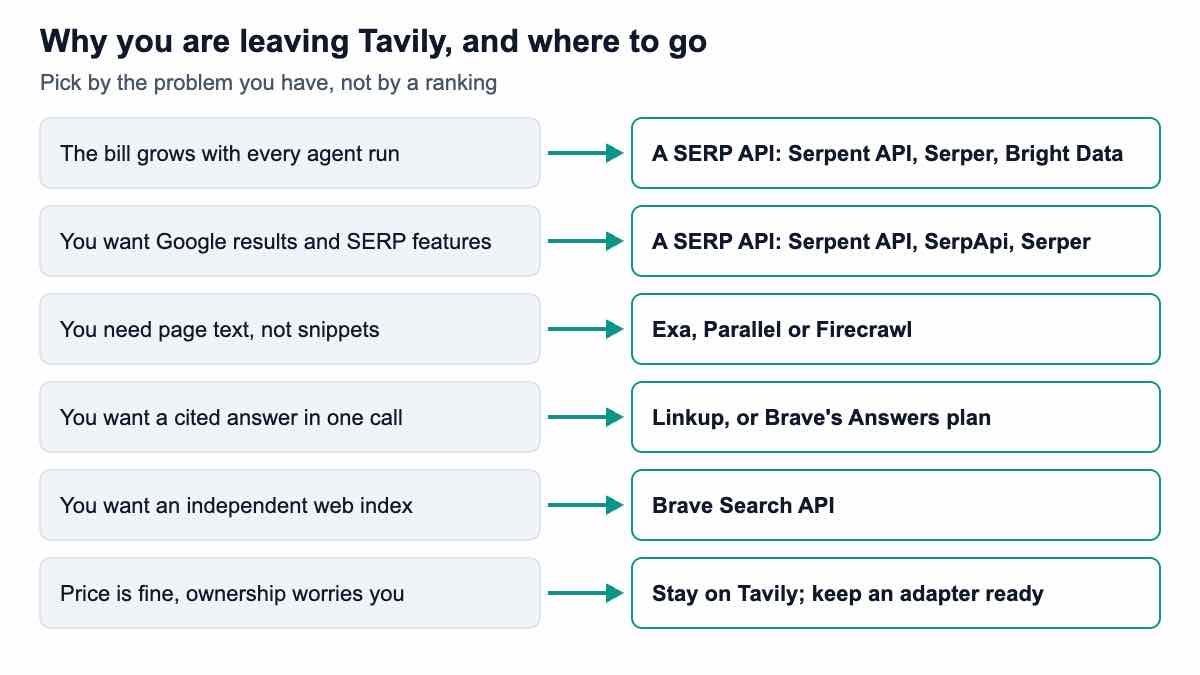
Most switches come from one of six problems, and each points to a different kind of replacement. Naming yours first saves you from comparing tools that solve someone else's problem.
The bill grows with every agent run. An agent that searches four times per question, for 25,000 questions a month, makes 100,000 searches. On Tavily's Growth plan that is $500 a month; at pay-as-you-go rates it is $800. Teams in this position usually do not need anything Tavily adds on top of the results, so a cheaper source of the same links is the fix.
You want search engine results, not a curated list. Tavily returns its own ranked list of pages with a relevance score.
It does not return Google's ranking, ads, People Also Ask, the AI Overview or a local pack. Its country parameter boosts results from a country rather than returning results localised to that country. If your product reports rankings or needs results for a specific country or city, you need a SERP API.
You need full page text, cheaply. Tavily can return raw page content, and its extract endpoint reads URLs you pass it. Exa and Parallel were built around returning page content in the search call, and they price it differently.
You want a written answer with sources. Tavily's include_answer adds a model-written answer. Linkup sells a sourced answer as its own product, and Brave sells an Answers plan.
You want an independent web index. Brave Search API answers from Brave's own index of the web, not from another engine's results. That gives you a second, separate view of the web, which some teams want for coverage or for checking one source against another.
Ownership risk. Some teams have a policy of keeping a second supplier for every dependency in the critical path. The acquisition made that policy apply to Tavily.
We looked for first-hand posts from developers explaining why they left and found none we could open and verify, so this list comes from the products' own documentation and pricing, not from quoted complaints.
Which alternative is cheapest at your volume?
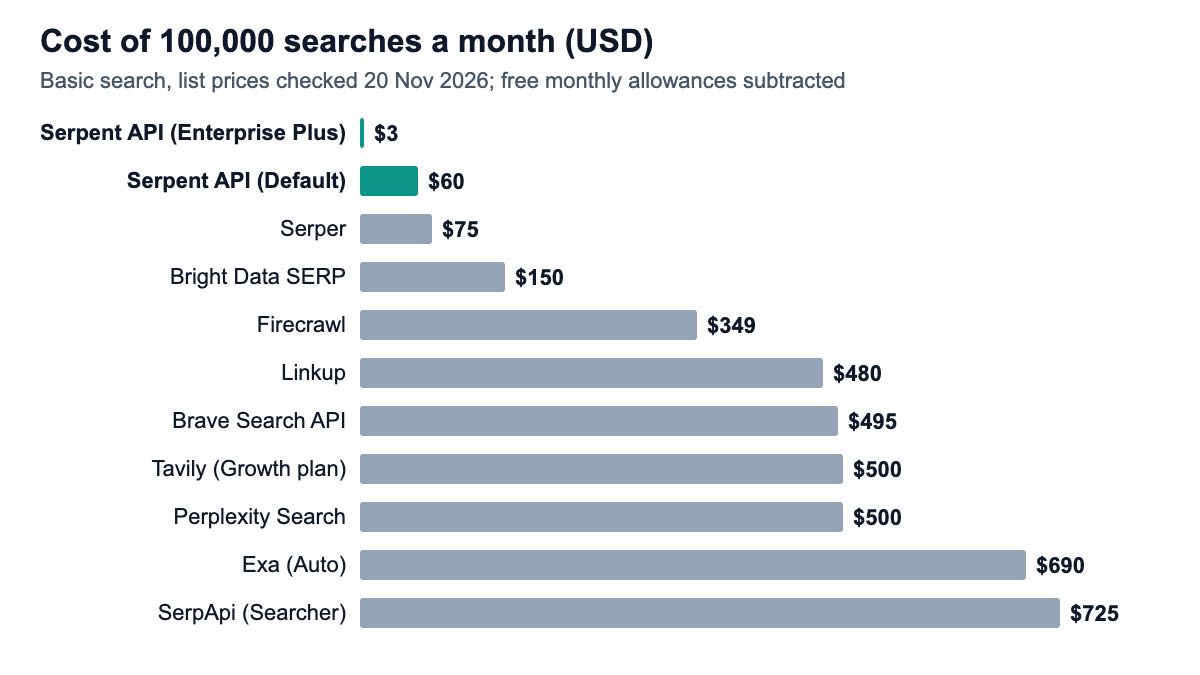
At 100,000 basic searches a month, the range runs from $3 to $725. The table below prices every option per 1,000 searches at three monthly volumes, using each vendor's live pricing page on 20 November 2026.
The rules: free monthly allowances are subtracted, except Bright Data's 5,000 free requests, which we leave in; subtracting them lowers its 100,000 row to $1.43 per 1,000.
Prepaid packs that expire are charged for what you can actually use before they expire. Monthly plans are charged in full even if you use less. Where a plan's credits run out, the overage rate applies. A cell we could not support from an official page says so.
| Option | 1,000 a month | 100,000 a month | 1,000,000 a month | What you get back |
|---|---|---|---|---|
| Serpent API, Default | $0.60 | $0.60 | $0.60 | Google, Bing, Yahoo, DuckDuckGo or Brave results as JSON |
| Serpent API, Growth ($100 deposit) | $0.30 | $0.30 | $0.30 | Same |
| Serpent API, Scale ($500 deposit) | $0.10 | $0.10 | $0.10 | Same |
| Serpent API, Enterprise ($1,000 deposit) | $0.05 | $0.05 | $0.05 | Same |
| Serpent API, Enterprise Plus ($1,250 deposit) | $0.03 | $0.03 | $0.03 | Same |
| Tavily (basic search) | $0 (1,000 free credits) | $5.00 (Growth plan) | about $7.70 (Growth + pay as you go) | Ranked pages with snippets; answer and raw content optional |
| Serper | about $8.33 (50k pack expires in 6 months) | $0.75 | $0.50 | Google results as JSON |
| SerpApi | $25.00 (Starter) | $7.25 (Searcher) | $3.75 (Cloud 1M) | Google and other engines as JSON |
| Bright Data SERP API | $0 (5,000 free) | $1.50 | about $1.31 (Scale plan) | Search engine results as JSON |
| Brave Search API | $0 ($5 monthly credit) | $4.95 | $5.00 | Results from Brave's own index |
| Exa (Auto / Lite) | $0 ($10 monthly credit) | $6.90 / $3.90 | $7.00 / $4.00 list | Links; page content $1 per 1,000 pages |
| Parallel (Fast / Basic) | $1 / $5 (free tier unverified) | $1 / $5 | $1 / $5 | Links with page excerpts |
| Perplexity Search (Fast / standard) | $1 / $5 | $1 / $5 | $1 / $5 | Ranked results |
| Linkup (standard) | $0 ($20 monthly credit) | $4.80 | $5.00 | Results, or a sourced answer at $0.006 |
| Firecrawl (search) | $19.00 (Hobby plan) | $3.49 | $1.75 | Links and snippets; page markdown costs extra |
Our price depends on the size of your deposit, not on your monthly volume, which is why the Serpent API rows are flat. Every new account gets 10 free API calls to test with, and the full rate card is on the pricing page.
Two footnotes matter more than they look. First, Serper's packs are cheap per search but expire after six months, so a small user who buys the smallest pack pays far more per search than the headline $1.00. Second, Tavily's per-1,000 cost rises once you outgrow Growth, because every credit past 100,000 is billed at $0.008. Its Enterprise plan is priced on request, so very large users should ask before assuming $7.70.
The alternatives, one by one
Each entry says what the option is best for, what it returns, and what it costs. They are grouped by the kind of output, because that decides more about the switch than price does.
Serpent API: best for cheap Google results in an agent
We sell this one, so weigh this entry accordingly. Serpent API returns search results from Google, Bing, Yahoo, DuckDuckGo or Brave as JSON: position, title, URL and snippet for each organic result, and the full results endpoint adds ads, People Also Ask, related searches and the other blocks on the page. You choose the engine and the country per call, and add location for city-level results. Prices start from $0.03 per 1,000 searches — pay as you go, no subscription.
For an agent, the simplest call is the organic results endpoint, which returns about ten results per search. If you used Tavily's include_answer, the closest equivalent is the include_ai_mode parameter on the full results endpoint: it adds an aiMode object with a written answer, its sources and follow-up questions, for a flat $0.004 per call on top of the search, on paid plans. There is also a hosted MCP server, so Claude Code or Cursor can call the same searches without any code.
What it does not do is fetch the pages behind the links. If your agent needs page text, pair it with a reader or pick one of the content APIs below.
Serper: best for Google results on prepaid packs
Serper sells Google results in prepaid packs: $50 for 50,000, $375 for 500,000, $1,250 for 2.5 million and $3,750 for 12.5 million credits, all valid for six months, with 2,500 free queries to start. At steady high volume it is cheap. At low volume the expiry does the damage, as the table shows. We compared it in more detail in our Serper alternatives guide.
SerpApi: best for breadth of engines and parsers
SerpApi is the long-established option with parsers for many engines and verticals. It is sold as monthly subscriptions: $25 for 1,000 searches, $725 for 100,000 and $3,750 for one million, with 250 free searches a month. It is the most expensive per search in this list at low volume, and you pay for the whole plan whether you use it or not.
Bright Data SERP API: best for pay-per-success at moderate volume
Bright Data charges $1.50 per 1,000 successful requests pay as you go, includes 5,000 free requests a month, and offers a $499 Scale plan with 380,000 requests and $1.30 per 1,000 after that. If you already buy other data from Bright Data, consolidating is an easy argument.
Brave Search API: best for an independent index
Brave runs its own web index rather than reselling another engine's ranking. Search costs $5 per 1,000 requests with $5 of free credit each month and up to 50 queries per second. A separate Answers plan costs $4 per 1,000 requests plus $5 per million tokens. Choose Brave when you want results that do not depend on Google or Bing, or when its privacy position matters to your buyers.
Exa: best for semantic search with page content
Exa charges $4 per 1,000 Lite searches, $7 for Auto or Fast, $12 for Deep and $15 for Deep Reasoning, with page content at $1 per 1,000 pages per content type. Everyone gets a $10 credit that resets monthly. Exa is the natural move if your agent asks meaning-based questions ("companies like X") rather than keyword ones, or if it always reads the pages it finds.
Parallel: best for low-cost results with excerpts
Parallel's Search API costs $1 per 1,000 requests in its fast modes and $5 in basic or advanced mode, each returning 10 results, plus $1 per 1,000 for each result beyond ten. Its Extract API reads pages at $1 per 1,000 URLs. Its pricing page did not state a free tier when we checked.
Perplexity Search API: best for one bill with Perplexity's other APIs
Perplexity's Search API costs $5 per 1,000 requests, or $1 with the Fast search type, and returns ranked results. Its docs say invalid and rate-limited requests are not billed. No free tier is listed. It suits teams already paying Perplexity for other models.
Linkup: best for sourced answers
Linkup charges $0.005 per standard search, $0.05 per deep search, and $0.006 for a sourced answer at standard depth. Accounts signed up with a work email get $20 of credit topped up each month. If your agent's job ends in a short answer with citations, Linkup sells exactly that.
Firecrawl: best when search is a side job of a crawler
Firecrawl is mainly a page-to-markdown and crawling service with a search endpoint. A search costs 2 credits per 10 results, and plans run from $19 for 5,000 credits to $749 for one million, with top-up packs. It is the convenient choice if you already crawl with it; for search alone, the plan structure makes small volumes expensive.
How hard is the switch?
If your code reads title, url and content from Tavily's results, a switch is one function. Tavily's search response gives each result a title, URL, content snippet and relevance score, per its API reference. The adapter below calls a SERP API instead and returns the same shape, so the rest of your agent does not change.
import os
import requests

def search(query: str, max_results: int = 5, country: str = "us") -> dict:
    resp = requests.get(
        "https://apiserpent.com/api/search/quick",
        params={"q": query, "country": country, "num": 10},
        headers={"X-API-Key": os.environ["SERPENT_API_KEY"]},
        timeout=30,
    )
    resp.raise_for_status()
    return to_tavily_shape(query, resp.json(), max_results)

def to_tavily_shape(query: str, data: dict, max_results: int = 5) -> dict:
    organic = data["results"]["organic"][:max_results]
    return {
        "query": query,
        "answer": None,
        "results": [
            {"title": r["title"], "url": r["url"], "content": r.get("snippet", ""),
             "score": round(1 - (r["position"] - 1) / 10, 2)}  # rank-based stand-in
            for r in organic
        ],
    }
This runs on Python 3.13 with requests 2.34 (20 November 2026). In that run the HTTP call was stubbed to return the documented example response, and the adapter printed:
{
  "query": "weather today",
  "answer": null,
  "results": [
    {
      "title": "Weather Forecast - Today",
      "url": "https://example.com/weather",
      "content": "Today's weather forecast...",
      "score": 1.0
    }
  ]
}
Three things do not carry over automatically. The score here is derived from rank, not a relevance model, so if your code filters on a score threshold, filter on position instead.
Snippets are shorter than Tavily's multi-chunk content, so prompts that relied on long content may need a reader step. And raw_content has no equivalent; fetch the pages yourself or use a content API. For a fuller walk-through of putting search behind an agent, see our real-time RAG guide and the LangChain cost math post.
Whatever you pick, keep the adapter. It is twenty lines, it makes the next switch as cheap as this one, and it is the honest answer to the ownership question: you do not need to predict what Nebius will do if leaving costs you an afternoon.
Which one should you pick?
You run an agent that searches a lot and reads snippets. Pick a SERP API. On our pricing, 100,000 searches cost from $3 a month — pay as you go, no subscription — against $500 on Tavily's Growth plan. Serper is the other cheap option if you can use a pack within six months.
Your product shows or tracks Google rankings. Pick a SERP API, because only these return ranked positions and page blocks such as People Also Ask. SerpApi has the widest set of parsers; Serpent API and Serper cost less.
Your agent reads every page it finds. Pick Exa or Parallel, which return content in the search call, or keep a SERP API for discovery and add a reader for the two or three pages that matter. The second route is usually cheaper because the agent rarely needs all ten pages.
Your output is a short cited answer. Pick Linkup's sourced answer, or Brave's Answers plan if you prefer Brave's index.
You only worry about the acquisition. Stay on Tavily's Growth plan, which is competitively priced for content-style results, and ship the adapter so you can move in a day if the price list changes.
If you are still deciding which kind of search API you need at all, start with SERP API vs Tavily vs Exa, which explains the three types, or our guide to web search APIs for agents and RAG.
How we checked this
Sources: 12 official pricing or documentation pages (Tavily pricing, credits and API reference, Exa, Brave, Perplexity, Parallel, Linkup, Serper, SerpApi, Bright Data, Firecrawl), one SEC filing, one company press release and one news report, all opened on 20 November 2026. We also opened the five pages that rank highest for this query to see what they cover; all five are published by vendors that rank their own product first.
Prices are list prices for basic or standard search; we did not negotiate or request quotes. The adapter code ran locally with the network call stubbed; no live searches were made for this article. What we could not verify: first-hand accounts of developers leaving Tavily, Parallel's free tier, whether Tavily's unused credits roll over, whether Serper offers an official MCP server, and the $275 million figure, which Nebius has not confirmed.
Try a SERP API in your agent
Serpent API returns Google, Bing, Yahoo, DuckDuckGo and Brave results as JSON, from $0.03 per 1,000 searches — pay as you go, no subscription. New accounts get 10 free API calls.
Get Your Free API KeyExplore: SERP API · Playground · Docs · Pricing
FAQ
What is the cheapest Tavily alternative?
For plain search results, a SERP API is cheapest. At 100,000 searches a month, Serpent API costs from $3 — pay as you go, no subscription — Serper about $75 and Bright Data $150, against $500 on Tavily's Growth plan. If you need page content in the same call, Parallel's fast modes at $1 per 1,000 and Exa Lite at $4 are the cheapest content-style options. Compare on the output you need, because a cheap API that returns the wrong thing costs more once you add a second service.
Did Nebius change Tavily's pricing?
Not as of 20 November 2026. Tavily's pricing page still lists 1,000 free credits, $0.008 per credit pay as you go and plans from $30 to $500 a month. Nebius said Tavily would keep its brand and keep serving existing customers. Its SEC filing shows an earnout of up to $67.3 million tied to revenue milestones, which gives the business an incentive to grow revenue, but no price change has been announced.
Is Tavily better than a SERP API for AI agents?
They do different jobs. Tavily returns its own ranked list of pages with longer content snippets and an optional answer, which suits agents that summarise pages. A SERP API returns search engine results as structured data, with ranked positions and blocks such as People Also Ask, for a much lower price per search. Agents that need current facts and links usually do well on a SERP API; agents that need long passages may prefer Tavily, Exa or Parallel.
How much does Tavily cost per 1,000 searches?
Basic search costs 1 credit and advanced search 2. At the pay-as-you-go rate of $0.008 per credit, that is $8 per 1,000 basic searches and $16 per 1,000 advanced searches. Monthly plans lower this: the $500 Growth plan includes 100,000 credits, which is $5 per 1,000 basic searches. The first 1,000 credits each month are free.
Can I switch from Tavily without rewriting my agent?
Usually, yes. Wrap the search call in one function that returns the fields your code already reads, as in the adapter above. Code that reads title, URL and content keeps working.
Code that depends on Tavily's relevance score, raw page content or its answer field needs a small change, such as filtering by position or adding a page reader. Keep the wrapper afterwards so future switches are just as small.
Does Serper or Serpent API have an MCP server?
Serpent API runs a hosted MCP server that Claude Code, Cursor, VS Code and other clients that can send a header can connect to, with one tool per endpoint and the same prices as the REST API. For Serper, we could not verify an official MCP server on 20 November 2026, so check Serper's site before you plan around one.
Sources
Official pricing and docs (checked 20 November 2026):
- Tavily pricing
- Tavily API credits
- Tavily search API reference
- Exa pricing
- Brave Search API
- Perplexity API pricing
- Parallel pricing
- Linkup pricing
- Serper
- SerpApi pricing
- Bright Data SERP API pricing
- Firecrawl pricing
Filings and news (checked 20 November 2026):