Leaving Exa? The alternative that fits depends on why

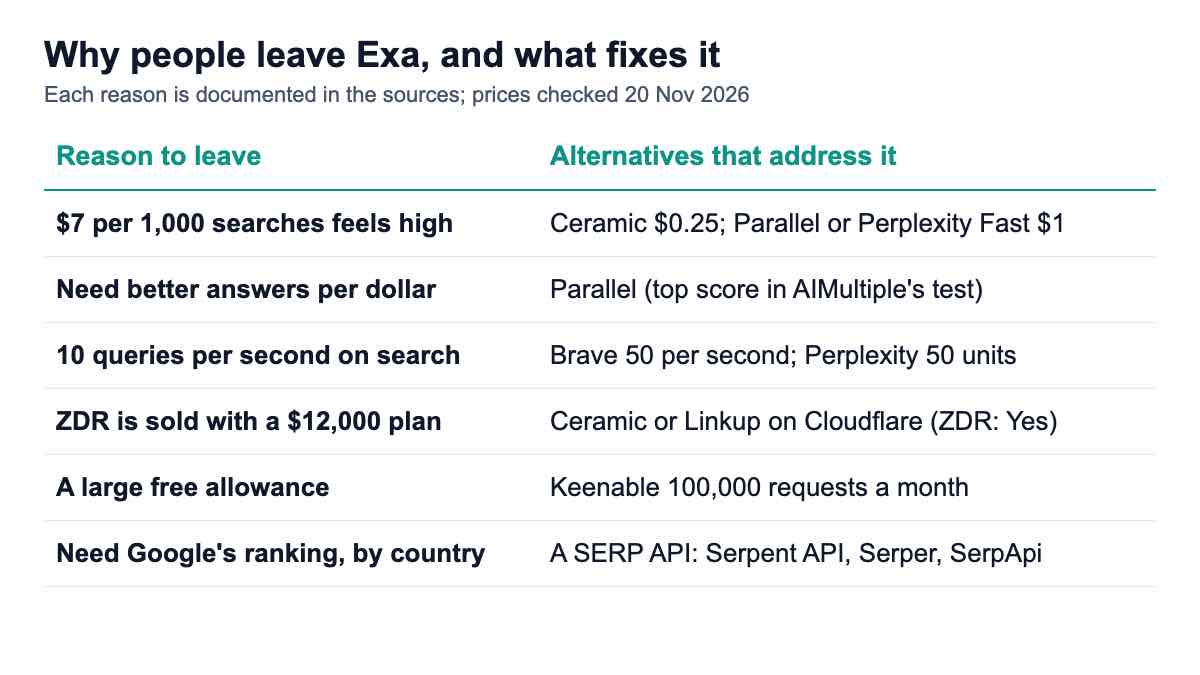
The best Exa alternative depends on why you are leaving. For price, Ceramic costs $0.25 per 1,000 searches and Parallel or Perplexity's Fast Search $1, against Exa's $7. For throughput, Brave allows 50 queries per second. For Google rankings by country, use a SERP API (prices checked 20 November 2026).
Short answer: If you want Exa-style results for less, try Parallel first: it topped AIMultiple's public agentic search benchmark and its fast mode costs $1 per 1,000. If price is all that matters, Ceramic at $0.25 is the cheapest paid option. If you need more than 10 queries per second, look at Brave or Perplexity's Search API. If your agent needs a ranked results page with positions, with country and freshness controls, use a SERP API such as Serpent API, from $0.03 per 1,000 — pay as you go, no subscription (pricing).
What does Exa cost now?
Exa's standard search costs $7 per 1,000 requests, with up to 10 results included, and its new lite search costs $4. Everything is pay as you go: the pricing page says "There is no subscription and no minimum spend", and every account gets $10 of credit each month plus a one-time $10 onboarding bonus.
| Exa product | Price | Notes |
|---|---|---|
/search lite or instant | $4 per 1,000 requests | Up to 10 results |
/search auto or fast | $7 per 1,000 requests | Up to 10 results; page contents for those results included |
| Extra results | $1 per 1,000 results | Each result above 10 in a request |
Deep search (deep-lite, deep) | $12 per 1,000 requests | deep-reasoning is $15 |
/contents | $1 per 1,000 pages, per content type | Text, highlights and summaries billed separately |
/answer | $5 per 1,000 requests | A written answer with sources |
| Enterprise | $12,000 paid upfront | Includes zero data retention, $12,000 of credits and 25 queries per second |
The price list moved several times in 2026, which is one reason older comparison pages disagree. Exa's changelog records a pricing update on 3 March (contents for the first 10 results included, deep search at $12), the retirement of the /research endpoint on 1 April in favour of deep-reasoning, the $4 lite type on 19 October, and Monitors dropping from $15 to $2 per 1,000 on 29 October.
For context, a reply written on behalf of Exa on Hacker News in May 2025 said "We charge $5 per 1000 requests with our search and answer endpoints." Standard search today is $7, while the new lite type comes in below the old price.
Why do people look for an Exa alternative?
The reasons that show up in public threads, docs and issues fall into five groups. None of them means Exa is a bad product; they mean it is the wrong fit for some jobs.
- Price at volume. On the Cloudflare launch thread in October 2026, one developer listed three providers side by side (Ceramic at $0.25, Exa at $7.00 and Linkup at $5.00 per 1,000 requests) and added that "Web search API pricing for AI agent usecases has always felt so expensive for what it is" (Hacker News). Another user asked on an earlier thread whether Exa had changed its pricing: "When I checked this a year or so ago, I might have gotten the impression that it was cheaper" (Hacker News).
- Throughput. Exa's rate-limit page sets
/searchand/answerat 10 queries per second and deep search at 5. The Enterprise plan lists 25. - Data retention. Zero data retention comes with the $12,000 Enterprise plan; the pricing page also mentions a dashboard upgrade for team owners without showing its price. Cloudflare's Web Search API providers page lists Exa as "No" for zero data retention, next to "Yes" for Ceramic and Linkup.
- Stale page content. An open GitHub issue on exa-py, filed on 6 October 2026, reports that
/contentscan return the stored text of a page that has since been deleted, marked as a success. For an agent that cites sources, that is a real risk to check. - It is not a ranking of Google. Exa returns its own relevance order from its own index, by design. If you need Google rankings for a given country, it is not built for that. Our SERP API vs Tavily vs Exa guide explains that difference in depth.
The alternatives, matched to your reason
Each option below gets a "best for" label, its list price on 20 November 2026, and the Exa pain it addresses. I have kept to vendors with public prices.
1. Parallel Search: best for answer quality per dollar
Parallel's pricing page lists $1 per 1,000 requests on its turbo and fast modes and $5 on basic and advanced, each with 10 results, plus $1 per 1,000 extra results. In AIMultiple's benchmark (below), Parallel Advanced had the highest accuracy and Parallel Fast the lowest cost per correct answer among the high scorers. Pick it if you like Exa's style of results and want to pay less for similar or better answers. Note that Parallel publishes its own comparison pages that rank itself first.
2. Perplexity Search API: best for throughput and packed queries
Perplexity's raw search endpoint costs $5 per 1,000 requests, or $1 with Fast Search, and one request can carry up to five queries and still bill once, per its pricing page. It allows 50 query units per second on every account and returns query-specific text extracts from each page. In AIMultiple's test its Fast mode had the lowest median latency of any configuration, 0.19 seconds. Pick it if Exa's 10 queries per second is your bottleneck.
3. Brave Search API: best for an independent index at scale
Brave's Search API costs $5 per 1,000 requests with $5 of free credit each month and allows 50 queries per second. It runs its own web index rather than reselling another engine. One catch: its FAQ says storing results or using them for training needs a custom plan. Pick it if you want high throughput on a mature index and only use results at query time.
4. Ceramic: best for the lowest price per search
Ceramic's pricing page lists $0.25 per 1,000 queries on pay as you go, with 1,000 free queries to start and 20 queries per second, or $99 a month for 495,000 queries and $0.20 per 1,000 after that, at 50 per second. It is also the default provider in Cloudflare's Web Search API, where it is marked for zero data retention. Its results come with long page descriptions. Pick it if Exa's price is the main problem and you will test relevance on your own queries.
5. Keenable: best free allowance
Keenable's credits page says "your organization gets 100,000 requests a month free" and prices paid use at $4 per 1,000 requests. For a prototype or a low-volume agent, that free tier covers far more than Exa's $10 of monthly credit. It is a newer product, so check its coverage before you rely on it.
6. Tavily: best for search and cleaned content in one call
Tavily's pricing is credit based: a basic search uses 1 credit and an advanced search 2, per its credits docs, at $0.008 a credit on pay as you go, with 1,000 free credits a month. That makes it $8 to $16 per 1,000 searches on pay as you go, so it does not fix a price problem, but it returns cleaned, ranked content ready for a prompt. Pick it if your pain is the work of turning search results into context. If you are already on Tavily and weighing a move, our Tavily alternatives guide matches each reason for leaving to a replacement.
7. Linkup: best for sourced snippets with data retention covered
Linkup's pricing lists $0.005 per standard or fast search with raw results ($5 per 1,000) and $0.05 for deep search, and it tops up eligible accounts to $20 of credit each month. Through Cloudflare it is marked for zero data retention. Pick it if retention terms are what you need fixed and $5 per 1,000 is acceptable.
8. Firecrawl search: best if you also need to scrape the pages
Firecrawl's pricing page charges 2 credits per 10 search results, and its $99 Standard plan includes 100,000 credits a month, which works out to about $1.98 per 1,000 searches. At 100,000 searches a month (200,000 credits) you need the $399 Growth plan with 500,000 credits. Its main product is page scraping, so it suits agents that search and then read full pages in one stack.
9. A SERP API: best when you need ranked results with positions
A SERP API returns a search results page as JSON: positions, titles, snippets, and features such as People Also Ask and AI Overviews. Exa and the options above rank pages by their own models; a SERP API returns the ranked results of Google, Bing or another engine for a query in a given country. That is what rank tracking, SEO tools, local answers and "what does the market see" agents need.
Serpent API's web search endpoint takes engine (Google, Bing, Yahoo, DuckDuckGo or Brave), country, language and freshness, and can be asked for up to 100 organic results in one call with num (a ceiling; Google calls often return 40 to 70). The full results endpoint adds People Also Ask, ads and related searches where the page shows them, plus AI Overview fields with include_aio=true where present. It starts from $0.03 per 1,000 — pay as you go, no subscription, see pricing. Other SERP APIs include Serper, from $1 down to $0.30 per 1,000 in packs that last six months, and SerpApi; our Serper alternatives post compares more.
Each SERP row carries a position, title, URL and snippet; when your agent needs the full page, it fetches the URL next. Our real-time RAG tutorial shows that search-then-fetch pattern end to end.
What does each cost at your volume?
At 100,000 searches a month, Exa's standard search costs $700. Parallel and Perplexity's fast modes cost $100, Ceramic $25, and a SERP API from $3 to $75 depending on vendor and tier.
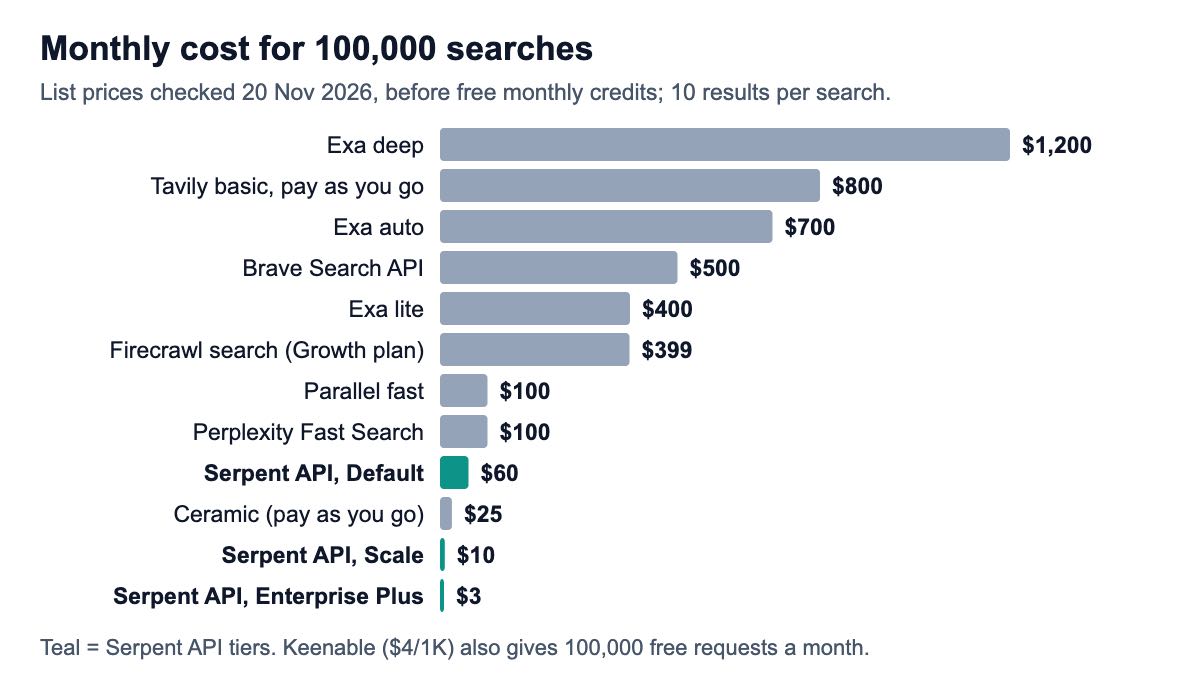
Rules: list prices on 20 November 2026, before free monthly credits. One search returns about 10 results. Prepaid packs are counted as if used before they expire.
| Option | Per 1,000 searches | 1,000 a month | 100,000 a month | 1,000,000 a month |
|---|---|---|---|---|
| Exa auto | $7.00 | $7 | $700 | $7,000 |
| Exa lite | $4.00 | $4 | $400 | $4,000 |
| Exa deep | $12.00 | $12 | $1,200 | $12,000 |
| Parallel fast | $1.00 | $1 | $100 | $1,000 |
| Perplexity Search API, Fast Search | $1.00 | $1 | $100 | $1,000 |
| Brave Search API | $5.00 | $5 | $500 | $5,000 |
| Ceramic, pay as you go | $0.25 | $0.25 | $25 | $250 |
| Keenable (100,000 free a month not applied) | $4.00 | $4 | $400 | $4,000 |
| Tavily basic, pay as you go | $8.00 | $8 | $800 | $8,000 |
| Linkup standard | $5.00 | $5 | $500 | $5,000 |
| Firecrawl search (cheapest plan that fits: Hobby, Growth, then Enterprise) | $7.60 to $1.50 by plan | $19 (Hobby) | $399 (Growth) | Custom quote |
| Serper (packs valid 6 months) | $1.00 to $0.50 | $1 (smallest pack $50) | $75 | $500 |
| Serpent API, Default | $0.60 | $0.60 | $60 | $600 |
| Serpent API, Growth ($100 deposit) | $0.30 | $0.30 | $30 | $300 |
| Serpent API, Scale ($500 deposit) | $0.10 | $0.10 | $10 | $100 |
| Serpent API, Enterprise ($1,000 deposit) | $0.05 | $0.05 | $5 | $50 |
| Serpent API, Enterprise Plus ($1,250 deposit) | $0.03 | $0.03 | $3 | $30 |
Free allowances change the picture at small volume. Keenable's 100,000 free requests a month cover the whole middle column. Exa's $10 monthly credit covers about 1,400 standard searches, Tavily's 1,000 free credits cover 1,000 basic searches, and Ceramic starts you with 1,000 free queries.
Remember the products are not interchangeable. Exa's $7 includes page contents for its 10 results; a SERP API's price buys ranked results with positions and snippets; Perplexity's includes query-specific extracts. Compare cost only between options that pass your quality test.
What does AIMultiple's public benchmark say?
The most useful public comparison is AIMultiple's agentic search benchmark, updated 10 November 2026. It ran 24 configurations of six search APIs (Brave, Exa, Firecrawl, Parallel, Perplexity and Tavily) through the same agent on 120 English questions, with three model judges and a two-of-three rule for a correct answer.
| Configuration | Accuracy | Cost per correct answer | Median latency |
|---|---|---|---|
| Parallel Advanced | 87.0% | $0.0121 | 2.62 s |
| Exa Fast | 82.6% | $0.0193 | 0.47 s |
| Parallel Fast | 79.7% | $0.0063 | 0.78 s |
| Exa Auto | 78.3% | $0.0211 | 1.37 s |
| Brave (8,192 tokens) | 77.9% | $0.0178 | 0.95 s |
| Perplexity Fast High | 76.5% | $0.0062 | 0.19 s |
| Exa Deep | 76.5% | $0.0308 | 8.69 s |
| Firecrawl | 73.5% | $0.0164 | 1.36 s |
| Tavily Advanced | 70.6% | $0.0604 | 3.61 s |
Three things stand out. Exa Fast is genuinely good: second on accuracy and quick. Exa's more expensive deep mode scored lower than its fast mode and took over eight seconds. And on cost per correct answer, Parallel Fast and Perplexity Fast are about three times cheaper than Exa Fast.
Read it with its own caveats. AIMultiple writes that "These intervals overlap, and each configuration was tested once", so the gap between the top two is not certain. The test did not include SERP APIs, Ceramic, Keenable or Linkup, and 120 questions are a small sample. Use it to pick a shortlist, then test on your own queries.
How do you switch without breaking your agent?
Treat it like any dependency swap: measure before you move. A practical sequence:
- Collect 50 to 100 real queries from your logs, including the hard ones: recent events, niche terms, local questions.
- Run them through Exa and two alternatives, and save every response.
- Score the results by hand or with a judge model: is the right page in the top five, is the date current, does the text answer the question?
- Map the fields. Every API names its URL, title, text and date fields differently. Write one small adapter so the rest of your code does not care which provider answered.
- Check the limits that bite in production: queries per second, result depth, retention terms, and what happens to failed requests on your bill.
If the agent's job includes Google rankings, run those queries through a SERP API as well; an index-based search is not built for that. Our overview of web search APIs for agents and RAG has a fuller acceptance test, and our guide to cutting LLM web search costs covers the search-then-prompt pattern that keeps token bills down.
Which one should you pick?
- Parallel if you want the closest replacement for Exa's quality at a lower price.
- Ceramic if price per search is the deciding factor.
- Perplexity Search API or Brave if you need 50 queries per second without an enterprise contract.
- Keenable for prototypes and low-volume agents that fit inside 100,000 free requests a month.
- Tavily if you want cleaned content for a prompt and price is secondary.
- Linkup or Ceramic through Cloudflare if zero data retention is a requirement and $12,000 upfront is not.
- A SERP API if your agent or product needs Google or Bing rankings, a specific country, fresh results or results-page features. Serpent API covers five engines on one key; see the SERP API overview.
How we checked this
On 20 November 2026 I read Exa's pricing page, pricing changelog and rate-limit docs, and the pricing pages of Parallel, Perplexity, Brave, Ceramic, Keenable, Tavily, Linkup, Firecrawl and Serper (13 official sources), plus our own pricing page and docs. I read AIMultiple's agentic search benchmark, Cloudflare's providers page, two Hacker News threads and one exa-py GitHub issue as evidence for why people switch, and five ranking "Exa alternatives" articles for the gap check, four of them written by competing vendors.
No searches were sent to any of these APIs for this post; costs are arithmetic on list prices, and benchmark figures are AIMultiple's. What we could not verify: a pricing change in July 2026 that some sources mention (Exa's changelog shows none), the price of Exa's dashboard upgrade for zero data retention, and the quality of Keenable and Ceramic results, which no third-party test has covered yet.
Need ranked search results, not just an index?
Serpent API returns ranked results from Google, Bing, Yahoo, DuckDuckGo and Brave, by country and language, from $0.03 per 1,000 — pay as you go, no subscription. Try it with 10 free API calls.
Get Your Free API KeyExplore: SERP API · Playground · Docs · Pricing
FAQ
What is the best alternative to Exa?
For most teams that like Exa's results but want to pay less, Parallel is the strongest candidate: it had the top accuracy in AIMultiple's November 2026 benchmark, and its fast mode costs $1 per 1,000 requests against Exa's $7. If price is the only concern, Ceramic costs $0.25 per 1,000. If you need Google rankings by country, no index-based search replaces a SERP API. Test two or three options on your own queries before you switch.
How much does Exa cost?
On 20 November 2026 Exa charged $7 per 1,000 requests for its auto and fast search types with up to 10 results, $4 for lite and instant, $12 for deep search and $15 for deep-reasoning. Extra results above 10 cost $1 per 1,000, contents $1 per 1,000 pages per content type, and the answer endpoint $5 per 1,000. There is no subscription; every account gets $10 of free credit a month.
What is the cheapest Exa alternative?
Among paid search APIs built for AI agents, Ceramic is the cheapest at $0.25 per 1,000 queries on pay as you go, or $0.20 on its $99 Pro plan. Keenable gives 100,000 free requests a month, which makes it cheapest for small volumes. Parallel and Perplexity's Fast Search cost $1 per 1,000. A SERP API such as Serpent API costs from $0.03 per 1,000 — pay as you go, no subscription — and returns ranked results with positions, titles and snippets.
Does Exa have a free tier?
Yes. Exa's pricing page says every account gets $10 of credit that resets on the first of each month, plus a one-time $10 bonus after onboarding, with no payment method needed. At $7 per 1,000 standard searches, $10 covers about 1,400 searches a month, or about 2,500 on the $4 lite type. Several alternatives are more generous, notably Keenable at 100,000 free requests a month.
Is Exa better than a SERP API?
They do different jobs. Exa ranks pages by its own neural relevance and returns page contents, which is strong for open-ended research and finding similar pages. A SERP API returns the ranked results of Google or another engine for a query in a given country, with positions and features such as People Also Ask, which is what rank tracking, SEO and market-facing agents need. Many agents use both; our SERP API vs Tavily vs Exa guide explains when.
What is Exa's rate limit?
Exa's rate-limit page sets 10 queries per second for /search and /answer, 5 for the deep search types and 100 for /contents. Requests over the limit get a 429 response. The $12,000 Enterprise plan lists 25 queries per second. If you need more without an enterprise contract, Brave's Search API and Perplexity's Search API both allow 50 per second.
Sources
Exa official (checked 20 November 2026):
Alternatives' pricing (checked 20 November 2026):
- Parallel pricing
- Perplexity pricing
- Brave Search API
- Ceramic pricing
- Keenable credits
- Tavily pricing and Tavily API credits
- Linkup pricing
- Firecrawl pricing
- Serper pricing
- Serpent API pricing
Benchmarks, community and docs (read 20 November 2026):
- AIMultiple: agentic search benchmark (updated 10 Nov 2026)
- Cloudflare Web Search API providers
- Hacker News: provider pricing comment (Oct 2026)
- Hacker News: Exa pricing question (May 2025)
- exa-py issue #281: stale cached contents
Other "Exa alternatives" guides (read 20 November 2026):