Linkup API pricing at 10K, 100K and 1M searches a month

Linkup charges $0.005 per standard search, which is $5 per 1,000, and $0.05 per deep search. A sourced answer or structured output adds $0.001 a call. Accounts opened with a work email get $20 of credit, topped back up to $20 each month, so about 4,000 standard searches cost nothing.
Short answer: Stay on Linkup if you want page text and a cited answer from one call at a flat price; its standard search costs the same $5 per 1,000 as Brave, Perplexity and You.com. If you only need ranked links for an agent and $5 feels high, Ceramic ($0.25) and Parallel’s fast mode ($1) cost less per 1,000. If you need Google or Bing rankings by country, use a SERP API instead: Serpent’s SERP API runs from $0.03 per 1,000 — pay as you go, no subscription (pricing).
What does Linkup charge per call?
Linkup bills every call from a prepaid balance in US dollars, and the price depends on two settings: how hard it searches (depth) and what it hands back (outputType). There is no monthly plan. You top up, calls draw the balance down, and when it reaches zero the API answers with an HTTP 429 until you add more.
The billing docs are the place to read prices, not the marketing page. On 22 November 2026 the pricing page still showed Fetch at “$0.001 - $0.006”, while the billing docs list Fetch options up to $0.011. Here is the full list from the docs.
| Endpoint and option | Per call | Per 1,000 calls |
|---|---|---|
| Search, depth flash, fast or standard, raw results | $0.005 | $5 |
| Search, depth flash, fast or standard, sourced answer or structured output | $0.006 | $6 |
| Search, depth deep, raw results | $0.05 | $50 |
| Search, depth deep, sourced answer or structured output | $0.055 | $55 |
| Fetch, standard mode, no JavaScript rendering | $0.001 ($0.002 with a schema) | $1 ($2) |
| Fetch, standard mode with rendering, or pro mode without | $0.005 ($0.006 with a schema) | $5 ($6) |
| Fetch, pro mode with rendering | $0.01 ($0.011 with a schema) | $10 ($11) |
| Research, reasoning depth S / M / L / XL | $0.25 / $0.50 / $1.50 / $2.50 | $250 to $2,500 |
| Extract (closed beta) | Varies; “most completed tasks fall in the $2–10 range” | Unverified |
| Any request paid through x402 (USDC on Base) | Same prices, $0.01 minimum | $10 minimum |
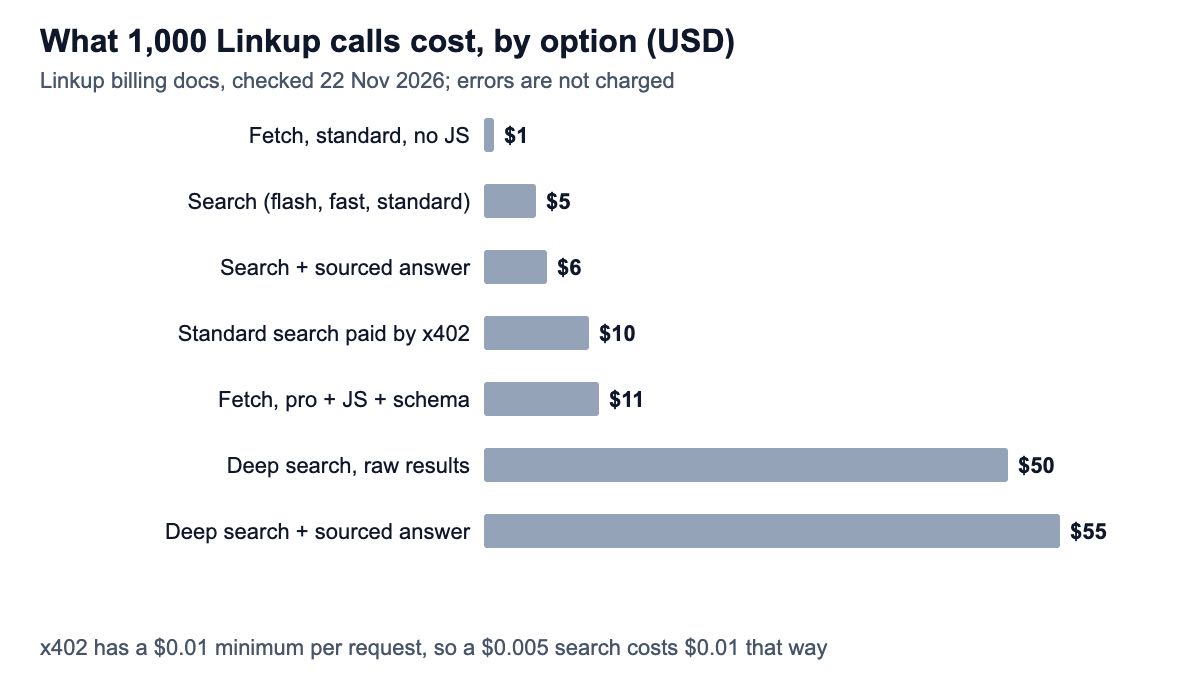
Three details in that table are easy to miss. First, the sourced-answer premium is small: $1 per 1,000 calls buys a written answer with inline citations on top of the results, which is cheap next to running your own model over the same text.
Second, failed calls are free; the docs say “No credit is subtracted when an error occurs.” Third, the x402 route, which lets an agent pay per request in USDC on Base with no account, has a $0.01 minimum. That is fine for deep search, but it doubles the price of a standard one.
The four search depths also differ in speed, according to Linkup’s search overview: flash (an alpha) returns in under 200 ms with no query rewriting, fast in about a second, standard in one to three seconds with parallel sub-searches, and deep in 5 to 30 seconds. The first three share one price, so the choice between them is about latency and quality, not money.
What does the free credit really give you?
At most $20 a month, and only on an account opened with a professional email address. The docs say a new account “is automatically credited with $20” and that Linkup will “top up eligible accounts back to $20 each month.” At $0.005 a search, that is the “4,000 queries for free” the pricing page advertises.
Read the wording closely. “Back to $20” describes a floor, not an extra $20 on top of what you hold. Taken literally, an account carrying $300 of paid credit would get nothing added that month.
Linkup’s pages do not spell out how the refill treats a funded balance, so I list it as unverified. The safe budgeting rule is to count the $20 only if your account usually runs low by month end.
The allowance has also moved. When Linkup switched its prices from euros to dollars in May 2026, its changelog says the monthly top-up rose from $5 to $20, at one dollar per euro. Some pricing trackers still show the old $5 figure; CostBench, last checked in August, is one.
Two larger offers sit on top. The pricing page invites startups to “apply for $5000 in free credits”, and the same changelog lists bonuses on large top-ups: 10% at $1,000, 15% at $5,000 and 20% at $10,000. A 20% bonus brings a standard search down to about $4.17 per 1,000 (my arithmetic). Whether bonus credit expires is not stated.
When is deep search worth ten times the price?
When one search would otherwise turn into several. Deep search costs $0.05 because Linkup runs what its docs call “multi-iteration agentic search-and-scrape chaining with evaluation”: it searches, reads pages, judges what is missing and goes again. If your own agent would need five or more standard calls plus page fetches to reach the same answer, deep search can be the cheaper path in total.
For most agent tool calls it is not. A question with a clear answer on one page, such as a price, a date or a company’s head office, is what standard depth is built for: it interprets the query, can fan out into parallel sub-searches, and can scrape one URL included in the question. Start every tool on fast or standard, log which queries come back thin, and route only those to deep.
Linkup’s own cost benchmark from 12 May 2026 puts the gap in real terms. Over 200 queries with 10 sources each, it reports $5.90 per 1,000 queries at standard depth and $59 at deep, close to list price because Linkup bills per call with no token charges. The post is vendor-run and concludes that Linkup is the cheapest of the four providers it chose, so treat its rankings as a claim rather than a verdict.
The other cost that grows with depth is time. Deep calls take up to 30 seconds. If a user is waiting on a chat reply, that delay often costs more in drop-off than the extra $45 per 1,000.
What will 10K, 100K and 1M searches a month cost?
Linkup’s cost is linear: volume does not lower the rate except through top-up bonuses. That makes the maths simple, and it means the per-1,000 price at a million searches is the same as at ten thousand.
| How you call it | 10,000 searches | 100,000 searches | 1,000,000 searches |
|---|---|---|---|
| Standard (or fast, flash), raw results | $50 ($5.00/1K) | $500 ($5.00/1K) | $5,000 ($5.00/1K) |
| Standard with a sourced answer | $60 ($6.00/1K) | $600 ($6.00/1K) | $6,000 ($6.00/1K) |
| Deep, raw results | $500 ($50/1K) | $5,000 ($50/1K) | $50,000 ($50/1K) |
| Standard, paid through x402 | $100 ($10/1K) | $1,000 ($10/1K) | $10,000 ($10/1K) |
| Standard, funded by a $5,000 top-up with its 15% bonus | Not applicable | Not applicable | about $4,348 ($4.35/1K) |
At 10,000 searches the $20 credit, if it applies, cuts the standard bill from $50 to $30. At 100,000 it is a rounding error: $480 instead of $500. At a million, the bonus matters more than the free credit. A $5,000 top-up with a 15% bonus funds 1.15 million standard searches, so a million of them costs about $4,348.
Volume has one more limit. Linkup’s rate-limit page sets 10 queries per second per organization for Search and Fetch, with higher limits on custom plans. A million searches a month averages under one query per second, so the cap only bites on bursts, such as a batch job that fans out 50 searches at once.
The number that tends to surprise teams is searches per task, not price per search. Agents call search more than once per question.
On Artificial Analysis’s search index, Linkup’s standard depth showed $61.15 of search spend per 1,000 agent tasks. At $0.005 a call, that is roughly 12 searches per task (my arithmetic). Budget from your own logs: count tool calls per conversation for a week, then multiply.
What changes on 1 December?
The default number of results drops from 20 to 10, and the price does not change. Linkup’s changelog says that from 1 December 2026, a request that does not set maxResults returns up to 10 results instead of 20, and that search is priced per call, not per result.
Two things follow. If your agent relied on 20 sources arriving by default, set maxResults: 20 explicitly now; it costs the same. And if you pass results into a model, the new default halves the text you send, which can lower your token bill more than any change in search price.
Linkup makes the same argument in a June post on token costs, which proposes cost per resolved query as the unit to compare.
What costs less, and what do you give up?
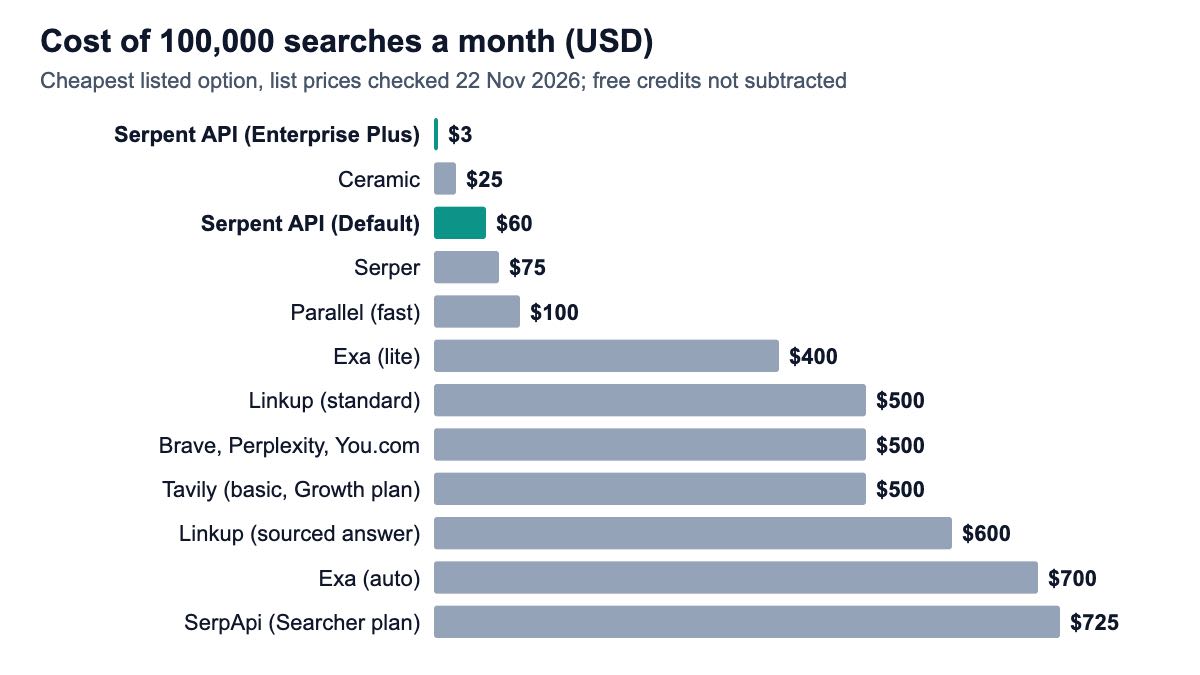
Several APIs cost less than $5 per 1,000, but they return different things, so compare like for like. Linkup’s standard search hands back results with page text attached, from its own index. The table below groups the alternatives by what they return, using each vendor’s live pricing page on 22 November 2026.
| Provider and rule | 10,000 searches | 100,000 searches | 1,000,000 searches | Free each month |
|---|---|---|---|---|
| AI search APIs: own index, text for a model | ||||
| Linkup, standard search | $50 ($5.00/1K) | $500 ($5.00/1K) | $5,000 ($5.00/1K) | Up to $20 |
| Ceramic, pay as you go | $2.50 ($0.25/1K) | $25 ($0.25/1K) | $250 ($0.25/1K) | 1,000 queries to start |
| Parallel, fast mode (basic is $5/1K) | $10 ($1.00/1K) | $100 ($1.00/1K) | $1,000 ($1.00/1K) | $5 with a card on file |
| Exa, lite search (auto is $7/1K) | $40 ($4.00/1K) | $400 ($4.00/1K) | $4,000 ($4.00/1K) | $10 |
| Brave Search API | $50 ($5.00/1K) | $500 ($5.00/1K) | $5,000 ($5.00/1K) | $5 |
| Perplexity Search API (fast is $1/1K) | $50 ($5.00/1K) | $500 ($5.00/1K) | $5,000 ($5.00/1K) | Not stated |
| You.com Web Search | $50 ($5.00/1K) | $500 ($5.00/1K) | $5,000 ($5.00/1K) | $10 credit (2,000 searches) |
| Tavily, basic search (plan + $0.008 overage) | $78 ($7.80/1K) | $500 ($5.00/1K) | $7,700 ($7.70/1K) | 1,000 credits |
| SERP APIs: ranked search-engine results with positions | ||||
| Serper (credit packs, 6-month expiry) | $10 ($1.00/1K) | $75 ($0.75/1K) | $500 ($0.50/1K) | 2,500 queries to start |
| SerpApi (monthly plans) | $150 ($15.00/1K) | $725 ($7.25/1K) | $3,750 ($3.75/1K) | 250 searches |
| Serpent API — Default ($10 deposit), per page of results | $6 ($0.60/1K) | $60 ($0.60/1K) | $600 ($0.60/1K) | 10 free calls to start |
| Serpent API — Growth ($100 deposit) | $3 ($0.30/1K) | $30 ($0.30/1K) | $300 ($0.30/1K) | — |
| Serpent API — Scale ($500 deposit) | $2 ($0.20/1K) | $20 ($0.20/1K) | $200 ($0.20/1K) | — |
| Serpent API — Enterprise ($1,000 deposit) | $1.50 ($0.15/1K) | $15 ($0.15/1K) | $150 ($0.15/1K) | — |
| Serpent API — Enterprise Plus ($1,250 deposit) | $0.30 ($0.03/1K) | $3 ($0.03/1K) | $30 ($0.03/1K) | — |
How I built the rows. Each cell uses the cheapest listed option that covers the volume, before tax. Tavily counts a basic search as one credit and an advanced one as two, per its credits page; the 10,000 cell is its $30 Project plan plus 6,000 credits at $0.008, and the million cell is the $500 Growth plan plus overage, where an enterprise quote would probably be lower.
Serper packs expire after six months, so each cell uses the largest pack you could finish in that time. SerpApi cells use the smallest monthly plan that covers the volume ($150 for 15,000 searches at the first volume).
A few notes on what each alternative is like to use:
- Ceramic is the low-price option and the default provider on Cloudflare’s Web Search API. Its pricing page shows $0.25 per 1,000 on pay as you go and a $99 Pro plan that includes 495,000 queries. Test relevance on your own questions before you move a production agent.
- Parallel charges $1 per 1,000 in fast or turbo mode and $5 in basic or advanced, each with 10 results, per its pricing docs. Its own Linkup comparison, checked against vendor pages on 27 October, is a competitor’s pitch, but it is fair in one respect: it says Linkup’s Private Index deployment is “a capability Parallel doesn’t offer.”
- Exa lists lite and instant search at $4 per 1,000 and auto or fast at $7, with page contents at $1 per 1,000 pages on its pricing page. At 100,000 searches that is $400 on lite and $700 on auto; if you want page text for every result, add the contents charge. Our Exa alternatives guide covers it in depth.
- Brave, Perplexity and You.com all sit at $5 per 1,000, the same as Linkup, per Brave’s API page, Perplexity’s pricing docs and You.com’s plans. Perplexity’s fast search is $1. See our Perplexity Search API pricing breakdown.
- Tavily sells monthly credit plans from $30 for 4,000 credits up to $500 for 100,000, per its pricing page. It is cheapest at exactly 100,000 a month and dearer elsewhere. Our Tavily alternatives post prices the switch.
One more route to Linkup itself: Cloudflare’s Web Search API in AI Gateway offers Linkup’s fast depth with raw results at $5 per 1,000, “with no additional markup”, per its providers page. That suits a team already billing through Cloudflare; our Cloudflare Web Search API comparison walks through it.
Is a SERP API a real alternative to Linkup?
Only if what you need is the ranking a search engine shows. Linkup answers a question from its own index and returns text a model can read. A SERP API returns the results page of Google, Bing or another engine as JSON: positions, titles, URLs and snippets, plus blocks such as People Also Ask and AI Overviews. They solve different problems, and price alone should not decide between them.
Linkup’s own SerpApi migration guide makes the split clear. It maps SerpApi’s q to query and num to maxResults, and says the engine parameter has no equivalent because Linkup uses its own index. Its search reference has no country or location parameter either; filtering is by domain (up to 100 included domains) and by date.
So a SERP API is the better fit when the question is “where does this page rank in Germany on Bing”, “which competitors hold the top three spots” or “what does the AI Overview cite for this query”. It is also a cheaper way to give an agent a list of candidate links when it will fetch the pages it picks. What you give up is the page text and the written answer; you fetch and summarise yourself.
Serpent’s per-page search endpoint, /api/search, takes q, an engine of google, bing, yahoo, ddg or brave, a country code, num or pages, and optional freshness and language filters, per the search API docs. Every engine returns the same results keys, so one parser covers all five. It is billed per page of results requested, from $0.03 per 1,000 pages at the Enterprise Plus tier to $0.60 on Default, and deposited credit never expires. The Google SERP API page shows the fields Google results carry.
Many agent stacks use both kinds: a SERP API to see what ranks, and a search API such as Linkup for questions where a cited answer saves a model call. If you are choosing the search layer for a new agent, our guide to web search APIs for agents and RAG sets out the trade-offs, and the Serper credits explainer covers the main low-cost SERP option.
Which one should you pick?
- You want page text and a cited answer in one call, at a flat price: stay on Linkup, standard depth, and add the $1-per-1,000 sourced answer if it replaces a model call.
- Your agent asks hard multi-step questions and accuracy beats latency: Linkup deep search at $50 per 1,000, routed only for the queries standard depth answers poorly.
- You want the lowest price for links plus a short description: Ceramic at $0.25 per 1,000, after testing relevance on your own questions.
- You want a low price with an established vendor and a fast mode: Parallel fast or Perplexity fast, both $1 per 1,000.
- You already pay Cloudflare and want one bill: Linkup through Cloudflare’s Web Search API at the same $5.
- You need Google or Bing rankings by country, or a cheap list of candidate links: a SERP API. Serpent runs from $0.03 per 1,000 pages; Serper from $0.30 to $1.00 per 1,000 depending on pack.
If none of that settles it, run 100 of your real queries through two finalists and compare answers side by side. Benchmarks disagree depending on who runs them: Linkup’s own post puts it first on price, while Artificial Analysis scored its standard depth 68 against a median of 74 on its search index. Your own queries are the only test that counts.
How we checked this
On 22 November 2026 I read Linkup’s billing docs, pricing page, USD changelog, maxResults changelog, search overview and reference, rate-limit page and SerpApi migration guide, then each alternative’s live pricing page. For the gap check I opened four of the top five results for “linkup api pricing” (Linkup’s docs, ColdIQ, usagepricing.com and CostBench; SaaSworthy refused the request, so I have not described it).
That is 26 linked sources: 19 official vendor pages, 3 vendor blog posts, 1 third-party index and 3 pricing guides. Monthly and per-1,000 costs are my arithmetic on list prices, excluding tax and promotions. I made no calls to any of these APIs.
What I could not verify: whether the “back to $20” monthly credit adds anything to a balance above $20; whether Linkup’s top-up bonus credit expires; Extract’s cost per 1,000 tasks; whether Tavily’s free 1,000 credits stack with a paid plan; and Ceramic’s overage rate above the Pro plan’s 495,000 queries.
Need search rankings rather than answers?
Google, Bing, Yahoo, DuckDuckGo and Brave results as one JSON shape, by country. From $0.03 per 1,000 — pay as you go, no subscription — and every account starts with 10 free API calls.
Get Your Free API KeyExplore: SERP API · Playground · Docs · Pricing
FAQ
How much does the Linkup API cost?
On 22 November 2026, Linkup’s billing docs listed $0.005 per search at flash, fast or standard depth with raw results, and $0.006 with a sourced answer or structured output. Deep search costs $0.05, or $0.055 with an answer. Fetch runs from $0.001 to $0.011 a call and Research from $0.25 to $2.50. There is no subscription; calls draw down a prepaid dollar balance, and errors are not charged.
Is Linkup free?
Partly. An account opened with a professional email gets $20 of credit, and Linkup tops eligible accounts back up to $20 each month, which covers about 4,000 standard searches. Startups can apply for $5,000 in credits, and beyond that you pay per call. Linkup does not spell out whether the monthly refill adds anything to an account already holding more than $20, so count on it only if your balance runs low.
How much does Linkup deep search cost?
Deep search costs $0.05 per call with raw results, or $50 per 1,000, and $0.055 with a sourced answer or structured output. That is ten times a standard search. Deep runs several rounds of searching and page reading and takes 5 to 30 seconds, so it pays off on questions that would otherwise need many standard calls, not on simple lookups.
Is Linkup cheaper than Tavily or Exa?
It depends on the mode. At $5 per 1,000, Linkup standard costs the same as Tavily’s Growth plan at exactly 100,000 searches, and less than Tavily at most other volumes, where overage is $0.008 a credit. Exa’s lite search is $4 per 1,000 and its auto mode $7, plus $1 per 1,000 pages if you want page text, which Linkup includes in its results.
Does Linkup charge per result?
No. Linkup prices search per call, so asking for 20 results costs the same as asking for 10. From 1 December 2026 the default maxResults drops from 20 to 10 for requests that do not set it. If you want 20 results, set the parameter explicitly; your search bill will not change, though the extra text may raise your model’s token cost.
What is the Linkup API rate limit?
Linkup’s docs set 10 queries per second per organization for the Search and Fetch endpoints, with higher limits available on custom plans through its sales team. Requests paid through x402 are limited per IP address instead. Ten per second is about 864,000 calls a day, so the cap matters for bursts, such as a batch job that fans out many searches at once, more than for monthly volume.
Sources
Linkup official docs and pages (checked 22 November 2026):
- Linkup docs — Pricing
- Linkup — Pricing page
- Linkup changelog — USD pricing
- Linkup changelog — default maxResults
- Linkup docs — Search overview (depths)
- Linkup docs — Search reference
- Linkup docs — Rate limits
- Linkup docs — Migrating from SerpApi
Other vendors’ pricing (checked 22 November 2026):
- Cloudflare Web Search — Providers
- Ceramic — Pricing
- Parallel docs — Pricing
- Exa — Pricing
- Brave Search API
- Perplexity docs — Pricing
- You.com — Plans
- Tavily — Pricing
- Tavily docs — API credits
- Serper
- SerpApi — Pricing
Benchmarks and vendor articles (checked 22 November 2026):
- Linkup — Cheapest AI search API? A benchmark (12 May 2026)
- Artificial Analysis — Linkup search API
- Linkup — Your search API isn’t what’s expensive (12 Jun 2026)
- Parallel — Linkup vs Parallel (checked by its author 27 Oct 2026)
Pricing guides read for the gap check (checked 22 November 2026):