Firecrawl search alternative: cheaper APIs for the /search call

Firecrawl's /search costs 2 credits per 10 results, which is $1.50 to $7.60 per 1,000 searches on its monthly plans, before you scrape anything. If your code only reads titles, URLs and snippets, a SERP API does the same job for less; if it reads page text, Parallel or Exa return content with the search.
Short answer: For links and snippets only, switch the search call to a SERP API: Serpent API is from $0.03 per 1,000 searches — pay as you go, no subscription — and Serper's packs run $0.50 to $1.00. For page text with each result, Parallel ($1 to $5 per 1,000) or Exa ($4 to $7, plus $1 per 1,000 pages). If you mostly scrape and crawl and search is a small side job, stay on Firecrawl; it is not worth a second vendor for a few thousand searches.
This page is only about Firecrawl's search endpoint. Firecrawl also scrapes and crawls sites, and if that is what you are replacing, the lists ranking for "Firecrawl alternatives" cover crawlers. For agent search in general, see our Tavily alternatives, Exa alternatives and web search APIs for agents guides. We sell a search API ourselves; every competitor price below links to that competitor's own page, read on 22 November 2026.
What does Firecrawl search cost?
Two credits for every 10 results, rounded up. Firecrawl's billing docs give the example that 11 results cost 4 credits, and a search that returns fewer than 10 still costs 2 (Firecrawl billing docs). If you add scrapeOptions, every result that gets scraped costs its normal scrape price on top: 1 credit a page, or 5 with JSON extraction.
| Plan | Monthly price (annual) | Credits a month | 10-result searches | $ per 1,000 searches at full use | /search per minute |
|---|---|---|---|---|---|
| Free | $0 | 1,000 | 500 | — | 10 |
| Hobby | $19 ($16) | 5,000 | 2,500 | $7.60 | 100 |
| Standard | $99 ($83) | 100,000 | 50,000 | $1.98 | 500 |
| Growth | $399 ($333) | 500,000 | 250,000 | $1.60 | 5,000 |
| Scale | $749 ($599) | 1,000,000 | 500,000 | $1.50 | 10,000 |
Plan credits do not roll over on Hobby, Standard or Growth; Scale carries unused credits for one month (Firecrawl pricing). When you run out, Firecrawl adds credits in $5 steps up to a limit you set: 1,000 credits per $5 on Hobby, 2,000 on Standard, 2,500 on Growth and 5,000 on Scale. In searches, that top-up is $10, $5, $4 and $2 per 1,000.
The rate limits for /search scale with the plan, from 10 a minute on Free to 10,000 on Scale (Firecrawl rate limits). For an agent making a few calls per task, Hobby's 100 a minute is plenty; for a batch job, rate limits can push you up a plan before credits do.
Why look for an alternative to /search?
Three reasons come up, and each points to a different replacement.
- Cost per search. Search is 2 credits where a scrape is 1, so a search-heavy workload uses credits twice as fast as a scrape-heavy one. At 100,000 searches a month you need 200,000 credits, which is Standard plus $250 of top-ups.
- What comes back. Without scraping, a Firecrawl web result has four fields:
url,title,descriptionandposition(Firecrawl search docs). If you want ads, People Also Ask, related searches or a knowledge panel, a SERP API returns them as separate fields. - Choice of engine. Firecrawl's search docs do not name the index behind web results; they refer to an "upstream search provider." If you want to pick the engine per call, look for an API with an engine parameter.
None of these is a reason to leave Firecrawl if you mainly crawl sites. They are reasons to move the search call, and keep scraping wherever it works for you.
What does your code read from it?
Check your code before you compare prices. The right replacement depends on which fields your code reads after the search returns.
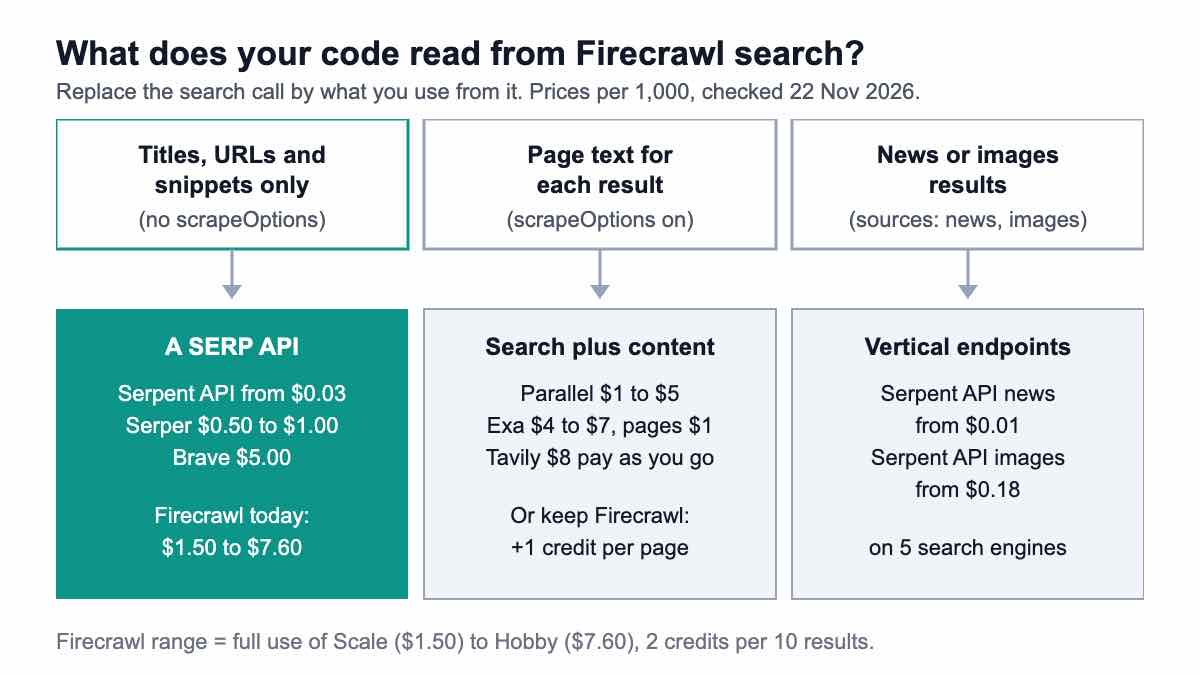
- Titles, URLs and snippets only (no
scrapeOptions): any SERP API replaces it. This is the cheapest switch and the easiest to test. - Page text for each result (
scrapeOptionswith markdown): either an API that returns content with the search (Parallel excerpts, Exa contents, Tavily raw content), or a SERP API for the search plus your existing scraper for the pages you actually open. - News or image results (
sources: ["news"]or["images"]): a dedicated news or image search endpoint, which returns fields such as publish time and source for news, or original image URL and dimensions for images.
Which alternative is cheapest at your volume?
At 100,000 searches a month, the range runs from $0.03 to $7.92 per 1,000, with Firecrawl at $3.49. The rules for the table: one search means 10 results; free monthly allowances are subtracted; monthly plans are charged in full; Firecrawl uses the cheapest mix of plan and $5 top-ups; prepaid packs use the pack that covers the volume.
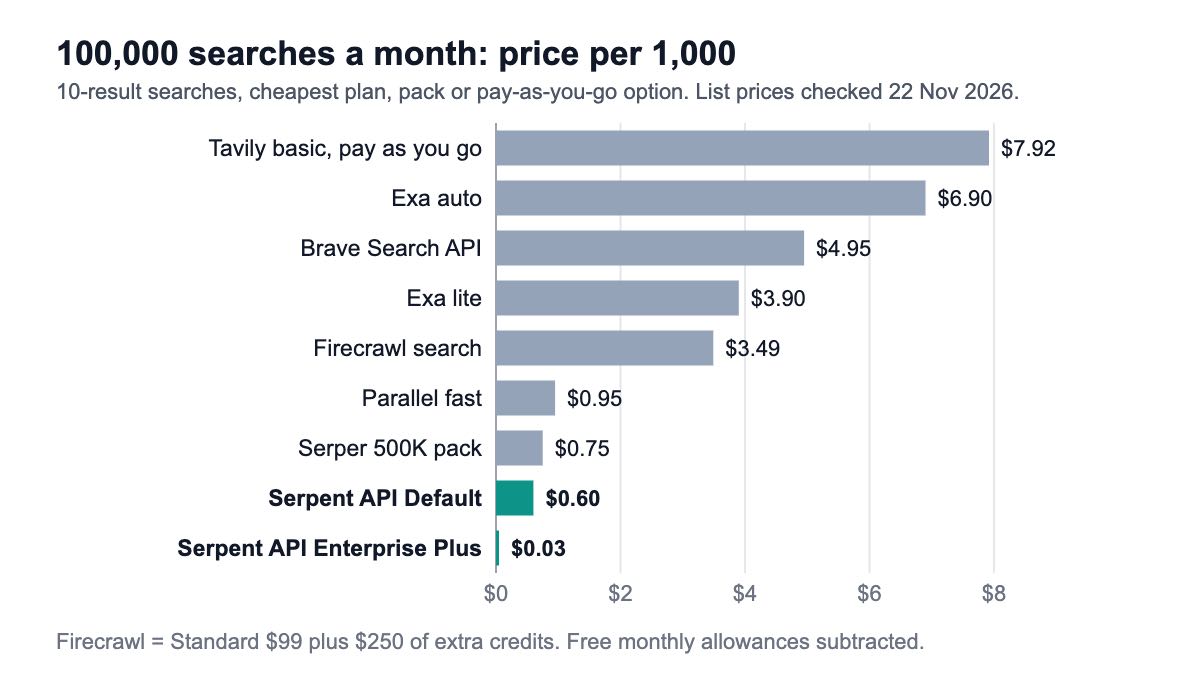
| Option | 1,000 a month | 100,000 a month | 1,000,000 a month | What you get back |
|---|---|---|---|---|
| Firecrawl search | $19.00 (Hobby) | $3.49 ($349: Standard + top-ups) | $1.75 ($1,749: Scale + top-ups) | URL, title, description, position |
| Tavily basic, pay as you go | $0 (1,000 free credits) | $7.92 ($792) | $7.99 ($7,992) | Links, snippets, optional raw content |
| Exa lite / auto | $0 ($10 monthly credit) | $3.90 / $6.90 | $3.99 / $6.99 | Links; page contents $1 per 1,000 pages |
| Brave Search API | $0 ($5 monthly credit) | $4.95 ($495) | $5.00 ($4,995) | Results from Brave's own index |
| Parallel fast / basic | $0 (free monthly allowance) | $0.95 / $4.95 | $1.00 / $5.00 | Links with page excerpts |
| Serper | $1.00 rate, $50 smallest pack | $0.75 ($375 pack) | $0.50 ($1,250 pack) | Google results as JSON |
| DataForSEO standard / live | $0.60 / $2.00, $50 top-up | $0.60 / $2.00 | $0.60 / $2.00 | Google results; standard queue is not instant |
| Serpent API — Default ($10 deposit) | $0.60 | $0.60 ($60) | $0.60 ($600) | Results from Google, Bing, Yahoo, DuckDuckGo or Brave, your choice per call |
| Serpent API — Growth ($100 deposit) | $0.30 | $0.30 ($30) | $0.30 ($300) | |
| Serpent API — Scale ($500 deposit) | $0.20 | $0.20 ($20) | $0.20 ($200) | |
| Serpent API — Enterprise ($1,000 deposit) | $0.15 | $0.15 ($15) | $0.15 ($150) | |
| Serpent API — Enterprise Plus ($1,250 deposit) | $0.03 | $0.03 ($3) | $0.03 ($30) |
At 1,000 searches a month, the free allowances win: Tavily, Exa, Brave and Parallel all cover that volume for $0. Firecrawl's own free plan covers 500 searches, so 1,000 needs Hobby. Paying $19 for a light month is the price of not managing a second account, which is a fair trade for many teams.
At a million, the gap is large: $1,749 a month on Firecrawl against $500 to $600 on the cheapest SERP API packs and plans, $30 on our Enterprise Plus tier, and $3,990 to $7,992 on the content-returning APIs. Annual Firecrawl billing lowers the plan part, for example Standard at $83 a month instead of $99, but not the top-ups.
The alternatives, one by one
Serpent API: best for links and snippets at the lowest price per search
A search is one call to GET /api/search/quick with q, engine (google, bing, yahoo, ddg or brave) and country, and one call is one charge; the standard search docs list every parameter. Prices start from $0.03 per 1,000 searches — pay as you go, no subscription (pricing). For the full set of result blocks, such as ads, People Also Ask and related searches, the per-page /api/search endpoint is described in the per-page search docs.
Firecrawl's tbs time filters map to our freshness parameter (hour, day, week, month, year), and its sources: ["news"] and ["images"] map to /api/news (from $0.01 per 1,000) and /api/images (from $0.18 per 1,000). The SERP API page shows the response shape, and new accounts get 10 free calls.
Serper: best prepaid Google packs
Serper sells prepaid credit packs: $50 for 50,000, $375 for 500,000, $1,250 for 2.5 million and $3,750 for 12.5 million, valid for six months, with 2,500 free queries to start (Serper). Its site says credits are deducted "every time you receive successful responses to queries." It returns Google results only. Our Serper pricing explainer covers the credit rules.
Parallel: best for search with page excerpts
Parallel prices its Search API at $1 per 1,000 fast requests and $5 per 1,000 basic or advanced requests, each with 10 results, plus $1 per 1,000 for results beyond 10; its Extract API is $1 per 1,000 URLs (Parallel pricing docs). The pricing page mentions up to 5,000 free requests a month with a card on file (Parallel pricing). Parallel publishes its own Firecrawl comparison, which ranks Parallel first; read it as a vendor page (Parallel's Firecrawl alternatives article).
Exa: best for meaning-based search with contents
Exa charges $7 per 1,000 auto searches and $4 per 1,000 lite searches for the first 10 results, with page contents at $1 per 1,000 pages per content type (Exa pricing). Every account gets $10 of credit each month, which the page says covers up to 2,500 lite searches. Exa runs its own index, which helps with exploratory queries where you cannot name the right keywords. Our Exa alternatives page compares it further.
Tavily: best if you want one agent-focused vendor
Tavily charges 1 credit for a basic search and 2 for an advanced one (Tavily credit docs). Pay-as-you-go credit is $0.008, so basic searches cost $8 per 1,000, and everyone gets 1,000 free credits a month (Tavily pricing).
The Project plan is $30 for 4,000 credits. Its search endpoint can also return each result's cleaned page content with include_raw_content (Tavily search reference). The page also shows larger plans on a slider I could not read reliably, so the table uses pay-as-you-go.
Brave Search API: best for an independent index
Brave's Search plan is $5 per 1,000 requests with $5 of free credit every month and up to 50 queries per second (Brave Search API). Results come from Brave's own index rather than Google's. Our Brave Search API coverage review looks at what that index includes.
Linkup: an answer-first option
Linkup lists a price of $0.005 to $0.006 per request across its Fast, Standard and Deep search modes, with 4,000 free queries (Linkup pricing). The page does not split the price by mode, so it is left out of the volume table. It suits agents that want a sourced answer rather than a list of links.
How hard is the switch?
For links and snippets, it is usually one function. A Firecrawl search call and a SERP API call both take a query and return a list; what changes is the field names.
| Firecrawl /search | Serpent API |
|---|---|
query | q |
limit | num |
location | country, or location for a city |
tbs: "qdr:d" (past day) | freshness=d |
sources: ["news"] | GET /api/news |
sources: ["images"] | GET /api/images |
Result url, title, description, position | Organic result URL, title, snippet and position |
Three checks before you switch production traffic:
- Field names. Write a small adapter that maps the new response to the shape your code already reads, so nothing downstream changes.
- Result counts. Log how many results each call returns on both services for a week of real queries. Count what you use, not what you request.
- Scraped pages. If you used
scrapeOptions, decide which results you actually open. Many agents read two or three of ten, so searching with one API and scraping only those pages with Firecrawl's/scrapeat 1 credit each can cost less than scraping all ten.
Firecrawl bills a returned document, including a 403 or 404 page, at 1 credit, and nothing when no document comes back. On our side, requests we could not complete are refunded automatically. Either way, log the status and result count per call so you can compare bills like for like.
A practical way to run the comparison: take 50 queries your code sent last week, run them through Firecrawl and the candidate on the same day, and save both responses. Compare the URLs your code would have used, not the whole list. If the top three match for most queries and the fields your adapter reads are present, the switch is safe. If they differ, look at which results your agent actually cited before deciding which list is better.
Which one should you pick?
- Your code reads links and snippets, and you want the lowest price: Serpent API, from $0.03 per 1,000, with Google, Bing, Yahoo, DuckDuckGo or Brave per call.
- You want Google only and like prepaid packs: Serper, $0.50 to $1.00 per 1,000.
- You want page excerpts in the same call: Parallel at $1 per 1,000 fast searches.
- You search by meaning and read full pages: Exa, $4 to $7 plus $1 per 1,000 pages.
- You want results outside Google's index: Brave Search API at $5 per 1,000, or Exa.
- You mostly crawl, and search a few thousand times a month: stay on Firecrawl. One vendor and one bill is worth more than the saving.
For a broader view of agent search, our comparison of SERP APIs vs Tavily and Exa for agents covers the trade-offs between links and content, and the web search MCP servers roundup covers tools you can plug straight into an assistant.
How we checked this
On 22 November 2026 I read Firecrawl's pricing page, billing docs, search docs and rate-limit docs (4 official sources), and the live pricing pages or docs of Tavily (2), Exa, Brave, Parallel (2), Linkup, Serper and DataForSEO (10 more). Serpent's prices and parameters come from our own pricing page and docs.
For the gap check I opened the pages ranking for "firecrawl search alternative": Parallel's article (vendor, prices checked 14 November 2026, ranks itself first), cloro's comparison (vendor, prices read 24 October 2026), Stork.ai's list (a directory that sells listings, 9 November 2026), and Crawleo's article, which returned a 404. Every cost here is arithmetic on list prices for 10-result searches; no API calls were made for this article.
What I could not verify: Tavily's plans above Project; whether Parallel's free monthly allowance applies equally to fast and basic searches; Linkup's price per mode; which index Firecrawl's web search uses.
Move the search call, keep everything else
Search results from Google, Bing, Yahoo, DuckDuckGo and Brave from $0.03 per 1,000 — pay as you go, no subscription. Start with 10 free calls.
Get Your Free API KeyExplore: SERP API · Playground · Docs · Pricing
FAQ
How many credits does a Firecrawl search use?
Two credits per 10 results, rounded up, so 1 to 10 results cost 2 credits and 11 results cost 4. If you add scrapeOptions, each scraped result costs its normal scrape price on top: 1 credit per page, or 5 with JSON extraction. A search with 10 results that scrapes all 10 therefore costs 12 credits, six times a plain search.
How much does Firecrawl search cost per 1,000 searches?
At full use of a monthly plan: $7.60 on Hobby, $1.98 on Standard, $1.60 on Growth and $1.50 on Scale, for 10-result searches. Top-up credits cost more per search: $10, $5, $4 and $2 per 1,000 on those plans. Plan credits expire monthly except on Scale, which carries them one month, so a half-used plan doubles the real price.
What is the cheapest alternative to Firecrawl search?
For links and snippets, a SERP API. On the pages I checked on 22 November 2026, Serpent API starts from $0.03 per 1,000 searches on its Enterprise Plus tier and $0.60 on Default, and Serper's packs run $0.50 to $1.00. For searches that also return page content, Parallel's fast mode at $1 per 1,000 is the lowest listed price.
Can I keep Firecrawl for scraping and use another API for search?
Yes, and it is often the cheapest setup. Send the search to a search API, then scrape only the results your code actually opens with Firecrawl's /scrape at 1 credit a page. If an agent reads three of ten results, that is 3 credits of scraping instead of 10, plus a cheaper search. The extra cost is a second API key and a small adapter.
Does Firecrawl search return Google results?
Firecrawl's search documentation does not name the index behind its web results; it refers to an upstream search provider. It supports web, news and image sources, category filters such as research, PDF and developer, and Google-style tbs time filters. If you want to pick the engine per call, look for an API with an engine parameter.
Is Firecrawl's free plan enough for search?
For light testing, yes. The free plan gives 1,000 credits a month, which is 500 ten-result searches, at 10 searches a minute and two concurrent requests. That covers a prototype agent but not a production workload. Tavily, Exa, Brave and Parallel all offer free monthly allowances of their own, so you can test two options side by side for free.
Sources
Firecrawl, official (checked 22 November 2026):
Alternatives, official pricing and docs (checked 22 November 2026):
- Tavily pricing
- Tavily API credits
- Tavily search reference
- Exa pricing
- Brave Search API
- Parallel pricing
- Parallel pricing docs
- Linkup pricing
- Serper
- DataForSEO Google Organic pricing
Third-party pages (opened 22 November 2026):