Parallel Web Search API Pricing: $1 or $5 per 1,000

Parallel’s Search API costs $1 per 1,000 requests in Turbo and Fast modes and $5 per 1,000 in Basic and Advanced, each with 10 results and page excerpts. Extra results are $1 per 1,000. A card on file adds $5 of free credit every month, and new accounts get up to $80 at signup.
Short answer: For an agent that needs page text in every response at the lowest price, Parallel Fast at $1 per 1,000. For multi-hop research where accuracy matters more than cost, Parallel Advanced at $5. For titles, URLs, snippets and result-page features from Google, Bing, Yahoo, DuckDuckGo and Brave at volume, Serpent API, from $0.03 per 1,000 — pay as you go, no subscription. For a small pilot, the free monthly credits at Parallel ($5), Brave ($5) or Exa ($10) cover it.
How much does Parallel’s Search API cost?
It depends only on the mode you pick: $1 per 1,000 requests for Turbo and Fast, $5 per 1,000 for Basic and Advanced. Every request includes 10 results, each further result costs $1 per 1,000, and the length of the excerpts does not change the price. That is how Parallel’s pricing documentation lists it, and the Search product page gives the same four modes with a typical latency for each.
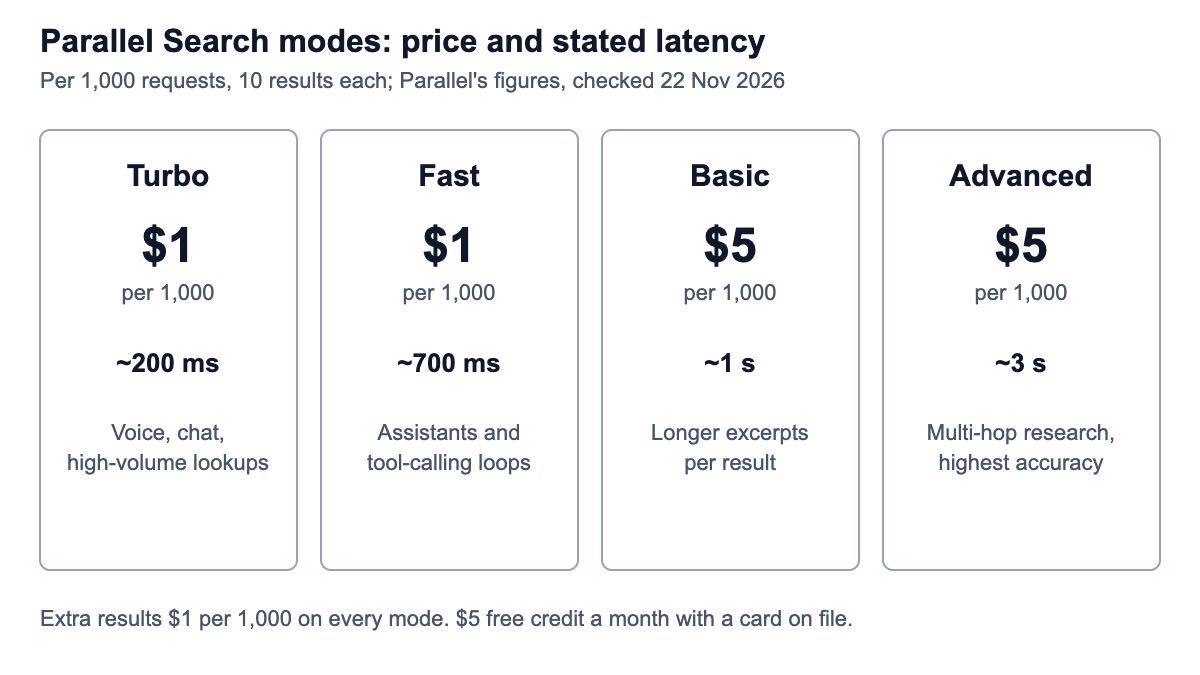
| Mode | Price per 1,000 requests | Results included | Stated latency | Parallel’s suggested use |
|---|---|---|---|---|
| Turbo | $1 | 10 | ~200 ms | Voice, chat, high-volume lookups |
| Fast | $1 | 10 | ~700 ms | Interactive assistants, tool-calling loops |
| Basic | $5 | 10 | ~1 s | Agents that reason over longer passages |
| Advanced | $5 | 10 | ~3 s | Background research, deep reasoning agents |
| Extra results (any mode) | $1 per 1,000 results | — | — | Beyond the first 10 |
Billing is per request, with nothing prepaid and nothing expiring. Parallel’s own Serper comparison puts it plainly: “Parallel bills per request. Nothing is prepaid and nothing expires.” For a team with spiky agent traffic that is a real advantage over monthly plans that reset.
The practical choice is between the $1 and the $5 tier. Turbo and Fast return the same 10 results with shorter excerpts and lower latency; Basic adds longer excerpts, and Advanced adds what Parallel calls “multi-hop retrieval and compression, for the highest accuracy.” If your agent runs one search per user message, the $1 modes are the default. If it runs a few careful searches in a background research job, the $5 modes are where Parallel says its accuracy lead comes from.
What do the free credits actually cover?
Quite a lot for a pilot. Parallel’s pricing page lists four free routes:
- Launch — free web search inside AI tools through Parallel’s MCP server, with “No account needed” and “Variable limits, enough for personal use.”
- $5 a month on the Build plan with a card on file. At $1 per 1,000 that is 5,000 Turbo or Fast searches a month, or 1,000 Basic or Advanced searches.
- Up to $80 at signup, which the product page describes as “up to 80,000 free search requests” — the figure assumes the $1 modes.
- Up to $250 for qualified startups.
Two cautions. The page says “up to” for both the signup credit and the startup grant, so do not budget the full amount until you see it in your account. And free credit is spent before your paid balance, according to the Orb pricing-atlas capture of the page, so the $5 monthly credit lowers every bill by $5 rather than funding a separate quota.
For comparison, Exa gives $10 of credit a month, Brave Search $5, Tavily 1,000 credits and Firecrawl 1,000 credits; Serper gives 2,500 queries once. A new Serpent API account gets 10 free API calls, enough to check the response shape before you pay.
What do Parallel’s other APIs cost?
Search is the cheapest product Parallel sells. Its research and extraction tools are priced per 1,000 runs or URLs, from $1 for Extract to $2,400 for the largest Task processor. You are charged only for runs that complete, according to the docs.
| Product | Unit | Price per 1,000 | Notes |
|---|---|---|---|
| Extract | URL | $1 | The pricing page FAQ says “per 1,000 results” (see below) |
| Task API | Successful run | $5 (lite) to $2,400 (ultra8x) | base $10, core $25, core2x $50, pro $100, ultra $300, ultra2x $600, ultra4x $1,200 |
| Responses API | Successful request | $10 (low) / $50 (medium) / $250 (high) | Reasoning effort sets the price |
| Monitor | Execution | $3 (lite) / $10 (base) | Recurring checks |
| FindAll | Run + match | Fixed $0.10–$10 per run, plus $0–$1 per match | Enrichments billed at Task prices |
| Entity Search | Request | $5 | 100 results included; extra $0.05 per 1,000 |
| Images, Places (fast) | Request | $1 | Up to 20 results |
| Shopping, Hotels / Flights | Request | $5 | Up to 40 / 20 results |
The Task API is the product to watch on a bill. A pro run is $0.10 and an ultra8x run $2.40, and the docs list latencies from 10 seconds to two hours. If you only need search results, you never touch these prices; if you hand whole research questions to Parallel, the Task processor you pick will dominate your spend.
Why do Parallel’s own pages show different prices?
Because the pricing page changed this month and its pages describe the same rates at different levels of detail. On 22 Nov 2026 I found three statements:
- The pricing page says Search starts “From $1 per 1k requests” and does not break prices out by mode.
- The pricing docs list Turbo and Fast at $1 and Basic and Advanced at $5 per 1,000.
- The product page says “$0.001 per request with 10 results + $0.001 per page extracted” next to the mode table that shows $5 for Basic and Advanced.
The Orb pricing atlas shows why: its 4 November capture read “$0.001 per request” with two plans, and its 16 November capture shows the current “From $1” page with four plans. The product page’s per-request line is the older wording. I trust the docs table, because it is the most detailed and it agrees with the mode table on the product page.
Extract has a similar wrinkle. The pricing table says “$1 per 1k URLs” while the FAQ on the same page says Extract is billed “per 1,000 results”. The docs say per URL. If you extract many pages, confirm the unit on your first invoice.
What about Scale, Enterprise and cloud marketplaces?
Scale is a commitment, not a discount. It costs $1,000 a month, or $10,000 a year paid upfront for $12,000 of credits, and the credits are spent at standard API rates; the Orb capture notes that monthly Scale credits do not roll over. What Scale buys is throughput: Search and Extract rise from 600 requests a minute on Build to 1,500 on Scale, excluding Turbo, while Task stays at 2,000 a minute on both. Enterprise is “Custom pricing, rate limits, and contract terms.”
You can also buy Parallel through cloud marketplaces. The AWS Marketplace listing sells the Search API as an MCP server on Bedrock AgentCore, metered so that “One unit equals one cent USD” on a $0 contract, with usage drawn against your AWS commitment. On Google Cloud, Grounding with Parallel is a separate offering for Gemini models: you pay Gemini token prices plus Parallel’s search price, either through the Marketplace or with your own Parallel key, and the default quota is 200 prompts a minute.
Marketplace billing matters more than the rate for many teams. If your company already has an AWS or Google Cloud commitment to burn down, buying Parallel there can be cheaper in practice than any list price comparison suggests.
How does Parallel compare at your volume?
At 100,000 searches a month, Parallel’s $1 modes cost $95 after the free credit, the second-cheapest of the AI search APIs I priced, level with Perplexity’s Fast Search at $100. Its $5 modes cost $495, in line with Brave, Tavily and Perplexity’s standard search. SERP APIs that return results pages instead of excerpts cost less again.
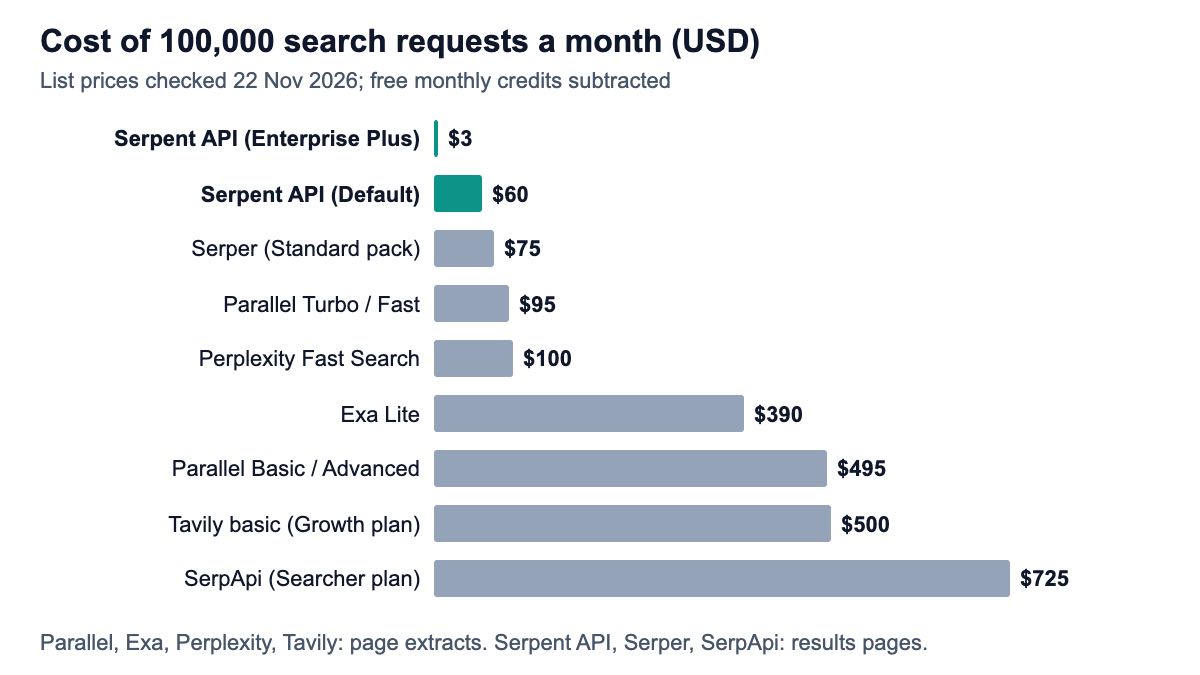
The table uses each vendor’s live pricing page. Rules: monthly free credits subtracted; monthly plans priced at the cheapest plan that covers the volume; prepaid packs priced by what you can use before they expire (Serper’s credits last six months).
| Provider (what a request returns) | 1,000 / month | 100,000 / month | 1,000,000 / month | Model |
|---|---|---|---|---|
| Serpent API (a results page from Google, Bing, Yahoo, DuckDuckGo or Brave) | $0.60 / $0.30 / $0.20 / $0.15 / $0.03 per 1,000 at any volume (Default $10 / Growth $100 / Scale $500 / Enterprise $1,000 / Enterprise Plus $1,250 deposit) | Pay as you go, no subscription | ||
| Parallel Turbo / Fast (10 results with excerpts) | $0 ($5 monthly credit) | $0.95 | $0.995 | Pay per request |
| Parallel Basic / Advanced (10 results, longer excerpts) | $0 ($5 monthly credit) | $4.95 | $4.995 | Pay per request |
| Perplexity Search API (results with content) | $5.00 | $5.00 | $5.00 | Pay per request |
| Perplexity Fast Search | $1.00 | $1.00 | $1.00 | Pay per request |
| Exa Lite (10 results) | $0 ($10 monthly credit) | $3.90 | $3.99 | Pay as you go |
| Exa Auto (10 results) | $0 ($10 monthly credit) | $6.90 | $6.99 | Pay as you go |
| Brave Search API | $0 ($5 monthly credit) | $4.95 | $4.995 | Pay per request |
| Tavily basic search (1 credit) | $0 (1,000 free credits) | $5.00 (Growth, $500) | $7.99 (pay as you go) | Monthly plan or pay as you go |
| Firecrawl search (2 credits per 10 results) | $19.00 (Hobby, $19) | $3.99 (Growth, $399) | Unverified (above Scale) | Monthly plan, no rollover |
| Serper (Google results page) | $8.33 ($50 pack, expires in 6 months) | $0.75 | $0.50 | Prepaid packs |
| SerpApi (Google results page) | $25.00 (Starter) | $7.25 (Searcher) | $3.75 (Cloud 1M) | Monthly plan |
As monthly bills at one million searches: Parallel Fast $995 and Advanced $4,995; Perplexity Fast $1,000; Exa Lite $3,990; Brave $4,995; Tavily about $7,992; Serper $500; SerpApi $3,750; Serpent API $600 on Default down to $30 on Enterprise Plus. At 100,000 a month the same rates give $95 for Parallel Fast, $75 for Serper and $3 to $60 for Serpent API. Serpent API’s $0.03 rate is the lowest per-1,000 search price in this table.
Where each number comes from: Exa lists Lite at $4 and Auto at $7 per 1,000 with $10 of free credit each month; Brave charges $5 per 1,000 with $5 free a month; Perplexity charges $5, or $1 for search_type: "fast"; Tavily charges 1 credit for a basic search and 2 for advanced, at $0.008 a credit or $500 for 100,000 on Growth; Firecrawl charges 2 credits per 10 search results on plans from $19; Serper sells packs from $50 for 50,000 credits; and SerpApi plans run from $25 for 1,000 searches. Our Perplexity Search API pricing guide and SerpApi pricing breakdown go deeper on two of them.
What do you get for each request?
Different things, which is why the price gap is so wide. Parallel returns ranked URLs with excerpts taken from the page bodies and selected against the objective you send, so the passage your model needs arrives in the first response; you can cap the text with max_chars_per_result and max_chars_total. Exa, Tavily and Perplexity’s Search API work the same way in broad terms.
A SERP API returns a results page as JSON: each organic result’s position, title, URL and snippet, plus blocks such as People Also Ask, related searches, featured snippets and knowledge panels. Serpent API’s per-page search (GET /api/search) returns that shape on five engines with engine, country, language and freshness parameters, billed per page; its standard search (GET /api/search/quick) returns organic results for one charge per call. Snippets are one or two lines, so if your agent needs the page text, you fetch the pages you choose in a second step.
On accuracy, Parallel publishes strong numbers, and they are its own. Its product page reports SimpleQA Verified scores of 97% for Advanced and Basic, 94% for Fast and 91% for Turbo, against 92% for Tavily and 91% for Exa at their top tiers, and BrowseComp scores of 74% for Advanced against 70% for Exa and 66% for Tavily. The tests are dated 9 September 2026, use 50 to 100 questions each, and were run by Parallel. Treat them as a reason to test Parallel on your own questions, not as a settled ranking.
So the honest comparison is not $1 against $0.03. It is “excerpts chosen for my model” against “the results page, plus whatever fetching I do myself”. Our SERP API vs Tavily and Exa guide walks through when each shape wins.
What would an agent’s monthly bill look like?
Take a support agent that handles 50,000 tasks a month and runs eight searches per task: 400,000 searches. On list prices that costs:
- Parallel Fast: $395 a month after the $5 credit.
- Parallel Advanced: $1,995 a month.
- Serpent API: $12 a month at the lowest rate — results pages only.
- A mix: results pages from Serpent API for discovery, then Parallel Extract on the two best URLs per task (100,000 URLs at $1 per 1,000 = $100): $112 a month at the lowest rate.
The mix is often the cheapest way to get page text when the agent only reads a few pages per task. If it needs excerpts from all 10 results on every search, Parallel Fast is simpler and the price gap shrinks. Our guide to cutting web-search costs for LLMs covers more ways to trim the search line of an agent’s bill.
Which one should you pick?
- An agent that needs page excerpts on every call, at the lowest price: Parallel Fast or Turbo, $1 per 1,000, or Perplexity Fast at the same price.
- Background research where accuracy beats cost: Parallel Advanced, $5 per 1,000, and test it on your own questions.
- Whole research questions answered with citations: Parallel’s Task API, from $5 per 1,000 runs, priced by processor.
- Rank tracking, SEO data or result-page features from five engines: Serpent API, from $0.03 per 1,000 with no subscription.
- An existing AWS or Google Cloud commitment: Parallel through the marketplace, so the spend counts against it.
- A small pilot: any of the free monthly credits — Exa’s $10 goes furthest on Lite, Parallel’s $5 on Fast.
For the wider field of search APIs built for agents, see our best web search APIs for AI agents, Tavily alternatives and Exa alternatives guides.
How we checked this
On 22 November 2026 I read Parallel’s pricing page, pricing documentation, Search product page and its Serper comparison article; the AWS Marketplace listing; Google Cloud’s Grounding with Parallel page; the Orb pricing-atlas captures of Parallel’s page; and the live pricing pages or docs of Exa, Tavily (two pages), Brave, Perplexity, Firecrawl (two pages), Serper and SerpApi. Serpent API prices and endpoints come from our pricing page and docs the same day. Sources: 4 Parallel pages, 2 cloud-marketplace pages, 1 third-party capture, 10 pages from other vendors.
No API calls were made. Monthly bills are list-price arithmetic at the volumes shown. Parallel’s benchmark figures are Parallel’s own and were not reproduced.
What we could not verify: G2’s Parallel listing (it refused the request); Parallel’s Enterprise prices; AWS per-unit prices on 12- and 24-month contracts; whether every new account receives the full $80 signup credit; Firecrawl’s price above one million credits a month; and which unit Extract is finally billed in, per URL or per result.
Price your search line per call
Serpent API returns Google, Bing, Yahoo, DuckDuckGo and Brave results as JSON from $0.03 per 1,000 — pay as you go, no subscription. Sign up for 10 free API calls and compare the output with your current provider.
Get Your Free API KeyExplore: SERP APIs · Playground · Docs · Pricing
FAQ
How much does the Parallel Search API cost?
$1 per 1,000 requests in Turbo and Fast modes and $5 per 1,000 in Basic and Advanced, according to Parallel’s pricing documentation on 22 November 2026. Each request includes 10 results with excerpts, extra results cost $1 per 1,000, and excerpt length does not change the price. Billing is per request with nothing prepaid. At 100,000 searches a month that is $95 in the $1 modes or $495 in the $5 modes after the $5 monthly credit.
Does Parallel have a free tier?
Yes, several. The Launch tier offers free web search inside AI tools through Parallel’s MCP server with no account. The Build plan applies $5 of free credit every month when a card is on file, enough for 5,000 Fast or Turbo searches, and new accounts can receive up to $80 at signup, which Parallel describes as up to 80,000 free search requests. Qualified startups can apply for up to $250 in credits.
What is the difference between Parallel’s Fast and Advanced modes?
Price, latency and depth: Fast costs $1 per 1,000 requests and Parallel states a latency of about 700 milliseconds, aimed at assistants and tool-calling loops. Advanced costs $5 per 1,000 at about three seconds and adds multi-hop retrieval and compression, which Parallel says gives its highest accuracy. Both return 10 results per request. Turbo is the $1 option at about 200 milliseconds, and Basic the $5 option at about one second with longer excerpts.
Is Parallel cheaper than Exa or Tavily?
In its $1 modes, yes. At 100,000 searches a month on 22 November 2026 list prices, Parallel Fast costs $95 against $390 for Exa Lite, $690 for Exa Auto and $500 for Tavily basic search on its Growth plan. In its $5 modes Parallel costs $495, between Exa Lite and Exa Auto and level with Tavily. Free credits change small bills: Exa’s $10 a month covers 2,500 Lite searches.
How much does Parallel’s Task API cost?
From $5 to $2,400 per 1,000 successful runs, depending on the processor: lite $5, base $10, core $25, core2x $50, pro $100, ultra $300, ultra2x $600, ultra4x $1,200 and ultra8x $2,400. Parallel’s docs list latencies from 10 seconds for lite to up to two hours for ultra8x, and say you are charged only for runs that complete. Task processors also price the enrichments in FindAll.
Can I buy Parallel through AWS or Google Cloud?
Yes. AWS Marketplace lists the Parallel Search API as an MCP server on Bedrock AgentCore, metered at one unit per US cent on a $0 contract, so usage counts against your AWS spend. On Google Cloud, Grounding with Parallel connects Gemini models to Parallel’s search; you pay Gemini token prices plus Parallel’s search price through the Marketplace or with your own key, with a default quota of 200 prompts a minute.
Sources
Parallel pricing and product pages (checked 22 November 2026):
Marketplaces and third parties (checked 22 November 2026):
- AWS Marketplace — Parallel Search API
- Google Cloud — Grounding with Parallel Web Search
- Orb Pricing Atlas — Parallel
Other vendors’ pricing (checked 22 November 2026):