Oxylabs SERP API pricing, worked out per 1,000 results
Oxylabs prices Google results from one monthly credit balance: Starter $15, Basic $100, Flexible $500, Enterprise from $2,500. Google costs $1.00 per 1,000 results without JavaScript rendering and $1.35 with it, falling to $0.50 and $0.90 at Enterprise. That makes 10,000 results about $15 a month and 100,000 about $100.
Short answer: Up to 15,000 Google results a month, Starter at $15 is the plan; up to about 111,000, Basic at $100; up to about 714,000, Flexible at $500, and beyond that Flexible plus a top-up until Enterprise makes sense. With rendering, every figure is roughly a third higher. Credit expires at the end of each cycle, so size the plan to your normal month. If you would rather not size a monthly plan, Serpent API’s Google results are from $0.03 per 1,000 — pay as you go, no subscription.
Everything below was read from Oxylabs' live pricing page and developer docs on 20 November 2026, with the arithmetic done for you. We sell a Google SERP API ourselves, so every Oxylabs figure links to Oxylabs' own page. For every vendor side by side, see our SERP API pricing comparison.
What are Oxylabs' plans now?
Four paid plans and a free welcome credit, all drawing on one balance that covers every Oxylabs product. The pricing page lists Welcome credits ("$5 toward any product"), Starter at $15 a month, Basic at $100, Flexible at $500 and Enterprise "for plans starting at $2,500/month", under the line "Single subscription. All product access." (Oxylabs pricing).
This structure is new. On 7 October 2026 Oxylabs introduced a dashboard with credit-based billing that "replaces product-specific subscriptions", so one subscription now covers all products and usage is charged from a single shared balance (Oxylabs changelog). Existing customers are being moved across in phases.
| Plan | Price | Google results it buys, no JS | Google results it buys, with JS |
|---|---|---|---|
| Welcome credits | $5, once | 5,000 | 3,700 |
| Starter | $15 a month | 15,000 | 11,000 |
| Basic | $100 a month | 111,000 | 76,000 |
| Flexible | $500 a month | 714,000 | 434,000 |
| Enterprise | from $2,500 a month | 5,000,000+ | 2,780,000+ |
VAT may apply on top. Self-service purchases are non-refundable, which is why the welcome credit exists: it lets you test before you pay.
What does a Google result cost on each plan?
Your plan sets your rate. Without rendering, a Google result is $1.00 per 1,000 on the welcome credit and Starter, $0.90 on Basic, $0.70 on Flexible and $0.50 on Enterprise. With rendering it is $1.35, $1.35, $1.30, $1.15 and $0.90.
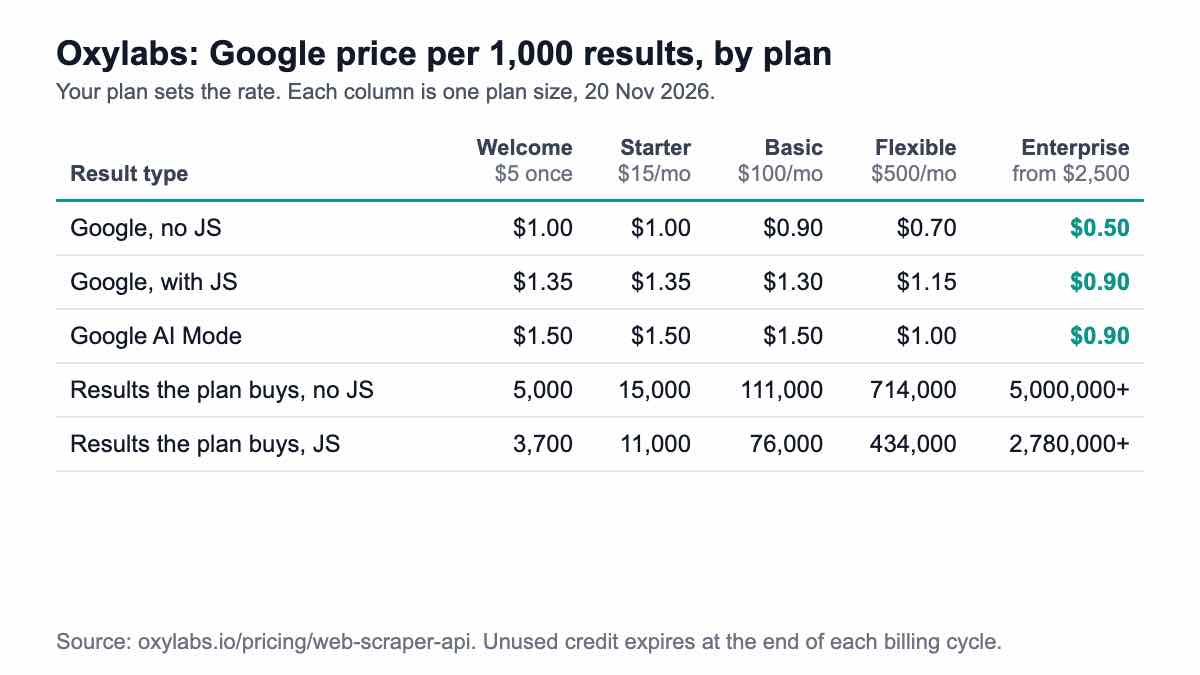
One reading note, because the page does not spell it out. Each product row shows five prices, each with an "up to" result count: for Google without rendering, "Up to 5K", "Up to 15K", "Up to 111K", "Up to 714K" and "5M+". Those are exactly $5, $15, $100, $500 and $2,500 divided by the rate in the same column. So the columns are the welcome credit and the four plans, in order.
| Result type | Welcome | Starter | Basic | Flexible | Enterprise |
|---|---|---|---|---|---|
| Google, no JS rendering | $1.00 | $1.00 | $0.90 | $0.70 | $0.50 |
| Google, with JS rendering | $1.35 | $1.35 | $1.30 | $1.15 | $0.90 |
| Google AI Mode | $1.50 | $1.50 | $1.50 | $1.00 | $0.90 |
| AI parsing (any page) | $3.00 per 1,000 parsed pages on every plan | ||||
The steepest step is Basic to Flexible: the Google rate without rendering drops from $0.90 to $0.70. Starter has the same rate as the welcome credit; you are buying a bigger allowance, not a cheaper result.
Do you need the JavaScript rate?
It depends on which parts of the results page you need, and it is worth testing rather than assuming. Rendering adds $0.35 per 1,000 on Starter and $0.40 at Enterprise, which is a third or more on top of the base price.
The practical test: run the same 100 keywords with and without rendering on the welcome credit, and check whether the fields you read (organic positions, ads, People Also Ask, AI Overviews) come back in both. If they do, the cheaper rate is the right one. If a block you depend on only appears with rendering, budget for the higher row. Oxylabs' changelog says its Google search source has returned AI Overviews alongside standard results since 18 August 2025, but they do not say which page features need rendering, so test it on your own queries.
What will you pay at 10K, 100K and 1M results?
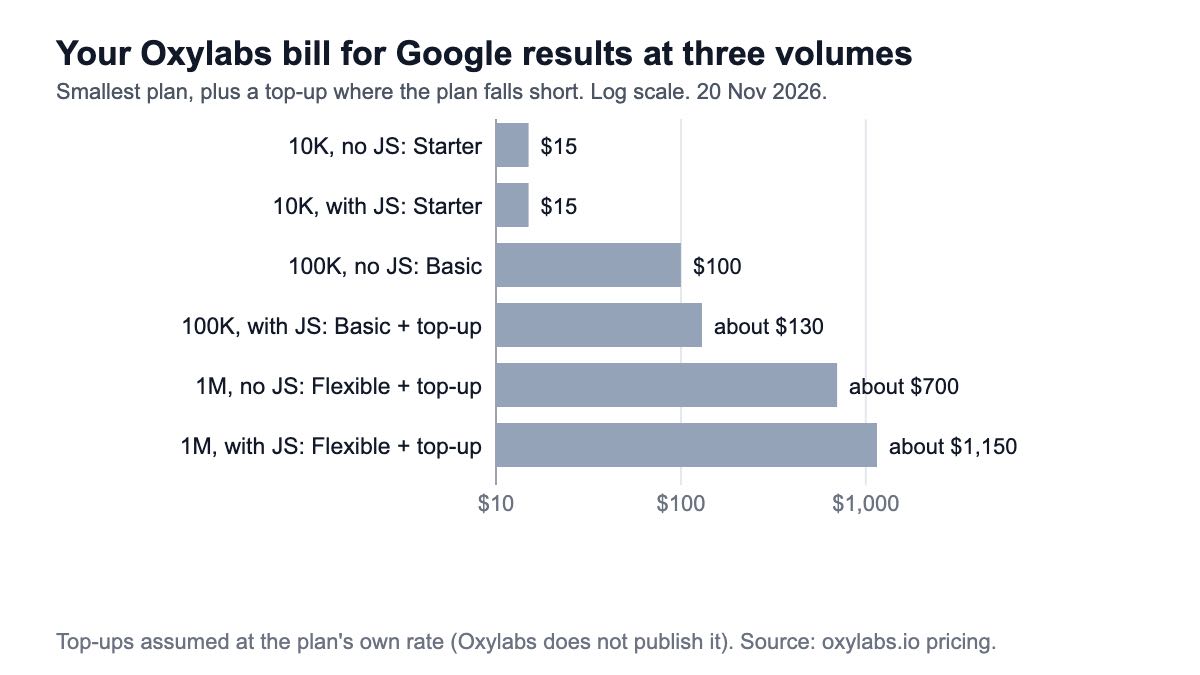
About $15, $100 and $700 a month without rendering, and about $15, $130 and $1,150 with it. The rule: buy the smallest plan, and top up when it falls short.
| Results a month | No JS: plan and bill | No JS: $ per 1,000 | With JS: plan and bill | With JS: $ per 1,000 |
|---|---|---|---|---|
| 10,000 | Starter, $15 ($5 of credit expires unused) | $1.50 | Starter, $15 ($1.50 expires unused) | $1.50 |
| 100,000 | Basic, $100 ($10 expires unused) | $1.00 | Basic $100 + about $30 top-up | about $1.30 |
| 1,000,000 | Flexible $500 + about $200 top-up | about $0.70 | Flexible $500 + about $650 top-up | about $1.15 |
Three things the headline rate hides. First, at 10,000 results the real price is $1.50 per 1,000, not $1.00, because Starter's $15 is the smallest purchase and the rest expires. Second, the top-ups: Oxylabs' help centre describes a top-up as a one-time payment added to your balance, and says funds "expire at the end of the current cycle unless you also upgrade before it ends" (Oxylabs billing help). It does not publish the rate a top-up is charged at, so the cells that need one say "about".
Third, Enterprise. At 1,000,000 results without rendering, Enterprise's $0.50 rate would be $500 of usage, but the contract starts at $2,500 a month, so Flexible plus a top-up stays cheaper until about 3.5 million results a month. Oxylabs' own advice is to "consider upgrading if you're topping up most months."
What counts as a billable result?
Any result with a 2xx or 4xx status code, even if it does not contain what you asked for. Oxylabs' billing docs say results with 2xx or 4xx codes are "counted as successful and are billable", and that if such a result "doesn't contain expected information, we still count it as a successful result" (Oxylabs billing information). Server errors (5xx and 6xx) are free, and so are 429 rate-limit responses.
Two more rules shape the bill:
- Each page is a result. In the new Web API, the
pagesparameter is documented as "Each page is a separate fetch and charge" (Oxylabs search engine scrapers). A top-100 check for one keyword is ten results. - Internal retries are free. The billing docs give an example where Oxylabs needs three attempts to fetch a page and you are billed only for the final, successful one.
For how other vendors treat failures, see which SERP APIs bill failed requests.
What happens to unused credit?
It expires at the end of the billing cycle. The pricing page says: "Unused credits expire at the end of the billing cycle, unless they carry over as part of an upgrade." The billing docs add that the balance "is not a pre-funded wallet" and that you "can't hold a balance without an active subscription" (Oxylabs credit-based billing).
- When the balance runs out, the service pauses; there is "no overusage allowance" in the self-service flow. You can top up or upgrade.
- Upgrades take effect immediately: the current cycle ends that day, you are charged the new plan, and unused balance carries into the new cycle.
- The welcome credit lasts while you stay on the free plan. If you upgrade, unused welcome credit carries over once; if your first paid cycle simply renews, it expires.
The practical effect: a team with uneven months pays for its busiest month every month, or tops up in the busy ones. That is the single biggest gap between the headline rate and the real one.
What about the /search endpoint and AI Mode?
The new Web API has a separate /search endpoint priced at $1 per 1,000 searches on every plan (Oxylabs Web API). It returns up to 20 organic results, set with max_results, localised by a two-letter country code (Oxylabs /search docs). It suits a quick list of links, for example for an AI agent, rather than a full results page with every feature.
Google AI Mode is priced as its own row: $1.50 per 1,000 up to Basic, $1.00 on Flexible and $0.90 on Enterprise. AI parsing, which pulls structured fields from any page with a prompt or schema, is $3.00 per 1,000 parsed pages on every plan.
Why do other sites quote different prices?
Because Oxylabs has repackaged twice in five months, and many pages have not caught up. Here is what changed, so you can date any figure you find.
- September 2026: an archived copy of the SERP page shows a Micro plan at $49 a month for up to 98,000 results, Google at $1.00 per 1,000 without rendering and $1.35 with it, and a 50 requests-per-second limit on paid plans (Wayback Machine).
- October 2026: credit-based billing replaced product subscriptions. Aggregator pages checked in late October list a $30 Starter plan (CostBench).
- 20 November 2026: the live page shows Starter at $15, with the same $1.00 and $1.35 entry rates.
So the per-result rates at entry level have held steady at $1.00 and $1.35; what moved is the size of the smallest purchase. If you see "$1.6 per 1,000" (still in the SERP page's own meta description), "$1.80" or "$2.80", the figure comes from an older plan, a different product or an average across plan sizes, not from today's Google rate.
Rate limits are the one area still documented under the old plan names. The Classic docs list 10 jobs per second on the free trial, 50 on the smaller paid plans and 100 on the larger ones, and cut a domain to 1 request per second if your success rate on it falls below 40% over five minutes (Oxylabs rate limits).
How does it compare with other Google APIs?
Mid-pack. At 100,000 results a month, Oxylabs without rendering ($1.00 per 1,000) is cheaper than SerpApi, SearchApi and Bright Data, and dearer than Serper, Zyte, DataForSEO's standard queue and Serpent API.
| Provider | 10,000 a month | 100,000 a month | 1,000,000 a month |
|---|---|---|---|
| Oxylabs, no rendering | $1.50 | $1.00 | about $0.70 |
| Oxylabs, with rendering | $1.50 | about $1.30 | about $1.15 |
| SerpApi | $15.00 | $7.25 | $3.75 |
| SearchApi | $4.00 | $2.50 | $1.50 |
| Bright Data SERP API | $1.50 | $1.50 | $1.31 |
| Zyte | $0.85 | $0.85 | $0.50 |
| Serper | $1.00 | $0.75 | $0.50 |
| DataForSEO, standard queue | $0.60 | $0.60 | $0.60 |
| Serpent API | $0.60 Default · $0.30 Growth ($100 deposit) · $0.10 Scale ($500) · $0.05 Enterprise ($1,000) · $0.03 Enterprise Plus ($1,250), at any volume | ||
Sources for the other rows: SerpApi, SearchApi, Bright Data, Zyte, Serper and DataForSEO, each read on 20 November 2026. Serper's packs last six months, so its cost is spread over the months a pack covers.
Serpent API returns Google, Bing, Yahoo, DuckDuckGo and Brave results at one price, with no subscription; deposited credits never expire and requests that cannot be completed are refunded automatically (pricing). A single call can ask for up to 100 organic results; that number is a ceiling, and Google calls often return 40 to 70 (docs).
Is Oxylabs worth it for Google results?
Yes, if you use several Oxylabs products and value one balance, enterprise support and a mature platform. Its Google coverage is broad, its docs are detailed, and the October changes made small plans cheaper to start. Less so if Google results are all you buy: the expiring credit, billing of 4xx results and per-page charges mean the real price at your volume is usually above the headline $1.00.
If you stay, three habits keep the bill close to the list rate:
- Size the plan to a normal month and top up in busy ones, rather than buying for your peak.
- Test without rendering first. If your fields arrive without it, you save a third.
- Ask for fewer pages. Most tracking needs the top 10 or 20, not the top 100.
For other costs that do not show on pricing pages, see SERP API hidden costs. If you would rather avoid subscriptions altogether, our no-subscription SERP API guide covers that route.
How we checked this
On 20 November 2026 I read Oxylabs' live pricing page and Web API product page, six developer-docs pages (credit-based billing, billing help, billing information, search engine scrapers, /search, rate limits) and the changelog: 9 Oxylabs sources. They were compared with an archived September 2026 copy of the SERP page and one aggregator page from late October, and with the live pricing pages of SerpApi, SearchApi, Bright Data, Zyte, Serper and DataForSEO.
The mapping of price columns to plans is arithmetic: each column's "up to N results" equals a plan's dollars divided by that column's rate. Worked bills use list prices and assume every credit is used. No API calls were made for this article.
What I could not verify: the rate at which Oxylabs charges top-ups (cells that need one say "about" and assume the plan's own rate); rate limits for the plans introduced in October 2026; the exact date Starter moved from $30 to $15; which Google page features need JavaScript rendering.
Compare it with a per-call Google API
Google, Bing, Yahoo, DuckDuckGo and Brave results from $0.03 per 1,000 — pay as you go, no subscription. Start with 10 free API calls and run the same keywords you priced here.
Get Your Free API KeyExplore: SERP API · Playground · Docs · Pricing
FAQ
How much does the Oxylabs SERP API cost?
Google results are sold from Oxylabs' shared credit plans: Starter $15 a month, Basic $100, Flexible $500 and Enterprise from $2,500, plus a one-time $5 welcome credit. Without JavaScript rendering, Google costs $1.00 per 1,000 results on Starter, $0.90 on Basic, $0.70 on Flexible and $0.50 on Enterprise. With rendering it is $1.35, $1.30, $1.15 and $0.90.
What is the cheapest Oxylabs plan?
Starter at $15 a month, which buys about 15,000 Google results without rendering or about 11,000 with it. Before paying, you can use the free $5 welcome credit, worth about 5,000 Google results without rendering. Self-service purchases are non-refundable, so the welcome credit is the intended way to test.
Does Oxylabs have a free trial?
It has a one-time $5 welcome credit "toward any product", which works out to about 5,000 Google results without rendering or 3,700 with it. The credit lasts while you stay on the free plan. If you upgrade, unused welcome credit carries into your first paid cycle once; if that cycle ends and renews, any welcome credit left expires.
Do Oxylabs credits roll over?
No. Unused credits expire at the end of the billing cycle unless they carry over as part of an upgrade, and top-ups expire with the cycle too. Oxylabs' docs say the balance is not a pre-funded wallet: you cannot hold credit without an active subscription. When the balance runs out the service pauses, with no automatic overage.
Does Oxylabs charge for failed requests?
Not for its own failures: 5xx and 6xx server errors and 429 rate-limit responses are free, and internal retries are billed only once. But results with 2xx or 4xx status codes count as successful and billable, even when they do not contain the expected information. Each extra page of results is also a separate charge.
Is the Oxylabs JavaScript rendering price worth paying?
Only if the fields you need are missing without it. Rendering adds $0.35 per 1,000 on Starter and $0.40 at Enterprise, about a third more. Run the same keywords both ways on the welcome credit and compare the blocks you read, such as ads, People Also Ask or AI Overviews. If they match, use the cheaper rate.
Sources
Oxylabs pricing and docs (checked 20 November 2026):
- Oxylabs pricing: plans and per-result rates
- Oxylabs Web API product page (/search pricing)
- Oxylabs docs: credit-based billing
- Oxylabs help: how pricing and billing work
- Oxylabs docs: billing information
- Oxylabs docs: Web API search engine scrapers
- Oxylabs docs: /search
- Oxylabs docs: rate limits
- Oxylabs changelog
Archives and aggregators:
- Wayback Machine: Oxylabs SERP page, 9 September 2026
- CostBench: Oxylabs SERP (checked late October 2026)
Other providers, official pricing (checked 20 November 2026):