Scrapingdog pricing, turned into dollars per Google search

Scrapingdog sells credits: monthly plans from $40 for 200,000 credits, or pay as you go at $10 per 25,000. A standard Google search costs 5 credits, so 1,000 searches cost $2.00 on pay as you go, $1.00 on Lite and $0.45 on Standard. Advanced and mobile searches cost 10 credits, double those figures.
Short answer: Under about 20,000 standard Google searches a month, use Scrapingdog's pay as you go (credits never expire). From roughly 20,000 to 200,000 a month, the Standard plan at $90 is the sweet spot, and unused credits roll over. Around 1,000,000 a month, Premium at $350. If you would rather not hold a subscription at all and want a lower price per search, Serpent API is from $0.03 per 1,000 Google searches — pay as you go, no subscription, and deposited credits never expire.
This page is the arithmetic of Scrapingdog's prices, read from its live pricing page and docs on 20 November 2026. If you are already deciding to leave Scrapingdog, our Scrapingdog alternative guide covers the switch. We sell a Google SERP API ourselves, so every Scrapingdog figure below is linked to Scrapingdog's own page.
What plans does Scrapingdog sell?
Twenty-eight of them, from a free plan with 100 credits to Nova Pro at $30,000 a month for 1.1 billion credits (Scrapingdog pricing). Every plan gives access to every API; what changes is the number of credits and how many requests you can run at once. Annual billing gives "2 months extra", which works out to paying for ten months and getting twelve.
| Plan | Price a month | Credits a month | Concurrent requests | $ per 1,000 credits |
|---|---|---|---|---|
| Free | $0 | 100 | 1 | — |
| Pay as you go | $10 minimum top-up | 25,000 per $10 | Not stated | $0.40 |
| Lite | $40 | 200,000 | 5 | $0.20 |
| Standard | $90 | 1,000,000 | 50 | $0.09 |
| Pro | $200 | 3,000,000 | 100 | $0.067 |
| Premium | $350 | 6,000,000 | 150 | $0.058 |
| Business | $500 | 9,000,000 | 200 | $0.056 |
| Business Plus | $1,000 | 19,000,000 | 250 | $0.053 |
| Corporate Pro | $3,000 | 65,000,000 | 450 | $0.046 |
| Nova Pro | $30,000 | 1,100,000,000 | 2,200 | $0.027 |
The plans in between (Business Pro, Corporate, Corporate Plus and the Enterprise, Global, Ultra, Titan and Nova ladders) follow the same curve. The biggest drop in price per credit is the first one: Standard costs less than half as much per credit as Lite. After that, each step saves a few cents.
Pay as you go arrived in late 2025. Scrapingdog's announcement says $10 buys 25,000 credits, top-ups go up in steps of $10, and "PAYG credits don't have an expiration date" (Scrapingdog PAYG announcement). You cannot hold pay-as-you-go credit and a subscription at the same time.
How many credits does each request use?
A standard Google search is 5 credits. Most Google endpoints are 5, the richer ones are 10, and general web scraping ranges from 1 to 25 depending on the options you turn on. The pricing page lists the same cost on every plan.
| Request | Credits |
|---|---|
| Google Search, standard | 5 |
Google Search with advance_search=true | 10 |
Google Search with mob_search=true | 10 |
deep_scrape on a standard search | +5 |
| Google AI Mode, Images, Shopping, Lens | 10 |
| Google Maps, News, Scholar, Trends, Jobs, Videos | 5 |
| Bing, Brave | 5 |
| Universal Search | 20 |
| Web page: basic / JavaScript / premium / both | 1 / 5 / 10 / 25 |
| Amazon search or product | 1 |
The Google Search API docs add the detail that matters for SERP work: a standard search is 5 credits, advance_search=true (for Google's "advanced feature snippets") and mob_search=true are 10, and deep_scrape adds 5 more and only works with advance_search=false (Scrapingdog Google Search API docs). Each request returns up to 10 results, and the older results parameter no longer has an effect.
So what does one Google search cost?
Divide the plan price by its credits, then multiply by the credits per search. For a standard search that gives $2.00 per 1,000 on pay as you go, $1.00 on Lite, $0.45 on Standard and $0.14 on the $30,000 Nova Pro plan.
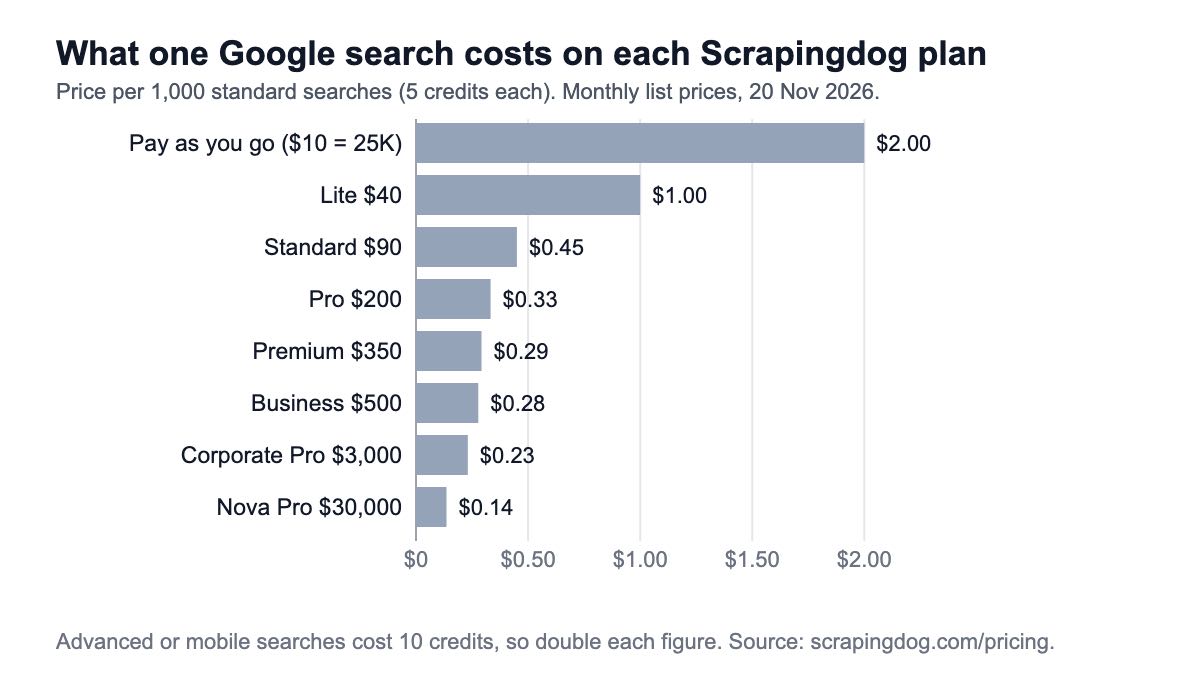
| Plan | Standard searches a month (5 credits) | $ per 1,000 standard | Advanced searches a month (10 credits) | $ per 1,000 advanced |
|---|---|---|---|---|
| Pay as you go ($10) | 5,000 per $10 | $2.00 | 2,500 per $10 | $4.00 |
| Lite ($40) | 40,000 | $1.00 | 20,000 | $2.00 |
| Standard ($90) | 200,000 | $0.45 | 100,000 | $0.90 |
| Pro ($200) | 600,000 | $0.33 | 300,000 | $0.67 |
| Premium ($350) | 1,200,000 | $0.29 | 600,000 | $0.58 |
| Business ($500) | 1,800,000 | $0.28 | 900,000 | $0.56 |
| Corporate Pro ($3,000) | 13,000,000 | $0.23 | 6,500,000 | $0.46 |
| Nova Pro ($30,000) | 220,000,000 | $0.14 | 110,000,000 | $0.27 |
These are best-case prices: they assume you use every credit. If you buy Standard and run 100,000 standard searches, you use half the plan and your real price that month is $0.90 per 1,000 — though, as the rules section explains, the rest rolls over on Standard and above.
Is pay as you go cheaper than a plan?
Only at small volumes. Pay-as-you-go credit costs $0.40 per 1,000 credits, twice Lite's $0.20. But Lite costs $40 whether you use it or not, so pay as you go wins until you need more than 100,000 credits a month, which is 20,000 standard searches or 10,000 advanced ones.
Scrapingdog says the same thing from the other side: its announcement calls subscriptions at least about 50% more economical and recommends them for production. Two more reasons pay as you go can still be the right call. Its credits do not expire, so a team that searches in bursts does not lose anything between bursts. And it lets you test real traffic for $10 rather than $40.
The catch: you cannot mix the two. Scrapingdog's announcement states that pay-as-you-go and subscription plans cannot be used together, so plan the switch for when one balance is used up.
What will you pay at 10K, 100K and 1M searches?
About $20, $90 and $350 a month for standard Google searches, picking the cheapest option that covers each volume. Advanced searches cost $40, $90 and $1,000.
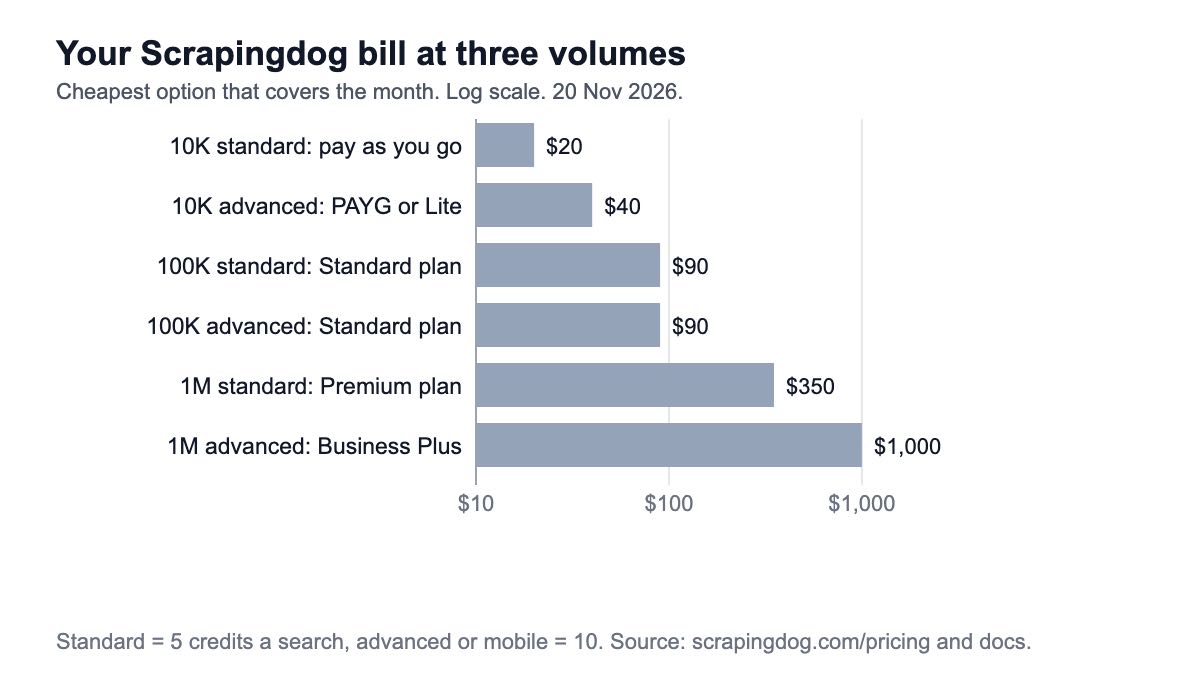
| Searches a month | Credits needed (standard / advanced) | Cheapest option, standard | Cheapest option, advanced | $ per 1,000 (standard / advanced) |
|---|---|---|---|---|
| 10,000 | 50,000 / 100,000 | Pay as you go, $20 | Pay as you go or Lite, $40 | $2.00 / $4.00 |
| 100,000 | 500,000 / 1,000,000 | Standard, $90 | Standard, $90 | $0.90 / $0.90 |
| 1,000,000 | 5,000,000 / 10,000,000 | Premium, $350 | Business Plus, $1,000 | $0.35 / $1.00 |
The 1,000,000 advanced row is worth a second look. Ten million credits is just over Business's 9,000,000, so you jump to Business Plus at $1,000. If you can make do with standard searches for part of your keyword list, the bill falls fast.
If you track rankings deeper than the first page, multiply by pages. Each request returns up to 10 results, so a top-100 check is ten requests: 50 credits for standard searches, 100 for advanced. A 1,000-keyword top-100 tracker run daily is 300,000 requests a month, which on standard searches needs 1,500,000 credits, or the Pro plan at $200.
Which options raise the price of a search?
Three switches double or triple the credit cost of a Google search, and they are easy to leave on by accident.
advance_search=truetakes a search from 5 to 10 credits. Use it only on the keywords where you actually read the extra SERP features.mob_search=trueis also 10 credits. If you track mobile and desktop for every keyword, that is 15 credits per keyword per day.deep_scrapeadds 5 credits on top of a standard search.
Separately, Google AI Mode, Images, Shopping and Lens are 10 credits each, and Universal Search is 20. For general web pages, JavaScript rendering and premium IPs push a page from 1 credit to 5, 10 or 25. If you compare Scrapingdog with ScraperAPI, which charges 25 credits for a Google request, see our ScraperAPI credits breakdown.
Do credits roll over, and are failures billed?
Credits roll over on Standard and higher plans, pay-as-you-go credits never expire, and failed requests are credited back. Those are three of the better rules in this market.
- Rollover. The pricing page says rollover applies to Standard and above. It does not say how long rolled-over credits last, or whether Lite credits roll over, so treat Lite as use-it-or-lose-it until you confirm.
- Failures. Failed, blocked and timed-out requests "are credited back", so you pay for successful requests. HasData's comparison page claims some blocked pages come back as 200 responses and are billed (HasData); it gives no example or source, and HasData sells a competing product, so I treat that as unverified.
- Running out. When a plan's credits are gone, requests return an over-limit response until the next billing date or an upgrade. There is no automatic overage charge.
- Downgrades. You can downgrade at any time, but you pay the full price of the new plan and your credits are reset to its allowance.
For how other providers handle failed requests, see which SERP APIs bill failures.
How does that compare with other Google APIs?
On a big plan, Scrapingdog is one of the cheaper ways to get Google results by subscription. At small volume, flat-priced APIs can beat it. Here is the same three-volume test across providers, for one page of Google results per search.
| Provider | 10,000 a month | 100,000 a month | 1,000,000 a month |
|---|---|---|---|
| Scrapingdog, standard (5 credits) | $2.00 (pay as you go) | $0.90 (Standard) | $0.35 (Premium) |
| Scrapingdog, advanced (10 credits) | $4.00 | $0.90 (Standard) | $1.00 (Business Plus) |
| SerpApi | $15.00 (Production $150) | $7.25 (Searcher $725) | $3.75 (Cloud 1M $3,750) |
| ScraperAPI (25 credits) | $14.90 (Startup $149) | $2.99 (Business $299) | Custom |
| SearchApi | $4.00 (Developer $40) | $2.50 (BigData $250) | $1.50 (Octo 1M $1,500) |
| Bright Data SERP API | $1.50 | $1.50 | $1.31 (Scale $499 + extra) |
| Serper | $1.00 ($50 pack) | $0.75 ($375 pack) | $0.50 ($1,250 pack) |
| DataForSEO, standard queue | $0.60 | $0.60 | $0.60 |
| Serpent API | $0.60 Default · $0.30 Growth ($100 deposit) · $0.10 Scale ($500) · $0.05 Enterprise ($1,000) · $0.03 Enterprise Plus ($1,250), at any volume | ||
Sources for the other rows: SerpApi, ScraperAPI, SearchApi, Bright Data, Serper and DataForSEO. Serper's packs last six months, so its cost is spread over the months a pack covers. For the full cross-vendor table, see our SERP API pricing comparison.
Serpent API's Google endpoint returns organic results with ads, People Also Ask, featured snippets and related searches where Google shows them, across Google, Bing, Yahoo, DuckDuckGo and Brave at one price (docs). There is no subscription, deposited credits never expire, and requests that cannot be completed are refunded automatically. The full ladder is on the pricing page.
How do you keep a Scrapingdog bill down?
Most of the savings come from not paying 10 credits where 5 will do, and from sizing the plan to your real month rather than your busiest one.
- Split your keyword list. Run advanced or mobile searches only on the keywords where you read those features, and standard searches on the rest. At a million searches a month, that choice alone moves the bill between $350 and $1,000.
- Ask for fewer pages. Most rank trackers only need the top 10 or top 20 for most keywords. Going from ten pages to two cuts a top-100 tracker's credits by 80%.
- Cache within a day. If two parts of your product ask the same query for the same country on the same day, store the first answer and reuse it.
- Use the rollover. On Standard and above, a quiet month is not wasted. Choose the plan that covers an average month, not your peak.
- Watch the Lite band. Lite only beats both pay as you go and Standard between roughly 20,000 and 40,000 standard searches a month. Outside that band one of the other two is cheaper.
- Log credits per request. Record the credits each call used next to its parameters. A single forgotten flag shows up in a day instead of on next month's invoice.
Which plan should you pick?
- Testing or under 20,000 standard searches a month: pay as you go. It never expires and costs less than Lite at that volume.
- 20,000 to 200,000 standard searches a month: Standard at $90. Lite only makes sense in a narrow band, and Standard's rollover protects quiet months.
- Around 600,000 a month: Pro at $200.
- Around 1,000,000 a month: Premium at $350 for standard searches; Business Plus at $1,000 if every search is advanced.
- A mix of search engines with no subscription: a flat per-call API such as Serpent API; see also our no-subscription SERP API guide.
Is Scrapingdog worth it? On price per credit at volume, yes: Standard and above are competitive, failed requests are credited back and credits roll over.
Its reputation is good too; Prospeo's review cites 4.7 out of 5 from 580 Trustpilot reviews (Prospeo). Where it is weaker is the entry point: at 10,000 searches a month, pay as you go at $2.00 per 1,000 is dearer than several flat-priced Google APIs. For more on the costs that do not show on a pricing page, read SERP API hidden costs.
How we checked this
On 20 November 2026 I read Scrapingdog's live pricing page, its Google Search API documentation and its pay-as-you-go announcement (3 official sources), and the pricing pages of SerpApi, ScraperAPI, SearchApi, Bright Data, Serper and DataForSEO (6 more).
I opened the top-ranking third-party pages on Scrapingdog pricing (Toolradar, Prospeo, HasData). Toolradar's plan list matched the live page; Prospeo's table still lists a "$500, 8,000,000 credits" plan where the live page shows Business at $500 for 9,000,000; HasData lists a 500-credit free trial where the live page shows 100. All costs are arithmetic on list prices, assuming every credit is used unless stated. No API calls were made for this article.
What I could not verify: how long rolled-over credits last and whether Lite credits roll over; pay-as-you-go concurrency; HasData's claim that some blocked pages are billed; review-site ratings beyond Prospeo's summary.
Price your Google searches per call, not per credit
Google, Bing, Yahoo, DuckDuckGo and Brave results from $0.03 per 1,000 — pay as you go, no subscription. Start with 10 free API calls.
Get Your Free API KeyExplore: SERP API · Playground · Docs · Pricing
FAQ
How many credits does a Scrapingdog Google search use?
A standard Google search uses 5 credits. Setting advance_search=true or mob_search=true makes it 10 credits, and deep_scrape adds 5 credits to a standard search. Each request returns up to 10 results, so checking the top 100 for one keyword is ten requests. Other Google endpoints range from 5 credits (Maps, News, Scholar, Trends) to 10 (AI Mode, Images, Shopping, Lens).
Does Scrapingdog have a free plan?
Yes. The free plan gives 100 credits with one concurrent request and no credit card, which is 20 standard Google searches. Some third-party pages quote larger free trials; the live pricing page on 20 November 2026 showed 100 credits. For more testing room, the pay-as-you-go option starts at $10 for 25,000 credits, which do not expire.
How much does Scrapingdog cost per 1,000 Google searches?
For standard searches: $2.00 on pay as you go, $1.00 on Lite, $0.45 on Standard, $0.33 on Pro, $0.29 on Premium and $0.28 on Business, falling to $0.14 on the $30,000 Nova Pro plan. Advanced or mobile searches cost twice those figures. These assume you use every credit; a half-used plan doubles your real price for that month.
Is Scrapingdog pay as you go worth it?
Below about 20,000 standard Google searches a month, yes. Pay-as-you-go credit costs $0.40 per 1,000 credits against Lite's $0.20, but Lite is a flat $40 a month, so pay as you go is cheaper until you need more than 100,000 credits. Pay-as-you-go credits also never expire. You cannot combine pay as you go with a subscription.
Do Scrapingdog credits roll over?
On Standard and higher plans, yes: the pricing page says unused credits roll over. It does not say for how long, or whether Lite credits roll over. Pay-as-you-go credits have no expiration date. When you downgrade, your credits are reset to the new plan’s allowance, so use them up before you change plans.
Does Scrapingdog charge for failed requests?
No, according to its pricing page: failed, blocked and timed-out requests are credited back. One competitor's comparison page claims some blocked pages return a 200 status and are billed, but it offers no example or source. If billing on failures matters to you, compare a day of logs with your credit usage during your trial.
Sources
Scrapingdog (checked 20 November 2026):
- Scrapingdog pricing and credit costs
- Scrapingdog Google Search API documentation
- Scrapingdog: introducing pay as you go
Other providers, official pricing (checked 20 November 2026):
- SerpApi pricing
- ScraperAPI pricing
- SearchApi pricing
- Bright Data SERP API pricing
- Serper pricing
- DataForSEO Google Organic SERP API pricing
Third-party pages (opened 20 November 2026):