Leaving Oxylabs? SERP API alternatives matched to your reason

The right Oxylabs alternative depends on what is pushing you away. For expiring credits and subscriptions, pick a pay-as-you-go API with a balance that lasts. For paying on 4xx results, pick one that bills only successes; for price at volume, DataForSEO's queue or Serpent API. For other sites as well, stay.
Short answer: For Google results at the lowest cost per 1,000, Serpent API: from $0.03 per 1,000 — pay as you go, no subscription (pricing). For the widest choice of search engines and verticals, SerpApi; for batch jobs that can wait, DataForSEO's standard queue. If you also scrape many non-search sites, stay on Oxylabs and move only the search traffic.
This page is about the switch decision. It compares Oxylabs with the providers people move to, mapped to the reason they move. If you want every SERP vendor priced side by side, see the SERP API pricing comparison. We sell one of the options here, so every price below links to the vendor's own page and was read on 20 November 2026.
What is Oxylabs selling for Google results now?
Since 7 October 2026, Oxylabs sells Google results through one shared credit balance that covers all its products. Its changelog calls it a "New Oxylabs Dashboard with credit-based billing" that "replaces product-specific subscriptions", launched alongside a new Web API (Oxylabs changelog). The older Web Scraper API still exists and its docs are now labelled "Classic".
The live plans are a $5 one-time welcome credit, Starter at $15 a month, Basic at $100, Flexible at $500 and Enterprise from $2,500 (Oxylabs pricing). Google results cost $1.00 per 1,000 without JavaScript rendering on the entry tiers, falling to $0.50 at Enterprise; with rendering it is $1.35 falling to $0.90.
Several of the pages that rank for this topic still quote a $30 Starter plan. The live page says $15. If an article you read gives older plan names such as Micro or Advanced, it predates the change.
Why do teams look for an Oxylabs alternative?
The documented reasons are billing rules more than data quality. Oxylabs is well regarded for its Google coverage, and its Trustpilot page shows mostly five-star reviews, with the complaints centred on support response times, account suspensions and identity checks, and billing. The friction shows up in how credit works.
1. Credits expire at the end of every billing cycle
The pricing page is direct: "Unused credits expire at the end of the billing cycle, unless they carry over as part of an upgrade." A team that buys Basic for 111,000 Google results and uses 60,000 loses the rest when the month rolls over.
2. Credit only exists inside a subscription
Oxylabs' billing docs say the balance "is not a pre-funded wallet" and that you "can't hold a balance without an active subscription" (Oxylabs credit-based billing). When the balance runs out the service pauses, with "no overusage allowance"; you can top up, and "top-up funds expire at the end of the current billing cycle" (Oxylabs top-ups). Self-service purchases are non-refundable.
3. A 4xx result is billed even when it has no data
This is the rule that surprises people most. Oxylabs counts results with 2xx or 4xx status codes as successful, and adds: "If the response contains 2xx or 4xx status codes, and the result doesn't contain expected information, we still count it as a successful result" (Oxylabs billing information). Server errors (5xx and 6xx) and 429s are not billed. For a deeper look at who bills what, see which SERP APIs bill failed requests.
4. Every extra page of results is another charge
In the new Web API, the pages parameter is documented as "Each page is a separate fetch and charge" (Oxylabs search engine scrapers). If you track the top 100 for a keyword, that is ten billed results per keyword.
5. The new API targets countries, not cities
In the Web API, location is a "Two-letter country code of the request origin". The Classic API's geo_location accepts a city, coordinates or a Google Criteria ID (Oxylabs SERP localization). If local rank tracking matters to you, check which of the two you are being migrated to.
6. You are paying platform prices for one job
Oxylabs is a scraping platform: Google is one of many targets, alongside AI assistants, ecommerce sites and its proxy products. If all you need is search results, a provider built only for search can be simpler and cheaper.
Which alternative fixes which problem?
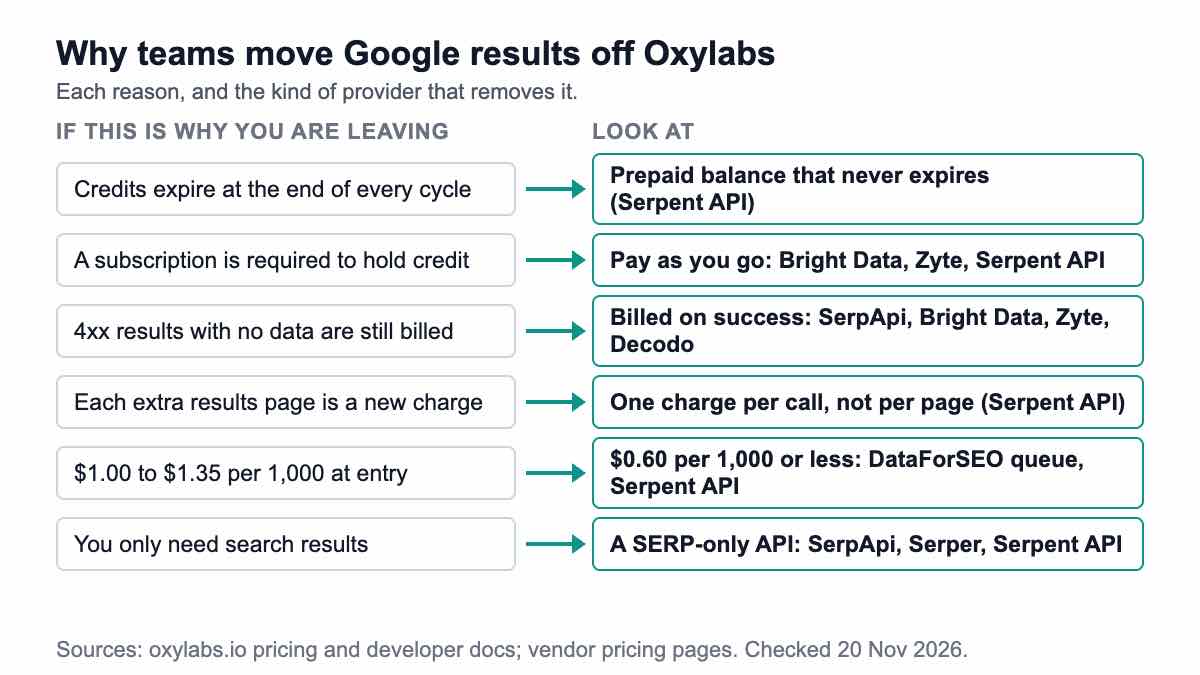
Start from your reason for leaving; the figure and table give one answer per reason.
| Provider | How you pay | Free to try | What is billed | Credit life |
|---|---|---|---|---|
| Oxylabs | Monthly subscription, shared credit | $5 welcome credit | 2xx and 4xx results | Expires each cycle |
| Serpent API | Prepaid balance, no subscription | 10 free API calls | Completed requests; failures refunded automatically | Deposited credits never expire |
| SerpApi | Monthly plan | 250 searches a month | Successful searches only | Monthly |
| Bright Data SERP API | Pay as you go or $499 plan | 5,000 a month | Successful requests | Pay as you go |
| Zyte SERP | Pay as you go or monthly commitment | $5 credit | Successful requests | No rollover on plans |
| Decodo Web Data API | Monthly plans from $0 | Free plan | Successful requests | Not stated |
| DataForSEO | Prepaid balance | Trial credit | Per SERP, by queue | Not verified |
| Serper | Credit packs | 2,500 queries | Not stated | 6 months |
| SearchApi | Monthly plan | 100 searches | Successful searches only | Monthly |
What do they cost at your volume?
At 100,000 Google searches a month, Oxylabs' Basic plan works out to $1.00 per 1,000 without rendering. That is mid-pack: cheaper than SerpApi and SearchApi, dearer than Serper, Zyte, DataForSEO's queue and Serpent API. The table prices the first page of results at three volumes.
The rules: list prices, the cheapest plan or pack that covers the month, and first page only. Where a pack lasts longer than a month (Serper credits are valid for six months), the cost is spread over the months it lasts. For Oxylabs, volumes that fall between plans need a top-up; Oxylabs does not publish the top-up rate, so those cells assume the plan's own rate and say so.
| Provider | 10,000 a month | 100,000 a month | 1,000,000 a month |
|---|---|---|---|
| Oxylabs, no rendering | $1.50 (Starter $15) | $1.00 (Basic $100) | About $0.70 (Flexible $500 + top-up, rate unverified) |
| Oxylabs, with rendering | $1.50 (Starter $15) | About $1.30 (Basic + top-up, unverified) | About $1.15 (Flexible + top-up, unverified) |
| SerpApi | $15.00 (Production $150) | $7.25 (Searcher $725) | $3.75 (Cloud 1M $3,750) |
| SearchApi | $4.00 (Developer $40) | $2.50 (BigData $250) | $1.50 (Octo 1M $1,500) |
| Bright Data | $1.50 | $1.50 | $1.31 (Scale $499 + extra at $1.30) |
| Serper | $1.00 ($50 pack) | $0.75 ($375 pack) | $0.50 ($1,250 pack) |
| Zyte | $0.85 | $0.85 | $0.50 ($500 plan) |
| DataForSEO, standard queue | $0.60 | $0.60 | $0.60 |
| Decodo | $0.75 to $0.40 per 1,000 depending on plan; which plan a volume needs is not published (unverified) | ||
| Serpent API | $0.60 Default · $0.30 Growth ($100 deposit) · $0.10 Scale ($500) · $0.05 Enterprise ($1,000) · $0.03 Enterprise Plus ($1,250), at any volume | ||
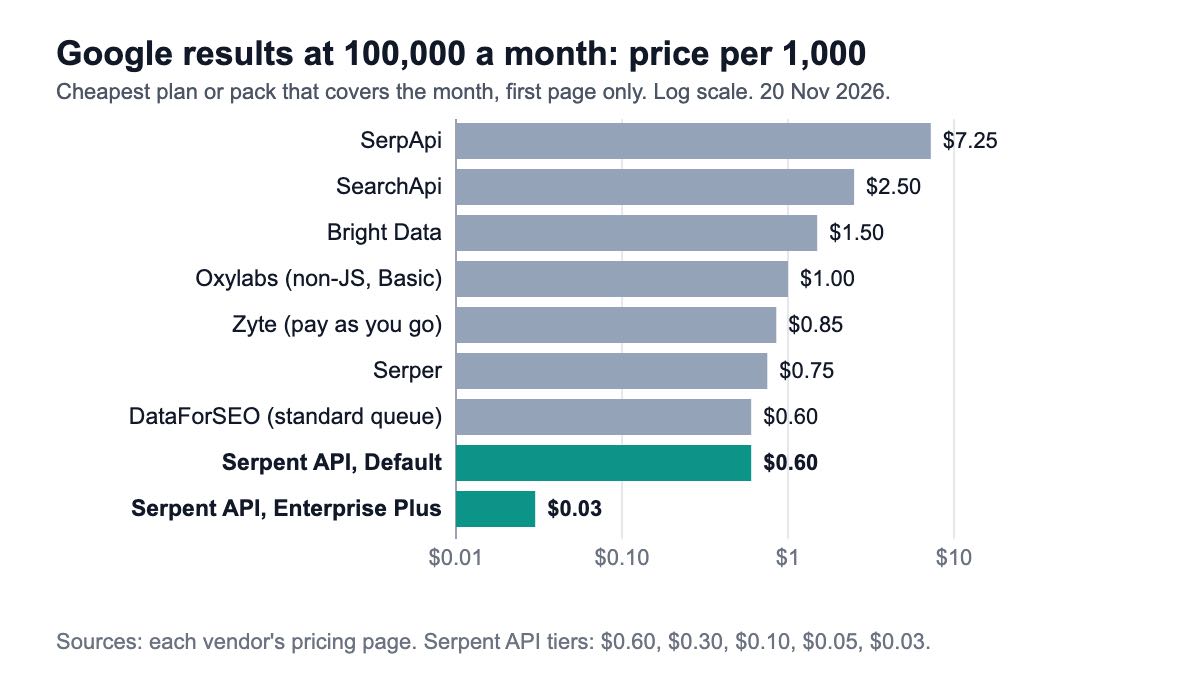
Two things the table cannot show. Oxylabs' 10,000-a-month price includes $5 of Starter credit you do not use, which expires. And on the providers that bill per page, tracking the top 100 multiplies the cost by up to ten; on Serpent API a single call can ask for up to 100 organic results (often 40 to 70 come back on Google) and is billed as one call (docs).
The alternatives, one by one
Each entry says what it is best for and the one thing to check before you move.
Serpent API: best for low cost per search with no subscription
Serpent API returns Google, Bing, Yahoo, DuckDuckGo and Brave results as JSON at one price on all five engines. The search endpoint returns organic results plus ads, People Also Ask, featured snippets, related searches and optional AI Overview fields; set country for a country and location for city-level results (billed at twice the standard rate). Requests that cannot be completed are refunded automatically, and deposited credits never expire.
Prices start from $0.03 per 1,000 — pay as you go, no subscription (pricing), and a new account gets 10 free API calls. Check before you move: run your own keyword list through it and compare the SERP features you depend on. The SERP API overview page lists every engine and endpoint.
SerpApi: best for breadth of engines and verticals
SerpApi covers a very long list of search engines and Google verticals, and only successful searches count; "cached, errored, and failed searches" do not (SerpApi pricing). Plans run from Starter at $25 for 1,000 searches to Cloud 1M at $3,750, with 250 free searches a month.
Check before you move: it is the most expensive per search at every volume in the table. You pay for breadth and maturity. Our SerpApi alternatives post covers that trade.
Bright Data: best pay-as-you-go option from a large scraping company
Bright Data's SERP API is $1.50 per 1,000 pay as you go, billed only on success, or $499 a month for 380,000 requests with extra requests at $1.30; the free tier is 5,000 a month (Bright Data SERP pricing). It is the closest like-for-like move from Oxylabs if you want a big vendor without a subscription.
Check before you move: its billing docs say that with custom headers or cookies "all requests are billed, including failed or errored requests" (Bright Data billing docs). See our Bright Data SERP alternative guide.
Zyte: best for cheap deep pages
Zyte charges $0.85 per 1,000 for the first results page pay as you go, and $0.61 for pages 2 to 10. Monthly commitments lower that to $0.63, $0.51 and $0.40 at $100, $200 and $500 a month, and only successful requests are charged (Zyte SERP pricing).
Check before you move: unused commitment does not roll over, which is the same expiring-credit problem in a different shape.
Decodo: best for rates that fall with plan size
Decodo, formerly Smartproxy, sells a Web Data API with a /search endpoint priced from $0.75 per 1,000 on its free and $19 plans down to $0.40 on the $1,499 plan, and you "only pay for successful requests" (Decodo billing docs).
Check before you move: Decodo's business looks a lot like Oxylabs', so the switch changes the price more than the way you buy.
DataForSEO: best for batch work that can wait
DataForSEO's Google Organic SERP API costs $0.60 per 1,000 SERPs in the standard queue, $1.20 in the priority queue and $2.00 in live mode, with up to 10 results per SERP (DataForSEO pricing). For overnight rank tracking, the queue is hard to beat among large SEO data vendors.
Check before you move: the queue is asynchronous, so you post tasks and collect results later. If you need answers in a user-facing request, budget for live mode. More in our DataForSEO alternatives post.
Serper and SearchApi: best for simple Google JSON
Serper sells credit packs from $50 for 50,000 queries to $3,750 for 12.5 million, valid for six months, with 2,500 free queries (Serper). SearchApi runs monthly plans from $40 for 10,000 searches to $1,500 for 1 million, does not bill failed requests, and caps use at 20% of a plan's credits per hour (SearchApi pricing).
When is Oxylabs still the right choice?
Stay if search is one of many sites you collect, or if you need something only a large scraping platform offers. Moving only the Google traffic can still cut your plan size.
- One balance for many targets. The shared credit covers Google, other websites, AI assistants and more. If you use several, one bill is convenient.
- Custom extraction. The Web API accepts a prompt or a JSON schema to pull your own fields from a page.
- Hyperlocal targeting on Classic. Coordinates with a radius, or a Google Criteria ID, for "near me" style searches.
- Enterprise buying. Contracts from $2,500 a month bring rates down to $0.50 per 1,000 without rendering, plus account management.
- An MCP server. A remote MCP server for the Web API shipped on 29 October 2026.
A common middle path is to keep Oxylabs for the non-search sites and send search traffic to a cheaper SERP provider. That lowers the Oxylabs tier you need without a full migration.
So which one should you pick?
- Lowest cost per search, no subscription, credit that keeps: Serpent API.
- Many engines and Google verticals from one vendor: SerpApi.
- A large vendor with pay as you go: Bright Data or Zyte.
- Overnight batch rank tracking: DataForSEO's standard queue.
- Simple Google JSON with a generous free start: Serper.
- Google plus many other sites, one bill: stay on Oxylabs.
If the reason you are looking is a lawsuit you read about, note that Reddit's October 2025 suit named Oxylabs alongside SerpApi, Perplexity and AWMProxy (Search Engine Land). Our post on the Google v SerpApi case covers what these cases mean for buyers of search data.
How do you move a Google integration?
Map the parameters, run both providers on the same keywords for a week, and switch in slices. Most of the work is in the response parser, not the request.
| Oxylabs | Serpent API | Note |
|---|---|---|
query | q | Same search text, operators included |
geo_location (country) / location | country | Two-letter code, e.g. us |
geo_location (city) | location + country | Place name such as Austin, TX |
pages / start_page | num or pages | num up to 100 |
parse: true / output: json | default | Parsed JSON is the default; format=simple trims it |
results_language | language | Two-letter ISO code |
- Write down the fields you read. Organic position, title and URL; maybe People Also Ask or ads. That list is your test.
- Pick 200 real keywords. Use last month's production queries, across the countries you serve.
- Compare field fill, not just status codes. A 200 with an empty list is not a success for your users.
- Put an adapter in front. One function maps each provider's JSON to your schema, so the next switch touches one file.
- Run down the Oxylabs credit first. Credit expires at the cycle end, so time the cut-over for the end of a cycle.
Two related reads: the hidden costs in SERP API pricing, and the Serpent API pricing page for the full tier ladder.
How we checked this
On 20 November 2026 I read Oxylabs' live pricing page and six of its developer docs pages (credit billing, top-ups, billing information, rate limits, SERP localization, search engine scrapers) plus its changelog, and the live pricing pages of SerpApi, Bright Data, Zyte, Decodo, DataForSEO, Serper and SearchApi: 16 official sources. The five top-ranking "Oxylabs alternatives" articles were also read on the same day; four are written by competing vendors and one by an affiliate site, and two of them still quote a $30 Starter plan. Every cost in the tables is arithmetic on list prices. No API calls were made for this article.
What I could not verify: the rate Oxylabs charges for top-ups (so cells that need one are marked "about"); Oxylabs rate limits on the plans introduced in October 2026 (the published table still uses the old plan names); Decodo's plan-to-volume fit; DataForSEO and Serper rules for failed requests; review-site wording on G2 and Capterra, which blocked automated reading.
Price your Google searches without a subscription
Google, Bing, Yahoo, DuckDuckGo and Brave results from $0.03 per 1,000 — pay as you go, no subscription. Start with 10 free API calls and run your own keywords.
Get Your Free API KeyExplore: SERP API · Playground · Docs · Pricing
FAQ
What is the best Oxylabs alternative for Google search data?
It depends on why you are leaving. For the lowest price per search with no subscription, Serpent API costs from $0.03 per 1,000 — pay as you go, no subscription (pricing), and deposited credits never expire. For the most engines and Google verticals, SerpApi; for a large vendor on pay as you go, Bright Data at $1.50 per 1,000 or Zyte at $0.85. For overnight batches, DataForSEO's standard queue at $0.60 per 1,000.
Is there a cheaper alternative to Oxylabs?
Yes, at most volumes. At 100,000 Google results a month, Oxylabs Basic works out to $1.00 per 1,000 without rendering. Serper ($0.75), Zyte ($0.85), DataForSEO's standard queue ($0.60) and Serpent API (from $0.03 per 1,000 — pay as you go, no subscription) are lower. SerpApi ($7.25) and SearchApi ($2.50) are higher, and at Enterprise Oxylabs falls to $0.50 per 1,000, but contracts start at $2,500 a month.
Do Oxylabs credits expire?
Yes. Oxylabs' pricing page says unused credits expire at the end of the billing cycle unless they carry over as part of an upgrade. Its billing docs add that the balance is not a pre-funded wallet: you cannot hold credit without an active subscription, and its top-ups page says top-up funds expire at the end of the billing cycle too. The one-time $5 welcome credit lasts while you stay on the free plan.
Does Oxylabs charge for failed requests?
It does not charge for its own server errors (5xx and 6xx) or for 429 rate-limit responses. It does count results with 2xx or 4xx status codes as successful and billable, and its docs say a 2xx or 4xx result is still counted even when it does not contain the expected information. SerpApi, Bright Data, Zyte, Decodo and SearchApi say they bill only successful requests.
What changed at Oxylabs in October 2026?
On 7 October 2026 Oxylabs launched a new dashboard with credit-based billing, replacing product-specific subscriptions with one shared balance for all products, and introduced a new Web API with /search and /scrape endpoints. The previous Web Scraper API is now documented as Classic. A remote MCP server for the Web API followed on 29 October 2026.
Can I keep Oxylabs for other sites and move only Google?
Yes, and it is often the cheapest path. Because Oxylabs bills every product from one balance, moving search traffic to a dedicated SERP API lowers the credit you need each cycle, which may let you drop a plan tier. Keep a thin adapter in your code so either provider can serve search, and time the switch for the end of a billing cycle so no credit is lost.
Sources
Oxylabs pricing and docs (checked 20 November 2026):
- Oxylabs pricing: plans and Google rates
- Oxylabs docs: credit-based billing
- Oxylabs docs: upgrading, downgrading and top-ups
- Oxylabs docs: billing information (what counts as a result)
- Oxylabs docs: Web API search engine scrapers
- Oxylabs docs: SERP localization (Classic)
- Oxylabs docs: rate limits
- Oxylabs changelog
Alternatives, official pricing (checked 20 November 2026):
- SerpApi pricing
- Bright Data SERP API pricing
- Zyte SERP scraping pricing
- Decodo Web Data API billing
- DataForSEO Google Organic SERP API pricing
- Serper pricing
- SearchApi pricing
- Bright Data SERP API billing docs
Reviews and news (checked 20 November 2026):