Bright Data SERP API pricing: what $1.50 per 1,000 really buys

Bright Data's SERP API costs $1.50 per 1,000 successful requests on pay as you go, or from $499 a month for 380,000 requests on its Scale plan, with $1.30 per 1,000 after that. Larger Scale steps cost $999 and $1,999. Scale only pays off above about 333,000 requests a month.
Short answer: Under about 333,000 requests a month, use Bright Data's pay as you go at $1.50 per 1,000 and set a monthly spend limit. From about 333,000 to 765,000, the $499 Scale step is cheapest; from there to about 1.8 million, the $999 step; above that, the $1,999 step, or ask sales for Enterprise volume pricing. If $1.00 to $1.50 per 1,000 is more than your project can carry, a pay-per-search API such as Serpent API costs from $0.03 per 1,000 — pay as you go, no subscription (pricing); the full list of options is in our Bright Data SERP API alternative guide.
What are Bright Data's SERP API prices?
Bright Data lists four options for its SERP API: a free tier, pay as you go, the Scale plan and custom Enterprise pricing. Scale has a slider with three steps. These are the figures on its SERP pricing page on 20 November 2026.
| Option | Monthly price | Included | Rate per 1,000 | Listed extras |
|---|---|---|---|---|
| Free Tier | $0 | 5,000 requests a month | — | No credit card, expert support |
| Pay as you go | None | — | $1.50 | Monthly spend limits, unlimited concurrency |
| Scale, first step | $499 | 380,000 requests | $1.31 at full use, then $1.30 for extra requests | Unlimited concurrency, cancel anytime |
| Scale, second step | $999 | 900,000 requests | $1.11 at full use, then $1.10 for extra requests | Unlimited concurrency, cancel anytime |
| Scale, third step | $1,999 | 2,000,000 requests | $1.00 at full use and for extra requests | Unlimited concurrency, cancel anytime |
| Enterprise | Custom | Custom | Volume discounts | Account manager, premium SLA, priority support, SSO |
Three details sit around the card. The page says "Every plan gives you full access", and parsed JSON is part of the price. The page also runs a sign-up promotion that matches your first deposit "dollar for dollar, up to $500". And prices may be shown in your local currency as an estimate, but you are charged in US dollars at the exchange rate on the day.
The page does not list engines by name, but Bright Data's SERP API introduction names Google, Bing, DuckDuckGo, Yandex, Baidu, Yahoo and Naver. There is no separate price per engine.
Check third-party price guides against the official card. One widely read guide calls the $499 and $999 options "Growth" and "Business" and quotes per-1,000 ranges down to $0.55. Bright Data's page uses neither name, and the lowest rate it lists is $1.00 per 1,000, on the $1,999 step. Budget from the official card above.
What exactly is a billable request?
One successful request is one billable unit, whatever the response size. Bright Data's pricing and billing documentation says it bills "per 1,000 successful requests", and failed or errored requests are not billed by default.
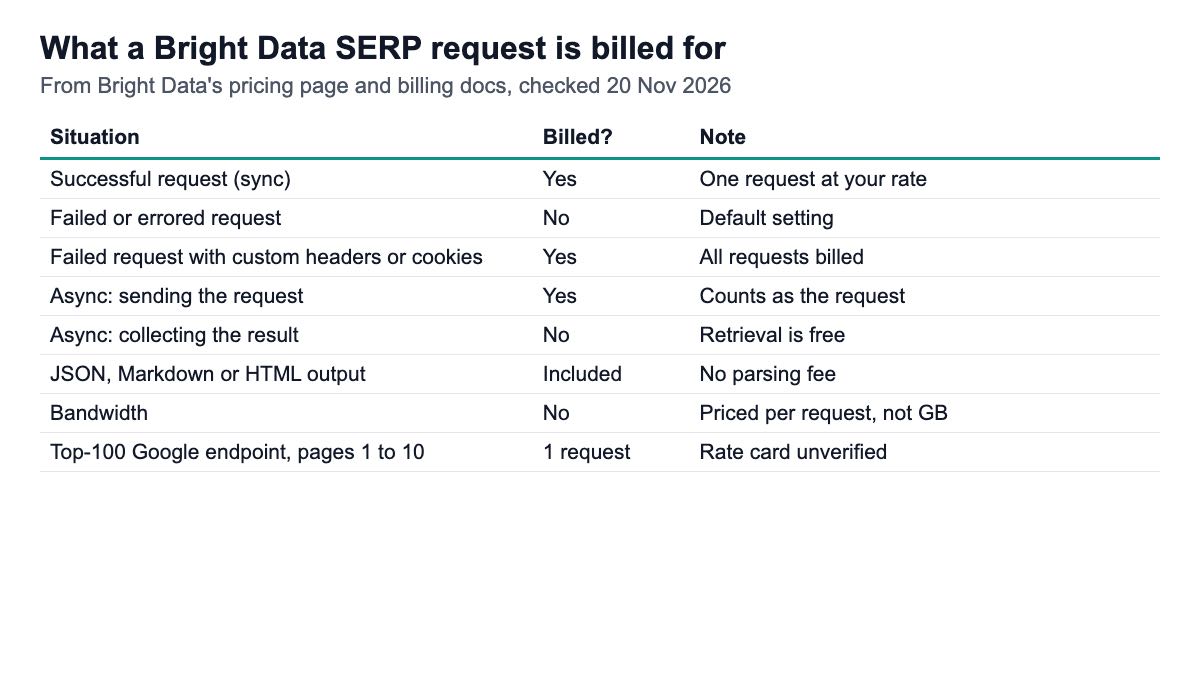
The rules, one by one, as the documentation states them:
- Success only, by default. Failed or errored requests are not billed, and Bright Data says repeated attempts on its side are not charged extra.
- The custom headers exception. If you send custom headers or cookies, "all requests are billed, including failed or errored requests." This is the line to read twice before you add a cookie to get a logged-in or personalised result.
- Asynchronous mode. Sending the request is billed; collecting the result later is not. So polling for a result does not add cost.
- Output format. "JSON, Markdown, and HTML outputs are included in the unit price."
- No bandwidth charge. The SERP API FAQ says pricing is per request, so "the bandwidth of your request doesn't matter."
- What is bundled. Unblocking and CAPTCHA handling, city and ZIP targeting, and desktop and mobile user agents are all part of Bright Data's per-request price.
Compared with how other providers handle failures, this is a fair policy with one sharp edge. Our guide to which SERP APIs bill failed requests puts it side by side with the rest.
When does the Scale plan beat pay as you go?
Scale beats pay as you go once you send more than about 332,667 requests a month. That is the point where $1.50 per 1,000 adds up to Scale's $499 fee. Below it, pay as you go is cheaper; above it, Scale is. Two more crossovers follow: the $999 step beats the $499 step from about 764,615 requests, and the $1,999 step beats the $999 step from about 1,809,091.
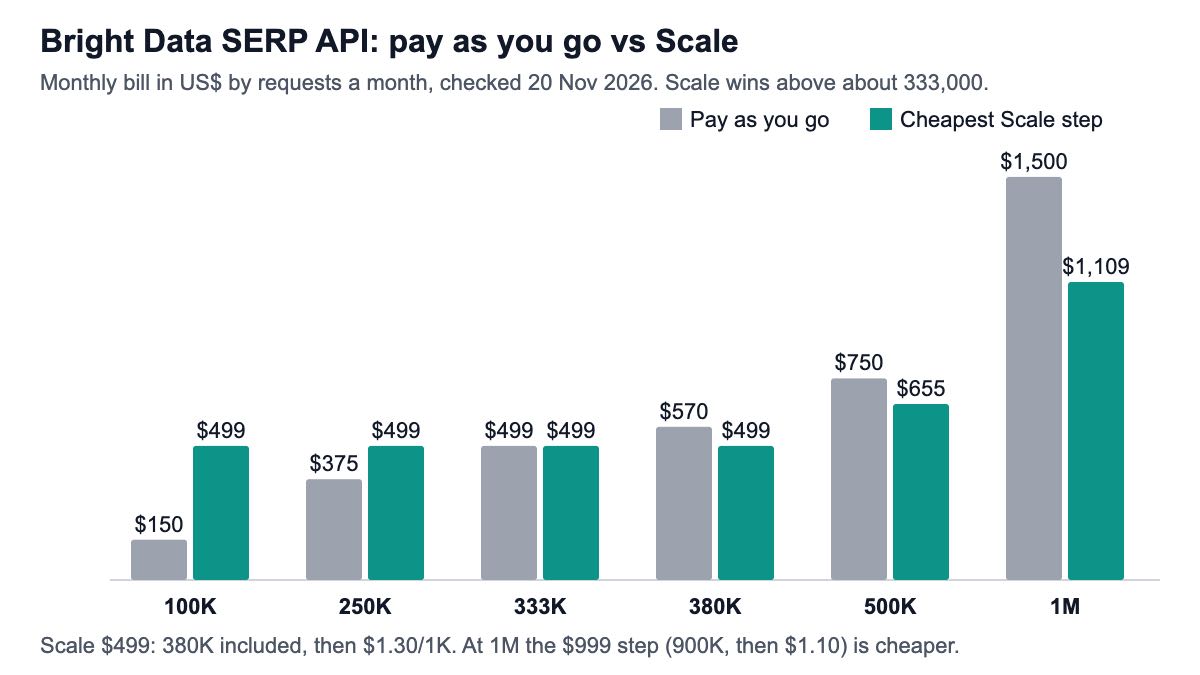
The saving above the break-even is real but modest. At 500,000 requests, Scale costs $655 ($499 plus 120,000 extra requests at $1.30) against $750 on pay as you go, a 13% saving. At 1,000,000 requests the $499 step would cost $1,305, but the $999 step costs $1,109 ($999 plus 100,000 extra requests at $1.10) against $1,500. The lowest listed rate is $1.00 per 1,000 on the $1,999 step, so above about 2 million a month it is worth asking sales about Enterprise volume discounts.
One more thing to weigh: pay as you go lets you set a monthly spend limit, while Scale is a $499, $999 or $1,999 commitment each month you keep it. If your volume is near the break-even and swings, pay as you go with a cap can be the safer choice even if it costs a little more in a busy month.
What will you pay at 10K, 100K and 1M requests?
At 10,000 requests a month you pay $15, at 100,000 you pay $150, and at 1,000,000 you pay $1,109 on the $999 Scale step. Here is the full calculation, with the cheapest option picked at each volume and the free tier left out.
| Requests a month | Pay as you go | Cheapest Scale step | Cheapest option | Effective per 1,000 |
|---|---|---|---|---|
| 10,000 | $15 | $499 | Pay as you go | $1.50 |
| 100,000 | $150 | $499 | Pay as you go | $1.50 |
| 250,000 | $375 | $499 | Pay as you go | $1.50 |
| 380,000 | $570 | $499 | Scale $499 | $1.31 |
| 500,000 | $750 | $655 | Scale $499 | $1.31 |
| 1,000,000 | $1,500 | $1,109 | Scale $999 | $1.11 |
| 2,000,000 | $3,000 | $1,999 | Scale $1,999 (or ask for Enterprise) | $1.00 |
Remember that one request is one search. If your product needs 10 pages of results for each keyword, multiply the request count by 10 unless you use the top-100 endpoint described below. If you track 1,000 keywords daily across two engines, that is about 60,000 requests a month, or $90 on pay as you go.
A worked example: an agency rank tracker
Say an agency tracks 40 clients with 250 keywords each, on Google only, every day. That is 10,000 keywords a day, or about 300,000 requests in a 30-day month. On pay as you go the bill is $450. Scale would cost $499, so pay as you go is still the cheaper choice, by $49.
Now the agency adds Bing for half of its clients. That is another 5,000 requests a day, or 150,000 a month, for 450,000 in total. Pay as you go rises to $675, while the $499 Scale step costs $499 plus 70,000 extra requests at $1.30, which is $590. The switch to Scale saves $85 a month.
The lesson is that the right option can change when a single client or engine is added. Recheck the break-even every time your keyword count moves by more than about 10%, and remember that Scale is a monthly commitment while pay as you go can be capped.
What are the free tier and deposit match worth?
The free tier is worth up to $7.50 a month at the pay-as-you-go rate, and the deposit match can halve your cost on your first $1,000 of usage. Both are useful, but neither should be in a long-term budget.
The free tier. The card says "5K requests" in its heading and "5K records per month" below it, with no credit card needed. That is enough to test a real keyword list in a few countries. The page does not say whether the free 5,000 also apply when you are on pay as you go or Scale, so I treat it as a testing allowance, not a discount.
The deposit match. If you deposit $500 and Bright Data matches it, you have $1,000 of credit. At $1.50 per 1,000 that buys about 666,667 requests for your $500, an effective $0.75 per 1,000 until the matched credit runs out. The page gives no expiry or product restrictions for the matched funds, so confirm them in your account before you plan around it.
What does the top 100 cost now that num=100 is gone?
For Google, Bright Data offers a separate endpoint that returns positions 1 to 100 and bills it as one request. Its documentation for getting the top 100 Google results says: "One successful API call = one billable request, regardless of page depth."
The background: Google phased out the num parameter that used to return 100 results on one page, and Bright Data's FAQ says so too. Now 100 results normally means 10 pages. Bright Data's answer is a scraper endpoint where you set start_page to 1 and end_page to 10 and collect the result asynchronously.
The documentation does not say which rate card that endpoint is billed on, so I could not price it. If you track deep positions, ask Bright Data to confirm the per-request price of the top-100 endpoint in writing. For more on what the change did to rank trackers, see our guide to tracking rankings after num=100 was removed.
Is $1.50 per 1,000 expensive?
It sits in the middle of the market. At 100,000 Google searches a month, Bright Data's $150 is cheaper than SerpApi and SearchApi, close to Zenserp, and more than Scrapingdog, Serper, DataForSEO's standard queue and Serpent API.
| Provider (plan) | Monthly cost | Per 1,000 |
|---|---|---|
| SerpApi (Searcher) | $725 | $7.25 |
| SearchApi (BigData) | $250 | $2.50 |
| Bright Data (pay as you go) | $150 | $1.50 |
| Zenserp (Medium) | $149.99 | $1.50 |
| Scrapingdog (Standard, 5-credit searches) | $90 | $0.90 |
| Serper (Standard pack, $375 for 500,000, used over 5 months) | $75 | $0.75 |
| DataForSEO (standard queue) | $60 | $0.60 |
| Serpent API, Default | $60 | $0.60 |
| Serpent API, Growth ($100 deposit) | $30 | $0.30 |
| Serpent API, Scale ($500 deposit) | $10 | $0.10 |
| Serpent API, Enterprise ($1,000 deposit) | $5 | $0.05 |
| Serpent API, Enterprise Plus ($1,250 deposit) | $3 | $0.03 |
Price is not the only axis. Bright Data lists unlimited concurrency, seven engines, city and ZIP targeting, and enterprise buying with SSO and a premium SLA. If those matter to your team, the extra cost buys something. If you mainly need organic results for a list of keywords, cheaper options do that job, and our Bright Data alternative guide compares them on fields and delivery, not just price.
For the cheapest end of that table: Serpent API costs from $0.03 per 1,000 — pay as you go, no subscription. One price covers Google, Bing, Yahoo, DuckDuckGo and Brave, and deposited credit never expires; every tier is on the pricing page.
How do you keep the bill down?
- Stay on pay as you go until about 333,000 requests a month. Set the monthly spend limit so a bug cannot run up the bill.
- Avoid custom headers and cookies unless you need them. With them, failed requests are billed too.
- Use async for big batches. Collecting results is free, so polling costs nothing extra.
- Cache repeated queries. Many rank-tracking and research jobs ask the same question several times a day; a short cache cuts requests directly.
- Fetch depth only where it pays. Ten pages for every keyword is ten requests. Check deep positions for the keywords where you rank on page two or lower, not for all of them.
- Pick the right Scale step, then ask about Enterprise. The lowest listed rate is $1.00 per 1,000, on the $1,999 step; above that, volume pricing is a sales conversation.
For a general list of costs that a headline per-1,000 price hides, see SERP API hidden costs, and to model your own volume across vendors, use the SERP API cost calculator.
How we checked this
On 20 November 2026 I read Bright Data's SERP pricing page and four of its documentation pages (pricing and billing, introduction, top-100 results, FAQ), the pricing pages of six other providers for the context table, and one third-party guide whose plan names and lowest rates do not match Bright Data's page: 12 external sources, 11 of them official vendor pages. The three Scale steps come from the slider on Bright Data's pricing page. Our own prices come from our pricing page the same day.
All costs are arithmetic on list prices; no paid requests were made. What I could not verify: which rate card applies to the top-100 Google endpoint, whether the free 5,000 requests stack with paid usage, the terms of the first-deposit match, and Enterprise rates.
Need search results for less than $1 per 1,000?
Serpent API returns Google, Bing, Yahoo, DuckDuckGo and Brave results as JSON from $0.03 per 1,000 — pay as you go, no subscription. Sign up for 10 free API calls and see the JSON for yourself.
Get Your Free API KeyExplore: SERP API · Playground · Docs · Pricing
FAQ
How much does Bright Data's SERP API cost per 1,000 requests?
On 20 November 2026 Bright Data listed $1.50 per 1,000 requests on pay as you go and $499 a month for 380,000 requests on the first step of its Scale plan, with $1.30 per 1,000 for requests beyond that. Larger Scale steps are $999 for 900,000 ($1.10 after that) and $1,999 for 2,000,000 ($1.00 after that). Enterprise customers get custom volume pricing. Only successful requests are billed by default.
Does Bright Data have a free trial for its SERP API?
Yes. The pricing page lists a Free Tier of 5,000 requests a month with no credit card required. It also runs a sign-up promotion that matches your first deposit dollar for dollar, up to $500. The page does not say whether the free requests stack with paid usage, or what the terms of the matched credit are, so treat both as ways to test rather than as a lasting discount.
Does Bright Data charge for failed SERP requests?
Not by default. Bright Data's billing documentation says it bills only successful responses and does not charge extra for repeated attempts on its side. The exception: if you send custom headers or cookies, all requests are billed, including failed or errored ones. In asynchronous mode, sending the request is billed and collecting the result is not.
When is Bright Data's Scale plan worth it?
When you send more than about 332,667 requests a month. Below that, $1.50 per 1,000 on pay as you go costs less than Scale's $499 monthly fee. Above it, Scale is cheaper: $655 against $750 at 500,000 requests on the $499 step, and $1,109 against $1,500 at 1,000,000 on the $999 step. The $1,999 step takes over from about 1.8 million, and much larger volumes are a conversation with Bright Data's sales team.
Which search engines does Bright Data's SERP API cover?
Bright Data's SERP API documentation names Google, Bing, DuckDuckGo, Yandex, Baidu, Yahoo and Naver, and the pricing page lists no separate price per engine. It also supports targeting in 195 countries and at city level, according to the pricing page FAQ. Check the engine-specific parameter pages before you build, because supported options differ by engine.
Sources
Bright Data pricing and documentation (checked 20 November 2026):
- Bright Data SERP API pricing page
- SERP API pricing and billing
- SERP API introduction (supported engines)
- Get top 100 Google results
- SERP API FAQ
Other providers' official pricing, for the context table (checked 20 November 2026):
- SerpApi pricing
- SearchApi pricing
- Zenserp pricing
- Scrapingdog pricing
- Serper credit packs
- DataForSEO Google Organic rates
Third-party guide with figures that do not match the official page: