Cloudflare Web Search API vs a SERP API: what you get and what it costs

Cloudflare's Web Search API is a single endpoint in AI Gateway that sends your query to Ceramic, Linkup or Exa and returns up to 10 results with a URL, title and description. It costs $0.25 to $7 per 1,000 searches. A SERP API returns a ranked results page with positions, by country.
Short answer: If you run on Workers or AI Gateway and want cheap, long page descriptions for prompts, use the Web Search API with its default provider, Ceramic, at $0.25 per 1,000. If you need Google or Bing rankings, a specific country or language, or People Also Ask and AI Overviews, use a SERP API such as Serpent API. Many agents use both.
What did Cloudflare actually launch?
On 2 October 2026 Cloudflare published Introducing Web Search API via AI Gateway. It is one search endpoint that sits inside AI Gateway, the same product many teams already use to route and log their model calls. You pick a search provider with one parameter, and the bill lands on your Cloudflare account.
The changelog entry calls it a beta, and the product docs say "Available in open beta". So treat the parameters and prices below as the state on 20 November 2026, not a contract.
There are two ways to call it. Over REST you send a POST to /client/v4/accounts/{account_id}/ai/websearch/ with a token that has Workers AI Read and AI Gateway Read permissions. Inside a Worker you call env.AI.websearch() through the AI binding. Both routes go through a gateway, so every search shows up in your gateway logs next to your model calls.
Two things it is not. It is not Cloudflare's own search engine: the results come from whichever partner index you choose. And it is not AI Search, the product formerly called AutoRAG, which indexes content you own, such as a domain or an R2 bucket, rather than the open web.
Ceramic, Linkup or Exa: which provider?
The provider is the real pricing decision, because the three list prices differ by a factor of 28. Cloudflare's providers page lists each one with a fixed search mode.
Provider (provider=) | Price per 1,000 | Mode used | Zero data retention | What the description holds |
|---|---|---|---|---|
Ceramic.ai (ceramic, default) | $0.25 | Its own index (per Ceramic's FAQ) | Yes | Long page descriptions, up to 8,000 characters |
Linkup (linkup) | $5.00 | fast depth | Yes | Linkup's fast-search snippet |
Exa (exa) | $7.00 | auto search type | No (providers page) | Exa page highlights |
Ceramic is the default and by far the cheapest. Its own FAQ describes it as "a web search API designed for LLMs and AI agents" that runs its own index. The long descriptions are the draw: you can often skip fetching the page because the description already holds the passage your model needs.
Linkup at $5 is its fast mode with raw results, which matches the $0.005 per call on Linkup's own pricing page. Linkup's deeper search, at $0.05 a call direct, is not offered through Cloudflare.
Exa at $7 is its auto search, the same price as on Exa's pricing page. Exa's cheaper lite type ($4 per 1,000 direct) and its deep types are not exposed through Cloudflare today.
One open question: the launch changelog says "All three support Zero Data Retention for requests made through Cloudflare", while the providers page marks Exa as "No". If retention matters to you, treat Exa as not covered until Cloudflare's two pages agree.
What does it cost at your volume?
At 100,000 searches a month, Cloudflare's cheapest route costs about $26 and its most expensive about $735. The spread comes almost entirely from the provider you choose, plus a small fee that depends on how you pay.
You can pay in two ways. With AI Gateway credits, each search is billed at the provider's list price, but Cloudflare's Unified Billing page says "A 5% fee is applied to all credits purchased through Unified Billing". With your own provider key (Cloudflare calls it BYOK), the provider bills you directly and the 5% fee does not apply, but you need an account with each provider.
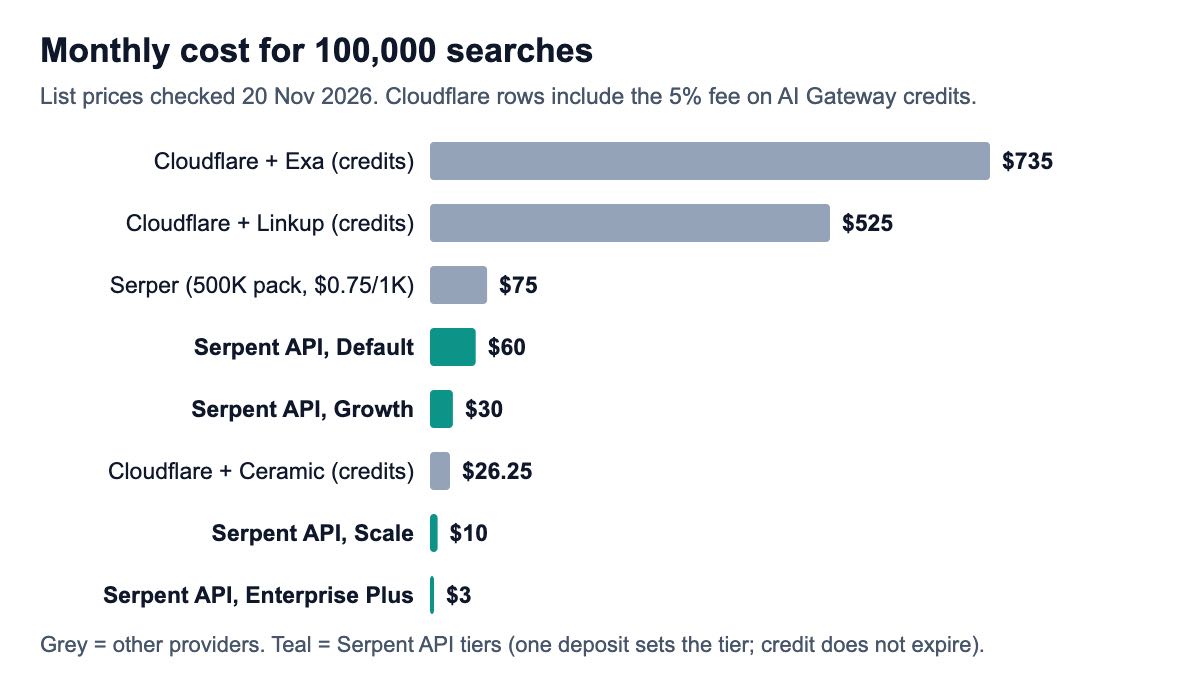
The table normalises every option to the same three volumes. Rules: Cloudflare rows paid with credits include the 5% fee. Prepaid packs are priced as if you use the whole pack before it expires. A cell shows the money you spend in that month, not the pack you must buy up front.
| Option | Per 1,000 | 1,000 a month | 100,000 a month | 1,000,000 a month |
|---|---|---|---|---|
| Cloudflare + Ceramic, AI Gateway credits | $0.2625 | $0.26 | $26.25 | $262.50 |
| Cloudflare + Ceramic, your own Ceramic key (pay as you go) | $0.25 | $0.25 | $25 | $250 |
| Ceramic Pro plan, your own key ($99 includes 495,000) | $0.20 after the included queries | $99 | $99 | $200 |
| Cloudflare + Linkup, credits | $5.25 | $5.25 | $525 | $5,250 |
| Cloudflare + Exa, credits | $7.35 | $7.35 | $735 | $7,350 |
| Brave Search API ($5 monthly credit applied) | $5.00 | $0 | $495 | $4,995 |
| Serper (packs expire after 6 months) | $1.00 to $0.30 | $1 (smallest pack is $50) | $75 (500K pack) | $500 (2.5M pack) |
| SerpApi (monthly plans) | $25 to $3.75 | $25 | $725 | $3,750 |
| Serpent API, Default | $0.60 | $0.60 | $60 | $600 |
| Serpent API, Growth ($100 deposit) | $0.30 | $0.30 | $30 | $300 |
| Serpent API, Scale ($500 deposit) | $0.10 | $0.10 | $10 | $100 |
| Serpent API, Enterprise ($1,000 deposit) | $0.05 | $0.05 | $5 | $50 |
| Serpent API, Enterprise Plus ($1,250 deposit) | $0.03 | $0.03 | $3 | $30 |
Sources for each row are listed at the end: Ceramic pricing, Brave Search API, Serper, SerpApi pricing and our own pricing page.
Two things the table does not show. First, Ceramic's pay-as-you-go plan starts with 1,000 free queries and Serper with 2,500, so a small prototype can cost nothing on either. Second, a "search" is not the same unit everywhere: a Cloudflare call returns at most 10 results, while one Serpent API organic-results call (/api/search/quick) can be asked for up to 100 results with num for a single charge (Google calls often return 40 to 70); num is a ceiling, not a guaranteed count. If you need deep result lists, divide by results, not calls.
The headline is simple. If you only care about the cheapest way to get text into a prompt, Ceramic through Cloudflare is hard to beat at $0.25 per 1,000. Linkup and Exa through Cloudflare cost 20 to 28 times more for a different style of result, and you should pick them for their relevance, not their price.
What comes back from one call?
A Web Search API call returns a list of up to 10 items, each with a url, a title and a description, plus a small metadata block. That is the whole contract on the how-to page:
{
  "items": [
    { "url": "https://example.com/salt-lake-city-fall-guide",
      "title": "Fall in Salt Lake City: A Local's Guide",
      "description": "..." }
  ],
  "metadata": { "query": "...", "requestId": "<REQUEST_ID>", "latencyMs": 612 }
}
The request body is just as small: query (1 to 1,024 characters), provider (defaults to ceramic), limit (1 to 10, default 10), an optional byokAlias for your own key, and the gateway id in options.
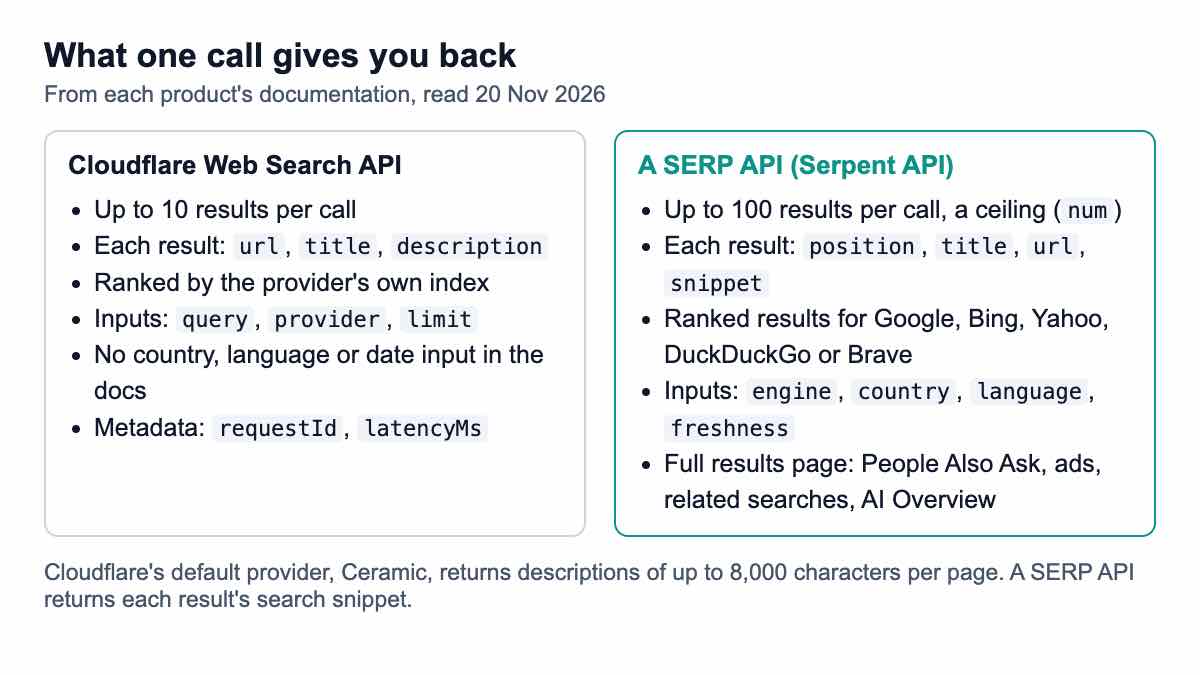
A SERP API answers a different question. Instead of "which pages in this index match my query", it answers "what does Google, or Bing, show for this query in this country today". Each organic row carries its position, and the response can carry the rest of the page: People Also Ask, ads, related searches and AI Overviews. Here is the shape of a Serpent API web search row, as printed in our docs:
{
  "success": true,
  "query": "how to tie a tie",
  "engine": "google",
  "country": "us",
  "results": {
    "organic": [
      { "title": "4 Ways to Tie a Tie - wikiHow",
        "url": "https://www.wikihow.com/Tie-a-Tie",
        "snippet": "Have you graduated beyond the clip-on tie? ...",
        "displayedUrl": "www.wikihow.com/Tie-a-Tie",
        "position": 1 }
    ]
  }
}
The difference in the description field matters more than it looks. Ceramic's descriptions can run to 8,000 characters, which is close to a page extract. A search engine snippet is one or two lines.
If your agent reads the results and answers straight away, long descriptions save you a fetch step. If your agent needs to know which page ranks first, the snippet is enough and the position is the point.
What the docs leave out
The Web Search API docs are short, and several things buyers ask about are simply not published yet. None of this is a criticism of a seven-week-old beta, but it should shape how you test it.
- No country, language or date input. The request schema has no market, language, freshness or domain parameter. If you need results for Germany in German from the past week, you have to put that into the query text and hope the provider's index respects it.
- Ten results per call, no paging.
limittops out at 10 and there is no offset or page parameter. - Rate limits are unclear. AI Gateway's limits page lists 200 requests per 60 seconds per gateway for requests paid with Cloudflare credits, but it does not mention web search. Ceramic's own plans list 20 queries per second on pay as you go and 50 on Pro. Load-test before you promise anyone a throughput number.
- No free allowance or plan eligibility. Cloudflare does not say whether Workers Free accounts can use it or whether any searches are free.
- Storage rights live in each provider's terms. On the launch thread, Simon Willison put it plainly, as InfoQ reported: "My number one question about search APIs is always if they allow you to store and resyndicate results you get from them." Cloudflare does not answer that for you; read the terms of the provider you pick.
On the positive side, Cloudflare sets rules for the partners. Its about page says a provider's crawler "must meet Cloudflare's published requirements for verified bots" and that "every search result must include a link to the location of the crawled content". That is a meaningful promise to publishers, and it is unusual for a search API to state it.
You may also see a claim that Ceramic costs $0.05 per 1,000. Parallel's write-up, dated "as of October 10, 2026", reported that figure from Ceramic's pricing page. On 20 November 2026 Ceramic's page listed $0.25 per 1,000 on pay as you go and $0.20 on the $99 Pro plan, which matches Cloudflare's providers page.
When is a SERP API the better tool?
A SERP API is the better tool whenever the answer depends on what a real search engine shows to a real market. Cloudflare's providers rank pages by their own relevance models, which is often what an agent wants, but it is a different question from "where do we rank on Google in Canada".
These jobs need a results page, not an index lookup:
- Rank tracking and SEO reporting. You need
position, the engine, and the country. See our rank tracking API for the workflow. - Local or country-specific answers. Serpent API takes
countryacross 112 markets and a two-letterlanguage, documented under web search. - Fresh news and events. The
freshnessinput filters to the past hour, day, week, month or year. - Search features. People Also Ask, ads, related searches and AI Overviews only exist on a results page. They are returned by the full web search endpoint described under /api/search.
- Engine diversity. One key covers Google, Bing, Yahoo, DuckDuckGo and Brave through the
engineinput, priced the same, as listed under engines. - More than 10 results.
numasks for up to 100 results in one call, often 40 to 70 on Google; on the organic-results endpoint that is still one charge.
If your agent runs in an MCP client such as Claude Code or Cursor, the same endpoints are available as tools through our hosted MCP server, billed exactly like the REST calls.
The trade-off is the description length. A SERP row gives you a short snippet, so an agent that must read the page will fetch it afterwards. For the cost of that pattern, our guide to cutting LLM web search costs works through the numbers, and SERP API vs Tavily vs Exa explains the three kinds of search API in more depth.
Can you use both in one agent?
Yes, and for many agents that is the sensible design. The two calls answer different questions, so they rarely compete for the same slot.
A common split looks like this. The agent calls a SERP API when the user's question is about the world as search engines show it: "who ranks for this", "what's the top result in Germany", "what are people asking about this product". It calls Cloudflare's Web Search API with Ceramic when it needs a cheap pile of readable context for a research step and does not care about ranking order. Both are a few lines of code each, and both can live in the same Worker.
The cost of running both is small. At 100,000 searches a month split evenly, Ceramic through credits is about $13 and the SERP half costs from $1.50 on Serpent API — pay as you go, no subscription. Most of an agent's bill will still be model tokens, which is why our agent cost math post focuses on tokens, not searches.
Which one should you pick?
- Pick Cloudflare + Ceramic if you already run on Workers or AI Gateway, want one bill and one log, and need cheap, long text to drop into a prompt. It is the cheapest per call in this comparison at $0.25 per 1,000.
- Pick Cloudflare + Exa or Linkup if you have already tested those providers' relevance on your own queries and prefer Cloudflare billing. Use your own key if the 5% credit fee matters at your volume.
- Pick a SERP API if the job is about rankings, a specific country or language, recent results, more than 10 results per call, or results-page features. Serpent API covers five engines on one key from $0.03 per 1,000 — pay as you go, no subscription.
- Pick both if your agent does research and also answers questions about what people see on Google or Bing.
If you are still deciding which family of search API fits your agent at all, start with which LLM web search API fits your agent and come back here once you know you need a list of links.
How we checked this
On 20 November 2026 I read Cloudflare's launch post, changelog, Web Search API overview, providers, how-to and about pages, the AI Gateway Unified Billing and limits pages, and the AI Search data-source page (8 official Cloudflare sources). I read the pricing pages of Ceramic, Linkup, Exa, Brave, Serper and SerpApi (6 vendor sources), our own pricing page and docs, and five third-party articles (InfoQ, PPC Land, Parallel, eesel and remio) for the gap check. No searches were run through any of these products for this post; every number is a list price or a documented limit, and the cost table is arithmetic on those prices. What we could not verify: whether AI Gateway's 200-requests-per-minute limit applies to web search, whether any free allowance exists, which Workers plans can use it, and which of Cloudflare's two statements about Exa's data retention is current.
Need search results by country?
Serpent API returns ranked results from Google, Bing, Yahoo, DuckDuckGo and Brave, by country and language, from $0.03 per 1,000 — pay as you go, no subscription. Start with 10 free API calls.
Get Your Free API KeyExplore: SERP API · Playground · Docs · Pricing
FAQ
What is the Cloudflare Web Search API?
It is a search endpoint inside Cloudflare AI Gateway, launched in beta on 2 October 2026. You send a query and choose one of three providers, Ceramic.ai, Linkup or Exa, and it returns up to 10 results, each with a URL, a title and a description. You can call it over REST or from a Worker with env.AI.websearch(). Searches appear in your gateway logs and are paid with AI Gateway credits or with your own provider key.
How much does Cloudflare's Web Search API cost?
Cloudflare charges each provider's list price with no markup: $0.25 per 1,000 searches for Ceramic, $5 for Linkup and $7 for Exa, according to its providers page on 20 November 2026. If you pay with AI Gateway credits, Cloudflare adds a 5% fee when you buy the credits, so the effective prices are about $0.26, $5.25 and $7.35. Using your own provider key avoids that fee because the provider bills you directly.
Is the Cloudflare Web Search API free?
Cloudflare does not publish a free allowance for it. Ceramic's own pay-as-you-go plan starts with 1,000 free queries, and Exa gives $10 of free credit a month on its own site, but those apply when you hold an account with the provider and use your own key. If you need to prototype for nothing, check each provider's current free credit before you build.
Does the Web Search API return Google results?
No. The results come from the index of the provider you choose. Ceramic runs its own index, which it says covers over 40 billion pages, and Linkup and Exa use their own search systems. If you need the results Google or Bing show for a query in a given country, with positions and page features, use a SERP API that returns those results pages, such as Serpent API.
Can I set a country or language in Cloudflare's Web Search API?
Not in the documented request on 20 November 2026. The body accepts query, provider, limit, byokAlias and gateway options, and nothing for country, language, date range or domains. You can add a place or language to the query text, but how much that changes the results depends on the provider. A SERP API with explicit country and language inputs is the reliable route when the market matters.
Which provider should I use on Cloudflare: Ceramic, Exa or Linkup?
Start with Ceramic, the default: it is the cheapest at $0.25 per 1,000 and returns long descriptions that often save a page fetch. Try Exa or Linkup only if Ceramic's relevance on your own test queries is not good enough, because they cost 20 to 28 times more. Run the same 50 to 100 real queries through each, score the results by hand, and decide on quality per dollar rather than on the price alone.
Sources
Cloudflare official (checked 20 November 2026):
- Introducing Web Search API via AI Gateway (2 Oct 2026)
- Changelog: Web Search API now available in beta
- Web Search API overview
- Web Search API providers and prices
- How to use the Web Search API
- About the Web Search API (crawler standards)
- AI Gateway Unified Billing (5% credit fee)
- AI Gateway limits
- AI Search data sources
Provider and vendor pricing (checked 20 November 2026):
- Ceramic.ai pricing and Ceramic FAQ
- Linkup pricing
- Exa pricing
- Brave Search API plans
- Serper pricing
- SerpApi pricing
- Serpent API pricing
News and commentary (read 20 November 2026):