Bright Data vs Oxylabs SERP API: which costs less, and when

For Google results, Oxylabs costs less than Bright Data at most volumes, and Bright Data is simpler to buy. Oxylabs charges $1.00 per 1,000 results on its $15 plan and $0.70 on its $500 plan. Bright Data charges $1.50 per 1,000 with no plan, lists more engines, and has no expiring credit.
Short answer: Pick Oxylabs if you send a steady 100,000 or more Google requests a month and can size a monthly plan, because $0.70 to $0.90 per 1,000 beats Bright Data’s list rates. Pick Bright Data if your volume swings, you want nothing to expire, or you need DuckDuckGo, Yahoo or Naver. If $0.70 per 1,000 is still too much, a pay-per-search Google SERP API such as Serpent runs from $0.03 per 1,000 — pay as you go, no subscription (pricing).
How do the two compare side by side?
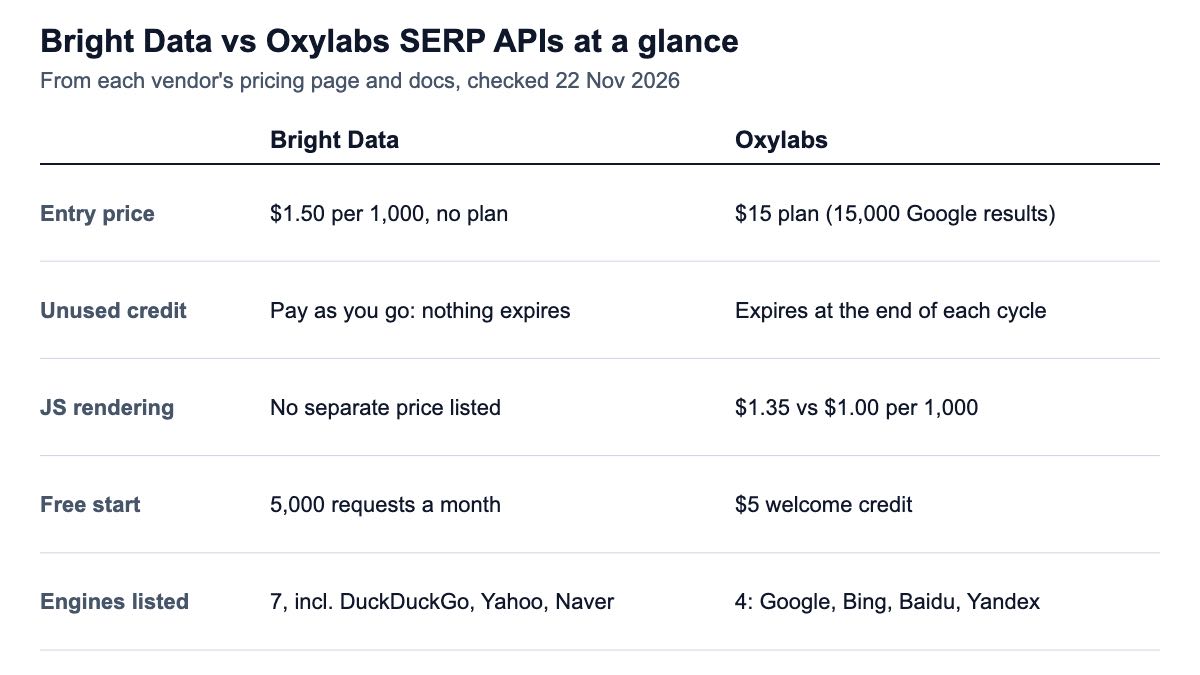
Both sell a SERP API that returns Google and other search results as JSON or HTML, bills only successful results, and handles blocks and locations for you. The differences that matter to a buyer are how you pay, what expires and which engines are covered. This table is built from each vendor’s pricing page and docs on 22 November 2026.
| Bright Data | Oxylabs | |
|---|---|---|
| How you pay | Pay as you go, or a $499 Scale plan | Monthly plan: $15, $100, $500, or Enterprise from $2,500 |
| Google rate per 1,000 | $1.50 pay as you go; $1.30 extra on Scale | $1.00 (Starter) to $0.50 (Enterprise) without rendering; $1.35 to $0.90 with it |
| Billed unit | Successful request | Result with successfully extracted data |
| Unused credit | Pay as you go has nothing to expire | Expires at the end of each billing cycle unless carried into an upgrade |
| Free start | 5,000 requests a month, no card | $5 welcome credit |
| Engines listed | Google, Bing, DuckDuckGo, Yandex, Baidu, Yahoo, Naver | Google, Bing, Baidu, Yandex |
| Location targeting | Engine parameters such as gl, hl, uule, location | Country, state, city or coordinates, 195 countries |
| Output | Raw HTML by default; JSON, Markdown or a light top-10 parse on request | Parsed JSON for Google search, Images and News, or HTML |
| Delivery | Synchronous or asynchronous | Real time, or to your cloud storage; a Scheduler for recurring jobs |
What does each cost at 10K, 100K and 1M?
At 10,000 Google pages a month they cost the same; above that, Oxylabs is cheaper. Each cell below uses the cheapest listed option that covers the volume, before tax, and leaves out free allowances.
| Provider and rule | 10,000 a month | 100,000 a month | 1,000,000 a month |
|---|---|---|---|
| Bright Data (pay as you go; $999 Scale step at 1M) | $15 ($1.50/1K) | $150 ($1.50/1K) | $1,109 ($1.11/1K) |
| Oxylabs, no JS rendering (Starter, Basic, Flexible plus top-up) | $15 ($1.50/1K) | $100 ($1.00/1K) | $700 ($0.70/1K) |
| Oxylabs, with JS rendering (Starter, Basic plus top-up, Flexible plus top-up) | $15 ($1.50/1K) | $130 ($1.30/1K) | $1,150 ($1.15/1K) |
| Serpent API — Default ($10 deposit), per page of results | $6 ($0.60/1K) | $60 ($0.60/1K) | $600 ($0.60/1K) |
| Serpent API — Growth ($100 deposit) | $3 ($0.30/1K) | $30 ($0.30/1K) | $300 ($0.30/1K) |
| Serpent API — Scale ($500 deposit) | $2 ($0.20/1K) | $20 ($0.20/1K) | $200 ($0.20/1K) |
| Serpent API — Enterprise ($1,000 deposit) | $1.50 ($0.15/1K) | $15 ($0.15/1K) | $150 ($0.15/1K) |
| Serpent API — Enterprise Plus ($1,250 deposit) | $0.30 ($0.03/1K) | $3 ($0.03/1K) | $30 ($0.03/1K) |
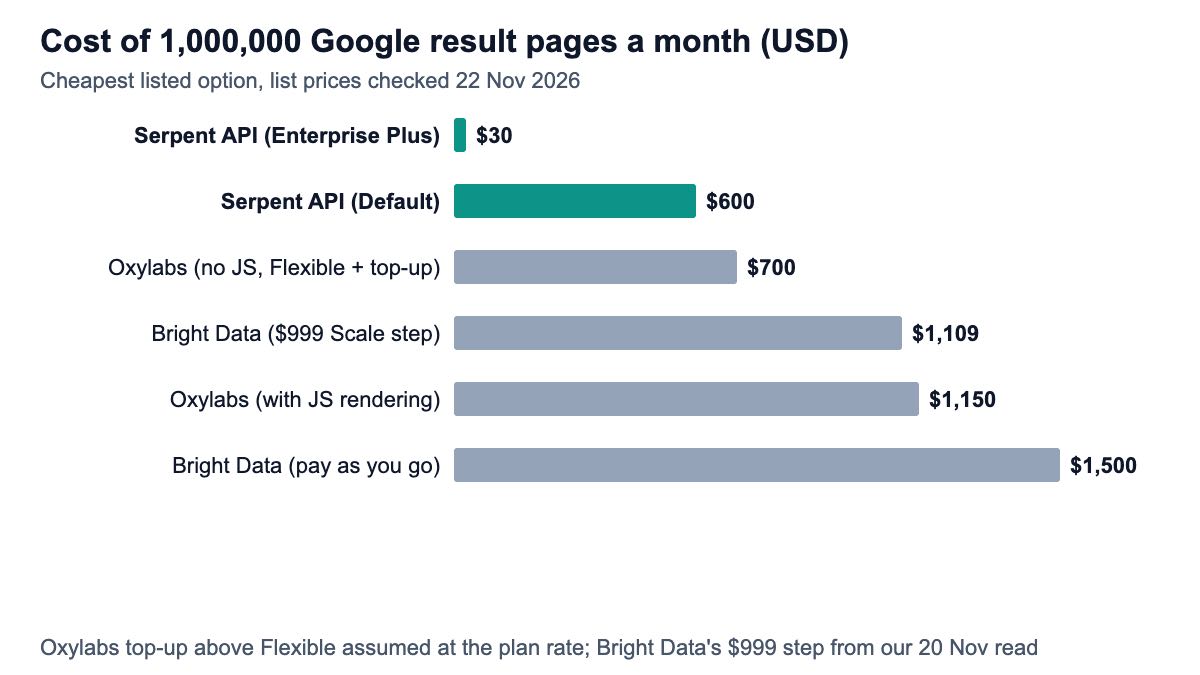
Three notes on the rows. At 10,000 pages, Oxylabs’ $15 Starter plan holds 15,000 results, so a third of it expires unused; Bright Data’s pay as you go charges exactly $15, and its free 5,000 requests a month would halve that. At 100,000 with rendering, Basic’s $100 covers about 76,000 results, so the cell adds a top-up of about $30.
At a million, Bright Data’s pricing page showed the first Scale step today ($499 for 380,000 requests, $1.30 per 1,000 after). Our Bright Data pricing breakdown read the full slider on 20 November, including a $999 step for 900,000 requests with $1.10 per 1,000 after, which gives the $1,109 here. On the $499 step alone, a million would cost about $1,305.
For Oxylabs above the Flexible plan’s 714,000 results, the cell assumes a top-up at the same $0.70 rate; Oxylabs says you can “always top-up or upgrade your plan at any time” but does not print a top-up rate. Our Oxylabs pricing breakdown works through each plan in more detail.
How do the billing rules differ?
Both bill only for successful results, but each has one rule that changes the bill.
Bright Data: its billing docs say it charges “per 1,000 successful requests”, and that failed or errored requests are not billed. The exception is custom headers or cookies: once you select them for a zone, “all requests are billed, including failed or errored requests.” In asynchronous mode, the send call is billed and the collect call is not. The pricing page also lets you set monthly spend limits, which is useful on pay as you go.
Oxylabs: its SERP API page says billing “is based on the number of results with successfully extracted data.” The catch is expiry. Its pricing page says “unused credits expire at the end of the billing cycle, unless they carry over as part of an upgrade.” Self-service billing cycles start on the day of purchase, per its billing help page, and the renewal date cannot be changed.
The rendering surcharge is the other Oxylabs rule to plan for. Google with JavaScript rendering costs $1.35 per 1,000 on Starter against $1.00 without, about a third more, falling to $0.90 against $0.50 at Enterprise. Bright Data’s pricing page lists one rate and no separate rendering price.
In practice: if your volume is uneven month to month, Oxylabs’ expiry costs you the gap between plan size and use, and Bright Data’s pay as you go costs you nothing for quiet months. If your volume is steady, size an Oxylabs plan to it and the expiry rule rarely bites.
Which engines, locations and formats does each cover?
Bright Data covers more engines; Oxylabs documents finer location targeting and more parsed Google features.
Bright Data’s SERP API docs list Google, Bing, DuckDuckGo, Yandex, Baidu, Yahoo and Naver. Output is raw HTML by default, with JSON, Markdown or a “parsed_light” format that returns only the top 10 organic results for speed. The docs recommend asynchronous requests “for large volumes, slower pages, or long-running queries”, and mention a sub-second “Fast SERP” option available on request through an account manager.
Oxylabs lists Google, Baidu, Bing and Yandex, with “country, state, city, or even coordinate-level targeting” across 195 countries. It parses Google search, Images and News into JSON and names featured snippets, local packs, item carousels, top stories, popular products and related searches. Results come back in real time or go to your own cloud storage bucket, and a Scheduler runs recurring jobs. OxyCopilot, its assistant, generates request and parsing code.
If DuckDuckGo, Yahoo or Naver matter to you, the choice is made: Bright Data. If you need coordinate-level local results and parsed Google features with no parsing work, Oxylabs has the clearer documentation.
Is one more reliable?
There is no like-for-like public test of both SERP APIs that I could find, so treat any claim of a winner with care.
The most recent third-party benchmark, AIMultiple’s SERP API test (updated 2 November 2026), included Oxylabs but not Bright Data. It measured Oxylabs at 95% success with a 6-second completion time on Google and 99% on Yandex. Its separate stability log shows Oxylabs’ daily success between 94.67% and 100% from 3 to 13 November, then 37.29% to 57.35% from 14 to 20 November. AIMultiple discloses that Bright Data, Oxylabs and others subscribe to its benchmarking services.
Bright Data’s own comparison page claims sub-second delivery and the higher success rate, but it compares figures gathered by different methods and is written by Bright Data staff. Older comparisons from AIMultiple and Proxyway test the two companies’ proxy and unblocker products, not their SERP APIs, so they say little about this choice.
The useful test is your own: send the same 200 keywords through both free allowances in one afternoon, and count how many pages come back complete with the blocks you read.
What changed at Oxylabs this autumn?
Oxylabs moved to one subscription for all its products. According to usagepricing.com’s change log, on 15 October 2026 it “replaced its per-product plan ladders with a single cross-product subscription”: one plan now sets the unit rate on every product, starting from a $5 welcome credit. An earlier change on 6 July only repackaged its scraper pricing page, with per-1,000 rates unchanged.
The same October update added a /Search product at $1 per 1,000 searches, which returns “ranked URLs and relevant snippets for your AI agents”, per its product page. It is aimed at agents rather than rank tracking. Many comparison pages predate both changes, so check the date before trusting an Oxylabs price you find elsewhere.
Both companies also sell large proxy networks, and that is often the real deciding factor: a team that already buys one vendor’s proxies may value one bill and one support contract over a gap of a few cents per 1,000 searches.
How do you run a fair trial of both?
Use the free allowances on the same day, with the same keywords and settings. Bright Data’s 5,000 free requests and Oxylabs’ $5 welcome credit, about 5,000 Google results without rendering, are enough for a solid sample.
- Pick 200 keywords from your real list, mixing short and long queries, local and national ones, and a few that show ads or a local pack.
- Fix the settings. Same country, same language, same device, and JSON output on both. Leave rendering off on Oxylabs unless a block you need is missing without it.
- Send each keyword to both within the same minute, so ranking changes do not look like vendor differences.
- Score what you read. For each response, check that the organic list is complete and that the blocks your product uses (People Also Ask, local pack, ads, AI Overviews) are present when they should be.
- Record time and cost. Note the median and slowest 5% of response times, and what each provider’s dashboard says the 200 calls cost.
Whichever wins on your sample, re-run the test a month later. Both vendors change products and prices often, as Oxylabs’ October overhaul shows.
Pick Bright Data if… pick Oxylabs if…
Pick Bright Data if:
- your monthly volume swings and you do not want unused credit to expire;
- you need DuckDuckGo, Yahoo, Naver or another engine beyond Oxylabs’ four;
- you want to start with no plan at all, on 5,000 free requests a month;
- you already buy other Bright Data products and want one bill.
Pick Oxylabs if:
- you send a steady 100,000 or more Google requests a month, where $0.70 to $0.90 per 1,000 beats Bright Data;
- you need city or coordinate-level local results;
- you want parsed Google features such as local packs and top stories without writing a parser;
- you want results written straight to your cloud storage on a schedule.
For a team leaving either one, our guides to Bright Data SERP API alternatives and Oxylabs SERP API alternatives map reasons to replacements.
Where does a pay-per-search API fit?
If you mostly need parsed Google or Bing results and both price points feel high, a pay-per-search SERP API is the third option. Bright Data and Oxylabs are broad data platforms whose SERP APIs share one billing system with many other data products; a dedicated search API prices only the search.
Serpent’s per-page endpoint, /api/search, takes q, an engine of google, bing, yahoo, ddg or brave, a country code and num or pages, with optional freshness and language filters, per the search API docs. Every engine returns the same results keys, organic results, ads, People Also Ask, related searches and the rest, so one parser covers all five. It is billed per page of results requested, from $0.60 per 1,000 on Default to $0.03 on Enterprise Plus, and deposited credit never expires.
What you give up against the two platforms: their wider engine lists, Oxylabs’ cloud delivery and Scheduler, and Bright Data’s other data products. For rank tracking and SEO data at volume, see our SERP API overview.
How we checked this
On 22 November 2026 I read both vendors’ SERP pricing pages, Bright Data’s SERP billing and introduction docs, Oxylabs’ SERP product page, /Search page and billing help, usagepricing.com’s Oxylabs change log and AIMultiple’s SERP benchmark. For the gap check I opened the top-ranking comparisons: Bright Data’s own page and the AIMultiple and Proxyway comparisons. G2, Capterra and TrustRadius refused the request, so I have not quoted their ratings.
That is 12 linked sources: 7 official vendor pages and docs, 1 vendor comparison, 1 pricing tracker and 3 third-party tests. Costs are my arithmetic on list prices, excluding tax and promotions. I made no calls to either API.
What I could not verify: Bright Data’s Scale slider steps above $499 today (the $999 step is from our 20 November read); Oxylabs’ top-up rate above the Flexible plan; and any like-for-like reliability test of the two SERP APIs.
Price Google results per search, not per plan
Google, Bing, Yahoo, DuckDuckGo and Brave results as one JSON shape. From $0.03 per 1,000 — pay as you go, no subscription — and every account starts with 10 free API calls.
Get Your Free API KeyExplore: Google SERP API · Playground · Docs
FAQ
Is Oxylabs cheaper than Bright Data for a SERP API?
Above about 15,000 Google pages a month, yes. On 22 November 2026, Oxylabs charged $1.00 per 1,000 Google results on its $15 Starter plan, $0.90 on Basic and $0.70 on Flexible, without JavaScript rendering. Bright Data charged $1.50 per 1,000 on pay as you go and $499 for 380,000 requests on Scale. At 10,000 pages a month the two cost the same $15.
Does Bright Data charge for failed SERP requests?
Not by default. Bright Data’s billing docs say it bills per 1,000 successful requests and does not bill failed or errored ones. The exception is a zone with custom headers or cookies selected, where all requests are billed, including failures. In asynchronous mode the send request is billed and the collect request is not.
Do Oxylabs SERP API credits expire?
Yes. Oxylabs’ pricing page says unused credits expire at the end of the billing cycle unless they carry over as part of an upgrade. Self-service cycles start on the day you buy, and the renewal date cannot be changed. Size your plan to a normal month rather than a busy one, and top up in the months that run over.
Which one supports more search engines?
Bright Data. Its SERP API docs list Google, Bing, DuckDuckGo, Yandex, Baidu, Yahoo and Naver. Oxylabs’ SERP Scraper API page lists Google, Baidu, Bing and Yandex, and adds parsed Google Images and Google News. If you need DuckDuckGo, Yahoo or Naver results from one provider, Bright Data is the only one of the two that lists them.
Is there a cheaper alternative to both?
Yes, if you mainly need parsed search results. Pay-per-search SERP APIs charge less per 1,000 than either platform’s list rates; Serpent’s per-page search runs from $0.60 per 1,000 on its Default tier down to $0.03 on Enterprise Plus, with credit that never expires. You give up the platforms’ extra products, such as Oxylabs’ cloud delivery or Bright Data’s other datasets.
Sources
Bright Data (checked 22 November 2026):
- Bright Data — SERP API pricing
- Bright Data docs — SERP API pricing and billing
- Bright Data docs — SERP API introduction
Oxylabs (checked 22 November 2026):
- Oxylabs — SERP Scraper API pricing
- Oxylabs — SERP Scraper API
- Oxylabs — /Search
- Oxylabs help — How does your billing cycle work
Trackers, tests and comparisons (checked 22 November 2026):