What an Amazon buy box API row can and cannot tell you

One Amazon buy box API row shows who held the Featured Offer for one product view, not who owns the product. Amazon’s own help page says the Featured Offer can be a rotation of the best offers and can differ by variation, shipping location and Prime membership. History needs another tool, and the other sellers need a second request.
Short answer: To see who holds the Featured Offer right now on ASINs you don’t sell, a one-row product API is enough: Serpent’s /api/amazon/product returns the featured price plus sold_by, ships_from and seller_id. For who held it over time, I would use Keepa; for every seller on an ASIN, an offers request, such as Serpent’s Amazon Offers API or Rainforest’s; for your own listings, Amazon’s SP-API, which is sellers only. Serpent has no price history.
What is the buy box called now, and is it one thing?
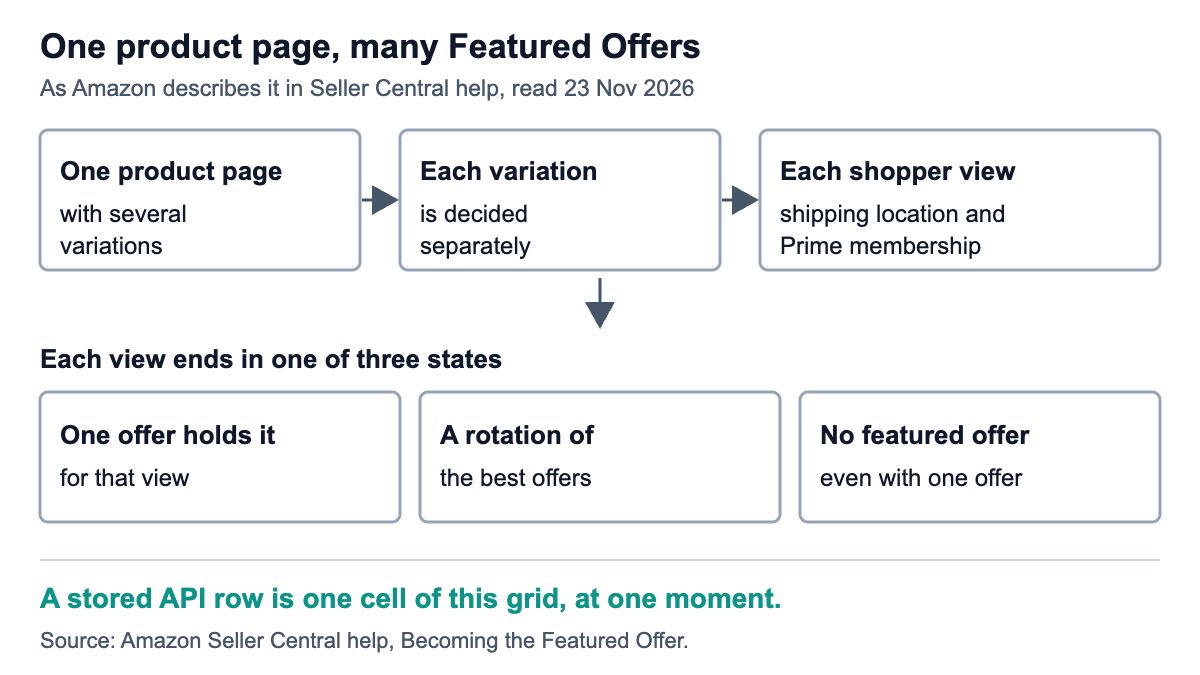
Amazon’s Seller Central help calls it the Featured Offer and defines it this way: “The Featured Offer is the offer that appears with Add to Cart / Buy Now buttons in the Offer Display on a product detail page.” (Becoming the Featured Offer, read 23 November 2026) It is not one stable thing, and the same page gives four reasons.
- It can rotate. “When no single offer is clearly more attractive than the other competing offers, then the Featured Offer could be a rotation of the best offers.” Offers that lose are not gone: “Offers that are not featured are still available to the customer from the All Offer Display.”
- It is per variation. “When a product has multiple variations (such as size or color), the Featured Offer is determined separately for each variation.”
- It is per shopper. Amazon adds that “customers may see different Featured Offers when shopping from different shipping locations or when enrolled in a Prime membership” that gives faster shipping at no extra cost per order.
- It can be absent. “Amazon will not feature any offer if none of the available offers meet our customer experience requirements, even if the product has only one available offer.”
So “who has the buy box?” has no single answer. It has an answer for each variation and each view, and sometimes none.
What decides who gets it?
A mix of price, delivery and seller performance, with price singled out. The page says “Total price (item price plus shipping fee) plays an important role in determining the Featured Offer,” and its list also names the delivery promise, free shipping, free returns and seller performance, which it breaks into order volume, chargeback rate and Voice of the Customer complaints.
It also says what does not decide it on its own. “Prime eligibility of the offer: If all other factors are equal, offers with or without the ‘Prime’ badge are equally likely to be featured.” And: “Fulfillment method: If all other factors are equal, offers fulfilled by Amazon or Fulfilled by Merchant are equally likely to be featured.”
On eligibility the page changed recently: “Yes. As of September 2026, Amazon no longer maintains a seller eligibility requirement, and offers from all sellers are now eligible to be evaluated for the Featured Offer. However, individual offers may still not be selected as the Featured Offer if they are not competitive.” The older “Featured Offer eligibility” page now reads “This page has been removed.” (old eligibility page) I read both as a US visitor, and the article says it applies to selling in the United States, so I did not check other marketplaces.
Here a competitor’s page disagrees with Amazon’s. kwery’s buy box tracking page says “FBA listings are generally favored over FBM for delivery speed and reliability,” and its list of factors includes account tenure. (kwery) I side with Amazon’s wording, because Amazon writes the rule: fulfilment method and the Prime badge are “equally likely to be featured” when all else is equal, and I did not see account tenure in the factors I read. Amazon’s sentence is conditional, so I would not read it as “fulfilment never matters”; the delivery promise is still on the list.
For an API that means sold_by, ships_from and seller_id tell you who holds the offer and who ships it, not why. Do not read them as proof that FBA or Prime won it.
What does one product row tell you?
It tells you the featured offer for the ASIN, marketplace and request you sent: price, currency, seller and who ships it. Serpent’s Amazon Product API documents these fields on GET /api/amazon/product, called with asin or url, plus domain, country and language.
| Field | What it holds | Use it for |
|---|---|---|
price and currency | “The featured offer, as a number” and an ISO-4217 code | The price on the Add to Cart offer, not necessarily the lowest offer |
seller_id | Merchant identifier for the featured offer | The stable key for “who holds it” |
sold_by | The merchant name, in one shape | Display name, for people |
ships_from | Who ships it | Telling Amazon-shipped from merchant-shipped |
asin, parent_asin, variants | The product served, its variation parent, and sibling variants | Matching the row to the exact variant you asked about |
Three habits make a row safe to use. First, ask for the exact variant ASIN, because Amazon decides the Featured Offer separately for each variation. Second, compare the returned asin with the one you asked for; the docs say it can differ when Amazon has merged the listing into another product.
Third, treat an empty seller field as “not known”, not as an answer. The docs say every key is always present and an empty value comes back as null. Amazon says a product can have no featured offer at all, so an empty field may be a real state, and one row cannot tell you which. Ask again before you act on it.
The docs do not promise a particular shipping address or Prime state for a row, so treat each row as one view and store the request parameters beside it. For general price and stock monitoring from the same call, the storage and comparison rules are in my price monitoring post; I won’t repeat them.
What can a single row not tell you?
Three things, and I would rather say so plainly: who held the offer before, who else is selling, and what share of shoppers see you. Serpent’s product row returns the featured offer’s seller fields only; the other offers are a separate request, and Serpent has no price history.
History. You can build your own by polling and storing rows, but it starts the day you start, and anything between two polls is invisible.
A history product works differently. Keepa’s product request has a buybox parameter, listed as “2 per product” and described as “Include Buy Box related data; incurs additional token cost.” Its docs name a buyBoxSellerIdHistory field among those the product object carries. (Keepa product request) SellerMagnet describes the same field as “a list of [timestamp, sellerId] pairs, one entry per change of holder.” That essay is written by the vendor and says it was drafted with AI assistance, so I treat it as a description of the field, not as evidence it is complete. (SellerMagnet, 8 November 2026)
Other sellers. Rainforest keeps this as a separate request: “For full information on all offers for a product make a type=offers request.” Its product response does describe the winner, though: “The ‘buybox’ describes the winning offer for the product,” with a fulfilment type of 1p (sold and fulfilled by Amazon), 2p (third party, fulfilled by Amazon) or 3p (third party, fulfilled by the seller), and an unqualified_buy_box flag. (Rainforest docs) An Apify actor lists “all Amazon seller offers per ASIN with Buy Box winner, prices, FBA status, and stock data.” (Apify listing)
Serpent answers this one with a second endpoint, the Amazon Offers API. A GET to /api/amazon/offers takes an asin and a marketplace and returns the featured offer first, marked buy_box: true, then up to 10 more offers per page, New and Used. Each offer carries price, shipping, condition, seller_name, seller_id, sold_by_amazon and fulfilled_by_amazon, and page 1 adds total_offers, the count Amazon’s offers panel shows. It covers 10 Amazon marketplaces; the fields are in the API reference.
Your own share. Amazon reports it, to sellers: “Your Featured Offer percentage is calculated as the total number of page views in which your offer is featured divided by the total number of page views for your products.” It is in Business Reports in Seller Central, a seller-only report about your own offers.
Where does Amazon’s own API fit?
If you sell on Amazon, it is the first stop. The Selling Partner API’s Product Pricing page lists the current version, v2022-05-01, with the availability “Sellers only,” and says the API “is designed to help you develop automated solutions that sellers can use to update and manage their prices.” (SP-API Product Pricing guide)
Its table names two on-demand calls and two push notifications:
getFeaturedOfferExpectedPriceBatch: “Returns the computed Featured Offer Expected Price (FOEP) for up to 40 SKUs.”getCompetitiveSummary: “Returns competitive pricing data, reference prices, andsampleLocationwith global view of the winning price (GVWP).”ANY_OFFER_CHANGEDnotification: “Fires when competing offers, the Featured Offer, or external prices change.”PRICING_HEALTHnotification: “Fires when an offer is disqualified from Featured Offer.”
For your own catalogue those push alerts beat polling anyone’s API. For a brand-protection or MAP analyst watching other people’s listings, the table’s “Sellers only” is the reason to look elsewhere. I did not open the older v0 pages or find a page stating what SP-API access costs.
Which route answers which question?
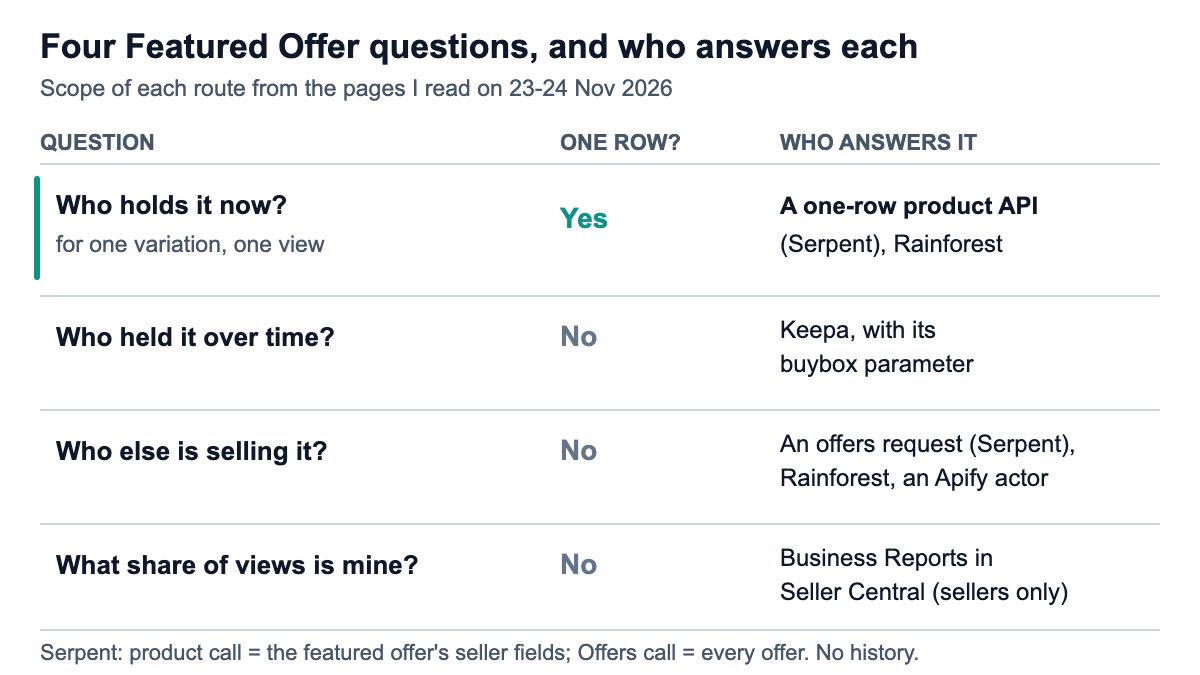
Pick by the question, not by the vendor. The first row and the “who else is selling” row are the ones Serpent answers; the others are where I would send you. I run Serpent, so read its row as a vendor’s.
| Question | Route | What the page says it returns |
|---|---|---|
| Who holds it now, on a listing that isn’t mine? | Serpent product call | price, currency, seller_id, sold_by, ships_from; no history |
| Same, with the winner as its own object? | Rainforest product request | A buybox winning-offer object, fulfilment type 1p, 2p or 3p, and unqualified_buy_box |
| Who held it over time? | Keepa, with the buybox parameter | buyBoxSellerIdHistory, at 2 extra tokens per product |
| Who else is selling this ASIN? | Serpent Offers call; Rainforest type=offers; Apify actor | All offers, with the winner marked (Serpent: buy_box, up to 11 offers on page 1, then 10 a page) |
| Tell me when it changes on my offers | SP-API notifications (sellers only) | ANY_OFFER_CHANGED, PRICING_HEALTH |
| Change webhooks on any listing? | kwery | “Every response includes the current Buy Box owner, owner ID, seller type (FBA/FBM), and the exact winning price”; change webhooks; 22 markets |
| What share of page views is mine? | Business Reports in Seller Central | Featured Offer percentage, for your own offers |
If your question is about a keyword rather than a seller, see Amazon keyword rank tracking. For category charts, see bestseller tracking. The field-by-field comparison of Amazon APIs is in best Amazon scraping APIs, free options are in free Amazon product API, and Rainforest alternatives are in their own post.
What does each route cost?
The units differ, so these are not like-for-like. Serpent’s product call starts at $0.010 per 1,000, pay as you go, no subscription; see pricing. One call is one ASIN and one featured offer. Checking 1,000 ASINs every hour is 720,000 calls in a 30-day month, which is $7.20 at that lowest rate (my arithmetic). Prices can change, so re-check pricing before you budget.
Serpent’s Offers call is billed per request, not per offer: from $0.033 per 1,000 requests, pay as you go, no subscription. Page 1 holds the featured offer and up to 10 more, so an ASIN with 20 offers is two requests (my arithmetic).
Apify’s actor lists “from $2.99 / 1,000 offers,” and the billed unit is the offer, not the ASIN. That is $0.00299 an offer by my arithmetic, so an ASIN with 20 offers would cost about $0.06. The cost per ASIN is not fixed.
kwery says “Plans from €79/mo” and quotes “17k credits” as “up to 34k SKUs” a month, about €2.32 per 1,000 SKUs on its own math (79 divided by 34). I did not open Keepa’s or Rainforest’s price pages, so I give no price for either.
How would I build a who-holds-it monitor?
On one row, I would keep it small and treat every change as a claim to confirm. This is a design on paper, not a result from live pages.
- Fix the list. Exact variant ASINs plus marketplace, not parent ASINs.
- Store every row. Requested and returned ASIN, marketplace,
country,language, time,price,currency,seller_id,sold_by,ships_from. - Define “changed hands” narrowly. A different
seller_idfrom the last non-empty one; a merchant name is for people to read. An empty value is “unknown”, not a change. - Confirm before alerting. Two reads minutes apart can disagree when offers rotate, and neither read is wrong. Alert when a second read agrees, and report flip-flopping as flip-flopping.
- Choose cadence by how fast you act. A daily report does not need an hourly poll.
- Hand off when you need the past. Hold-time and share questions are Keepa questions.
So which should you pick?
- You sell on Amazon and want alerts on your own offers: SP-API, with
ANY_OFFER_CHANGEDandPRICING_HEALTH. It is the one route here whose docs list an alert for an offer being disqualified. - You watch other people’s listings and need who holds the offer now across many ASINs: a one-row product API. This is where Serpent fits, from $0.010 per 1,000 calls.
- You need hold time, or who held it last Tuesday: Keepa, through the
buyboxparameter. - You need every seller and FBA status: an offers request, such as Serpent’s Amazon Offers API (from $0.033 per 1,000 calls), Rainforest’s
type=offers, or the Apify actor, which also lists stock data. - You want a hosted change feed with webhooks: kwery, after you check its claims against Amazon’s wording above.
How we checked this
On 23 November 2026 I read pages from three groups: Amazon’s own (two Seller Central help articles and the SP-API Product Pricing guide), vendor docs and pages (Keepa, Rainforest, Apify, kwery), and one vendor-authored essay (SellerMagnet on Medium), plus a Google results page for “amazon buy box api”. Our own fields come from Serpent’s API reference and pricing page (the Amazon Offers rows read on 24 November 2026); I did not call either endpoint for this post. This is a read of public pages, not a test of any service. Not verified: Keepa and Rainforest prices; the SP-API v0 operations and what SP-API access costs; the Seller Central articles for marketplaces other than the US; whether SellerMagnet’s history is complete; and any claim a vendor makes about its own accuracy.
Check who holds the Featured Offer on your ASINs
Serpent’s Amazon product call is from $0.010 per 1,000 calls, pay as you go, no subscription, and you can try 10 free calls first. See pricing for every tier.
Get Your Free API KeyExplore: Amazon Scraper API · Playground · Docs · Pricing
FAQ
What is the Amazon buy box called now?
Amazon’s Seller Central help calls it the Featured Offer: the offer that appears with the Add to Cart and Buy Now buttons on a product detail page. Sellers and vendors still say “buy box”, and APIs still use that name in fields such as Rainforest’s buybox object and Keepa’s buyBoxSellerIdHistory.
How do I get the Amazon buy box winner in Python or JavaScript?
Send a GET request to /api/amazon/product with asin and domain and your API key, then read seller_id, sold_by, ships_from and price from the JSON. Any HTTP client works in either language. The Amazon Product API docs show the request, and the playground lets you try it.
Can I get Amazon buy box history from an API?
Yes, from a history product. Keepa’s docs list a buybox parameter that adds Buy Box data at 2 extra tokens per product, and SellerMagnet describes a buyBoxSellerIdHistory field of timestamp and seller pairs. Serpent has no price history and no buy box history; you could poll its product call and keep your own rows, but that only starts when you do.
Does FBA or Prime decide who gets the Featured Offer?
Not on its own, according to Amazon’s page. It says that if all other factors are equal, offers with or without the Prime badge, and offers fulfilled by Amazon or by the merchant, are equally likely to be featured. Some vendor pages say FBA is generally favoured; I go with Amazon’s wording. Total price and delivery promise sit among the factors it does list.
Why did the buy box winner change between two calls?
Amazon gives several legitimate reasons. The Featured Offer could be a rotation of the best offers, it is decided separately for each variation, and shoppers may see different offers by shipping location or Prime membership. A changed seller between two reads is therefore not proof of a real change; confirm with a second read before you alert on it.
Sources
Amazon’s own pages (read 23 November 2026):
- Seller Central help: Becoming the Featured Offer
- Seller Central help: Featured Offer eligibility (page removed)
- Selling Partner API: Product Pricing API use case guide
Vendor docs and pages (read 23 November 2026):
- Keepa API docs: product request
- Rainforest API docs: product results
- Apify: Amazon Buy Box API actor
- kwery: Buy Box tracking API
Vendor-authored essay (8 November 2026, read 23 November 2026):
Serpent docs (our own pages): Amazon Product API · Pricing