Rainforest API alternatives, priced per 1,000 product lookups

The best Rainforest API alternative depends on why you are leaving. For a lower entry price, ASINSpotlight sells 10,000 lookups for $9 and Oxylabs starts at $15. For pay-as-you-go billing, Bright Data and DataForSEO charge per record. For the lowest rate per lookup, Serpent’s Amazon API bills per request.
Short answer: Stay on Rainforest if you rely on its breadth: offers, seller feedback, questions, reviewer profiles and scheduled Collections in one product. Otherwise: Oxylabs for a large vendor with Amazon pricing that falls with volume, Bright Data or DataForSEO to pay per record without a plan, ASINSpotlight or Easyparser for cheap packs, ScraperAPI if you want to stay with Rainforest’s new owner, and Serpent’s Amazon API for product, search and best-seller data from $0.010 per 1,000 — pay as you go, no subscription (pricing).
What does Rainforest API cost now?
Rainforest’s entry plan is $83 a month for 10,000 credits, and one standard request uses one credit. That is $8.30 per 1,000 product lookups at the bottom of the ladder, falling to $1.00 per 1,000 on the BigData plan. On 22 November 2026 Traject Data’s Rainforest pricing page listed seven plans:
| Plan | Price a month | Credits a month | Per 1,000 credits | Extra credit |
|---|---|---|---|---|
| Hobbyist | $23 | 500 | $46.00 | $0.06 |
| Starter | $83 | 10,000 | $8.30 | $0.0118 |
| Production | $375 | 250,000 | $1.50 | $0.003 |
| BigData | $1,000 | 1,000,000 | $1.00 | $0.002 |
| ScaleUp | $2,200 | 2,500,000 | $0.88 | $0.00176 |
| Platform | $4,000 | 5,000,000 | $0.80 | $0.0016 |
| Volume | $9,000 | 20,000,000 | $0.45 | $0.0009 |
Two details make the headline price harder to read than it looks. Each card says “Billed Annually”, next to a Monthly/Annual toggle marked “-20%”. When we read the same page on 8 September for our Amazon scraping API comparison, $83 was the monthly price and annual billing took it to $66, so the monthly price today may be higher than the cards show. I list it as unverified.
The second detail is the credit. Rainforest’s product data docs show credits_used: 1 for a product and a best-seller request, and name one parameter, skip_gtin_cache=true, that costs 2 credits instead of 1. A competitor’s comparison claims other options cost two or three credits too; I could not confirm that from Rainforest’s own pages.
Plans also differ in custom ZIP or postal codes (one on Starter, 15 on Volume) and in Collections, Rainforest’s scheduled batches of requests. And the vendor itself has changed hands: the page carries a “Traject Data joins ScraperAPI” banner, and ScraperAPI’s announcement says “nothing changes immediately with your current service, pricing, or API key.”
Why do teams look for an alternative?
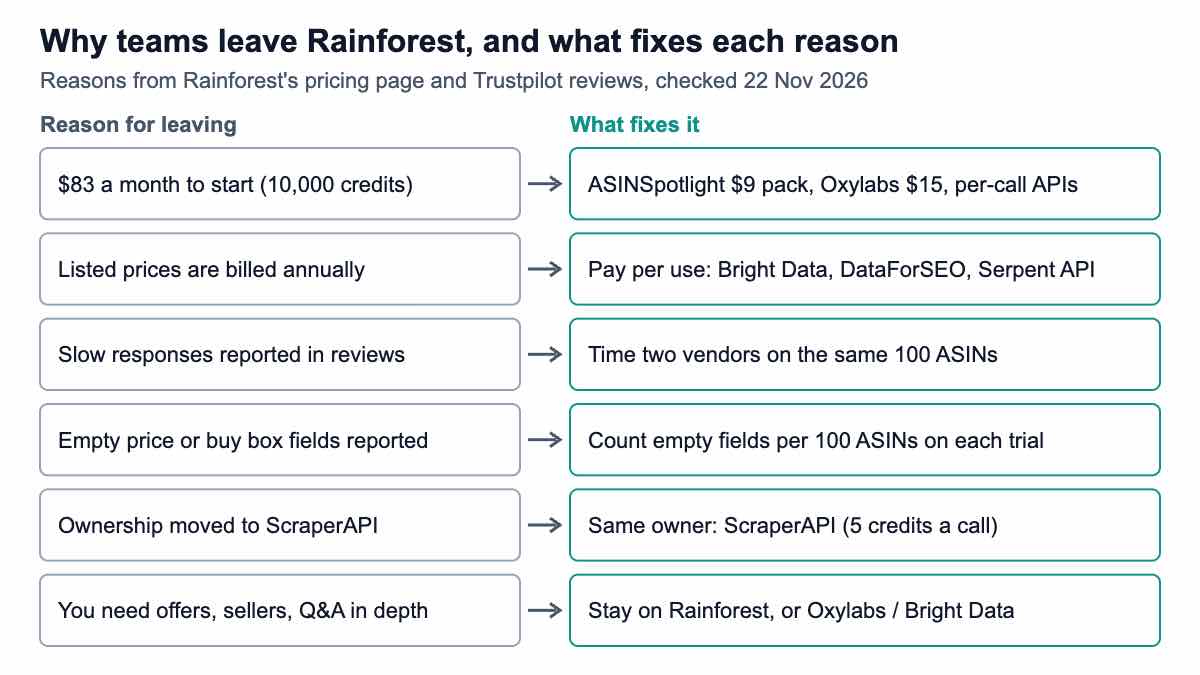
Four reasons recur in reviews and on Rainforest’s own pricing page. None is unusual for a data API; each matters more to some buyers than others.
- The entry price. $83 a month buys 10,000 requests. Hobbyist is cheaper at $23, but its 500 credits work out at $46 per 1,000. Small projects pay a lot per lookup.
- Speed and empty fields. Rainforest holds 3.2 out of 5 from 94 reviews on Trustpilot. One reviewer wrote in 2023 that the “data is wildly inconsistent”; another, in May 2026, that the reviews API “always answers as service unavailable” after three weeks of trying. A rival’s comparison collects reports of 15 to 50 seconds per product request.
- Annual billing. The listed prices are annual-billing prices. A team that wants to pay month by month, or only for what it uses, has to look elsewhere or pay more.
- The ownership change. Some buyers want to see how ScraperAPI merges the two platforms before they commit to another year.
Reviews cut both ways. Another Trustpilot reviewer wrote in April 2026: “Excellent support, top notch API. Fast and priced well!” Your own trial on your own ASINs is worth more than any of these quotes, and the figure below maps each reason to the alternative that addresses it.
The eight Rainforest alternatives
I kept APIs that return structured Amazon product data as JSON, with a price on a public page wherever one exists. Prices are list prices on 22 November 2026.
1. Oxylabs: best large vendor with falling Amazon rates
Oxylabs prices Amazon results by volume on its Amazon scraper page: $0.50 per 1,000 results on the $15 Starter plan, $0.45 on the $100 Basic plan, $0.35 on the $500 Flexible plan and $0.25 above 10 million. You “pay only for successfully delivered results”, and new accounts get $5 of welcome credit. Because each plan is a minimum spend, 10,000 lookups still costs the $15 Starter fee.
2. Bright Data: best for pay-per-record with a free allowance
Bright Data’s Amazon scraper API costs $1.50 per 1,000 records on pay as you go, or $499 a month for 384,000 records with extras at $1.30 per 1,000. The first 5,000 records each month are free and do not roll over. It covers products, reviews, search results and seller information. Note the unit: a search that returns 30 products counts as 30 records.
3. ScraperAPI: best if you want to stay with Rainforest’s new owner
ScraperAPI now owns Traject Data, so it is the alternative that keeps you with the same company. Its pricing page sells credits: $49 for 100,000, $149 for 1 million, $475 for 5 million. Its credit docs put Amazon in the e-commerce group at 5 credits per request, so $149 buys 200,000 Amazon requests. A 7-day trial includes 5,000 credits.
4. DataForSEO: best for batch jobs that can wait
DataForSEO’s Amazon API pricing charges $0.0015 per product in its standard queue, which returns within 45 minutes, $0.003 in the priority queue and $0.005 in live mode. That is $1.50, $3 and $5 per 1,000. It suits nightly catalogue refreshes; for a live price check in a user-facing app, budget for the live rate.
5. ASINSpotlight: best low-cost packs
ASINSpotlight sells one-off packs with no subscription on its API page: 10,000 products for $9, 100,000 for $49, 500,000 for $199 and 2 million for $649. Packs expire after 30 to 120 days, so buy the size you will use. It lists product, search, category, offers and seller endpoints, with a reviews API “in development”. Its own Rainforest comparison is a competitor’s pitch, so read its claims as such.
6. Easyparser: best monthly plan for mid volumes
Easyparser’s pricing page starts at $49 a month for 100,000 credits, then $150 for 350,000 and $300 for 750,000, with “1 credit = 1 product result” and 100 free credits a month. At exactly 100,000 lookups it matches ASINSpotlight’s pack price; below that you pay for credits you do not use.
7. Canopy API: best if you want GraphQL or MCP
Canopy offers Amazon product, offer, buy box, search, best-seller and seller data over REST, GraphQL and a hosted MCP server, per its site. I could not find a price on its public pages, and third-party listings disagree, so it is not in the cost table. If your agent stack already speaks MCP, it is worth a trial.
8. Serpent Amazon API: best price per lookup
Serpent’s Amazon API bills per request, from $0.010 per 1,000 at the Enterprise Plus tier to $0.020 on Default, per our pricing page. Three endpoints cover the core of most Rainforest workloads:
/api/amazon/producttakes anasinor a producturl, plus adomainorcountryfor the marketplace. It returns price, list price and currency, availability, seller, rating and rating breakdown, feature bullets, images, variants, categories, Best Sellers Rank and specs, plus the review sample shown on the product page (typically 8 to 13 reviews) at no extra charge./api/amazon/searchtakesq, a marketplace and apage, and returns one page of ranked product cards, 16 to 48 per page depending on the marketplace, with sponsored, Amazon’s Choice and Best Seller flags./api/amazon/bestsellerstakes acategoryslug and returns the ranked chart, about 30 entries.
Prices come back as numbers with an ISO currency code, and fields a listing does not carry come back as null, per the Amazon API docs. Every account starts with 10 free API calls, and deposited credit never expires.
Amazon’s own routes are not on this list because they serve narrower audiences. The Creators API that replaced the Product Advertising API needs an approved Associates account, and the Selling Partner API is for sellers’ own data; our free Amazon product API guide covers both.
What does each cost per 1,000 lookups?
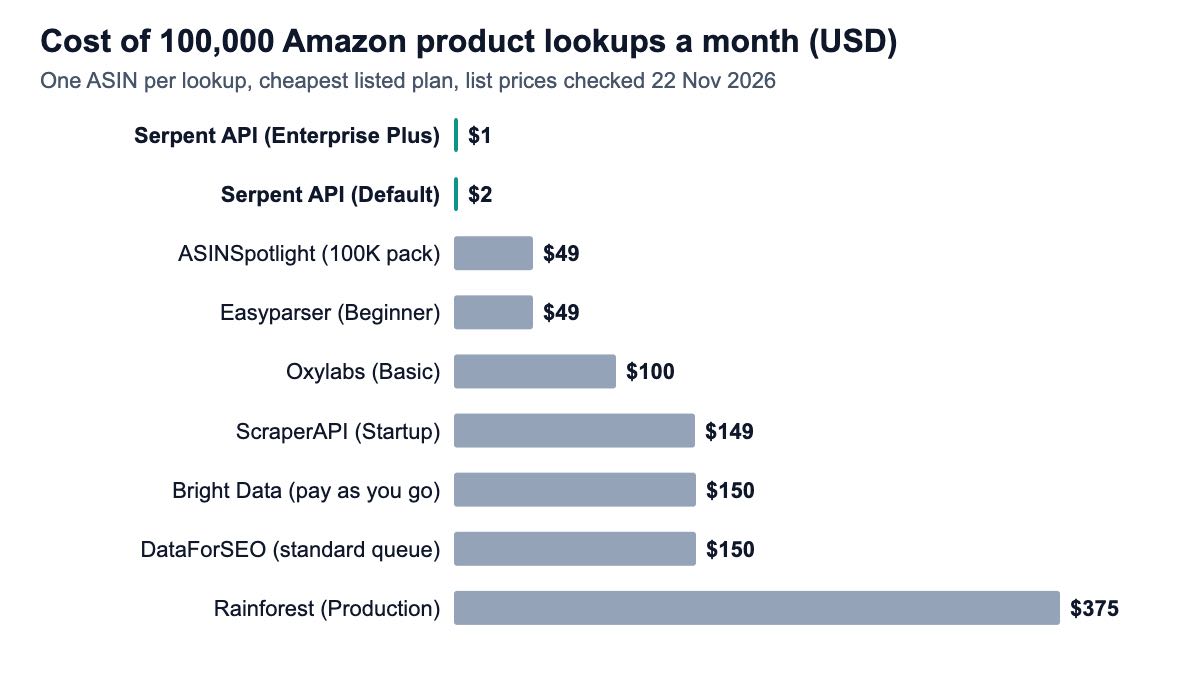
To compare fairly, I priced one workload: product lookups, one ASIN per request, at 10,000, 100,000 and 1 million a month. That avoids the biggest trap in this market, where a search request is one unit for some vendors and 16 to 48 records for others.
| Provider and rule | 10,000 lookups | 100,000 lookups | 1,000,000 lookups |
|---|---|---|---|
| Rainforest (Starter, Production, BigData; billed annually) | $83 ($8.30/1K) | $375 ($3.75/1K) | $1,000 ($1.00/1K) |
| Oxylabs (Starter, Basic, Flexible plan fee) | $15 ($1.50/1K) | $100 ($1.00/1K) | $500 ($0.50/1K) |
| Bright Data (pay as you go; Scale plus extras at 1M) | $15 ($1.50/1K) | $150 ($1.50/1K) | $1,300 ($1.30/1K) |
| ScraperAPI (5 credits a request: Hobby, Startup, Scaling) | $49 ($4.90/1K) | $149 ($1.49/1K) | $475 ($0.48/1K) |
| DataForSEO (standard queue; live is $5/1K) | $15 ($1.50/1K) | $150 ($1.50/1K) | $1,500 ($1.50/1K) |
| ASINSpotlight (packs, used before expiry) | $9 ($0.90/1K) | $49 ($0.49/1K) | $325 ($0.32/1K) |
| Easyparser (Beginner, Beginner, from-$500 plan) | $49 ($4.90/1K) | $49 ($0.49/1K) | $500 ($0.50/1K) |
| Canopy API | Unverified | Unverified | Unverified |
| Serpent API — Default ($10 deposit) | $0.20 ($0.020/1K) | $2.00 ($0.020/1K) | $20 ($0.020/1K) |
| Serpent API — Growth ($100 deposit) | $0.18 ($0.018/1K) | $1.80 ($0.018/1K) | $18 ($0.018/1K) |
| Serpent API — Scale ($500 deposit) | $0.14 ($0.014/1K) | $1.40 ($0.014/1K) | $14 ($0.014/1K) |
| Serpent API — Enterprise ($1,000 deposit) | $0.12 ($0.012/1K) | $1.20 ($0.012/1K) | $12 ($0.012/1K) |
| Serpent API — Enterprise Plus ($1,250 deposit) | $0.10 ($0.010/1K) | $1.00 ($0.010/1K) | $10 ($0.010/1K) |
The rules behind each row. Plan-based vendors use the cheapest plan that covers the volume, and the plan fee counts in full even when you use part of it. ScraperAPI’s rows multiply lookups by its 5 Amazon credits.
ASINSpotlight’s million-a-month row assumes you buy the 2-million pack every two months, inside its 120-day expiry. Bright Data’s million row is the $499 Scale plan plus 616,000 extra records at $1.30 per 1,000.
Free allowances are left out because they are small next to these volumes: Bright Data’s 5,000 monthly records, Oxylabs’ $5 welcome credit, Easyparser’s 100 monthly credits and Serpent’s 10 free calls. Tax is excluded too.
Search is a different story. If your workload is keyword searches rather than ASIN lookups, a per-record vendor bills every product on the page, while Rainforest and Serpent bill the request. Re-run the arithmetic with your page size before you decide; our Amazon keyword rank tracking guide works through that case.
When should you stay on Rainforest?
Stay if you use its breadth. Rainforest’s docs list request types for products, offers, lightning deals, category results, search, also-bought products, seller profiles, seller feedback, seller products, reviewer profiles, questions and best sellers. Few alternatives cover all of those in one product, and swapping one vendor for three costs engineering time that cheaper lookups may not repay.
Stay, too, if you depend on Collections, its scheduled batches (up to 10,000 Collections on Starter and ScaleUp, unlimited on Production, BigData, Platform and Volume), or on custom ZIP codes for local prices and delivery promises. Rebuilding scheduling and location handling around a new API is real work.
And if your only complaint is price at high volume, note that Rainforest’s ladder keeps falling: $0.88 per 1,000 on ScaleUp and $0.45 on Volume. The case to leave is strongest below 250,000 lookups a month, where its plans cost several times the alternatives, or when your own trial shows the slow or empty responses that reviewers describe.
How do you switch without breaking things?
Run the old and new APIs side by side on the same ASINs for a week, and measure before you cut over. Prices and stock on Amazon change by the hour, so compare calls made within a minute of each other.
- Pick 100 ASINs from your real catalogue, across your main marketplaces and including some with many variants and some with no buy box.
- Map the fields you use. List every Rainforest field your code reads, then find its equivalent in the new response. Names differ; a price may be a number in one API and an object in another.
- Time every call and record the median and the slowest 5%. Reviewers’ complaints about speed are about the tail, not the average.
- Count empty fields per 100 ASINs for price, availability, seller and rating, on both APIs. This is the number that tells you whether the switch is an upgrade.
- Check marketplaces and currency. Make sure each API reads the same marketplace for the same ASIN and reports currency the same way.
- Replace scheduling last. If you rely on Collections, move the schedule to your own job runner only once the data checks pass.
For price and stock monitoring specifically, our Amazon price and availability monitoring guide shows a polling pattern, and the best-seller tracking guide covers category charts.
Which Rainforest alternative should you pick?
- You use offers, seller feedback, questions and Collections: stay on Rainforest.
- You want a large vendor whose Amazon rate falls with volume: Oxylabs.
- You want to pay per record with no plan and a free monthly allowance: Bright Data.
- Your refresh can wait up to 45 minutes: DataForSEO’s standard queue at $1.50 per 1,000.
- You want cheap prepaid packs: ASINSpotlight, or Easyparser at a steady 100,000 a month.
- You want to stay with the same company: ScraperAPI.
- You want GraphQL or an MCP server for an agent: Canopy API, after asking for a price.
- You want the lowest cost per product, search or best-seller request: Serpent’s Amazon API.
For a field-by-field comparison of these vendors rather than a switching guide, see our Amazon scraping API roundup.
How we checked this
On 22 November 2026 I read Rainforest’s pricing page and product docs, ScraperAPI’s acquisition post, every alternative’s live pricing page and Rainforest’s Trustpilot reviews. For the gap check I opened the top-ranking pages for “rainforest api alternatives”: SellerApp’s guide, ASINSpotlight’s comparison and Trustpilot. G2 refused the request, so I have not described it.
That is 14 linked sources: 11 official vendor pages and docs, 1 review site and 2 vendor comparisons. Costs are my arithmetic on list prices, excluding tax and promotions. I made no calls to any of these APIs.
What I could not verify: Rainforest’s monthly-billing prices; the size of its free trial; credit costs for request types beyond the one parameter its docs name; Canopy’s prices; and the speed and empty-field claims in reviews, which only a trial on your own ASINs can settle.
Try Amazon product data without a plan
Product, search and best-seller data as JSON, billed per request. From $0.010 per 1,000 — pay as you go, no subscription — and every account starts with 10 free API calls.
Get Your Free API KeyExplore: Amazon Scraper API · Playground · Docs · Pricing
FAQ
How much does Rainforest API cost?
On 22 November 2026, Rainforest’s pricing page listed Hobbyist at $23 a month for 500 credits, Starter at $83 for 10,000, Production at $375 for 250,000 and BigData at $1,000 for 1 million, with larger ScaleUp, Platform and Volume plans. The cards are marked “Billed Annually”. A standard request uses one credit, and extra credits cost $0.0118 on Starter down to $0.0009 on Volume.
Is there a cheaper alternative to Rainforest API?
Yes, at most volumes. For 10,000 product lookups a month, ASINSpotlight’s pack costs $9 and Oxylabs’ Starter plan $15, against Rainforest’s $83 Starter plan. At 100,000 lookups, Oxylabs costs $100 and ASINSpotlight $49 against $375 on Rainforest Production. Serpent’s Amazon API bills per request from $0.010 per 1,000, so 100,000 lookups cost $1 to $2.
Who owns Rainforest API now?
Rainforest API was built by Traject Data, which ScraperAPI has acquired. Traject’s pricing page carries a “Traject Data joins ScraperAPI” banner and a ScraperAPI copyright line. ScraperAPI’s announcement says nothing changes immediately with current service, pricing or API keys, and that it will integrate Traject’s products over the coming months, without giving dates.
Does Rainforest API have a free trial?
Yes. Its pricing page offers a free trial that it says shows results instantly, but it does not state how many requests the trial includes. Several alternatives state theirs: Bright Data gives 5,000 free records a month, ScraperAPI a 7-day trial with 5,000 credits, Oxylabs $5 of credit, Easyparser 100 credits a month and Serpent 10 free API calls.
Which Rainforest alternative returns Amazon reviews?
Bright Data lists a dedicated Amazon reviews scraper, and Rainforest’s docs cover customer reviews too. ASINSpotlight lists its reviews API as in development. Serpent’s product endpoint includes the review sample shown on the product page, typically 8 to 13 reviews, with the star breakdown, in the same per-request price as the product record.
How do I compare Amazon API prices fairly?
Pick one workload and one unit. Vendors bill per request, per credit, per record or per product result, and a search request can be one unit or dozens. Price your real mix, such as product lookups by ASIN, at your monthly volume, include plan minimums and credit multipliers, and leave out free allowances unless they are large next to your usage.
Sources
Rainforest and its owner (checked 22 November 2026):
- Traject Data — Rainforest API pricing
- Rainforest API docs — Product data API overview
- ScraperAPI — ScraperAPI has acquired Traject Data (30 Apr 2026)
Alternatives’ pricing and docs (checked 22 November 2026):
- Oxylabs — Amazon Scraper API
- Bright Data — Amazon Scraper API
- ScraperAPI — Pricing
- ScraperAPI docs — Credits and request costs
- DataForSEO — Amazon API pricing
- ASINSpotlight — API
- Easyparser — Pricing
- Canopy API
Reviews and comparisons (checked 22 November 2026):