Telegram Channel Data for Crypto and News Monitoring

To monitor public Telegram channels, poll each channel's newest page on a schedule, store every post id and view count, and alert on ids you have not seen before. One request returns up to 20 posts with views, reactions and dates, so watching 50 channels once an hour is 36,000 requests a month, or $36.00 at $1.00 per 1,000.
Short answer: For an exchange announcement channel such as Binance's, about 4.3 posts a day in the saved answer, poll every few minutes and alert on new ids whose text matches your keywords. For an on-chain alert feed such as Whale Alert, about 59 posts a day, poll as often and alert on the amount. For news channels, poll hourly and watch the gaps between posts. For a competitor or brand channel, poll daily and track views and reactions per post. Cost is pay as you go, $1.00 per 1,000 requests (one request = one page of up to 20 posts), with no subscription.
Many exchanges announce listings in channels, newsrooms push headlines to them, and on-chain trackers post every large transfer there. If your job is to know when something appears, a channel is a feed with no feed reader, and a small program can be the reader.
This guide builds that program in Python and runs it on saved answers dated 21 November 2026: Binance's announcement channel, the Whale Alert transfer feed, and two news channels. The results below, from posting rates to reaction totals, are computed from those answers. The monitor takes its data through a function you pass in, so you point it at the live endpoint by changing that one function; the how-to guide has the request code.
What can you watch on a public channel?
Seven signals are visible in each answer, and a monitor needs a stored history to turn any of them into news:
- New posts: a post id you have not stored.
- Edits: each post carries an
editedflag. In the saved answers, none of the 20 posts on either crypto channel is marked edited, 1 of Bloomberg's 20 is, and 8 of rian_ru's 19 are. - Views: a counter at the moment of the call.
- Reactions: a list of emoji, Stars and custom emoji, each with a count.
- Cadence: the dates of the posts on a page.
- Links and media:
link_preview,photos,videosanddocuments. All 20 Binance posts in the saved answer carry a photo. - Audience size: the
subscribersfigure, which you can store on every poll to build your own history. Binance's is 3,150,000 and Whale Alert's is 295,000 in the saved answers.
The channel does not tell you any of these over time. Each answer is a photograph, so the history is yours to keep.
What does one answer give a monitor?
One request to GET /api/telegram/channel?channel=<username>, with your key in the X-API-Key header, returns the newest page: up to 20 posts, newest first, with the channel's title and subscriber count. Add before=<post id> for older posts, using the next_before value from the previous answer. When there is nothing older, next_before is null.
The shape never changes, so a monitor can rely on it: a field the channel does not show arrives empty and is never missing. The Telegram Channel API page lists each field, and the documentation has the parameters.
How does a monitor know a post is new?
By id. In the saved answers, post ids rise with time and each page is sorted newest first. Keep the ids you have stored; any id in the answer that is not in the store is new.
If more than 20 posts arrive between two polls, the new ones do not fit on one page. The monitor below handles that by paging back with next_before until a page contains a post it already has, then stopping. In steady state that is one request per channel per poll.
The first poll of a channel is special. Everything on the page is new to an empty store, but none of it is news. The monitor stores the backlog and sends no alerts for it.
One limit of this version: it stores a post's text the first time it sees it. News channels edit posts, and 8 of the 19 rian_ru posts in the saved answer carry the edited flag. To catch edits, compare the edited flag and the text on every poll and update the store when they change.
How do you measure view growth?
With two polls, not one. Views are a counter read at the moment of the call, so a single answer cannot tell you how fast a post is climbing. Store the count with the time of each poll, and divide the views gained between two polls by the hours between them.
Comparing posts of different ages misleads. The saved Whale Alert answer covers 7.7 hours, and its views fall almost steadily as posts get newer. The 10:56 post has 6,330 views, the 12:56 post 5,390, the 15:43 post 4,090, the 17:05 post 3,030, the 18:00 post 1,930 and the newest, from 18:41, 658.
Those are different posts, so this is a hint and not a growth curve. But if they are typical, views climb fast in the first hour and slowly after: 41 minutes separate the 18:41 and 18:00 posts and 1,272 views separate their counts, while the 12:56 and 10:56 posts are two hours apart and 940 views apart. Poll a new post often at first and less as it ages.
Counts are rounded the way Telegram shows them, to three significant digits in the saved answers: 3,030, 24,200, 1,080,000. A post at 3,030 moves in steps of about ten views and one at 24,200 in steps of about a hundred. Choose a poll gap long enough for the gain to exceed the step, or the velocity will read zero.
What does posting cadence tell you?
How often a channel posts, and when it has gone quiet. Take the dates on one page, sort them, and look at the gaps. The table comes from the newest page of four saved answers, two crypto and two news:
| Channel | Posts on the page | Span | Posts per day | Median gap | Longest gap |
|---|---|---|---|---|---|
| binance_announcements | 20 | 4.4 days | 4.3 | 2.0 hours | 22.0 hours |
| whale_alert_io | 20 | 7.7 hours | 58.9 (pace of that stretch) | 9.3 minutes | 2.2 hours |
| bloomberg | 20 | 255.8 days | 0.07 | 68.1 hours | 168.1 days |
| rian_ru | 19 | 7.0 hours | 61.6 (pace of that stretch) | 21.9 minutes | 50.1 minutes |
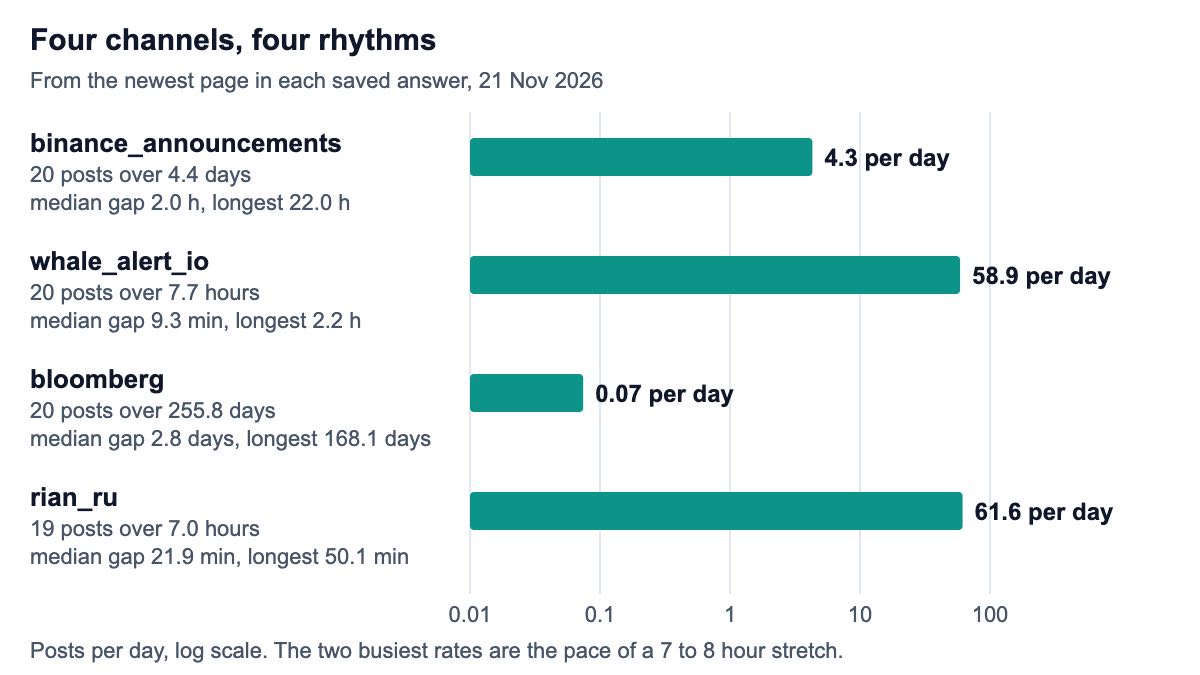
Four channels, four jobs. Whale Alert fills a 20-post page in about 8.2 hours (20 divided by 58.9 posts per day), and rian_ru in about 7.8, so both need a poll at least every few hours, or paging. Binance's page spans more than four days, so a poll every few minutes will usually see zero or one new post. The Bloomberg channel's newest post in this answer is from 22 September, and one gap between its posts is 168 days, so a quiet week there means nothing.
A silence alert is the simplest use of gaps: flag a channel when the time since its newest post passes a few times its median gap. Five times the median is about 10 hours for Binance, 47 minutes for Whale Alert and 110 minutes for rian_ru. Binance's longest gap on the page, 22.0 hours, and Whale Alert's, 133 minutes, would each have set that alert off once, which is a reminder that 20 posts make a noisy estimate. Treat it as a starting threshold and tune it per channel.
The same answers give an engagement figure. Median views as a share of subscribers is 0.9 percent for Binance (29,800 of 3,150,000), 1.0 percent for Whale Alert (3,015 of 295,000), 39.1 percent for Bloomberg (72,400 of 185,000) and 3.6 percent for rian_ru (108,000 of 3,020,000). Do not rank channels by it: Whale Alert's and rian_ru's posts are hours old and Bloomberg's are months old, and views accumulate with age.
What do reactions add?
A second signal besides views, and sometimes a sentiment one. Reactions are a list of entries, each with an emoji, a custom_emoji_id and a count. A star in the emoji field is a Stars reaction, an ordinary emoji has an empty id, and a custom emoji has an empty emoji and an id.
The saved answers show three different situations:
| Channel | Total reactions | Per 1,000 views | What they are |
|---|---|---|---|
| binance_announcements | 2,588 | 4.2 | 17 kinds of emoji, 6 on every post: heart 1,320 (51 percent), thumbs up 491 (19 percent), sad face 199, fire 109 |
| whale_alert_io | 0 | 0.0 | No reactions on any of the 20 posts |
| bloomberg | 12,592 | 7.9 | Heart 2,682, thumbs up 2,141, fire 2,059, clap 1,475, thinking 797 |
| rian_ru | 9,594 | 5.0 | Thumbs up 6,665 and thumbs down 2,929 (69 and 31 percent) |
Three uses follow. On a news channel with an up-and-down pair, the ratio is a crude read of how readers took the story: rian_ru's is about 2.3 thumbs up for every thumbs down. On an announcement channel, the mix is a mood gauge for each notice. And on a feed with no reactions at all, like Whale Alert's, views are the only engagement signal you have, which makes the view-growth method above matter more.
Channels that accept paid Stars reactions show them as a star entry, and custom emoji arrive as an id and no picture. In the saved Durov answer, 2,348,930 of its 3,447,402 reactions are Stars. Store the id, and label the few custom ones that matter by hand.
What does the whole monitor look like?
About 85 lines of Python, with SQLite from the standard library as the store. It is two files in this guide. The first, monitor.py, keeps two tables, one row per post and one snapshot per post per poll, and exposes poll_channel, velocity, cadence and engagement:
import re
import sqlite3
import statistics
from datetime import datetime


def open_db(path=":memory:"):
    db = sqlite3.connect(path)
    db.executescript(
        """
        CREATE TABLE IF NOT EXISTS posts (channel TEXT, id INTEGER, date TEXT, text TEXT, PRIMARY KEY (channel, id));
        CREATE TABLE IF NOT EXISTS snapshots (channel TEXT, id INTEGER, polled_at TEXT, views INTEGER, reactions INTEGER);
        """
    )
    return db


def reaction_total(post):
    return sum(r["count"] for r in post["reactions"])


def poll_channel(db, channel, get, now, max_pages=3, watch=None):
    """Poll one channel. Pages back with next_before until a page reaches a post we already stored.
    `get(channel, before)` returns one API answer; `watch(text)` is True when a new post deserves an alert.
    Returns what changed since the last poll."""
    out = {"requests": 0, "new": [], "alerts": [], "gained": {}, "status": "ok"}
    # First poll of a channel: store everything, alert on nothing (the backlog is not news).
    baseline = db.execute("SELECT 1 FROM posts WHERE channel = ? LIMIT 1", (channel,)).fetchone() is None
    before = None
    for _ in range(max_pages):
        data = get(channel, before)
        out["requests"] += 1
        if data["preview_enabled"] is False:
            out["status"] = "preview off: no posts to monitor"
            break
        known = {i for (i,) in db.execute("SELECT id FROM posts WHERE channel = ?", (channel,))}
        for p in data["posts"]:
            last = db.execute(
                "SELECT views, polled_at FROM snapshots WHERE channel = ? AND id = ? ORDER BY polled_at DESC LIMIT 1",
                (channel, p["id"]),
            ).fetchone()
            if p["id"] not in known:
                out["new"].append(p)
                db.execute("INSERT INTO posts VALUES (?, ?, ?, ?)", (channel, p["id"], p["date"], p["text"]))
                if watch and not baseline and watch(p["text"]):
                    out["alerts"].append(p)
            elif last and p["views"] is not None and last[0] is not None:
                hours = (now - datetime.fromisoformat(last[1])).total_seconds() / 3600
                out["gained"][p["id"]] = (p["views"] - last[0], hours)
            db.execute("INSERT INTO snapshots VALUES (?, ?, ?, ?, ?)",
                       (channel, p["id"], now.isoformat(), p["views"], reaction_total(p)))
        db.commit()
        page_ids = {p["id"] for p in data["posts"]}
        if page_ids & known or not data["next_before"]:
            break  # reached posts we already have, or the oldest post there is
        before = data["next_before"]
    return out
The second block holds the three small calculations used above. cadence parses the dates with datetime.fromisoformat and measures the gaps, engagement uses the statistics module for median views as a share of subscribers, adds reactions per 1,000 views, and velocity turns two snapshots into views per hour:
def velocity(gained):
    """Views gained per hour for every post seen in two polls (hours > 0)."""
    return {i: g / h for i, (g, h) in gained.items() if h > 0}


def cadence(posts):
    """Posts per day and gap statistics from the dates on one answer."""
    when = sorted(datetime.fromisoformat(p["date"]) for p in posts if p["date"])
    gaps = [(b - a).total_seconds() for a, b in zip(when, when[1:])]
    span = (when[-1] - when[0]).total_seconds()
    return {
        "posts": len(when),
        "span_hours": span / 3600,
        "per_day": len(gaps) / (span / 86400) if span else None,
        "median_gap_h": statistics.median(gaps) / 3600,
        "longest_gap_h": max(gaps) / 3600,
    }


def engagement(data):
    views = [p["views"] for p in data["posts"] if p["views"] is not None]
    reacts = sum(reaction_total(p) for p in data["posts"])
    return {
        "median_views": statistics.median(views),
        "reach_pct": 100 * statistics.median(views) / data["subscribers"] if data["subscribers"] else None,
        "reactions": reacts,
        "per_1k_views": 1000 * reacts / sum(views) if views else None,
    }
The poll function takes get(channel, before), any function that returns one answer, and watch(text), any function that says whether a new post deserves an alert. In production, pass the get_channel function from the how-to guide, which has the same two arguments and returns the same dictionary.
For the demo, the second file below passes a stand-in that reads the saved answers and one watch rule per crypto channel: Binance notices that mention a removal, a monitoring tag or a delisting, and Whale Alert transfers of $200 million or more. It also leaves the newest five posts out of each channel's first poll, so the second poll has new posts to find:
import json
import os
import re
from datetime import datetime, timedelta, timezone

from monitor import cadence, engagement, open_db, poll_channel

SAMPLES = os.path.join(os.path.dirname(os.path.abspath(__file__)), "..", "..", "development", "content", "samples")
PAGE2 = os.path.join(os.path.dirname(os.path.abspath(__file__)), "telegram-bloomberg-page2-2026-11-21.json")
T0 = datetime(2026, 11, 21, 19, 0, tzinfo=timezone.utc)  # a clock value for the demo, not a capture time

RISK = re.compile(r"removal|monitoring tag|delist", re.I)


def usd(text):
    m = re.search(r"\(([\d,]+) USD\)", text)
    return int(m[1].replace(",", "")) if m else 0


WATCH = {
    "binance_announcements": lambda text: bool(RISK.search(text)),   # notices that can hurt a holding
    "whale_alert_io": lambda text: usd(text) >= 200_000_000,         # transfers of $200 million or more
}


def load(path):
    with open(path, encoding="utf8") as f:
        return json.load(f)["response"]


def saved_answers(hide_newest=0):
    """Stand-in for the API: the saved answers, optionally without the newest posts."""
    def get(channel, before):
        if channel == "bloomberg" and before:
            return load(PAGE2)
        name = {"coindesk": "coindesk-preview-off"}.get(channel, channel)
        data = load(os.path.join(SAMPLES, f"telegram-{name}-2026-11-21.json"))
        data["posts"] = data["posts"][hide_newest:]
        return data
    return get


def snippet(post):
    return re.sub(r"\s+", " ", re.sub(r"[^\x00-\x7f]", "", post["text"])).strip()[:46]


db = open_db()

r = poll_channel(db, "bloomberg", saved_answers(), T0, max_pages=2)
print(f'bloomberg, first poll: {len(r["new"])} posts stored from {r["requests"]} requests')

for channel, watch in WATCH.items():
    r = poll_channel(db, channel, saved_answers(hide_newest=5), T0, max_pages=1, watch=watch)
    print(f'\n{channel}, poll 1 (newest 5 left out): {len(r["new"])} stored, alerts: {len(r["alerts"])}')
    r = poll_channel(db, channel, saved_answers(), T0 + timedelta(hours=1), watch=watch)
    print(f'{channel}, poll 2 (one hour later): {len(r["new"])} new posts from {r["requests"]} request')
    for p in r["new"]:
        flag = "ALERT" if p in r["alerts"] else "     "
        print(f'  {flag} {p["id"]} {p["date"][:16]} {p["views"]:>7,} views | {snippet(p)}')
    print(f'  {len(r["gained"])} older posts re-read; views gained on them: {sum(g for g, h in r["gained"].values())}')

r = poll_channel(db, "coindesk", saved_answers(), T0)
print("\ncoindesk:", r["status"])

print()
for name in ["binance_announcements", "whale_alert_io", "bloomberg", "rian_ru"]:
    data = saved_answers()(name, None)
    c, e = cadence(data["posts"]), engagement(data)
    print(f'{name:21} {c["posts"]} posts over {c["span_hours"]:7.1f} h | {c["per_day"]:5.2f}/day | '
          f'median gap {c["median_gap_h"]:5.2f} h, longest {c["longest_gap_h"]:6.1f} h')
    print(f'{"":21} median views {e["median_views"]:>8,.0f} ({e["reach_pct"]:.1f}% of {data["subscribers"]:,} subscribers) | '
          f'{e["reactions"]:,} reactions = {e["per_1k_views"]:.1f} per 1,000 views')
Run on the saved answers, it printed:
bloomberg, first poll: 40 posts stored from 2 requests

binance_announcements, poll 1 (newest 5 left out): 15 stored, alerts: 0
binance_announcements, poll 2 (one hour later): 5 new posts from 1 request
        9155 2026-11-20T11:01  24,200 views | Binance Alpha Trading Competition: Trade Pieve
        9154 2026-11-20T08:02  26,600 views | Binance Earn: Enjoy Up to 5% APR with USDC and
  ALERT 9153 2026-11-20T06:04  29,700 views | Binance Will Extend the Monitoring Tag to Incl
        9152 2026-11-19T17:33  31,300 views | Deposit Fiat or Buy Crypto/bStocks to Share $4
        9151 2026-11-19T17:12  33,100 views | Binance Will Add Anthropic (ANTB) bStocks Toke
  15 older posts re-read; views gained on them: 0

whale_alert_io, poll 1 (newest 5 left out): 15 stored, alerts: 0
whale_alert_io, poll 2 (one hour later): 5 new posts from 1 request
  ALERT 105180 2026-11-21T18:41     658 views | 3,860 $BTC (232,335,978 USD) transferred from
        105179 2026-11-21T18:36     845 views | 142,500,000 $USDT (142,309,762 USD) transferre
        105178 2026-11-21T18:28   1,120 views | 142,500,000 $USDT (142,418,442 USD) transferre
  ALERT 105177 2026-11-21T18:21   1,380 views | 213,200,000 $USDT (212,864,103 USD) transferre
        105176 2026-11-21T18:19   1,450 views | 125,000,000 $USDT (124,800,250 USD) transferre
  15 older posts re-read; views gained on them: 0

coindesk: preview off: no posts to monitor

binance_announcements 20 posts over   106.0 h |  4.30/day | median gap  2.01 h, longest   22.0 h
                      median views   29,800 (0.9% of 3,150,000 subscribers) | 2,588 reactions = 4.2 per 1,000 views
whale_alert_io        20 posts over     7.7 h | 58.86/day | median gap  0.15 h, longest    2.2 h
                      median views    3,015 (1.0% of 295,000 subscribers) | 0 reactions = 0.0 per 1,000 views
bloomberg             20 posts over  6139.6 h |  0.07/day | median gap 68.13 h, longest 4034.0 h
                      median views   72,400 (39.1% of 185,000 subscribers) | 12,592 reactions = 7.9 per 1,000 views
rian_ru               19 posts over     7.0 h | 61.59/day | median gap  0.36 h, longest    0.8 h
                      median views  108,000 (3.6% of 3,020,000 subscribers) | 9,594 reactions = 5.0 per 1,000 views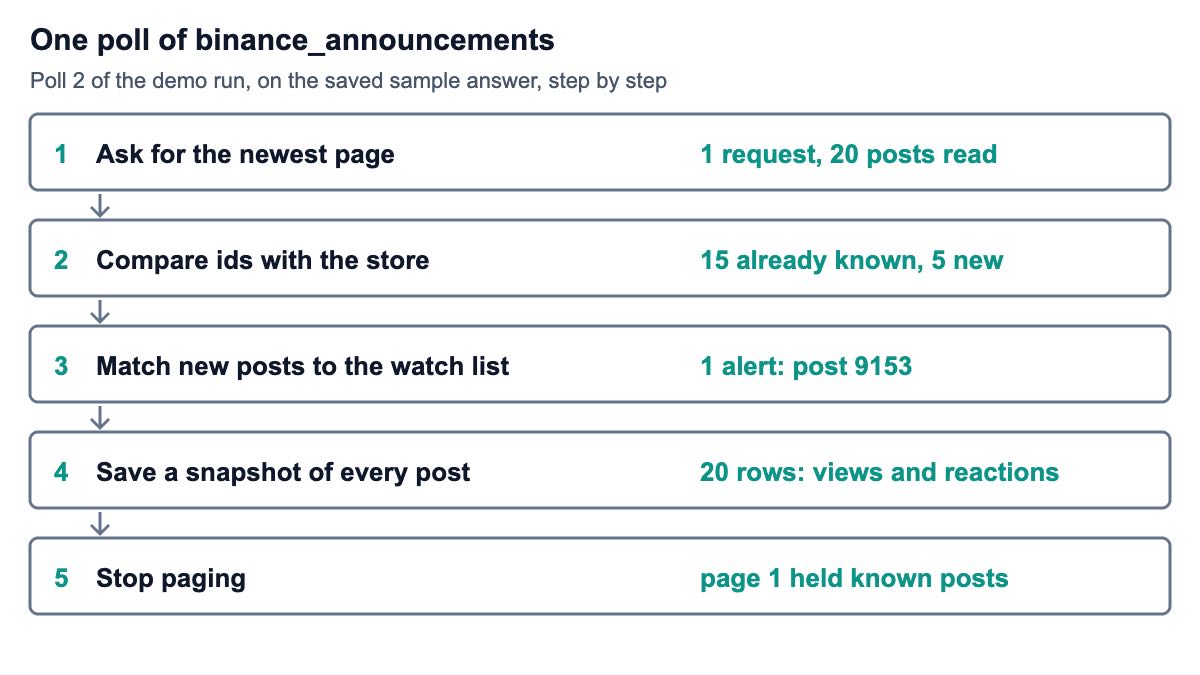
Read the output top to bottom. Bloomberg's first poll stored 40 posts from two requests, paging back once with next_before. Each crypto channel's first poll stored 15 posts and raised no alerts, as designed.
The second Binance poll used one request and found five new posts. Post 9153, an extension of the monitoring tag to six tokens, matched the risk pattern and raised the alert, and the other four did not match. The second Whale Alert poll also used one request and found five new posts, two of them at or above $200 million: 105180, a 232 million dollar Bitcoin transfer, and 105177, a 213 million dollar Tether transfer.
The line about views needs an honest reading. The 15 older posts on each channel were read twice from the same saved answer, so they gained 0 views, and the one-hour gap is a clock value passed into the demo, not a real hour. What the run proves is the plumbing, from stored snapshots through the elapsed hours to a rate. Real growth appears when you poll the live endpoint twice.
The last block of the output is the cadence and engagement figures used in the tables above. The coindesk line is the preview-off case, covered below.
What do two crypto channels look like when you monitor them?
Different from each other, and the difference decides the setup. Binance's announcement channel is a slow, high-value feed: 4.3 posts a day, a median gap of 2.0 hours, every post with a photo, and a typical post read about 29,800 times. The titles carry the news, and several carry a date in brackets, so a keyword rule on the text works. In the saved answer, the risk pattern matches 2 of 20 posts: 9153 (the monitoring tag) and 9145 (a notice of removal of spot trading pairs).
Whale Alert is the opposite: 58.9 posts a day at the pace of the saved stretch, a median gap of 9.3 minutes, and a typical post read about 3,015 times. Each post states an amount in dollars in a fixed pattern, so a number rule works better than a word rule. In the saved answer, 18 of 20 posts carry an amount and 4 are at or above $200 million. The 7.7-hour page fills fast, so poll often or page back.
Two practical notes. A listing notice or a maintenance window loses value quickly, so keep the alert path short and make the alert link to the post (the url field), so a person can read the original before acting on it. And a channel post is a claim by its owner, not a verified fact: the amounts and notices above were not checked against anything for this guide.
Your keywords will differ. For Binance, listing, delisting, maintenance and airdrop are natural candidates, and the demo's pattern is one example. Run the monitor on your own list and read the cadence table it produces before you set intervals.
What if a channel returns no posts?
Then look at preview_enabled. For a channel whose owner turned off public viewing of its posts, the answer still arrives with the title and the subscriber count, preview_enabled is false, and posts is empty. The saved CoinDesk answer is exactly that: 11,202 subscribers, preview_enabled false, no posts.
A monitor should record that as its own state. The monitor above reports “preview off: no posts to monitor” and does nothing else. A quiet channel looks different: preview_enabled is true and the posts are old. If you treated both as “no news”, you would believe a dead feed was a calm one.
You can still use the subscriber count of a preview-off channel. Store it each poll and you have a growth line for an audience whose posts you cannot read.
How often should you poll, and what does it cost?
Poll more often than a page fills up, and no more often than you will act. One request returns up to 20 posts. Pricing is pay as you go, $1.00 per 1,000 requests, so the arithmetic is channels times polls per month, divided by 1,000:
| Setup | Polls per channel per month | Requests per month | Cost per month |
|---|---|---|---|
| 1 announcement channel, every 5 minutes | 8,640 | 8,640 | $8.64 |
| 10 channels, every 15 minutes | 2,880 | 28,800 | $28.80 |
| 50 news channels, every hour | 720 | 36,000 | $36.00 |
| 200 brand channels, once a day | 30 | 6,000 | $6.00 |
Run poll_channel from cron or any job scheduler. Those figures assume the monitor stops at the first page that holds a known post. If a channel posts more than 20 times between polls, the monitor needs an extra request for each further 20. For Whale Alert, about 2.5 new posts arrive per hour at the saved pace, so a poll every five minutes sees under one and even an hourly poll needs one request.
For a comparison with per-post pricing from other services, the price comparison for Telegram channel APIs works it out per 1,000 posts at three volumes.
Which setup should you pick?
- Alerts on exchange announcement channels: a few minutes between polls, a keyword pattern, and the first-poll rule so the backlog never alerts.
- On-chain or price feeds with a number in every post: the same interval, a numeric threshold instead of a word, and a page-back loop for bursts.
- A news or media watch across many channels: hourly polls, a silence alert from the gap table, and a stored
editedflag. The PR and media monitoring guide covers the web-search side of the same job. - Competitor or brand channels: a daily poll, with views and reactions per post kept in the snapshot table.
- Audience trends: store
subscriberson every poll. It works even when the preview is off. - A wider listening stack: the social listening API stack guide places channels next to Reddit, X and TikTok, and the Social Media API page lists what else is available under the same key.
If you would rather build and run your own parser, the do-it-yourself guide shows how and lists what goes wrong.
How we checked this
Code. Both monitor files ran on 21 November 2026 (UTC) under Python 3.15.2 and 3.9.6 and printed the same text. Only the standard library is used. No request went to any site, because the demo hands the monitor a stand-in that reads saved answers.
Data. Every figure is computed from saved sample answers dated 21 November 2026 for binance_announcements, whale_alert_io, bloomberg (pages 1 and 2), rian_ru and coindesk, plus the Durov answer for the Stars total. They are real answers from this API, saved while it was tested before launch, so live numbers will have moved since. Posting rates use the 20 newest posts of each channel (19 for rian_ru), so they describe that window and not a long-run average.
Arithmetic. The cost table is channels times polls per 30-day month at $1.00 per 1,000 requests. Reaction totals and shares are sums over the posts on the page, rounded in the table.
What I could not verify:
- Real view growth: no two live polls of the same channel were available, so the velocity code was run only on identical saved data and shows zero gain.
- The content of the posts: the notices on Binance's channel and the amounts on Whale Alert's were not checked against any other source.
- How edits to a post show up between polls, beyond the
editedflag in a single answer. - The views-by-age pattern is six posts from one channel and is a hint only.
- Endpoint speed: none was measured here, so none is claimed.
Watch one channel before you build the monitor
Serpent's Telegram Channel API is pay as you go, $1.00 per 1,000 requests, with no subscription. Open the playground, enter a channel and read the answer before you design the polling loop.
Get Your Free API KeyExplore: Telegram Channel API · Playground · Docs · Pricing
FAQ
How do I get an alert when a Telegram channel posts something new?
Poll the channel's newest page on a schedule and keep every post id you have stored. A post whose id is not in the store is new. Match its text against your keywords and send the alert. The monitor in this guide does that with SQLite, stops paging as soon as a page contains a post it already has, and does not alert on the first poll, because the backlog is not news.
How often should I poll a public Telegram channel?
Poll more often than a page fills up. One request returns up to 20 posts, and in the saved answers Whale Alert posted at about 58.9 posts per day, so a page covered roughly 8.2 hours. Binance's announcement channel, at 4.3 posts per day, fills a page in more than four days. Poll hourly for news, every few minutes for crypto announcement and alert channels.
Can I see how fast a post is gaining views?
Not from a single answer, because views are a counter read at one moment. Store the view count with the time of each poll, then divide the views gained between two polls by the hours between them. Counts above a thousand are rounded as Telegram shows them, so choose a poll gap long enough for the gain to be bigger than the rounding step.
What happens when a channel has public viewing of its posts turned off?
The answer still arrives. It carries the channel's title and subscriber count, preview_enabled is false and posts is empty. In the saved answer for the CoinDesk channel that was 11,202 subscribers and no posts. A monitor should report posts not public as its own state, not as no news, because a quiet channel returns preview_enabled true with posts.
How much does it cost to monitor 50 channels?
At pay as you go, $1.00 per 1,000 requests, with one request being one page of up to 20 posts, polling 50 channels once an hour is 36,000 requests a month, or $36.00. Polling every 15 minutes is 144,000 requests, or $144.00. A monitor that stops at the first known post uses one request per channel per poll unless more than 20 posts arrived in between.
Sources
Python references (links checked when this post was drafted, 21 Nov 2026):
- Python sqlite3 documentation
- Python statistics documentation
- Python datetime.fromisoformat
- Python re documentation
Scheduling: