Cheapest Telegram Channel API in 2026

Serpent API is the cheapest Telegram channel API I could find on 22 November 2026: $0.05 per 1,000 posts pay as you go, down to $0.015 on its highest tier, at a full page of 20 posts per call. The lowest rival rate I could verify is $0.109 per 1,000 posts, at the top tier of an Apify marketplace actor. Most of the actors people actually use start between $0.45 and $5.00.
Short answer: For anything from a few thousand to a few million posts a month, use Serpent's pay-as-you-go rate of $1.00 per 1,000 calls, which is $0.05 per 1,000 posts, and move up its tiers as your deposits grow; a million posts a month is $50.00 pay as you go and $15.00 on the highest tier. If you need comments, keyword search across Telegram or stored media files, pay a specialist from the shortlist below. If your channels post only a handful of times, do the break-even sum in the section on per-call prices before you decide.
If you are pricing a Telegram channel API, the number on the pricing page is rarely the number on your invoice. Most sellers charge per post, one charges per request in rubles, and Serpent charges per call. Prices also sit behind account tiers, and three of the five most-used channel actors changed their price in the last three months.
So I took every public price I could verify on 22 November 2026, converted it to dollars per 1,000 posts, and worked it out at three monthly volumes. Every rate below links to the page it came from. Where a vendor does not publish enough to do the sum, the cell says “unverified” rather than a guess.
How do you compare a per-call price with a per-post price?
You divide. The Apify actors bill per post, message or result. A Serpent call returns one page of up to 20 posts, newest first, so the price of 1,000 posts is the price of 50 calls, and the per-post rate is the per-call rate divided by 20.
| Serpent tier | Deposit for the tier | Per 1,000 calls | Per call | Per 1,000 posts |
|---|---|---|---|---|
| Serpent API: Pay as you go | $10 minimum deposit | $1.00 | $0.001 | $0.05 |
| Serpent API: Growth | $100 | $0.74 | $0.00074 | $0.037 |
| Serpent API: Scale | $500 | $0.55 | $0.00055 | $0.0275 |
| Serpent API: Enterprise | $1,000 | $0.41 | $0.00041 | $0.0205 |
| Serpent API: Enterprise Plus | $1,250 | $0.30 | $0.0003 | $0.015 |
The assumption that carries the whole comparison is 20 posts per call, so here is what I know about it. The answers I captured on 21 November 2026 held 20 posts for @durov and @bloomberg and 19 for @rian_ru. On the 60 channel names in my fixed check, the median page from a channel with its public preview on held 20 posts.
A page is always the same size, but not the same stretch of time. Bloomberg's page of 20 posts runs from 9 January to 22 September 2026, because the channel posts a few times a month, while Durov's runs from 31 August to 20 November. A channel that has fewer than 20 posts to show returns fewer, and you pay for the call either way. The break-even section below puts a number on that.
What does a month of posts cost at 10,000, 100,000 and 1,000,000?
At 100,000 posts a month, Serpent costs between $1.50 and $5.00 depending on tier, while the cheapest rival rate I could verify costs $10.89 and the lowest rate I can show a public Apify plan for costs $23.34. At a million posts the gap widens: $15.00 to $50.00 against $108.91 at the lowest published rival rate and $233.38 at the lowest rate a public Apify plan gets you.
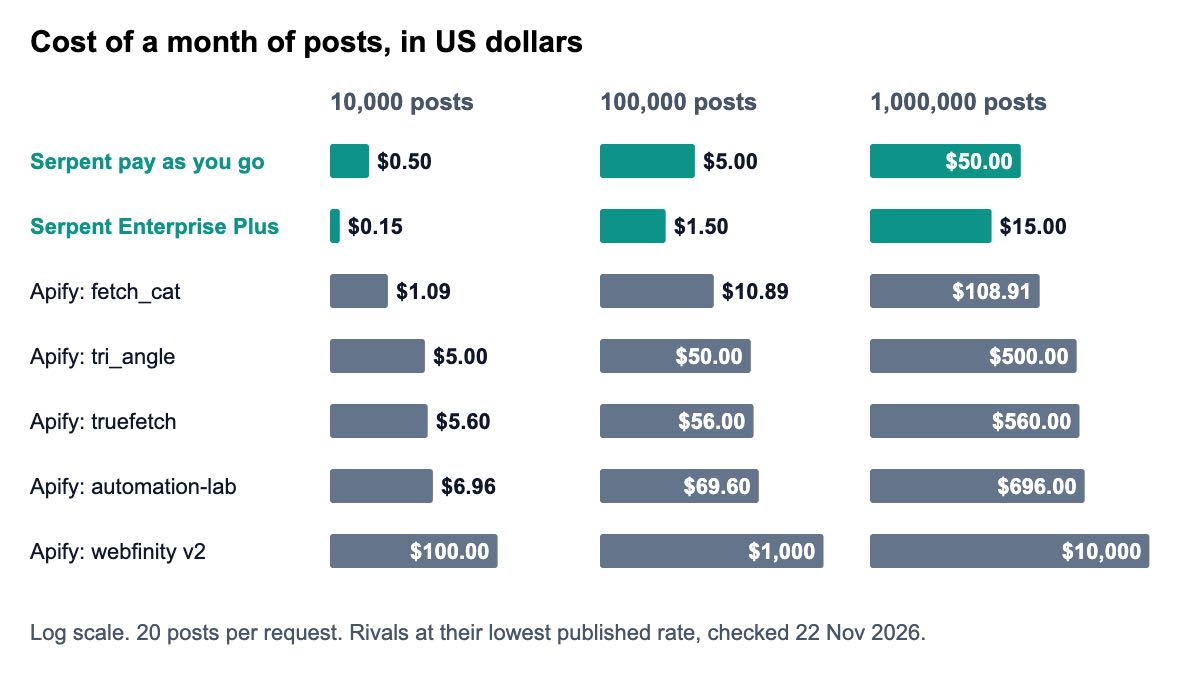
| Provider and plan | 10,000 a month | 100,000 a month | 1,000,000 a month |
|---|---|---|---|
| Serpent API: Pay as you go ($10 minimum deposit) | $0.50 | $5.00 | $50.00 |
| Serpent API: Growth ($100 deposit) | $0.37 | $3.70 | $37.00 |
| Serpent API: Scale ($500 deposit) | $0.275 | $2.75 | $27.50 |
| Serpent API: Enterprise ($1,000 deposit) | $0.205 | $2.05 | $20.50 |
| Serpent API: Enterprise Plus ($1,250 deposit) | $0.15 | $1.50 | $15.00 |
| Apify: fetch_cat, free plan ($0.447 per 1,000) | $4.47 | $44.73 | $447.31 |
| Apify: fetch_cat, Business plan ($0.233) | $2.33 | $23.34 | $233.38 |
| Apify: fetch_cat, Diamond tier ($0.109) | $1.09 | $10.89 | $108.91 |
| Apify: truefetch, free plan ($0.75) | $7.50 | $75.00 | $750.00 |
| Apify: truefetch, Business plan and above ($0.56) | $5.60 | $56.00 | $560.00 |
| Apify: automation-lab, free and Starter plans ($0.87, from 22 Nov) | $8.70 | $87.00 | $870.00 |
| Apify: automation-lab, Business plan and above ($0.696, from 22 Nov) | $6.96 | $69.60 | $696.00 |
| Apify: tri_angle, free plan ($5.00) | $50.00 | $500.00 | $5,000.00 |
| Apify: tri_angle, Business plan ($1.25) | $12.50 | $125.00 | $1,250.00 |
| Apify: tri_angle, Diamond tier ($0.50) | $5.00 | $50.00 | $500.00 |
| Apify: webfinity v2 ($10.00, flat) | $100.00 | $1,000.00 | $10,000.00 |
The rule behind each cell is the per-post rate at that plan, times the number of posts, at list price, before tax, with no free-tier credit subtracted. Here is how each row was built, so you can audit it:
- Serpent API. One call is one charge for up to 20 posts, so 10,000, 100,000 and 1,000,000 posts are 500, 5,000 and 50,000 calls. The size of a deposit sets the rate on that credit, and deposited credit does not expire. The first deposit can be as little as $10, and the free tier is 10 free API calls. The five rates are $1.00, $0.74, $0.55, $0.41 and $0.30 per 1,000 calls.
- Apify plans and tiers. Apify gives each Store actor a price per tier. Its pricing page maps the Free plan to no discount, Starter ($19 a month) to Bronze, Scale ($199) to Silver and Business ($999) to Gold. It does not mention Platinum or Diamond, so I do not know how a buyer reaches them (unverified). I show Diamond rows as the lowest published rate, which is generous to the rivals, and the Business-plan rows as the lowest rate I can show a public plan for.
- fetch_cat. $0.00044731 per post on the free plan, $0.00023338 at Gold and $0.00010891 at Diamond, plus $0.005 per run. Its page headline reads “from $0.23”, which is the Gold figure.
- truefetch. $0.00075 per result on the free plan and $0.00056 at Gold and above, plus $0.01 per run, and stored media files are charged on top ($0.00085 each on the free plan, $0.00064 at Gold).
- automation-lab. From 22 November 2026, $0.00087 per message or comment on the free and Starter plans and $0.000696 at Business and above, plus $0.005 per run and $0.00174 to $0.001392 per channel looked up.
- tri_angle. $0.005 per result on the free plan, $0.00125 at Gold and $0.0005 at Diamond, plus $0.0001 to $0.00005 per run.
- webfinity v2. $0.01 per post, with no run fee and no tiers.
Apify's own plan fees are not in these cells, and I did not research them, so a real Apify bill may sit above these numbers. Run fees are left out too, and they matter when you start many small runs. The pricing page shows how deposit size sets the Serpent rate.
What is the catch with the Apify actors?
Nearly all the rival prices come from Apify, a marketplace where independent developers publish scrapers as “actors”. Each actor sets its own price, billing unit and fields, and Apify's plan tier changes the price. Read the actor page before you build on one.
| Actor | Users, last 30 days | Free plan, per 1,000 | Lowest published, per 1,000 | Billed unit and extras |
|---|---|---|---|---|
| automation-lab | 316 | $0.87 (from 22 Nov; $1.00 before) | $0.696 (before 22 Nov: $0.244) | Message or comment; channel info and $0.005 per run extra |
| tri_angle | 151 | $5.00 | $0.50 | Result (a message or a profile item); $0.0001 per run |
| truefetch | 97 | $0.75 | $0.56 | Result; stored media files and $0.01 per run extra |
| fetch_cat | 92 | $0.447 | $0.109 | Post saved; $0.005 per run |
| webfinity v2 | 54 | $10.00 | $10.00 | Post; albums count once; no run fee |
| khadinakbar | 42 | $2.00 | $1.50 | Message; channel info $0.001 and $0.003 per run extra |
| tugelbay | 42 | $2.00 | $1.20 | Dataset item; $0.00005 per run |
| boundary | 4 | $2.00 | $2.00 | Dataset item; $0.00005 per run |
Three patterns stand out.
First, the most-used actor, automation-lab with 316 users, charges $0.87 per 1,000 on the free plan, which is 17 times Serpent's pay-as-you-go rate, and the cheapest actor on the list is not the most used one.
Second, prices move. The fetch_cat actor's changelog announces new per-post prices from 5 September 2026, and its pricing record shows the free-plan rate going from about $0.042 to $0.447 per 1,000 on that date. truefetch's record shows a new schedule from 19 November, with its free-plan rate going from $0.35 to $0.75 per 1,000. automation-lab's record shows a new schedule from 22 November at 12:00 UTC: the free-plan rate falls from $1.00 to $0.87, but its top-tier rate rises from $0.244 to $0.696 per 1,000.
Third, the user counts matter. I ignore sellers with fewer than 50 users in the last 30 days when naming the lowest standing rate, which removes khadinakbar, tugelbay and boundary from the claim; they are in the table anyway so you can see them. One other small actor currently lists no per-result charge of its own, only Apify's platform usage, and has 3 users, so it is excluded the same way. A newer automation-lab actor, telegram-public-channel-history-scraper, lists $0.326 per 1,000 items on the free plan and $0.079 at Diamond, plus $0.005 per run, but it had 7 users on 22 November 2026, so it is excluded too; it still costs more per post than Serpent's $0.05 per 1,000 posts at a full page. I found no time-limited promotional rate on the actor pages and pricing records I read.
Two more points keep the picture honest. The busiest Telegram actor on the store, lofomachines, has 516 users and charges $2.50 per 1,000 results, but it searches Telegram by keyword rather than reading a channel, so I left it out of the table. And automation-lab's prices apply to comments as well as posts, so a run that reads comments is billed at the same rate.
When does a per-post price beat a per-call price?
When a page holds only a few posts. The break-even is the price of one Serpent call divided by the rival's price per post: below that many posts per call, the per-post seller is cheaper, and above it Serpent is.
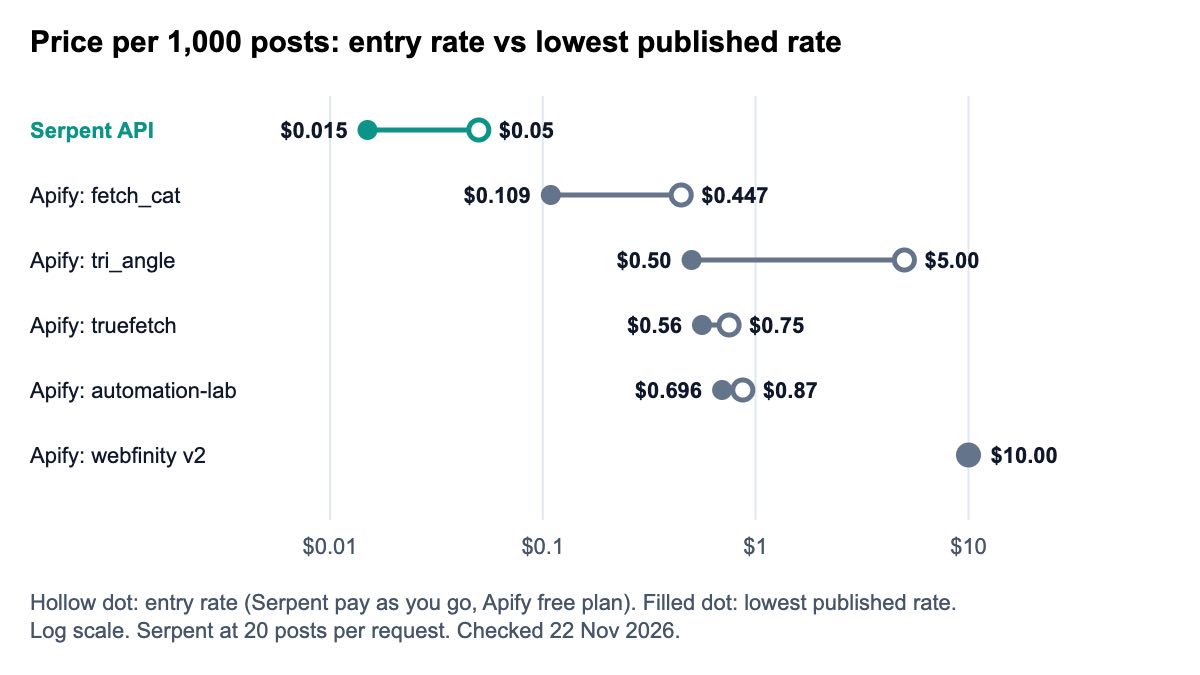
| Serpent rate | Rival rate | Break-even, posts per call |
|---|---|---|
| Pay as you go, $1.00 per 1,000 calls | automation-lab, free plan, $0.87 per 1,000 posts | about 1.1 |
| Pay as you go, $1.00 per 1,000 calls | fetch_cat, free plan, $0.447 per 1,000 posts | about 2.2 |
| Pay as you go, $1.00 per 1,000 calls | fetch_cat, lowest published rate, $0.109 per 1,000 posts | about 9.2 |
| Enterprise Plus, $0.30 per 1,000 calls | fetch_cat, Business plan, $0.233 per 1,000 posts | about 1.3 |
| Enterprise Plus, $0.30 per 1,000 calls | fetch_cat, lowest published rate, $0.109 per 1,000 posts | about 2.8 |
Read the rows as like for like. Pay as you go against a free-plan rate needs 2.2 posts per call to break even with the cheapest actor. Our top tier against that actor's lowest rate needs 2.8. The stiffest row is our entry rate against the rival's lowest published rate, which needs 9.2 posts per call, and a full page clears it more than twice over.
When does a call return fewer than 3 posts? When the channel has almost nothing to show, such as a brand-new channel, or when you have paged back to the start of a channel's history. For the newest page of an active channel it does not happen. If your list is thousands of small channels, run a hundred of them first and count the posts per page before you commit.
Per-run fees pull the other way. Apify's $0.005 to $0.01 per run is the same as 5 to 10 pay-as-you-go Serpent calls, so many small runs cost more than the per-post price suggests. Reading history costs calls too: 1,000 posts of history is about 50 pages, and each page is one call.
What do you get for the money?
With Serpent, one GET request to /api/telegram/channel returns the channel's username, title, description, subscriber count and picture, whether its posts are publicly viewable, and up to 20 posts newest first, with next_before to page back.
Each post carries its id and link, its date, text, view count, edited flag, author signature, forwarded-from name, the id of the post it replies to, photo and video links, document names, a link preview and its reactions. You pass channel as a username, an @name or a t.me link, and optionally before as a post id. The docs list every field, and the playground lets you try a channel without writing code.
A channel whose owner turned off public viewing of its posts still answers with its title and subscriber count, preview_enabled set to false and an empty posts list, in the same shape as every other answer. The answer for @durov on 21 November 2026 shows the full post fields, and the Telegram Channel API page has the answers for @durov, @rian_ru and a preview-off channel in full.
Some vendors do more than return a channel's posts, and if you need those features, price those vendors instead of the cheapest row:
- automation-lab's listing covers channels, messages, comments and profiles, and bills comments like messages.
- fetch_cat's changelog lists optional public comments, topic search, literal text checks, exclusion phrases and media-type selection.
- truefetch stores media files and charges per file, which suits you if you want the images themselves; Serpent returns the links as Telegram publishes them.
- webfinity v2 returns hashtags, mentions, links, edit dates and grouped albums, and downloads media free of charge.
- lofomachines searches Telegram posts by keyword, at $2.50 per 1,000 results, which is a different job from reading one channel.
- TGStat sells a statistics database rather than a live read: plans run from 2,100 rubles for 6,000 requests (0.35 rubles a request) to 60,900 rubles for 2,000,000 requests (0.03 rubles), with 50 free requests a month, per-post view counts over time and no stated number of posts per request. I did not convert it to dollars (unverified).
- Telegram's own developer API is free, and it needs a Telegram account plus an api_id and api_hash from registering an app, per Telegram's page. You then write and run all the code, which the Python and Node guide walks through.
If your job is mostly “give me the latest posts of these public channels with their numbers”, those extras are cost you do not need to pay. For ideas on what to build, see Telegram channel data for crypto and news monitoring.
Which free options are worth using?
For a prototype, any of them. Serpent gives a new account 10 free API calls, which is up to 200 posts at full pages. Apify's actors draw on its free plan's monthly credit, and I did not research its size. TGStat gives 50 requests a month, though its free plan also limits you to 2 of your own channels and 3 days of post history.
Free options are for testing, not for volume. If you also want other social data on the same key, the Social Media API page lists what is available, and the cheapest YouTube transcript API comparison uses the same per-1,000 method. The SERP API pricing comparison applies it to web search.
Which one should you pick?
Here are named picks by scenario, on the evidence I have:
- Prototype or a few thousand posts a month: Serpent's pay-as-you-go rate. Ten thousand posts is $0.50, and you start with 10 free API calls.
- A steady 100,000 posts a month: Serpent. The pay-as-you-go row is $5.00 and the highest tier is $1.50. The nearest rival rate I can show a public plan for is $23.34, from fetch_cat on Apify's Business plan.
- A million posts a month or more: Serpent Enterprise Plus at $15.00 per million posts. The lowest published rival rate is $108.91, and I could not confirm how a buyer reaches it.
- Channels that post only a handful of times: count posts per page on a sample first. Below about 2.2 posts per call, fetch_cat's free-plan rate wins.
- Comments, keyword search or stored media files: automation-lab or fetch_cat for comments, lofomachines for keyword search, truefetch for media files.
- Historical statistics on channels you do not read yet: TGStat, which is built as a database.
- You already pay for a general scraping service: I found no Telegram channel endpoint on the pricing and documentation pages of Scrapingdog, ScraperAPI, ScrapingBee, Zyte or Bright Data, so check before you assume one (unverified absence).
The one situation where I would not choose on price is a product whose users wait on the result. Check hit rate and speed on your own list of channels before you commit, which is easy because the playground lets you try real channels, and the Telegram Channel API page lists the fields.
How we checked this
What I checked. On 22 November 2026 I read the public actor record and the actor page for each of the eight Apify channel actors in the table, and the changelog of the cheapest. I read Apify's pricing page for which plan gets which tier, TGStat's API page for its plans and Telegram's developer page for what its own API needs. Each row records the billing unit, the price at each tier and the users in the last 30 days from Apify's public listing. The volume costs are my own arithmetic from those prices, shown above so you can repeat it.
Serpent's own numbers. The five Serpent rates are the published rates. The answers for @durov, @bloomberg and @rian_ru were captured on 21 November 2026. The check behind the speed and coverage figures was a fixed list of 60 channel names drawn before any call was made: all 31 that were public channels with public viewing on returned their posts on page one, all 10 second-page requests returned older posts, and the median call took about 3.0 seconds, with nine in ten within 6.4 seconds.
This is Serpent's check of Serpent's product, so treat it as a vendor claim and try your own list.
What I could not verify:
- automation-lab's new prices took effect on 22 November 2026 at 12:00 UTC; I read them again in its live pricing record after that time. I have not seen a bill at the new rates.
- I could not confirm how a buyer reaches Apify's Platinum and Diamond tiers. Apify's pricing page lists plans only up to Business (Gold), so $0.109 and $0.50 may not be reachable on a standard plan.
- I did not research Apify's own plan fees or the size of its free-plan credit.
- I could not confirm that a billed “message” or “result” is exactly one post. tri_angle's page says a result can be a profile item or a message, and automation-lab bills comments as messages. I treated one billed unit as one post.
- The truefetch page showed an older price table when I fetched it, while its pricing record and page headline show the 19 November schedule. I used the record.
- One actor that appeared in a web search, cheapget, returned a page-not-found on 22 November, so I excluded it.
- TGStat is priced in rubles and does not state posts per request, so it has no per-post figure; I could not convert it.
- I found no Telegram endpoint at the general scraping services named above, judged from their pricing pages only.
Prices change often, so re-check any vendor within a week of buying.
Price your own volume
Serpent's Telegram Channel API is from $0.05 per 1,000 posts — pay as you go, no subscription, with 10 free API calls to start. Try a real channel in the playground before you write any code.
Get Your Free API KeyExplore: Telegram Channel API · Playground · Docs · Pricing
FAQ
What is the cheapest Telegram channel API?
On public prices checked on 22 November 2026, Serpent API is the cheapest I found: $0.05 per 1,000 posts pay as you go and $0.015 on its highest tier, at a full page of 20 posts per call. The lowest rival rate I could verify is $0.109 per 1,000 posts at the top tier of an Apify actor, and its free-plan rate is $0.447. The comparison assumes full pages, so check what a page holds for your channels.
How much does it cost to get 1,000 Telegram posts?
At full pages of 20 posts, 1,000 posts is 50 calls: $0.05 at Serpent's pay-as-you-go rate of $1.00 per 1,000 calls, and $0.015 on its highest tier. Apify actors charge per post, from $0.447 per 1,000 on the cheapest actor's free plan and $0.109 at its lowest tier, up to $10.00 per 1,000 on a flat-rate actor.
How do I compare a per-call price with a per-post price?
Divide the per-call price by the posts a call returns. A Serpent call returns one page of up to 20 posts, so $1.00 per 1,000 calls is $0.05 per 1,000 posts. A channel with fewer posts returns fewer, and Serpent stays cheaper per post as long as a page holds more than about 2.2 posts against the cheapest actor's free-plan rate, or about 2.8 posts at the top tier against its lowest rate.
Is there a free Telegram channel API?
Serpent gives a new account 10 free API calls, which is up to 200 posts at full pages. Apify actors draw on its free plan's monthly credit, which I did not research, and TGStat's API has a free plan of 50 requests a month. Telegram's own developer API is free, but it needs a Telegram account and an api_id and api_hash from registering an app, and you write all the code yourself.
How often do Telegram scraper prices change?
Often. The fetch_cat actor's per-post price changed on 5 September 2026, truefetch's pricing record shows a new schedule from 19 November, and automation-lab's changes on 22 November, when its free-plan rate falls from $1.00 to $0.87 per 1,000 messages and its top-tier rate rises from $0.244 to $0.696. Treat any price here as a snapshot and check the vendor's page within a week of buying.
Does a cheaper Telegram API mean worse results?
Not by itself. Price says nothing about hit rate, speed or fields, so judge those on your own list of channels. A useful test includes a busy channel, a quiet one, one in a non-Latin script and one whose owner turned off public viewing of its posts. Compare what comes back for each, not only the price, and keep the fields you need in mind, such as views, reactions and forwarded-from.
Sources
Apify actor pages and public records (checked 22 Nov 2026):
- automation-lab Telegram scraper and its pricing record
- tri_angle Telegram scraper and its pricing record
- truefetch Telegram channel message and its pricing record
- fetch_cat Telegram channel posts scraper, its changelog and its pricing record
- webfinity Telegram channel content and media scraper v2
- khadinakbar Telegram channel scraper and its pricing record
- tugelbay Telegram posts scraper and its pricing record
- boundary Telegram channel scraper
- lofomachines Telegram keyword search scraper
- Apify Store listing for “telegram” (users in the last 30 days)
- Apify pricing, plans and Store discount tiers
Other providers (checked 22 Nov 2026):
Considered and excluded (checked 22 Nov 2026):
- cheapget Telegram channel message actor: page not found on 22 November 2026
- Actors with fewer than 50 users in 30 days are listed in the table but not counted for the lowest standing rate