SerpApi vs SearchApi: the real price per 1,000 searches

SearchApi costs less per search than SerpApi at 10,000, 100,000 and 1,000,000 searches a month, by 2.5x to 3.75x. SerpApi wins below 1,000 searches a month and sells paid speed modes. Both charge only for successful searches and cap hourly use near 20% of a plan.
Short answer: pick SerpApi if you stay at or under 1,000 searches a month (Starter is $25 against SearchApi's $40) or want a published speed tier and will pay 2x or 4x for it. Pick SearchApi for anything from 1,001 searches up when price decides. If your volume is uneven and you dislike monthly plans, a pay-as-you-go option such as Serpent API is a third route.
SerpApi and SearchApi look alike from a distance: both sell monthly plans, both return Google results as JSON, and both promise legal cover. The bill is where they split, and so are the small print and the speed claims. I read both vendors' own pages on 21 Nov 2026 and put the numbers side by side. Full disclosure: I run Serpent API, a third option, so every figure below links to its source and anything I could not confirm is labelled.
What does each one cost per 1,000 searches?
It depends on how much of your plan you use, because both vendors sell fixed monthly bundles. I divided each plan's price by the searches it includes. Where a page prints its own per-1,000 rate, I show that as printed.
SerpApi's pricing page lists a Free plan and then a long ladder that runs on to a Cloud 54M plan at $106,050 a month. These are the rows that matter for most buyers:
| Plan | Price a month | Searches a month | Price per 1,000 | Searches per hour (page) |
|---|---|---|---|---|
| Free | $0 | 250 | n/a | 50 |
| Starter | $25 | 1,000 | $25.00 | 200 |
| Developer | $75 | 5,000 | $15.00 | 1,000 |
| Production | $150 | 15,000 | $10.00 | 3,000 |
| Big Data | $275 | 30,000 | $9.17 | 6,000 |
| Searcher | $725 | 100,000 | $7.25 | 20,000 |
| Volume | $1,475 | 250,000 | $5.90 | 50,000 |
| Infrastructure | $2,750 | 500,000 | $5.50 | 100,000 |
| Cloud 1M | $3,750 | 1,000,000 | $3.75 | 110,000 |
SearchApi's pricing page is shorter, with a "High Volume" tab for the Octo plans:
| Plan | Price a month | Searches a month | Price per 1,000 (as printed) | Searches per hour (calc) |
|---|---|---|---|---|
| Developer | $40 | 10,000 | $4 | 2,000 |
| Production | $100 | 35,000 | $3 (division gives $2.86) | 7,000 |
| BigData | $250 | 100,000 | $2.5 | 20,000 |
| Scale | $500 | 250,000 | $2 | 50,000 |
| Octo 500K | $900 | 500,000 | $1.8 | 100,000 |
| Octo 1M | $1,500 | 1,000,000 | $1.5 | 200,000 |
| Octo 2M | $2,800 | 2,000,000 | $1.4 | 400,000 |
| Octo 5M | $5,000 | 5,000,000 | $1 | 1,000,000 |
One unit matters here. A "search" at SearchApi is one page of results: its Google docs say num is fixed at 10 and you move through results with page. SerpApi's Search API docs page with a start offset, and its pricing page says a response with 100 results counts as one search, so check what you request before you compare prices.
The printed per-1,000 rate for a plan only holds if you use every search in it. A buyer at 10,000 searches a month on SerpApi still pays for a 15,000 plan. Other comparison pages mix these two ideas: OpenSerp's October 2026 table labels a row "~1,000" searches but lists SearchApi's 10,000-search plan, so its $4.00 is a rate for 10,000, not a cost at 1,000.
Which plan do you land on at 10K, 100K and 1M searches a month?
SearchApi is cheaper at all three, and the gap narrows as volume grows. My rule: take the cheapest plan that covers the volume, then divide the cash for the month by the searches you actually use.
| Searches a month | SerpApi plan | SerpApi per 1,000 used | SearchApi plan | SearchApi per 1,000 used | SerpApi costs |
|---|---|---|---|---|---|
| 10,000 | Production, $150 | $15.00 | Developer, $40 | $4.00 | 3.75x |
| 100,000 | Searcher, $725 | $7.25 | BigData, $250 | $2.50 | 2.9x |
| 1,000,000 | Cloud 1M, $3,750 | $3.75 | Octo 1M, $1,500 | $1.50 | 2.5x |
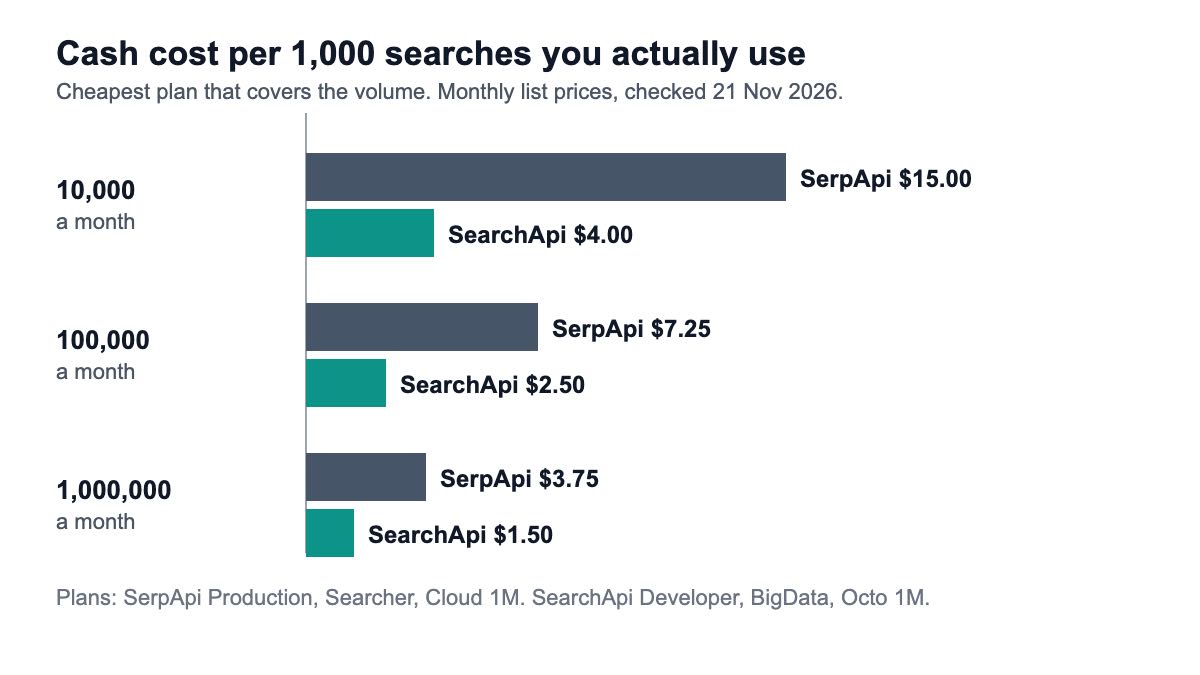
In cash, that is $150 against $40 a month at 10,000, $725 against $250 at 100,000, and $3,750 against $1,500 at 1,000,000. For deeper SerpApi numbers see SerpApi pricing explained.
The order flips at the bottom. At 1,000 searches a month SerpApi's Starter plan is $25, while SearchApi's smallest plan is $40 and holds 10,000. From 1,001 searches SerpApi has to step up to Developer at $75 for 5,000, which is still above SearchApi's $40. So SerpApi is cheaper only if you stay at or below 1,000 searches, and it also gives you 250 free searches a month.
Neither pricing page states a per-search overage price, so I cannot tell you what happens at 10,001 searches on a 10,000 plan. SearchApi's page also gives no annual discount. Ask both vendors before you size a plan to the edge of your volume.
What happens to free, failed and unused searches?
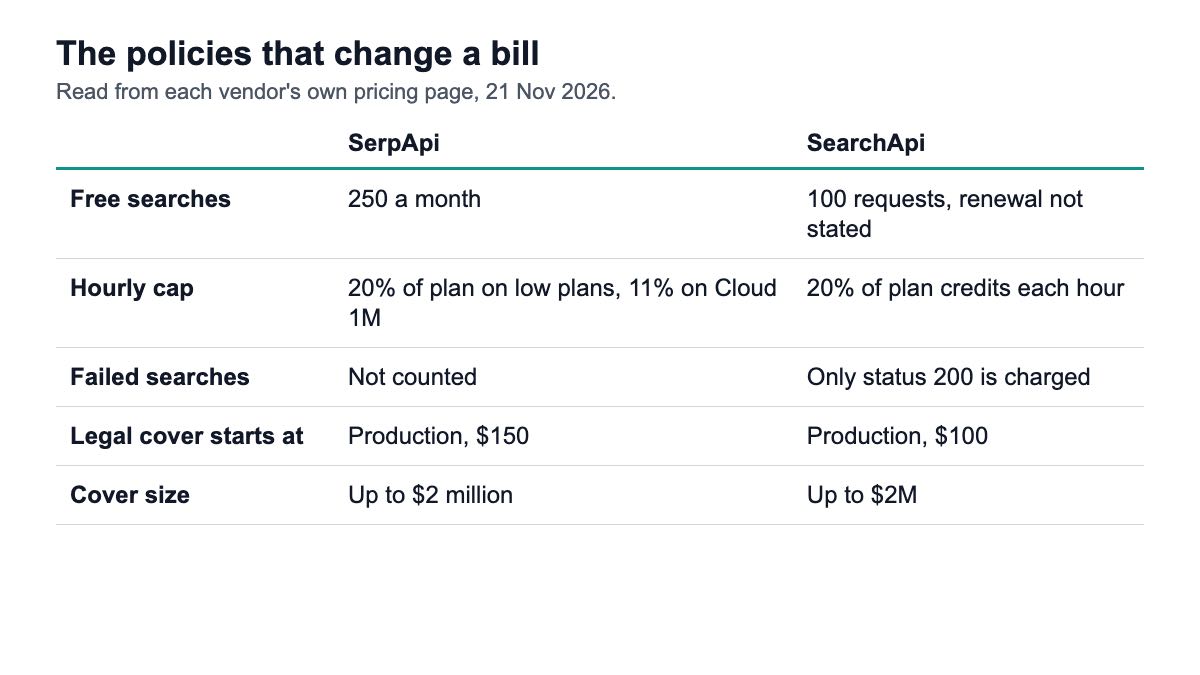
SerpApi's Free plan is $0 for 250 searches a month at up to 50 an hour. SearchApi's button reads "Sign up for 100 free requests" with "No credit card required. No commitment. Cancel anytime." The page does not say whether those 100 recur each month, so treat them as a one-time trial.
Be careful with older articles. SerpApi's own comparison post says in its FAQ that you get "100 free searches per month", while a banner on the same page says 250. The pricing page is the one to trust.
Failed searches are free at both. SerpApi says: "Only successful searches are counted toward your monthly searches. Cached, errored, and failed searches are not." It adds that a response with an empty result set still counts as 1 search. SearchApi says: "Only successful searches with a 200 status code incur charges." Its page does not say how it treats an empty result set that returns a 200.
Cache matters on SerpApi. Its docs say cached results expire after 1 hour and a no_cache parameter forces a fresh fetch, so repeat queries inside an hour cost nothing there.
Unused searches are the least clear area. SerpApi's page says leftovers from a previous plan go to an "Extra Credits" balance when you change plans, and does not say whether Extra Credits expire. SearchApi's page does not mention rollover at all.
I treat monthly searches at both as use-it-or-lose-it until a vendor says otherwise in writing. For how credit expiry works elsewhere, see do SERP API credits expire.
How fast are they, really?
I cannot tell you which is faster, because neither vendor publishes a measurement I could verify and the one head-to-head timing I found is too small to rank them. What exists is vendor claims, which I quote with their source.
- SerpApi sells three speed modes on its pricing page: Best Effort at no extra cost, Ludicrous Speed at 2x the base price and Ludicrous Speed Max at 4x. Its page says Ludicrous Speed delivers "2.2× faster average response times and 4.2× faster p99 compared to Best Effort", and Max "9.6% faster average response times and 35.4% faster p99 compared to Ludicrous Speed". Its home page gives no latency figure and says "Each API request runs immediately".
- SearchApi's home page says "Sub-2 second average response time" and "99.9% success rate". Its pricing page shows "Standard speed" and "Enhanced speed" beside each plan and does not say what the difference is or what Enhanced costs.
So the honest question is "faster at what price". SerpApi puts a multiplier on speed. SearchApi publishes one average without defining it.
The only direct timing in the results I read is Scrapingdog's post, published 28 Jan 2026 and edited 26 Oct 2026. Scrapingdog sells a third product and presents it as the fastest and cheapest of the three. It reports Google search averages of 3.34 seconds for SerpApi and 4.55 seconds for SearchApi, and Google Shopping averages of 7.20 and 3.67 seconds.
Each figure rests on 10 requests, and "success" meant an HTTP 200. The script printed on the page uses a placeholder endpoint and key, so the table cannot be reproduced from it as shown.
Ten requests and a status code cannot separate two vendors, and the Shopping result points the other way from the search result. I would not choose on it.
The better move is a ten-minute check of your own. Both vendors offer free searches, and SearchApi's response includes a search_metadata block with total_time_taken, so you can log what it reports for your own queries.
What happens when you hit the hourly cap?
Both vendors limit how fast you can spend a plan, and on the lower plans the limit is the same: 20% of the plan each hour. SearchApi's FAQ says "you can utilize only up to 20% of your plan's credits each hour". SerpApi prints a throughput column, and my arithmetic on its table gives 20% for Free (50 of 250), Starter (200 of 1,000) and Searcher (20,000 of 100,000), and 11% for Cloud 1M (110,000 of 1,000,000).
This turns into a scheduling fact. A 100,000-search job on either vendor's 100,000-search plan takes at least 5 hours (100,000 divided by 20,000 an hour). A 1,000,000-search job takes about 9 hours on Cloud 1M at 110,000 an hour, and about 5 hours on SearchApi's Octo 1M if one credit equals one search, which is my assumption. SearchApi's page labels higher plans "Medium Throughput", "High Throughput" and "Dedicated" without numbers, so above the 20% rule I have no figures for it.
SerpApi's home page also advises spreading searches evenly through each hour. ScrapeCreators' comparison, updated 29 Aug 2026, reports the same 20% rule for SearchApi and the same entry prices for both.
Which one covers more engines and result types?
Neither page gives a clean engine count, so I will not name a winner. SerpApi's home page lists roughly 100 APIs, about 65 of them Google, plus Bing, Baidu, Brave, DuckDuckGo, Naver, Yahoo and Yandex, and shopping and social APIs such as Amazon, eBay, Walmart, YouTube, TikTok and Instagram. SearchApi's "APIs" menu lists about 100 entries as well, mixing search engines (Google, Bing, Baidu, Naver, Yahoo, Yandex, DuckDuckGo) with non-search APIs such as Amazon, Reddit, Airbnb, TikTok, LinkedIn Jobs, Trustpilot and Instagram. Both counts are my approximate reading of a page or screenshot, and I did not see Brave among SearchApi's search engines.
SerpApi's comparison post claims "80+" search engines for itself and "25+" for SearchApi. That is a vendor's count of a rival, written in 2024 and updated in February 2026, so I treat it as a claim.
The same post runs four one-off queries and marks features with ticks. In its "events in Austin" test it shows Event Results and Sponsored results as supported only by SerpApi. That is SerpApi's test of a rival, and I did not repeat it.
The call shape is nearly the same. SerpApi: GET https://serpapi.com/search?api_key=...&engine=google&q=... with keys such as organic_results, knowledge_graph, related_questions, local_results and pagination, plus output=json|html|md. SearchApi: https://www.searchapi.io/api/v1/search with engine=google, a key as a parameter or Bearer header, and keys such as organic_results, knowledge_graph, related_searches, pagination and search_metadata.
Field names differ in places, so budget a few hours to remap a parser either way.
Both list SOC 2 Type II and ISO 27001 on their home pages, SerpApi also SOC 3 and SearchApi GDPR. On uptime, SerpApi's home page says both "a 99.95% SLA guarantee with all plans" and "uptime SLAs of up to 99.97%" in the premium-support text, so it quotes two figures. SearchApi lists a 99.9% SLA on its plan cards.
What does the legal protection say?
Both promise up to $2 million, and both exclude your own use of the data. SerpApi's "U.S. Legal Shield provides up to $2 million in coverage for the scraping and parsing of search engine data, as long as your use of the data or service is not illegal." SearchApi's page says it accepts "legal responsibility for how SearchApi collects and parses publicly available search results, backed by up to $2M in coverage", that it applies worldwide under U.S. law, and that it "does not cover your use of the data or unlawful activities".
The threshold differs. SerpApi's cover starts at the Production plan ($150 a month); Starter and Developer show a cross on the plan cards, and the Free plan's marking I could not confirm. SearchApi's "Legal Protection Guarantee" starts at Production ($100); its Developer plan has no such line. If cover matters and you are small, SearchApi reaches it for $50 less, and for a 35,000-search plan against SerpApi's 15,000.
Is there a court case between them?
SerpApi filed a lawsuit against SearchApi in 2026; the case was pending as of April.
Where does Serpent API fit?
I run Serpent API, the site you are reading, so weigh this section accordingly. It is a third option with a different billing shape: no monthly plan to size, and credits you deposit and spend. Prices start from $0.03 per 1,000 searches, pay as you go (see pricing; checked 21 Nov 2026).
The rate depends on the size of your deposit, so here is the full ladder next to the two plans from the table above at 100,000 searches a month. The unit is the per-page search at /api/search, billed per page of up to 10 results, which is the closest match to a "search" at either vendor.
| Option | What you commit | Price per 1,000 searches |
|---|---|---|
| SerpApi, Searcher plan | $725 a month for 100,000 | $7.25 |
| SearchApi, BigData plan | $250 a month for 100,000 | $2.50 |
| Serpent API, Default | $10 deposit | $0.60 |
| Serpent API, Growth | $100 deposit | $0.30 |
| Serpent API, Scale | $500 deposit | $0.10 |
| Serpent API, Enterprise | $1,000 deposit | $0.05 |
| Serpent API, Enterprise Plus | $1,250 deposit | $0.03 |
The two kinds of rows are not the same product shape. The vendor rows are monthly plans that reset; the Serpent API rows are one-time deposits whose size sets your rate. Deposited credits do not expire, while promotional bonus credits expire after 30 days, and the first deposit must be at least $10, per the pricing page. A free account adds 10 free API calls.
Setting engine= to google, bing, yahoo, ddg or brave does not change the price. The output is structured JSON for each of those engines, documented under engines in the docs, with per-page search described in the docs. See also the Google SERP API and Bing SERP API pages, and the wider SERP API overview.
I make no speed or accuracy claim for Serpent API in this post, in either direction. If you are comparing, use the free calls on your own queries, which is the same advice I gave for the two vendors above. For broader comparisons, see SerpApi alternatives, Serpent API against SerpApi, DataForSEO and Serper and SERP APIs without a subscription.
Which one should you pick?
- Pick SerpApi if you run 1,000 searches a month or fewer, want 250 free searches a month, or need a speed tier with published figures and accept paying 2x or 4x the base price for it.
- Pick SearchApi if you run more than 1,000 searches a month and price decides: at 10,000, 100,000 and 1,000,000 it is $4.00, $2.50 and $1.50 per 1,000 used, against $15.00, $7.25 and $3.75. It also reaches legal cover at $100 instead of $150.
- Also pick SerpApi if you value its public SOC 3 and SLA wording, its documented caching with
no_cache, and its larger plan ladder, and your volume leaves room for the extra cost. - Look at pay as you go if your volume is uneven, you do not want a monthly reset, or you want Google, Bing, Yahoo, DuckDuckGo and Brave JSON on one rate. See the Serpent API table above.
On the evidence I have, I would start on SearchApi's free requests for any new project above 1,000 searches a month, log the response times it reports, and move to SerpApi only if I needed its speed modes or its Starter economics. That is a judgement from price pages, not a performance result.
How I checked this
Sources and dates. I read 6 official vendor pages (SerpApi and SearchApi pricing, home and docs), 4 comparison articles by vendors (SerpApi, Scrapingdog, OpenSerp, ScrapeCreators), 2 review-site compare pages (TrustRadius, SaaSHub) and Serpent API's own pricing page. Prices were read on 20 Nov 2026; the entry plans re-read on 21 Nov 2026 matched, and the high-volume plans and speed figures are from the 20 Nov read. I made no calls to either vendor's API or to Serpent API for this post, so there is no timing or accuracy data here.
How the numbers were made. Per-1,000 figures are plan price divided by included searches. Cost at volume is the cash for the cheapest plan that covers the volume divided by the searches used. Hourly figures for SearchApi apply its 20% rule to plan size and assume one credit per search.
What I could not verify. SearchApi's total engine count and whether its 100 free requests recur; SearchApi rollover, overage price, annual discount and what "Enhanced speed" means; SerpApi's overage price and whether Extra Credits expire; any real speed difference; and SerpApi's Free-plan legal cover marking. The SerpApi speed-mode figures and SearchApi Octo prices were read through a fetch tool rather than a raw browser view. Two further comparison pages returned HTTP 403 and are not used.
Review sites. Their content is thin. TrustRadius shows SerpApi at 7.4 out of 10 from 4 reviews, no SearchApi rating, and a SerpApi starting price of $50 for 5,000 searches that no longer matches SerpApi's own page; SaaSHub shows no reviews for either. I did not use their prices.
Try a pay-as-you-go option
From $0.03 per 1,000 searches, pay as you go, no subscription (checked 21 Nov 2026), with 10 free API calls on a free account.
Get Your Free API KeyExplore: SERP API · Playground · Docs · Pricing
FAQ
Is SearchApi cheaper than SerpApi?
On list prices read on 21 Nov 2026, yes from 1,001 searches a month upward. At 10,000, 100,000 and 1,000,000 searches a month SearchApi works out to $4.00, $2.50 and $1.50 per 1,000 used, against $15.00, $7.25 and $3.75 for SerpApi. Below 1,000 searches a month SerpApi's $25 Starter plan is cheaper than SearchApi's $40 Developer plan.
Do SerpApi and SearchApi have a free plan?
SerpApi's Free plan gives 250 searches a month at up to 50 an hour. SearchApi offers 100 free requests with no credit card, but its pricing page does not say whether they renew, so treat them as a one-time trial. SerpApi's own comparison post mentions 100 free searches elsewhere, which conflicts with its pricing page; the pricing page is the current source.
Which one is faster?
I could not verify a difference. SerpApi's page claims 2.2x faster average response for its 2x-price Ludicrous Speed mode compared with Best Effort, and SearchApi's home page claims a sub-2 second average. The only head-to-head timing I found is a 10-request test by a third vendor, judged on HTTP 200, which cannot separate them. Time your own queries on the free searches.
Do they charge for failed searches?
No, per their pricing pages. SerpApi says cached, errored and failed searches are not counted, though an empty result set counts as 1 search. SearchApi says only successful searches with a 200 status code incur charges. SearchApi's page does not state how it treats an empty result that still returns a 200.
Do both include legal protection?
Both offer up to $2 million in coverage, and both say it does not cover your own unlawful use of the data. SerpApi's U.S. Legal Shield starts at its $150 Production plan. SearchApi's Legal Protection Guarantee starts at its $100 Production plan. Entry plans on both lack it.
Which should I use at 100,000 searches a month?
If cost is the deciding factor, SearchApi's BigData plan is $250 for 100,000 searches against $725 for SerpApi's Searcher plan. Both cap hourly use at about 20% of the plan, so a full 100,000-search job takes at least 5 hours on either. Choose SerpApi at this size only for a feature or speed mode you need.
Sources
Official pricing and docs (checked 21 November 2026):
- SerpApi pricing
- SearchApi pricing
- SerpApi home page
- SearchApi home page
- SerpApi Search API docs
- SearchApi Google Search API docs
Comparison articles by vendors (read 21 November 2026; read as claims):
- SerpApi: SerpApi vs Serper vs ValueSERP vs SearchApi
- Scrapingdog: SerpApi vs SearchApi vs Scrapingdog
- OpenSerp: SearchApi vs SerpApi
- ScrapeCreators: SERP API comparison
Review sites and court record (read 21 November 2026):