SERPHouse alternatives priced at 10K to 1M searches

SERPHouse is a fair deal at small volume and unpriced above 80,000 searches a month. Basic costs $29.99 for 40,000 searches ($0.75 per 1,000) by its own 10-credit rule. For more volume or a lower rate, the alternatives below run $0.03 to $7.25 per 1,000 at 100,000 searches a month.
Short answer: Stay on SERPHouse if you use under 40,000 searches a month and want one fixed $29.99 bill for Google, Bing and Yahoo. Move to Serper if you want credit packs that last six months, to DataForSEO if results can wait in a queue for $0.60 per 1,000, and to Zenserp if you need DuckDuckGo and Yandex on a paid plan. Pick Serpent API if price per search at 100K and 1M matters most, and weigh that we sell it. Prices checked 21 Nov 2026.
Full disclosure: I run Serpent API, one of the options in this comparison, so every number below links to the page it came from and carries the date I read it. If a vendor does not publish a figure, the table says "not published" instead of guessing. For the wider market, see the SERP API pricing comparison.
What does SERPHouse cost right now?
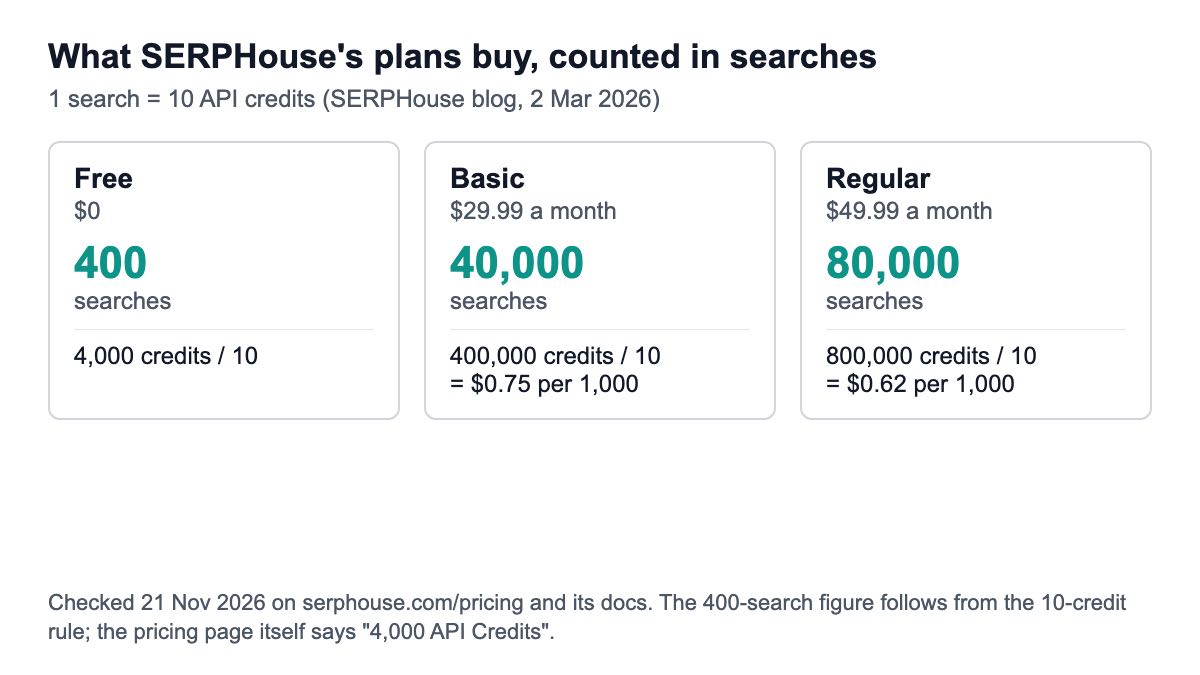
SERPHouse sells three published plans, and its prices are quoted per request but billed in credits. I checked its pricing page on 21 Nov 2026. SERPHouse's March 2026 blog post says one SERP request is 10 API credits, and that Google, Bing and Yahoo SERP requests each cost 10.
That rule is what turns a credit count into a search count. The "searches" column below is my arithmetic, not a figure printed on the pricing page.
| Plan | Price | API credits | Searches at 10 credits (my calc) | Per 1,000: printed / calc | Other terms on the page |
|---|---|---|---|---|---|
| Free | $0 | 4,000 | 400 | n/a | 60 concurrency, no credit rollover |
| Basic | $29.99 a month | 400,000 | 40,000 | $0.75 / $0.7498 | 60 concurrency, Priority Support |
| Regular | $49.99 a month | 800,000 | 80,000 | $0.62 / $0.6249 | 60 concurrency, Dedicated Support, marked "Most Popular" |
| Custom | "$$$" | Not published | Not published | Not published | "Contact us" |
The pricing page also lists Auto Complete at $0.37 per 1,000 on Basic and $0.31 on Regular. By my arithmetic that is about 5 credits per request at the Basic rate, while the March blog post says Google Autocomplete costs 2 credits. I could not reconcile the two, so I do not use autocomplete in any comparison here.
There is one more line to read carefully. The pricing page still lists "$7.50/1k Top 100 Google SERP Requests" on Basic and $6.25 on Regular. SERPHouse's Top 100 docs page, last updated 26 Oct 2026, is tagged "Deprecated" and says to use the Google Search API page by page instead. The same docs page prices it as "1 page = 10 credits", so ten pages is 100 credits.
Both statements are on SERPHouse's own site. I treat the Top 100 row as a legacy price, not a current offer.
Two more details sit on different pages. The pricing page says "99.99% Uptime SLA" for the paid plans, while the docs pricing table shows 99.95%. I quote neither as a guarantee.
Why do people look for a SERPHouse alternative?
The reasons I can source fall into seven groups. None of them is a defect; each is a trade-off that suits some buyers and not others.
- The published ladder stops at 80,000 searches. Regular is the largest plan with a price. The Custom card shows "$$$" and "Contact us" (pricing page).
- Allowances do not roll over. The FAQ says unused searches do not carry forward: "No, they don't. At the start of your billing cycle each month, your subscription renews with a fresh allowance of successful search credits."
- The trial is smaller than it sounds. 4,000 credits is 400 searches under the 10-credit rule. More on that in the next section.
- Error handling is on you. The FAQ says "We only count successful requests. Failed requests need to be retried." SERPHouse's getting-started docs add that a 200 status can also carry an error body, with
"status": "error"and the message "Please try again", so your code has to read the body, not just the status code. - Response time reports differ. The SERPHouse home page claims a standard average response time under 8 seconds. One reviewer on Trustpilot wrote "The avg response time is between 8-11 sec, and have some spikes over 20 sec". That is one person's experience, not a measurement, and I have no timing data of my own.
- One account per user. The docs say "Our system allows single account per user", so splitting a large workload across several accounts is not offered.
- Price at higher volume. Other vendors publish rates down to $0.30 or less per 1,000 at scale. The cost table below shows where.
Customer sentiment is mostly positive. Trustpilot showed a 4.6 TrustScore across 28 reviews with 92% five-star when I read it on 20 Nov, and SERPHouse's own pages say 4.7. G2 listed one review, rated 5.0, on 21 Nov, which is too few to tell you anything.
What does the free trial actually give you?
The pricing page says 4,000 API credits, which is 400 searches if the 10-credit rule applies to the request type you use. The arithmetic is 4,000 credits divided by 10 credits per search, using the pricing page and the March 2026 blog post.
SERPHouse uses both units on its own pages. Its compare page lists the free tier as "4,000 searches" in a row headed "Amount of Searches available for free". The home page tab title on 21 Nov read "4,000 Free Credits", and a note I took on 20 Nov had the home page body saying "4,000 free searches".
I could not re-read the home page body on 21 Nov, so I do not know which word it uses today. I read the figure as credits because that is what the pricing page says.
The length of the trial depends on your email address. The pricing page says "Work email 1 month, renews monthly" and "Personal email 7 days, no auto-renewal". Its refund rule is separate: a full refund within 7 days of subscribing, as long as no more than 20% of search credits on Basic or Regular, or 20,000 searches on custom plans, have been used, and only on the first month's charge.
Free allowances at the alternatives, read on the same dates:
| Provider | Free allowance as written | Note |
|---|---|---|
| SERPHouse | 4,000 API credits | 400 searches by the 10-credit rule |
| SerpApi | 250 searches per month | 50 throughput per hour on the free card |
| SearchApi | 100 free requests | Whether it recurs is not stated |
| Serper | 2,500 free queries | Button text on the pricing cards |
| Zenserp | 50 free searches a month | Free plan covers Google Search |
| Scrapingdog | 100 credits | "Start free with 100 credits" |
| Serpent API | 10 free API calls | On a free account, see pricing |
What happens above 80,000 searches a month?
The published answer is "contact us". The FAQ says: "We offer a custom plan based on your requirements. You have to write us at getsupport@serphouse.com with your Monthly/Yearly requirement." It does not say what happens when credits run out before the month ends, and I found no overage rate.
That matters because most alternatives publish a price at 100K and 1M. SerpApi lists a Searcher plan at $725 for 100,000 searches and Cloud 1M at $3,750 for 1,000,000, and its table runs on to 54,000,000 searches. Zenserp lists Enterprise at $899 for 1,000,000. If you plan to grow, a published price lets you budget before you talk to sales.
Which alternative fixes which problem?
Each row names the reason from the list above and the options whose own pages address it. "Checked" means read on the vendor's page on 21 Nov 2026, except where noted.
| If your problem is | Look at | What their page says |
|---|---|---|
| No price above 80,000 searches | SerpApi, Zenserp, SearchApi, Serper, Scrapingdog | SerpApi plans up to 54M searches; Zenserp 1,000,000 for $899; Serper packs up to 12.5M credits for $3,750 |
| Unused allowance is lost each month | Serper, Scrapingdog, Serpent API | Serper: "Credits valid for 6 months"; Scrapingdog: unused credits roll over from the Standard plan upward; Serpent API: deposited credits never expire (bonus credits expire after 30 days) |
| Paying for failed requests | SerpApi, Zenserp, Scrapingdog | SerpApi: "Cached, errored, and failed searches are not" counted; Zenserp: "Only successful requests are billed"; Scrapingdog: "Failed requests never charged". SERPHouse also counts successful requests only |
| Need DuckDuckGo or Yandex | Zenserp, Serpent API | Zenserp's Small plan lists Google, Bing, Yandex and DuckDuckGo; Serpent API lists google, bing, yahoo, ddg and brave on one price |
| Lowest price and results can wait | DataForSEO Standard | $0.60 per 1,000; "Target: 45 minutes", "about 5 minutes on average" for the queue |
| Need a faster DataForSEO mode | DataForSEO Live | $2.00 per 1,000; "Up to 6 seconds on average" per its pricing page |
| Want a bigger free trial | Serper, SerpApi | 2,500 free queries; 250 searches per month |
For deeper write-ups of single vendors, see the posts on SerpApi alternatives, Serper alternatives, Zenserp alternatives, DataForSEO alternatives and Scrapingdog alternatives.
So which one is cheapest at 10K, 100K and 1M?
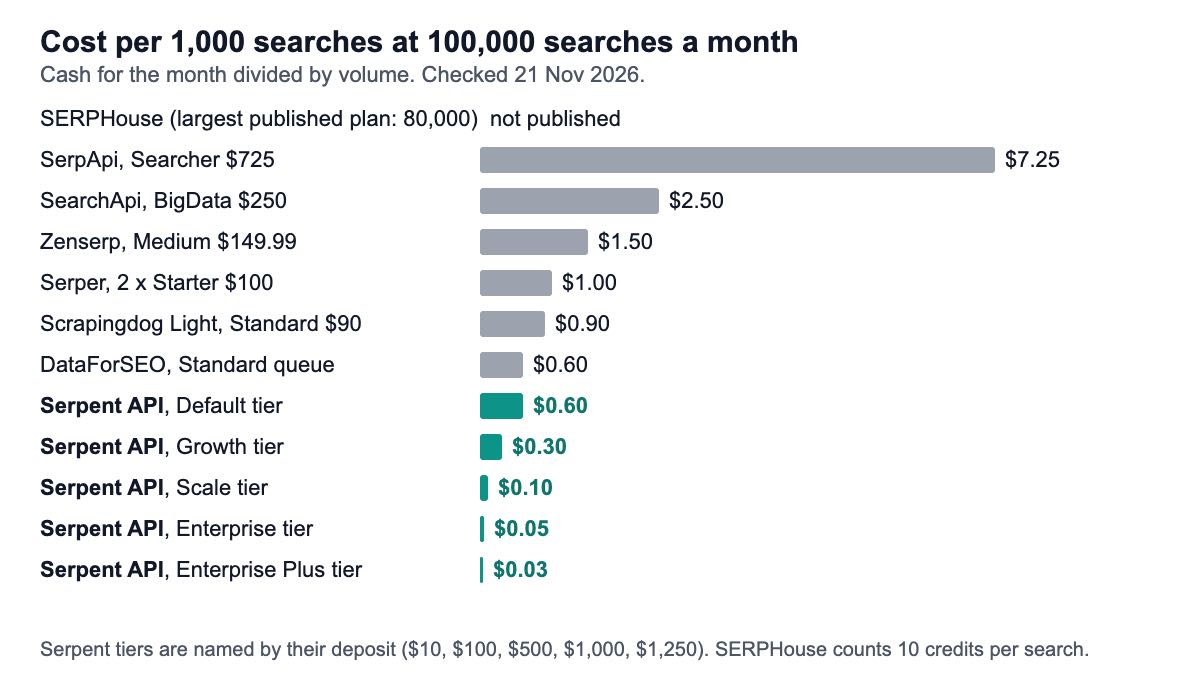
On price per search alone, the higher Serpent API tiers are the lowest in the table, and they also need the largest deposits. The cheapest non-Serpent figures are DataForSEO Standard at $0.60 flat and Scrapingdog Light at $0.35 per 1,000 at 1M. SERPHouse has no published price above 80,000 searches.
The rules I used, so you can redo the arithmetic:
- Cost per 1,000 is the cash for one month divided by the searches in that month, using the smallest published plan or pack that covers the volume.
- A search is one page of results. SERPHouse counts 10 credits per search; Scrapingdog's Light request is 5 credits; for Serper I treat 1 credit as 1 search, which I did not confirm for every request type.
- Prepaid packs (Serper, DataForSEO, Serpent API) keep unused balance, so the leftover is not wasted; monthly plans (SERPHouse, SerpApi, SearchApi, Zenserp, Scrapingdog) reset each month, so I count the full plan price.
- Yearly toggles and promo codes are left out, such as Zenserp's yearly discount of 20% and Scrapingdog's Black Friday code.
- DataForSEO's $50 minimum top-up is in my 20 Nov notes and I did not re-read it on 21 Nov, so the $6 and $60 usage figures assume you already hold a balance.
- Serpent API rows show usage cost at each tier's rate. Each tier is named by its deposit, so the $0.03 rate needs the $1,250 deposit.
| Provider and plan used | 10,000 searches | 100,000 searches | 1,000,000 searches |
|---|---|---|---|
| SERPHouse (Basic, then Regular up to 80,000) | $29.99 ($3.00) | Not published | Not published |
| SerpApi (Production, Searcher, Cloud 1M) | $150 ($15.00) | $725 ($7.25) | $3,750 ($3.75) |
| SearchApi (Developer, BigData, Octo) | $40 ($4.00) | $250 ($2.50) | $1,500 ($1.50), read 20 Nov |
| Zenserp (Small, Medium, Enterprise) | $49.99 ($5.00) | $149.99 ($1.50) | $899 ($0.90) |
| Serper (1 or 2 packs of the 50k or 500k size) | $50 ($5.00) | $100, two 50k packs ($1.00) | $750, two 500k packs ($0.75) |
| Scrapingdog Light, 5 credits (Lite, Standard, Premium) | $40 ($4.00) | $90 ($0.90) | $350 ($0.35) |
| DataForSEO Standard queue | $6 ($0.60) | $60 ($0.60) | $600 ($0.60) |
| DataForSEO Live mode | $20 ($2.00) | $200 ($2.00) | $2,000 ($2.00) |
| Serpent API, Default tier ($10 deposit) | $6.00 ($0.60) | $60 ($0.60) | $600 ($0.60) |
| Serpent API, Growth tier ($100 deposit) | $3.00 ($0.30) | $30 ($0.30) | $300 ($0.30) |
| Serpent API, Scale tier ($500 deposit) | $1.00 ($0.10) | $10 ($0.10) | $100 ($0.10) |
| Serpent API, Enterprise tier ($1,000 deposit) | $0.50 ($0.05) | $5 ($0.05) | $50 ($0.05) |
| Serpent API, Enterprise Plus tier ($1,250 deposit) | $0.30 ($0.03) | $3 ($0.03) | $30 ($0.03) |
Read the SERPHouse row with care. At 10,000 searches the $29.99 plan costs $3.00 per 1,000 in practice, because you pay the plan price whether you use 10,000 or 40,000 searches. The $0.75 headline applies only when you use all 40,000. Serper's $1.00 at 100K buys two 50,000-credit packs, which covers the month exactly, while at 10K the first pack leaves 40,000 credits valid for six months.
SearchApi's 1M price comes from my 20 Nov read, because I did not open its high-volume plans again on 21 Nov.
Scrapingdog's Light price is for a lighter request than its 10-credit Advance request, and its page does not say what Light leaves out. Check the response you need before you count on $0.35. For the other pricing models side by side, see SERP APIs without a subscription and whether SERP API credits expire.
Does SERPHouse cover the engines you need?
SERPHouse's pricing page says "Data From Google, Bing And Yahoo", and prices Web, News, Image, Shop, Jobs, Videos and Short Videos requests under one per-1,000 rate. For many teams that is enough. Open WebUI's docs list SERPHouse as a supported web-search provider, which shows at least one open-source chat tool supports it.
If you need other engines, the alternatives differ. Zenserp's Small plan lists Google, Bing, Yandex and DuckDuckGo, while its free plan lists Google Search. Serpent API's documented engines are Google, Bing, Yahoo, DuckDuckGo and Brave, set with the engine parameter and returned as structured JSON in one shape. I did not re-read DataForSEO's engine list on 21 Nov, so I make no claim about it here.
Our engine pages cover Google, Bing and Yahoo, the same three engines SERPHouse lists. If Yahoo is your main reason for looking, the free Yahoo search API guide covers the free tiers in more detail.
When should you stay on SERPHouse?
Stay if the numbers fit and nothing on the "why" list is hurting you. These are reasons that hold up against the sources above.
- You use 40,000 searches or fewer a month and want one predictable bill. Basic is a fixed $29.99; a prepaid balance is a different habit to manage.
- You need Google, Bing and Yahoo on one plan with 60 concurrent requests on every plan, as the pricing page and docs state.
- You use its extra features. The home page lists bulk processing and postback or pingback URLs. I have not tried them and they are SERPHouse's claims.
- You are already integrated and happy. Reviews are mostly positive (4.6 across 28 on Trustpilot when I read it), and a rewrite has a cost of its own.
- Refund terms matter. A full first-month refund within 7 days is stated, with the 20% usage cap.
If one of these is you, the cheapest move is to do nothing. If you are on Basic and close to 40,000 searches, compare Regular at $49.99 for 80,000 before you compare vendors.
Where does Serpent API fit?
I run Serpent API and publish this blog, so weigh this section accordingly. Our price is from $0.03 per 1,000 searches, pay as you go, no subscription (checked 21 Nov 2026; see pricing). The five tiers are in the cost table above, from $0.60 at the $10 deposit tier to $0.03 at the $1,250 tier, and the lowest rate needs that top deposit.
What the docs describe: one price across engine=google, bing, yahoo, ddg and brave, billed per page of results, with a header key and structured JSON back. Every documented key, such as organic, ads and peopleAlsoAsk, is always present, and an empty block comes back as null or [], so one parser can read any engine (search API docs). Deposited credits never expire, and a free account gets 10 free API calls. I say nothing here about speed or accuracy; test any vendor, me included, on your own keywords.
How do you switch without breaking your code?
Most of the work is in authentication, parameters and the response parser, not in the search itself. Use this checklist.
- Authentication. SERPHouse's docs show host
api.serphouse.com, path/serp/livewith an HTTP POST, and either anAuthorization: Bearerheader or anapi_tokenquery parameter. Serpent API's docs show a GET with anX-API-Keyheader. - Parameters. Map your query, country and engine fields one by one. On Serpent API the engine is the
enginevalue from the docs. - Response keys. Run the same 50 keywords through both and compare parsed fields (rank, URL, title), not just the HTTP status. A 200 can hide an error body, as SERPHouse's docs warn.
- Billing units. Convert credits to searches before you compare invoices. SERPHouse's 400,000 credits is 40,000 searches.
- Concurrency. SERPHouse's docs state a concurrency of 60 on Free, Basic and Regular. Check the new provider's published figure before you copy your worker count.
- Overlap. Because SERPHouse allowances reset monthly and do not roll over, switch at the start of a billing cycle and use up what you have paid for.
Which one should you pick?
- Under 40,000 searches, three engines, fixed bill: stay on SERPHouse Basic.
- 40,000 to 80,000 searches: SERPHouse Regular at $49.99 is still the simplest step; compare it with Scrapingdog Light, where $90 buys 200,000 searches at 5 credits each.
- Above 80,000 and you want a published price: SerpApi, SearchApi, Zenserp, Serper, Scrapingdog and Serpent API all publish one.
- Lowest cost per search with a prepaid balance: Serpent API's higher tiers, with the deposit trade-off stated above, or DataForSEO Standard at $0.60 if a queue is acceptable.
- Unused balance should not vanish: Serper (six months) or Serpent API (deposited credits never expire).
- Larger free trial: Serper's 2,500 queries is the largest free allowance in the table above.
How I checked this
I read about 25 pages between 20 and 21 Nov 2026: 3 SERPHouse pages (pricing, FAQ, home), 2 SERPHouse docs pages (getting started and the Top 100 endpoint), 4 SERPHouse blog posts, the SERPHouse compare page, 6 competitor pricing pages (SerpApi, SearchApi, Serper, DataForSEO, Zenserp, Scrapingdog), Trustpilot, G2, SaaSHub, Open WebUI's docs, AlternativeTo, WebCatalog and SourceForge, plus our own pricing and docs pages. I made no API calls and no sign-ups. The searches, per-1,000 and cash figures are my arithmetic from the published numbers, and the sums are in the table rules above. Some pages were read as text and some as screenshots, which I note where it matters.
What I could not verify: how SERPHouse's home page body words its free allowance today; the credit cost of News, Image, Shop and other request types (only Google, Bing and Yahoo SERP at 10 credits is stated); what happens when credits run out; Custom and overage pricing; real response times for any vendor; SearchApi's 1M plan and whether its 100 free requests recur on 21 Nov; DataForSEO's $50 minimum top-up and engine list, from my 20 Nov notes and not re-read; the G2 alternatives page, which returned a 403; and the autocomplete credit mismatch described above. SERPHouse's own comparison tables use undated "approx." figures for rivals, so I did not use them.
Try Serpent API on your own keywords
From $0.03 per 1,000 searches, pay as you go, no subscription (checked 21 Nov 2026). Get 10 free API calls on a free account, and compare the parsed results with your current provider before you move anything.
Get Your Free API KeyExplore: SERP API · Playground · Docs · Pricing
FAQ
How many searches do SERPHouse's 4,000 free credits give you?
400 searches if the 10-credit rule applies. SERPHouse's pricing page says 4,000 API credits, and its March 2026 blog post says a Google, Bing or Yahoo SERP request costs 10 credits. Its compare page words the same allowance as "4,000 searches", so check which unit your plan page shows when you sign up.
Does SERPHouse offer a free trial?
Yes. The pricing page lists a Free plan at $0 with 4,000 API credits and 60 concurrency. A work email gets 1 month that renews monthly, and a personal email gets 7 days with no auto-renewal. A screenshot of the home page hero on 21 Nov also shows "No Credit Card Required", though its text could not be read.
What is SERPHouse's price per 1,000 searches?
The pricing page prints $0.75 on Basic and $0.62 on Regular. My arithmetic gives $0.7498 and $0.6249, which round to the same figures. Those rates assume you use the full plan, so 10,000 searches on Basic works out to $3.00 per 1,000 in practice, and the page publishes no price above 80,000 searches a month.
Is the SERPHouse Top 100 endpoint still available?
It is unclear. The pricing page still lists a "Top 100 Google SERP Requests" row at $7.50 per 1,000 on Basic. The docs page for it, last updated 26 Oct 2026, is tagged "Deprecated" and points to the Google Search API page by page. Ask SERPHouse support before you build on it.
Do SERPHouse credits roll over?
No. The FAQ says unused searches do not carry over, and each month the subscription renews with a fresh allowance of successful search credits. The docs pricing table also shows "No" for monthly credit rollover on every plan. Serper's packs last six months, and Serpent API's deposited credits never expire, if you want a balance that stays.
Which SERPHouse alternative is cheapest?
It depends on your volume and on how much deposit you accept. At 100,000 searches a month the lowest published figures in my table are Serpent API's tiers, from $0.60 down to $0.03 per 1,000, then DataForSEO Standard at $0.60 and Scrapingdog Light at $0.90. SERPHouse has no published price at that volume. I sell Serpent API, so check each row against the linked pricing page.
Sources
SERPHouse pages and docs (checked 21 November 2026):
- SERPHouse pricing
- SERPHouse FAQ
- SERPHouse home page
- SERPHouse getting-started docs
- SERPHouse Top 100 docs page
- SERPHouse blog, 2 March 2026 (credits per request)
- SERPHouse compare page
Competitor pricing pages (checked 21 November 2026; SearchApi 1M plan, 20 November):
- SerpApi pricing
- SearchApi pricing
- Serper
- DataForSEO Google organic SERP pricing
- Zenserp pricing plans
- Scrapingdog pricing
Reviews, directories and third-party docs (read 20 and 21 November 2026):