Leaving SearchApi? Seven alternatives, matched to your reason

The best SearchApi alternative depends on which part of SearchApi you want to get away from. If it is the price, pay-per-search APIs start from $0.03 per 1,000 against SearchApi's $1.00 to $4.00. If it is the 20%-per-hour cap or the monthly reset, other billing models fix that instead.
Short answer: To cut cost per search, move to Serpent API (from $0.03 per 1,000 — pay as you go, no subscription; pricing) or DataForSEO's standard queue ($0.60 per 1,000). If the hourly cap is the problem, Bright Data lists unlimited concurrency and Scrapingdog sells plans by concurrent requests. For Google-only work on prepaid credits, Serper; for the widest catalogue with legal coverage, SerpApi, which costs more. Stay on SearchApi if you rely on its legal coverage from the $100 plan, its long list of engines and verticals, and you can live with the hourly share.
What does SearchApi cost today?
SearchApi sells monthly plans from $40 for 10,000 searches ($4.00 per 1,000) to $5,000 for 5,000,000 ($1.00 per 1,000). New accounts get 100 free requests with no card. These are the figures on SearchApi's pricing page on 20 November 2026.
| Plan | Price a month | Searches a month | Per 1,000 | Most searches in one hour (20%) |
|---|---|---|---|---|
| Developer | $40 | 10,000 | $4.00 | 2,000 |
| Production | $100 | 35,000 | $2.86 | 7,000 |
| BigData | $250 | 100,000 | $2.50 | 20,000 |
| Scale | $500 | 250,000 | $2.00 | 50,000 |
| Octo 500K | $900 | 500,000 | $1.80 | 100,000 |
| Octo 1M | $1,500 | 1,000,000 | $1.50 | 200,000 |
| Octo 2M | $2,800 | 2,000,000 | $1.40 | 400,000 |
| Octo 5M | $5,000 | 5,000,000 | $1.00 | 1,000,000 |
Two small notes on the table. The pricing page labels the Production plan "$3 per 1,000", but $100 for 35,000 searches is $2.86, so I show the arithmetic. And older comparison pages disagree on SearchApi's prices; one competitor's guide gives the 100,000-search price three different ways, so check the live page before you budget.
The good parts are real. Only searches that return a 200 status are charged. From the Production plan up, SearchApi offers a Legal Protection Guarantee, which its homepage describes as accepting legal responsibility for how it collects and parses public search results, "backed by up to $2M in coverage". Its API menu lists about 100 products, from Google and its sub-products to Bing, Baidu, Naver, Yandex, DuckDuckGo, YouTube, Amazon and Walmart.
Why do teams look for a SearchApi alternative?
Four reasons come up, and they are about packaging, not data quality. This section sticks to what SearchApi's pricing page says.
1. The price per search
At 10,000 searches a month you pay $4.00 per 1,000, and even at 1,000,000 you pay $1.50. Pay-per-use options charge the same rate whatever your monthly volume, from $0.03 per 1,000 on Serpent API to $0.60 on DataForSEO's standard queue, and fixed plans like Scrapingdog's reach $0.35 per 1,000 at a million searches. For a rank tracker or an AI agent that searches often, that gap is the whole budget.
2. The 20%-per-hour cap
The pricing page says "you can utilize only up to 20% of your plan's credits each hour." On the Developer plan that is 2,000 searches an hour; on BigData, 20,000. If your job runs once a night and needs to finish in an hour, you must buy a plan five times larger than your monthly need. Our guide to SERP API rate limits compares how each provider limits speed.
3. A monthly allowance that may not carry over
SearchApi sells searches per month, and its pricing page does not say whether unused searches roll over. Budget as if they reset. If you are busy one month and quiet the next, you pay for the busy month twice.
4. A small free trial
One hundred free requests is enough for a smoke test, not for running your real keyword list across countries. Bright Data gives 5,000 requests every month and Serper 2,500 once.
Which alternative fixes which problem?
Pick the alternative that removes your specific reason. A cheaper provider does not automatically fix the hourly cap, and a provider without a cap may not be cheaper.
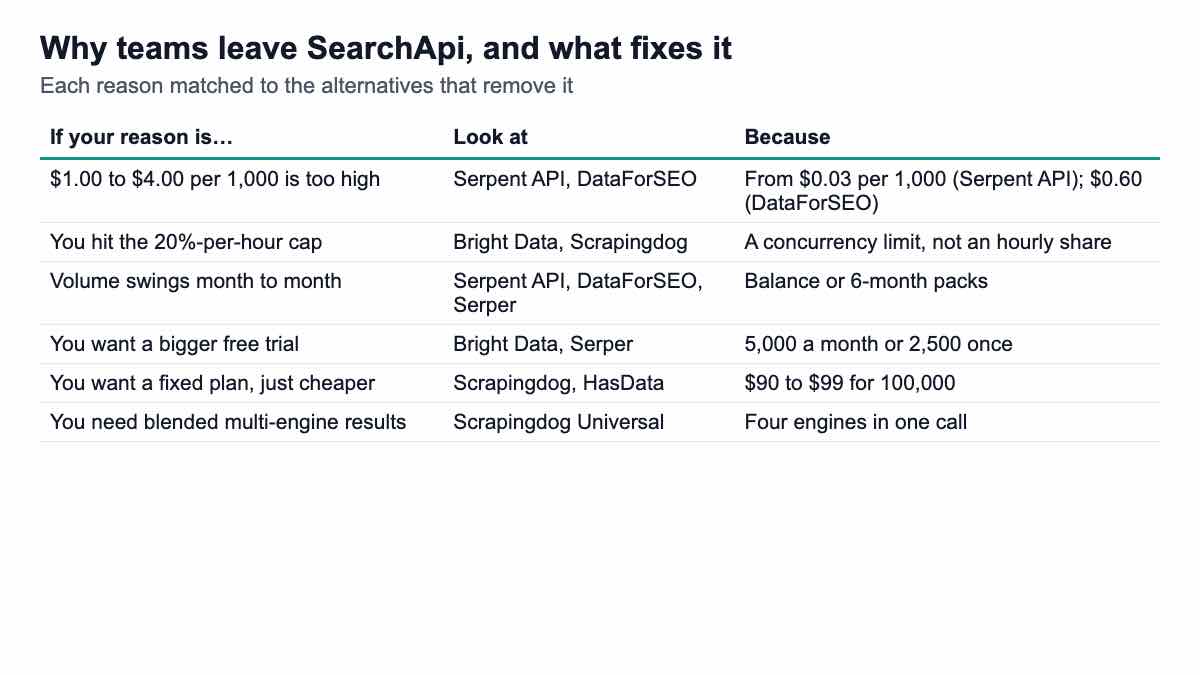
- Price per search too high: Serpent API (from $0.03 per 1,000) or DataForSEO's standard queue ($0.60 per 1,000).
- Hitting the hourly cap: Bright Data lists unlimited concurrency on pay as you go and its Scale plan; Scrapingdog limits concurrent requests per plan (50 on Standard) instead of an hourly share.
- Volume swings month to month: Serpent API's deposited credit and DataForSEO's funds do not expire; Serper's packs last 6 months.
- Bigger free trial: Bright Data (5,000 a month) or Serper (2,500 once).
- Want a fixed plan, cheaper: Scrapingdog ($90 for 1,000,000 credits) or HasData ($99 for 100,000 searches).
- Want blended results from several engines in one response: Scrapingdog's Universal Search API, which merges Google, Bing, Yahoo and DuckDuckGo for 20 credits a call (docs).
How much do the alternatives cost at 10K, 100K and 1M?
At SearchApi's BigData size of 100,000 Google searches a month, the same workload costs $725 on SerpApi, $250 on SearchApi, $90 on Scrapingdog, $60 on DataForSEO's standard queue, and $3 on Serpent API at its lowest rate (from $0.03 per 1,000 — pay as you go, no subscription; see pricing).
The rules: one search is one page of Google results with no add-ons. For monthly plans I took the cheapest plan that covers the volume and divided its price by the searches used. Serper's packs are valid 6 months, so its cost is the pack price spread over the months it lasts.
Pay-per-use prices are rate times volume, and free tiers are left out. Serpent API rows show every deposit tier, and a deposit is spendable credit, not a fee.
| Provider (plan picked) | 10,000 / month | 100,000 / month | 1,000,000 / month |
|---|---|---|---|
| SearchApi | $40 (Developer) = $4.00/1K | $250 (BigData) = $2.50/1K | $1,500 (Octo 1M) = $1.50/1K |
| SerpApi | $150 (Production) = $15.00/1K | $725 (Searcher) = $7.25/1K | $3,750 (Cloud 1M) = $3.75/1K |
| Zenserp | $49.99 (Small) = $5.00/1K | $149.99 (Medium) = $1.50/1K | $899 (Enterprise) = $0.90/1K |
| HasData | $49 (Startup) = $4.90/1K | $99 (Basic) = $0.99/1K | Unverified (largest listed plan is 300K) |
| Scrapingdog (Light, 5 credits) | $40 (Lite) = $4.00/1K | $90 (Standard) = $0.90/1K | $350 (Premium) = $0.35/1K |
| Serper (6-month packs) | $10 = $1.00/1K | $75 = $0.75/1K | $500 = $0.50/1K |
| Bright Data | $15 pay as you go = $1.50/1K | $150 pay as you go = $1.50/1K | $1,109 (Scale, $999 step) = $1.11/1K |
| DataForSEO, standard queue | $6 = $0.60/1K | $60 = $0.60/1K | $600 = $0.60/1K |
| Serpent API, Default | $6 = $0.60/1K | $60 = $0.60/1K | $600 = $0.60/1K |
| Serpent API, Growth ($100 deposit) | $3 = $0.30/1K | $30 = $0.30/1K | $300 = $0.30/1K |
| Serpent API, Scale ($500 deposit) | $1 = $0.10/1K | $10 = $0.10/1K | $100 = $0.10/1K |
| Serpent API, Enterprise ($1,000 deposit) | $0.50 = $0.05/1K | $5 = $0.05/1K | $50 = $0.05/1K |
| Serpent API, Enterprise Plus ($1,250 deposit) | $0.30 = $0.03/1K | $3 = $0.03/1K | $30 = $0.03/1K |
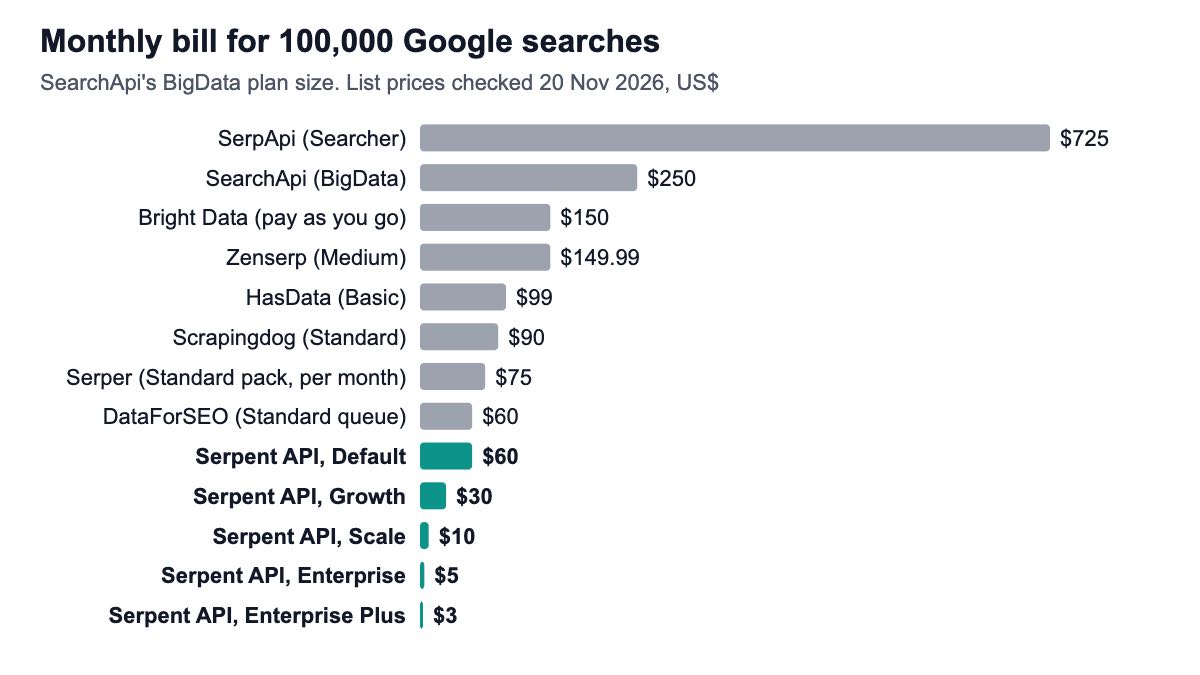
SearchApi is cheaper than SerpApi at every volume, so if you are coming from SerpApi it can still be a saving. Against the rest of the field, it sits near the top: about four times DataForSEO's standard queue at 100,000 searches, and more than 80 times Serpent API's lowest rate.
The seven alternatives, one by one
Serpent API: best for the lowest price per search
Serpent API returns Google, Bing, Yahoo, DuckDuckGo and Brave results as JSON from $0.03 per 1,000, pay as you go, with no subscription and no plan to outgrow. The engine is a parameter, the price does not change with it, and deposited credit never expires. The organic endpoint can be asked for up to 100 results in one call for one charge, with num as a ceiling rather than a guaranteed count (Google calls often return 40 to 70); the web search reference has every parameter.
How the rate is set: the size of a single deposit picks your rate, and the deposit is credit you then spend. Every tier is on the pricing page.
DataForSEO: best for big queued batches
DataForSEO charges $0.0006 per page of 10 Google results in its standard queue, $0.0012 in priority and $0.002 live (Google Organic rates). The minimum top-up is $50 and funds do not expire.
Watch out for: the cheapest rate is queued, so results arrive later rather than in the same request. Our DataForSEO alternatives page covers the trade-offs.
Scrapingdog: best for a cheaper fixed plan
Scrapingdog's plans sell credits: $40 for 200,000, $90 for 1,000,000, $350 for 6,000,000. A Google Light search is 5 credits, Advance 10, Bing 5. From the Standard plan up, unused credits roll over, and failed requests are credited back. Plans set a concurrency limit (5 on Lite, 50 on Standard) rather than an hourly share of credits.
Watch out for: check which Google API returns the fields you read, since Advance doubles the cost. See our Scrapingdog alternative guide for its limits.
Serper: best for fast Google-only work on prepaid credits
Serper sells packs from $50 for 50,000 credits to $3,750 for 12,500,000, and credits are valid for 6 months. You get 2,500 free queries to start.
Watch out for: it is Google only, so you lose SearchApi's other engines. Our Serper alternatives page explains when that matters.
Bright Data: best when the hourly cap is the problem
Bright Data's SERP pricing lists 5,000 free requests a month, $1.50 per 1,000 pay as you go, and a Scale plan in three steps: $499 for 380,000 requests ($1.30 per 1,000 after that), $999 for 900,000 ($1.10 after) and $1,999 for 2,000,000 ($1.00 after). Pay as you go and Scale both list unlimited concurrency. Its product page lists seven engines: Google, Bing, DuckDuckGo, Yandex, Baidu, Yahoo and Naver.
Watch out for: it is not cheap per search, and its billing docs say a zone set to send custom headers or cookies is billed for failed requests too.
SerpApi: best for catalogue breadth with legal coverage
SerpApi has the most familiar name in the category and a very wide engine list. Its U.S. Legal Shield covers "up to $2 million" for scraping and parsing search data, from the $150 Production plan up. Cached, errored and failed searches are not counted.
Watch out for: it costs more than SearchApi at every volume compared here, and each plan is sold with an hourly throughput figure as well. If you are leaving SearchApi for price, this is not the move. Our SerpApi alternatives page shows the gap.
HasData: best for a simple monthly plan with Bing included
HasData sells 20,000 Google or Bing searches for $49, 100,000 for $99 and 300,000 for $208, with 1,000 free credits every month. Concurrency is 5, 15 and 50 on those plans.
Watch out for: the low concurrency on the smaller plans, and no listed self-serve plan above 300,000 searches.
Zenserp is the eighth name people ask about. Its plans start at $49.99 for 25,000 searches and fall to $0.90 per 1,000 at a million (Zenserp pricing), but it is another monthly plan with a similar shape to SearchApi. If you are leaving Zenserp itself, the Zenserp alternatives guide matches each reason for leaving to a replacement.
When should you stay on SearchApi?
Stay if legal coverage on a mid-sized plan is a requirement and you use more than plain Google results. SearchApi includes its Legal Protection Guarantee from the $100 Production plan, while SerpApi's Legal Shield starts at $150. Our SerpApi vs SearchApi comparison sets the two side by side.
Its catalogue is also a reason to stay. If your product reads Google Flights, Google News, Amazon and YouTube through one schema and one key, replacing that with three cheaper vendors costs engineering time.
Finally, if your traffic is spread evenly through the day, the 20%-per-hour rule rarely bites. In that case, the main argument for leaving is price, and you can decide on the table above.
How do you switch without a bad week?
Run both side by side before you cancel anything. A cheaper result that differs from what your users expect is not a saving.
- List the fields you use. Organic title, link and position, perhaps related questions or local results. Ignore fields you never read.
- Pick 30 real queries in the countries and languages you serve, on each engine you need.
- Run them through SearchApi and your shortlist. Free allowances get you started: 10 free API calls on Serpent API, 2,500 on Serper, 5,000 a month on Bright Data.
- Check the parsed fields, not just status codes. Confirm every field you read is filled, the country and language match what you asked for, and the result counts suit your job.
- Move one job at a time and keep SearchApi until the billing month ends.
Most of the work is mapping response fields. SearchApi and most alternatives return organic results as a list with title, link and position, so a thin adapter in your code usually covers it. If you also want to avoid a monthly plan altogether, see SERP APIs without a subscription.
Which one should you pick?
- You are leaving for price, any volume: Serpent API, or DataForSEO if queued results are fine.
- The hourly cap breaks your batch window: Bright Data, or Scrapingdog with a plan sized for concurrency.
- Google only, quick setup, prepaid: Serper.
- You are weighing SERPHouse too: our SERPHouse alternatives guide prices it against the same field.
- About 100,000 a month on a fixed plan: Scrapingdog or HasData.
- Legal coverage and a huge catalogue matter more than price: stay on SearchApi, or SerpApi if you want its larger plans.
How we checked this
On 20 November 2026 I read SearchApi's pricing page, homepage and Bing docs; the live pricing pages of SerpApi, Scrapingdog, Serper, DataForSEO, Bright Data, HasData and Zenserp; DataForSEO's top-up page, Bright Data's billing docs and SERP API product page, and Scrapingdog's Universal Search page and docs: 15 external sources, all official vendor pages. I also read four of the pages that rank for "searchapi alternatives" to see what they get wrong. Serpent API's prices and parameters come from our own pricing page and API docs the same day.
The cost table is arithmetic on list prices with the rules stated above it. No paid calls were made and no output quality or speed is compared. What I could not verify: whether SearchApi carries unused searches over (its page does not say), whether its "Enhanced" speed option costs extra (no price shown), HasData's price above 300,000 searches, and whether SerpApi's hourly throughput figure works as a hard cap.
Try the cheaper side of the table
Serpent API returns Google, Bing, Yahoo, DuckDuckGo and Brave results as JSON from $0.03 per 1,000 — pay as you go, no subscription. Sign up for 10 free API calls and compare against your SearchApi output.
Get Your Free API KeyExplore: SERP API · Playground · Docs · Pricing
FAQ
How much does SearchApi cost?
On 20 November 2026 SearchApi's plans ran from Developer at $40 a month for 10,000 searches to Octo 5M at $5,000 for 5,000,000, with Production at $100 for 35,000 and BigData at $250 for 100,000 in between. That is $4.00 per 1,000 at the bottom and $1.00 at the top. New accounts get 100 free requests, and only searches with a 200 status are charged.
Is SearchApi cheaper than SerpApi?
Yes, at every plan size compared here. For 10,000 searches a month SearchApi costs $40 against SerpApi's $150, for 100,000 it costs $250 against $725, and for 1,000,000 it costs $1,500 against $3,750. Both offer legal coverage of up to $2 million on mid-tier plans and up, from $100 on SearchApi and $150 on SerpApi. SearchApi caps each hour at 20% of the plan, and SerpApi lists an hourly throughput for each plan.
What does SearchApi's 20% hourly limit mean in practice?
SearchApi's pricing page says you can use up to 20% of your plan's credits each hour. On the 10,000-search Developer plan that means at most 2,000 searches in any hour; on the 100,000-search BigData plan, 20,000. If you need to run a whole month's quota in a short window, for example a nightly job, you would need a larger plan or a provider that limits concurrent requests instead.
Which SearchApi alternative has the biggest free tier?
Bright Data lists 5,000 free SERP requests every month with no card, and Serper gives 2,500 free queries once. SerpApi's free plan is 250 searches a month, HasData gives 1,000 credits a month (100 searches), and Serpent API gives 10 free API calls usable on any of its five engines. SearchApi itself gives 100 free requests at sign-up.
Does any SearchApi alternative return several engines in one call?
Scrapingdog's Universal Search API returns organic results from Google, Bing, Yahoo and DuckDuckGo in one request and merges duplicate links into one entry, for 20 credits a call. Most other providers, SearchApi included, return one engine per call, which keeps each engine's own positions. That is what you want for rank tracking; the merged call suits research lists where position by engine does not matter.
Sources
SearchApi (checked 20 November 2026):
- SearchApi pricing
- SearchApi homepage (legal coverage, free requests)
- SearchApi Bing docs and engine list
Official pricing and docs of the alternatives (checked 20 November 2026):
- SerpApi pricing and Legal Shield
- Scrapingdog pricing
- Scrapingdog Universal Search API
- Scrapingdog Universal Search API docs (credit cost)
- Serper credit packs
- DataForSEO Google Organic rates
- DataForSEO pricing (minimum top-up, expiry)
- Bright Data SERP API pricing
- Bright Data SERP API billing docs
- Bright Data SERP API product page (engine list)
- HasData prices
- Zenserp pricing