Apify Google Search Scraper pricing: what 1,000 result pages really cost

Apify's official Google Search Results Scraper charges per page of results: $4.50 per 1,000 pages on the Free plan, $2.50 on Starter, $1.95 on Scale and $1.80 on Business. A page holds about 10 results. Add-ons such as AI Overview and ads cost extra, and the monthly plan fee sets a floor under the bill.
Short answer: For a few thousand pages a month, the official actor on Apify's Free or Starter plan is fine and costs $0 to $25. For 100,000 pages or more, the official actor costs $1.80 to $1.99 per 1,000, and cheaper community actors such as scraperlink's charge $0.50, so test one if you stay on Apify. If you only need search results and not the rest of Apify's platform, a SERP API is usually cheaper: Serpent API is from $0.03 per 1,000 — pay as you go, no subscription — and DataForSEO's standard queue is $0.60.
How does the official actor charge?
The official actor, apify/google-search-scraper, is billed per event, and the main event is one Google results page scraped successfully. You pay that event once per page, and the price depends on your Apify plan.
The actor's store page advertises "from $1.80 / 1,000 scraped search result pages" and says platform usage is not billed separately. The full rate card sits in the actor's public pricing data on Apify's API, which I read on 20 November 2026; this pricing took effect on 7 October 2026.
| Apify plan (store discount tier) | Per result page | Per 1,000 result pages |
|---|---|---|
| Free (no discount) | $0.0045 | $4.50 |
| Starter (Bronze) | $0.0025 | $2.50 |
| Scale (Silver) | $0.00195 | $1.95 |
| Business (Gold) | $0.0018 | $1.80 |
| Higher tiers in the data (Platinum, Diamond) | $0.0015 and $0.0012 | $1.50 and $1.20 |
The plan-to-tier mapping comes from Apify's pricing page, which gives Starter a Bronze store discount, Scale Silver and Business Gold. Apify's store documentation adds that Enterprise customers can get further discounts; the two higher tiers in the price data are not tied to a public plan, so treat them as negotiated prices.
There is also a small start charge of $0.00005 per run for each GB of memory the run uses. For any real job it rounds to nothing, but it explains why a tiny test run shows a fraction of a cent more than pages times price.
One page means about 10 organic results. The actor's input still offers a results-per-page setting, but its own description of maxPagesPerQuery says each page contains "approximately 10 results", and Google has phased out the old way of asking for 100 results on one page. Plan your budget on 10 results per page.
What do the add-ons cost?
Every add-on is a separate event with its own price, and two of them can cost far more than the page itself. AI Mode and the AI chat engines cost $0.20 a query on the Free plan, which is 44 times the price of a result page.
| Add-on (event) | When it is charged | Free | Starter | Scale | Business |
|---|---|---|---|---|---|
| Google AI Overview | Per query, when one is captured | $3.00 | $2.00 | $1.50 | $1.00 |
| Paid results (ads) | Per page when enabled, ads found or not | $6.50 | $5.00 | $4.00 | $3.50 |
| Google AI Mode | Per successful query | $200 | $5.00 | $3.00 | $2.00 |
| ChatGPT, Copilot or Gemini search | Per successful query | $200 | $5.00 | $4.00 | $3.00 |
| Perplexity search | Per successful query | $200 | $13.00 | $10.00 | $9.00 |
| Website content | Per page scraped | $8.00 | $5.00 | $4.00 | $3.00 |
| Business lead | Per lead extracted | $100 | $5.00 | $5.00 | $4.00 |
| Email verification | Per valid, invalid or disposable result | $100 | $4.00 | $3.00 | $2.00 |
Two rows deserve a second look. The ads add-on is charged on every page while it is switched on, whether Google showed ads or not, so turning it on for a keyword list with few ads doubles or triples your page cost for little data. And the AI add-ons are priced to push you off the Free plan: $200 per 1,000 queries on Free against $5 on Starter.
The AI Overview add-on is the most useful of the group for SEO work. It is charged only when an overview is actually captured, so on keywords where Google shows none you pay nothing extra.
How does your Apify plan change the bill?
Your plan does two things: it sets the discount tier for the per-event price, and its monthly fee is prepaid usage you lose if you do not spend it. So the bill is never below the plan fee, and above it you pay overage.
- Free: $0 with $5 of usage a month. When it runs out, Apify blocks further runs until the next cycle.
- Starter: $19 a month, including $19 of usage, Bronze prices. Overage is allowed up to a limit you set, at most $100, so Starter tops out at $119 of usage a month.
- Scale: $199 a month, including $199 of usage, Silver prices.
- Business: $999 a month, including $999 of usage, Gold prices.
Annual billing saves 10%. Unused usage credit "expires at the end of the billing cycle", according to the pricing page, so a quiet month on Scale still costs $199. That matters for scraping jobs that run in bursts.
The $100 overage cap on Starter is easy to miss. At $2.50 per 1,000 pages, $119 of usage buys about 47,600 pages a month. Beyond that, you need the Scale plan even if Starter's price would otherwise be fine.
What is the real monthly bill at 10K, 100K and 1M pages?
With the plan fee included, 10,000 result pages a month cost $25, 100,000 cost $199 and 1,000,000 cost $1,800 on the official actor. At 1,000 pages a month, the Free plan's $5 credit covers it.
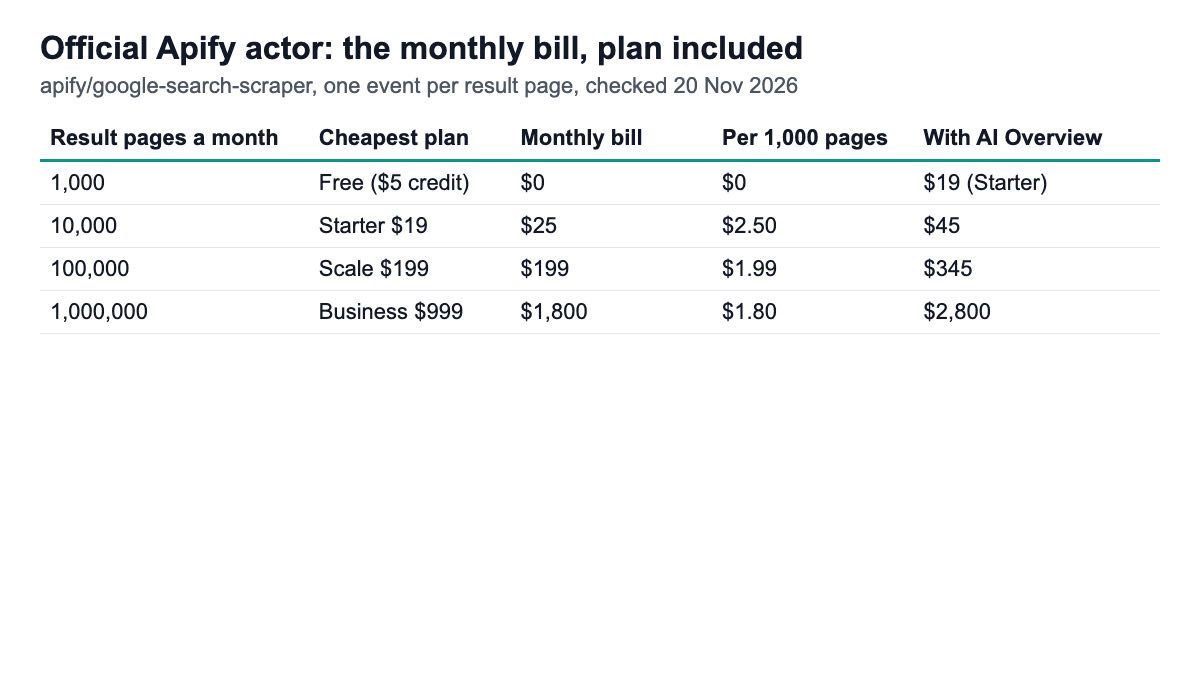
How each row was worked out. At 10,000 pages, Free would need $45 of usage and is blocked at $5, while Scale's $199 fee is more than the usage, so Starter wins: $19 plus $6 of overage. At 100,000 pages, usage on Starter would be $250, which is past the $100 overage cap, so Scale it is: $195 of usage inside the $199 fee. At 1,000,000 pages, Scale would cost $1,950 and Business $1,800, so Business wins.
With the AI Overview add-on captured on every query, the same rows become $19, $45, $345 and $2,800. In practice Google shows overviews on only part of a keyword list, so your figure lands between the two columns.
A worked example: 500 keywords a day
Say you track 500 keywords every day, top 10 only, on the official actor. That is 15,000 result pages in a 30-day month. On Starter the usage is $37.50, so the bill is $19 plus $18.50 of overage, or $37.50 in total.
Now you want the top 30 for the same keywords, three pages each. That is 45,000 pages and $112.50 of usage, which still fits under Starter's $119 ceiling, so the bill is $112.50. Ask for the top 50 and you need 75,000 pages and $187.50 of usage, which breaks the Starter cap; Scale's $199 becomes the cheapest plan.
Depth, not keyword count, is what moves you between plans. Before you raise the page count for every keyword, check how many of them actually rank below position 10. For a vendor-by-vendor view of the same budget question, see our SERP API pricing comparison.
Are other Google search actors cheaper?
Yes. Several community actors in the Apify Store charge $0.50 to $2.00 per 1,000 result pages at Starter prices, against the official actor's $2.50. Normalised to the same unit, they look like this.
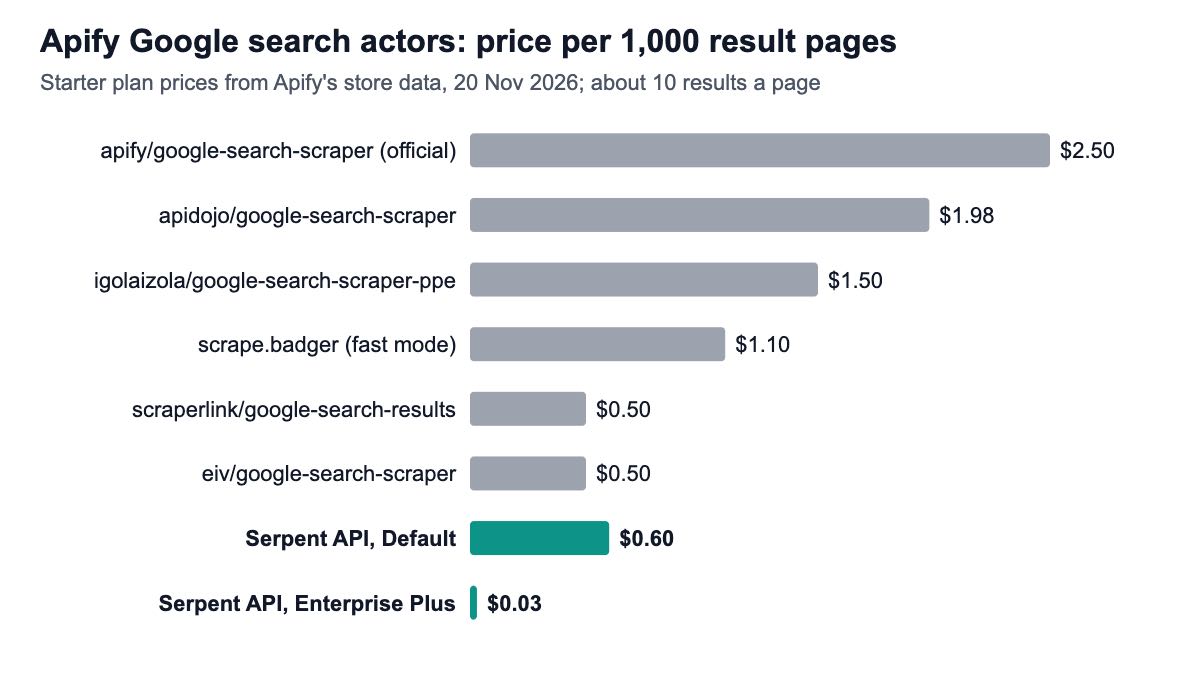
| Actor | How it bills | Free | Starter | Business | Users |
|---|---|---|---|---|---|
| apify/google-search-scraper (official) | Per page | $4.50 | $2.50 | $1.80 | 238,539 |
| apidojo/google-search-scraper | Per query, first 10 results included | $2.00 | $1.98 | $1.94 | 1,792 |
| igolaizola/google-search-scraper-ppe | Per result, plus a start fee | $3.00 | $1.50 | $1.30 | 3,276 |
| scrape.badger/google-search-scraper | Per page (fast mode) plus per result | $1.10 | $1.10 | $1.10 | 476 |
| scraperlink/google-search-results-serp-scraper | Per full page | $0.50 | $0.50 | $0.50 | 16,951 |
| eiv/google-search-scraper | Per page | $0.60 | $0.50 | $0.40 | 286 |
Per-result actors are converted at 10 results per page. A few actors whose headline price did not match their own event data, or that had almost no runs, are left out.
Cheaper is not automatically better. The official actor returns many optional fields and add-ons, and it is the most used by far: Apify's public data shows 10,196,845 runs in the 30 days to 20 November 2026, of which 98.2% succeeded and 1.5% timed out. The scraperlink actor showed 4,464,659 runs with 99.9% succeeded. Smaller actors have far less history, so run your own keyword list through any of them and check the fields before switching.
If you would rather build your own actor, Apify also sells a SERPs proxy at $2.50 per 1,000 SERPs on Free and Starter, $2.00 on Scale and $1.70 on Business, plus compute. That is already above the community actors' prices before you count your time.
What does the top 100 cost?
On the official actor, the top 100 results for one keyword is 10 page events. That is $25 per 1,000 keywords on Starter and $18 on Business, ten times the one-page price.
This is the cost most rank trackers feel since Google phased out returning 100 results on a single page, a change Bright Data's SERP FAQ also describes. Most tools now fetch deep positions page by page. If you only need the top 10 for most keywords and the top 100 for a few, set the page count per keyword rather than for the whole run. Our guide to rank tracking after num=100 covers that strategy.
For comparison, Serpent API's organic results endpoint can be asked for up to 100 results in one call with num, billed as one call; num is a ceiling rather than a guaranteed count (Google calls often return 40 to 70), and the response says when fewer arrive. Details are in the web search docs.
Apify actor or SERP API?
If search results are all you need, a SERP API is usually cheaper at volume and simpler to call. If you also scrape websites, run leads enrichment or chain several scrapers, Apify's platform is the point and the per-page price is only part of the value.
| Option | Per 1,000 pages | How you pay |
|---|---|---|
| Apify official actor, Starter to Business | $2.50 to $1.80 | Monthly plan plus overage |
| Apify scraperlink actor | $0.50 | Monthly plan plus overage |
| Bright Data pay as you go | $1.50 | Pay as you go |
| Serper packs | $1.00 to $0.30 | Prepaid, valid 6 months |
| DataForSEO standard queue | $0.60 | Prepaid balance, $50 minimum |
| Serpent API, Default | $0.60 | Pay as you go |
| Serpent API, Growth ($100 deposit) | $0.30 | Pay as you go |
| Serpent API, Scale ($500 deposit) | $0.10 | Pay as you go |
| Serpent API, Enterprise ($1,000 deposit) | $0.05 | Pay as you go |
| Serpent API, Enterprise Plus ($1,250 deposit) | $0.03 | Pay as you go |
Where Apify wins: you get a scheduler, storage, webhooks and hundreds of other scrapers on one bill, and the official actor can enrich results with website content and business leads in the same run. Where a SERP API wins: no monthly plan to size, a single HTTP call per search, and a lower price per page. Our comparison of web scraping and SERP APIs covers the trade-off in more depth.
The same pattern holds for other Apify scrapers. Our breakdown of Apify LinkedIn scraper pricing walks through the event model for that actor, and the ScraperAPI credit math does the same exercise for a credit-based scraper.
Which should you pick?
- Under about 1,100 pages a month: the official actor on Apify's Free plan; $5 of credit covers it.
- A few thousand to 40,000 pages, already on Apify: the official actor on Starter, or scraperlink's actor if its fields cover your needs.
- You need AI Overview, ads, or website content in the same run: the official actor on Scale or Business, and keep the ads add-on off unless you read ads.
- Search results only, at any volume: a SERP API. Serpent API is pay as you go from $0.03 per 1,000 with one price on five engines; DataForSEO is $0.60 per 1,000 if a queue is fine.
How we checked this
On 20 November 2026 I read the official actor's store page and its full pricing data from Apify's public API, the store listing data for the community actors, Apify's pricing page and store documentation, and the pricing pages and docs of three SERP API providers: 14 external sources, all official vendor or platform pages. The raw pricing data is saved with this article's working files. Our own prices come from our pricing page the same day.
All costs are arithmetic on list prices; no actor runs or paid calls were made. What I could not verify: which public plan, if any, maps to the Platinum and Diamond price tiers; the overage caps on Scale and Business; and whether asking the official actor for more than 10 results per page still returns more than about 10 results.
Search results without sizing a monthly plan
Serpent API returns Google, Bing, Yahoo, DuckDuckGo and Brave results as JSON from $0.03 per 1,000 — pay as you go, no subscription. Sign up for 10 free API calls and compare the output with your Apify runs.
Get Your Free API KeyExplore: SERP API · Playground · Docs · Pricing
FAQ
How much does Apify's Google Search Scraper cost per 1,000 results?
The official actor charges per page of about 10 results: $4.50 per 1,000 pages on the Free plan, $2.50 on Starter, $1.95 on Scale and $1.80 on Business, as of 20 November 2026. Per individual result that is roughly $0.45, $0.25, $0.20 and $0.18 per 1,000 results. Add-ons such as AI Overview, ads and AI Mode are charged as separate events on top.
Is the Apify Google Search Scraper free?
You can run it on Apify's Free plan, which includes $5 of usage a month. At the Free price of $0.0045 per result page, that covers about 1,100 pages, or roughly 11,000 results, with no add-ons. When the $5 is used up, Apify blocks further runs until the next month. AI add-ons cost $0.20 a query on the Free plan, so they use up the credit very quickly.
Why is my Apify bill higher than pages times price?
Usually for one of three reasons: add-ons, the plan fee, or start charges. Add-ons you switched on, such as ads extraction, are charged per page even when no ads appear. Your plan fee is a minimum: on Scale you pay $199 even if your runs used less, and a small start charge also applies per run per GB of memory. Check the run's charged events in the Apify console to see which one applied.
What is the cheapest Google search actor on Apify?
Among actors with real usage on 20 November 2026, scraperlink's Google Search Results actor charged $0.50 per 1,000 full result pages at every plan level, and eiv's actor charged $0.40 to $0.60 per 1,000 pages depending on plan. The official actor costs $1.80 to $4.50. Field coverage and track record differ, so compare outputs on your own keywords before you move a production job.
Is a SERP API cheaper than Apify for Google results?
At most volumes, yes. The official actor costs $1.80 to $2.50 per 1,000 pages on paid plans, while SERP APIs on 20 November 2026 ranged from $1.50 (Bright Data pay as you go) down to $0.60 (DataForSEO's standard queue and Serpent API's Default rate) and $0.03 (Serpent API's Enterprise Plus rate). Apify's value is the wider platform, so it can still be the better buy if you use more than search.
Sources
Apify platform and actor data (checked 20 November 2026):
- Google Search Results Scraper store page
- Apify API: official actor pricing data and run statistics
- Apify pricing (plans, store discounts, overage, proxy)
- Apify docs: Actors in Store and pay per event
- apidojo Google Search Scraper
- igolaizola Google Search Scraper
- scrape.badger Google Search Scraper
- scraperlink Google Search Results
- eiv Google Search Results Scraper
SERP API pricing for comparison (checked 20 November 2026):