Peec AI alternatives, matched to why you are leaving

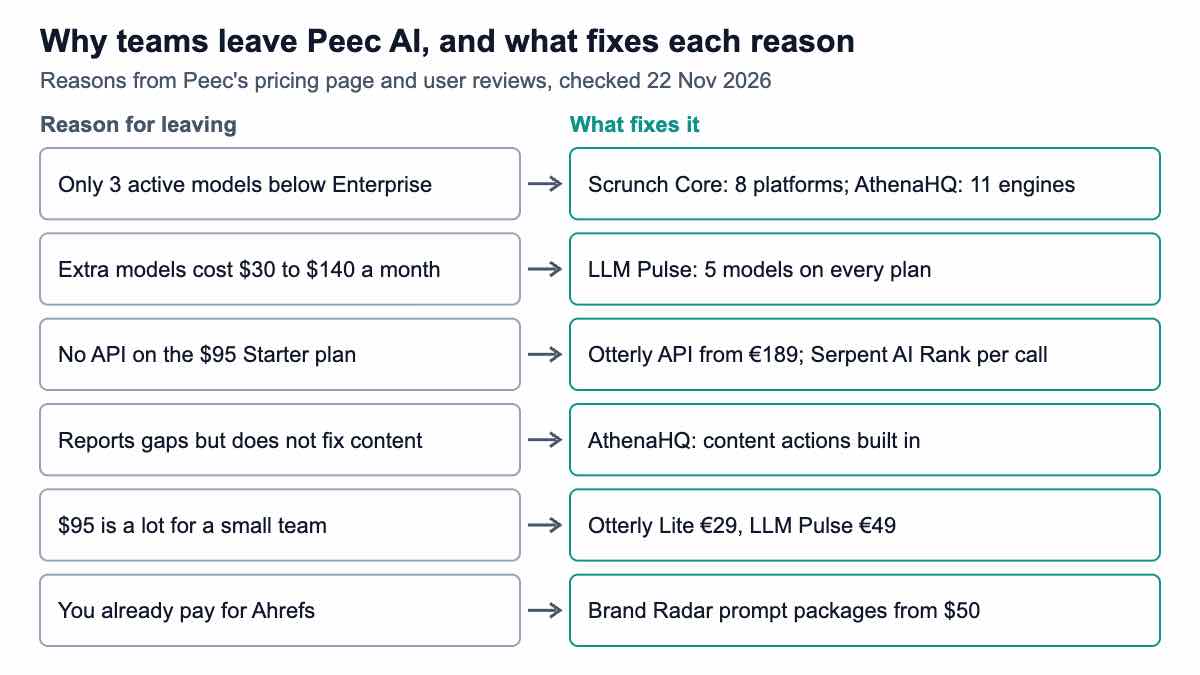
The best Peec AI alternative depends on why you are leaving. For more engines on a self-serve plan, Scrunch and AthenaHQ cover eight or more. For a smaller bill, Otterly starts at €29 and LLM Pulse at €49. For an API without a $245 plan, Serpent’s AI Rank bills per call.
Short answer: Stay on Peec if you want answer counts stated up front, unlimited seats and competitors, and daily tracking on three engines. Otherwise: Scrunch or AthenaHQ for engine breadth, LLM Pulse for five models with no add-ons, Otterly for the cheapest start and an API from €189, Ahrefs Brand Radar packages if you already pay for Ahrefs, AthenaHQ for content actions, Profound for an enterprise contract, and Serpent’s AI Rank API for your own pipeline, from $0.70 per 1,000 — pay as you go, no subscription (pricing).
What does Peec AI cost now?
Peec AI starts at $95 a month for 50 prompts and 4,500 answers. On 22 November 2026 its pricing page listed three self-serve plans and an annual Enterprise plan. Every self-serve plan includes unlimited seats, unlimited competitors and daily tracking, and annual billing takes 15% off.
| Plan | Price a month | Prompts | Answers a month | Active models | Countries | API |
|---|---|---|---|---|---|---|
| Starter | $95 | 50 | 4,500 | 3 of 8 | 1 | No |
| Pro | $245 | 150 | 13,500 | 3 of 8 | 3 | Yes |
| Advanced | $495 | 350 | 31,500 | 3 of 8 | 3 | Yes |
| Enterprise (annual) | Custom | Unlimited | Unlimited | Up to 26 | Unlimited | Yes |
Extra models cost $30 a month on Starter, $70 on Pro and $140 on Advanced, from a list that includes ChatGPT, Google AI Mode, AI Overviews, Bing AI Mode, Perplexity and Gemini. Peec has also added agent credits (500 to 1,000 a month), fact-checked prompts and, from Pro, crawl insights to its plans. Our Peec AI pricing breakdown covers each plan in depth, so this post is about where to go instead.
Why do teams look for an alternative?
Five reasons come up, on Peec’s own pricing page and in reviews. Peec is well liked: it holds 4.8 out of 5 from 18 reviews on OMR Reviews. These are fit problems for particular buyers, not a verdict on the tool.
- Three active models. Below Enterprise you choose three engines out of eight. Tracking a fourth means an add-on or a bigger contract.
- Add-on costs. Each extra model is $30 to $140 a month depending on plan, so a five-engine setup on Pro costs $385, not $245.
- No API on Starter. The API arrives with Pro at $245. Teams that want the data in their own reports pay for 150 prompts to get it.
- Price for small teams. One OMR reviewer wrote that “pricing isn’t super transparent”; another, in German, that Peec is probably “ein Brocken” (a heavy lift) for smaller companies.
- Monitoring, not fixing. Several vendors argue that Peec shows gaps but leaves the content work to you. They sell content tools, so weigh the point accordingly; Peec’s newer agent credits narrow the gap.
The nine Peec AI alternatives
I kept tools that track your brand in AI answers on prompts you choose, plus one API. Prices are list prices on 22 November 2026.
1. Scrunch: best for more platforms on a self-serve plan
Scrunch’s Core plan is $250 a month for 15,000 AI responses across eight platforms: ChatGPT, Perplexity, Gemini, Google AI Overviews, Google AI Mode, Microsoft Copilot, Grok and Meta AI, per its pricing page. That is five more platforms than Peec activates at a similar price to Peec Pro. The trade-off: no API on Core, and Claude is an Enterprise add-on. A 7-day trial is available.
2. AthenaHQ: best for content actions and the widest engine list
AthenaHQ’s Starter plan is $295 a month for 3,600 credits, where one credit is one AI response, with 11 engines including Claude, Grok, DeepSeek and Mistral, per its pricing page. It also bundles on-page and off-page actions and a content optimisation agent, which answers the “monitoring, not fixing” complaint. A free Essential plan gives 300 credits. The API and extra credits are paid add-ons whose prices are not listed.
3. LLM Pulse: best for five models with no add-ons
LLM Pulse prices by prompt and includes ChatGPT, Perplexity, Google AI Mode, AI Overviews and Gemini on every plan, per its pricing page. Starter is €49 for 50 weekly prompts, Growth €99 for 150 and Scale €299 for 450 with an API; daily tracking costs more (€79, €149 and €449). For the same 50 prompts as Peec Starter, it covers five engines instead of three, weekly rather than daily.
4. Otterly: best low-cost start and an API at mid-tier
Otterly starts at €29 a month for 16 prompts and 2,000 credits, then €189 for 120 prompts and 15,000 credits, and €489 for 403 prompts and 50,000 credits, per its pricing page. One answer is one credit, except Claude at three, and Standard includes 2,000 API and 2,000 MCP requests a month.
Its page says plans include “4 of 7” engines but also that “every plan can track every engine”, so confirm engine limits in a trial. Our Otterly pricing guide has the detail.
5. Rankscale: best for engine breadth on credit plans
Rankscale sells credits: €99 for 1,200, €229 for 3,000 with a REST API, €385 for 5,500 and €780 for 12,000, per its pricing page. An answer from ChatGPT, Google AI Mode, AI Overviews, Gemini or Bing AI Mode costs 0.25 credits; other model options cost 1 to 4. On the 0.25-credit engines, the plans cover up to 4,800, 12,000, 22,000 and 48,000 answers.
A Black Friday offer of 50% off the first two months runs to 30 November. See our Rankscale alternatives post if you are weighing it.
6. Ahrefs Brand Radar: best if you already pay for Ahrefs
Ahrefs sells custom prompt tracking in checks, where “tracking one prompt on one platform in one location uses 1 check”, per its pricing page. Packages are listed as additions to a plan: Basic $50 for 2,500 checks, Growth $100 for 7,000 and Scale $250 for 25,000, with overage at $0.020, $0.015 and $0.010. Lite ($129), Standard and Advanced plans include 150, 300 and 600 checks. At volume this is the cheapest dashboard route here.
7. Semrush AI Visibility Toolkit: best inside an existing Semrush workflow
Semrush’s toolkit is $99 a month with 25 prompts, and 50 more cost $60, per its knowledge base. Brand Performance reports analyse responses from ChatGPT and Google’s AI Mode. There is no free trial, and each teammate needs their own $99 licence, which is the opposite of Peec’s unlimited seats. Our Brand Radar vs Semrush comparison sets the two side by side.
8. Profound: best for an enterprise contract
Profound now lists only a custom-priced Enterprise plan, tracking up to ten answer engines with API access, per its pricing page. Its FAQ says the Starter and Growth plans were retired in September 2026 and their $399 and $499 prices are “no longer available for new subscriptions.” Our Profound pricing guide covers what the contract buys.
9. Serpent AI Rank API: best for your own pipeline
If you want the numbers in your own reports rather than a dashboard, use an API. AI Rank tracks brand citations and positions across ChatGPT, Claude, Gemini and Perplexity as JSON. You send a keyword and your domain to /api/ai/rank, optionally with country and language, and each engine’s result carries target_found, target_position and its full citations list, per the AI Rank docs.
There is no plan threshold: the first call works the same as the millionth, and every account starts with 10 free API calls. What you give up is the dashboard, prompt suggestions and sentiment reports; you build the charts yourself.
What does each cost per 1,000 answers?
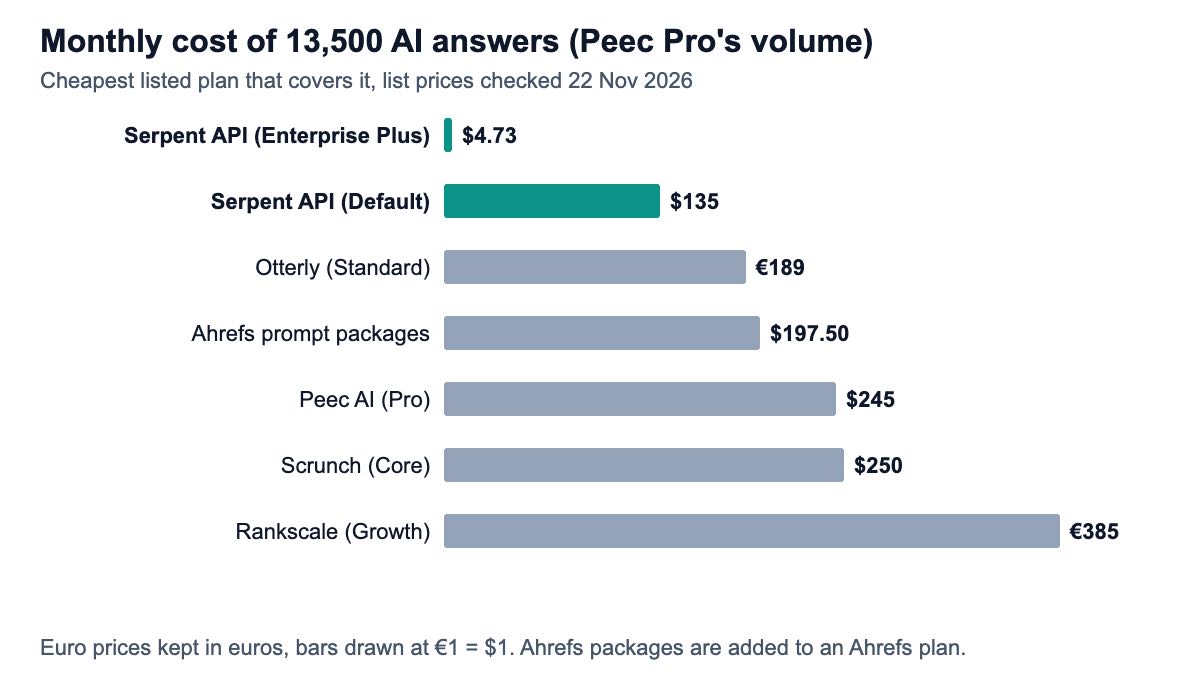
One answer is one prompt answered by one engine. To make the comparison concrete, I priced each tool at Peec’s own plan volumes: 4,500, 13,500 and 31,500 answers a month. Each cell uses the cheapest listed plan that covers the volume.
| Tool and plan rule | 4,500 answers | 13,500 answers | 31,500 answers |
|---|---|---|---|
| Peec AI (Starter, Pro, Advanced) | $95 ($21.11/1K) | $245 ($18.15/1K) | $495 ($15.71/1K) |
| Otterly (Standard, Standard, Premium; 1 credit an answer) | €189 (€42.00/1K) | €189 (€14.00/1K) | €489 (€15.52/1K) |
| Rankscale (0.25-credit engines: Pro, Growth, Enterprise) | €99 (€22.00/1K) | €385 (€28.52/1K) | €780 (€24.76/1K) |
| Scrunch (Core, 15,000 responses) | $250 ($55.56/1K) | $250 ($18.52/1K) | Unverified (Enterprise) |
| Ahrefs prompt packages (Basic, Growth, Scale plus overage; on top of an Ahrefs plan) | $90 ($20.00/1K) | $197.50 ($14.63/1K) | $315 ($10.00/1K) |
| AthenaHQ (Starter covers 3,600 credits) | Unverified | Unverified | Unverified |
| Serpent API — Default ($10 deposit; $40 per 1,000 four-engine calls) | $45 ($10.00/1K) | $135 ($10.00/1K) | $315 ($10.00/1K) |
| Serpent API — Growth ($100 deposit; $16 per 1,000 calls) | $18 ($4.00/1K) | $54 ($4.00/1K) | $126 ($4.00/1K) |
| Serpent API — Scale ($500 deposit; $10 per 1,000 calls) | $11.25 ($2.50/1K) | $33.75 ($2.50/1K) | $78.75 ($2.50/1K) |
| Serpent API — Enterprise ($1,000 deposit; $7 per 1,000 calls) | $7.88 ($1.75/1K) | $23.63 ($1.75/1K) | $55.13 ($1.75/1K) |
| Serpent API — Enterprise Plus ($1,250 deposit; $1.40 per 1,000 calls) | $1.58 ($0.35/1K) | $4.73 ($0.35/1K) | $11.03 ($0.35/1K) |
Read the table with three caveats. First, the plan minimums bite at low volume: Otterly Lite’s 2,000 credits do not cover 4,500 answers, so the cheapest Otterly row there is Standard. Second, LLM Pulse and Semrush price by prompt and do not state answers per prompt, so I left them out rather than guess. Third, Serpent rows divide the four-engine call price by four answers, and an API price includes no dashboard; compare it with what you would spend building one.
Per prompt rather than per answer, the cheapest entry points are Otterly at €29 for 16 prompts and LLM Pulse at €49 for 50, against Peec Starter’s $95 for 50.
Which prices on other lists are out of date?
Several of the pages that rank for “Peec AI alternatives” quote prices that no longer apply. I checked each against the vendor’s own page on 22 November.
- Profound at $99 or $399. HubSpot’s list quotes “$99/month (annual)” and Frase’s “$99/month for ChatGPT tracking only; three engines costs $399/month”. Profound’s FAQ says those plans were retired in September 2026.
- Peec’s add-on models at $35, $85 and $165. Writesonic’s list, last verified in July, gives those figures, and SE Visible’s says “starting at $35 per month on Starter”. Peec’s page now shows $30, $70 and $140.
- Ahrefs at $199 per AI index. That is Ahrefs’ Brand Radar AI add-on, which still starts at $199. For tracking your own prompts, the $50, $100 and $250 packages are the relevant price.
Each of those four pages is published by a vendor that ranks its own product first or near the top, which is normal for this query; it is one more reason to read prices from the vendors themselves.
When should you stay on Peec?
Stay if clear answer counts and unlimited seats matter more than engine breadth. Peec states the number of answers each plan buys, where credit-based tools make you calculate it, and it puts no limit on seats or competitors on any plan. For an agency with many people in one workspace, Semrush’s per-user licence would cost more.
Stay, too, if three engines are enough for your market. Many brands only need ChatGPT, Google AI Overviews and Perplexity, and Peec tracks those daily. Its newer features, fact-checked prompts, objections tracking and crawl insights, add things a plain tracker lacks.
The case to leave is strongest when you need five or more engines without an enterprise contract, an API on a small budget, or a much smaller monthly bill.
How do you switch without losing history?
Export first, then run both tools side by side for two to four weeks. AI answers change from run to run, so the first week on any new tool is noise; our citation repeatability study shows how much.
- Export your prompt list and history from Peec while your plan is active.
- Re-create the same prompts, engines and countries in the new tool. Different engines produce different numbers, so match them before you compare.
- Write down metric definitions. “Visibility” and “share of voice” are calculated differently by each vendor; our guide to AI search visibility metrics sets out the common ones.
- Mark the switch on every chart so a step change from the new method is not read as a real change in visibility.
Which Peec AI alternative should you pick?
- You need more than three engines without Enterprise: Scrunch Core (eight platforms) or AthenaHQ Starter (11 engines).
- You want five models with no add-on fees: LLM Pulse.
- You need the smallest monthly bill: Otterly Lite at €29, or LLM Pulse Starter at €49.
- You want an API on a mid-size plan: Otterly Standard at €189.
- You already pay for Ahrefs, or track at high volume: Brand Radar prompt packages.
- You want the tool to help fix content too: AthenaHQ.
- You want a managed enterprise vendor: Profound.
- You want the data in your own reports, by API, without a plan: Serpent AI Rank.
- You want stated answer counts and unlimited seats: stay on Peec.
For a wider field, including tools that do not start from prompts, see our AI visibility tools comparison.
How we checked this
On 22 November 2026 I opened the top-ranking pages for “Peec AI alternatives” from HubSpot, Writesonic, Frase and SE Visible (all vendors that list their own tool first or near it), then OMR Reviews for user comments and every vendor’s own pricing page. G2 and Capterra refused the request, so I have not described them.
That is 14 linked sources: 9 official vendor pages, 1 review site and 4 ranking pages. Per-answer costs are my arithmetic on list prices, excluding tax and promotions, with euro prices kept in euros.
What I could not verify: how many answers a prompt produces on LLM Pulse and Semrush; the price of AthenaHQ’s extra credits and API; Scrunch’s Enterprise price; Peec’s agency pricing; and which engines Otterly’s plans include, since its page states two different limits.
Track AI answers without a plan threshold
Your keywords, four engines, every citation as JSON, billed per call. From $0.70 per 1,000 — pay as you go, no subscription — and every account starts with 10 free API calls.
Get Your Free API KeyExplore: AI Rank API · Docs · Pricing
FAQ
Is there a cheaper alternative to Peec AI?
Yes, at small volumes. Otterly starts at €29 a month for 16 prompts and LLM Pulse at €49 for 50, against Peec Starter’s $95 for 50. At Peec Pro’s 13,500 answers a month, Otterly Standard costs €189 and Ahrefs prompt packages about $197.50, against $245 for Peec. A per-call API such as Serpent’s AI Rank is cheaper again per answer, but it comes without a dashboard.
How much does Peec AI cost?
On 22 November 2026 Peec AI listed Starter at $95 a month for 50 prompts and 4,500 answers, Pro at $245 for 150 prompts and 13,500 answers, and Advanced at $495 for 350 prompts and 31,500 answers, with a custom annual Enterprise plan. Annual billing takes 15% off. Each plan activates three of eight models; extra models cost $30, $70 or $140 a month.
Which Peec AI alternative tracks the most AI engines?
On self-serve plans, AthenaHQ Starter lists 11 engines, including Claude, Grok, DeepSeek and Mistral, and Scrunch Core covers eight platforms. Rankscale offers a long list of engines and model options on every credit plan. Profound tracks up to ten engines on its Enterprise plan, and Peec Enterprise up to 26 models.
Which Peec AI alternatives have an API?
Otterly includes 2,000 API requests a month from its €189 Standard plan, Rankscale includes a REST API from €229, LLM Pulse lists an API on its €299 Scale plan, and Profound includes one on Enterprise. AthenaHQ sells API access as an add-on, and Scrunch reserves it for Enterprise. Serpent’s AI Rank is an API from the first call. Peec itself includes its API from Pro at $245.
Is Profound cheaper than Peec AI?
Not for new customers on a self-serve plan, because Profound no longer sells one. Its pricing page lists only a custom-priced Enterprise plan, and its FAQ says the $399 Starter and $499 Growth plans were retired in September 2026. Several comparison articles still quote a $99 Profound plan; that price is no longer offered.
Sources
Official pricing pages (checked 22 November 2026):
- Peec AI pricing
- Scrunch pricing
- AthenaHQ pricing
- LLM Pulse pricing
- Otterly pricing
- Rankscale pricing
- Ahrefs pricing (plans and prompt packages)
- Semrush AI Visibility Toolkit help article
- Profound pricing
Reviews (checked 22 November 2026):
Ranking pages read for the gap check (22 November 2026):