Leaving Rankscale? 8 Alternatives, Priced per 1,000 AI Answers

The best Rankscale alternative depends on why you are leaving. For predictable bills, Peec AI or LLM Pulse sell fixed prompt plans. For a cheaper start, Otterly begins at €29; for an API without a $229 plan, Serpent’s AI Rank bills per call. If you already pay for Ahrefs, Brand Radar prompt packages start at $50.
Short answer: Stay on Rankscale if you want 17+ engines in every country on one plan and the credit maths does not bother you. Otherwise: Peec AI for a clean dashboard with answers counted for you, Otterly or LLM Pulse for a small budget, LLMrefs for keyword-first tracking at a flat $79, Ahrefs Brand Radar if you hold an Ahrefs plan, Semrush’s toolkit for narrative client reports, and an API for your own pipeline: Serpent’s AI Rank runs from $0.70 per 1,000 — pay as you go, no subscription (pricing).
What does Rankscale cost now?
Rankscale starts at $99 a month, not $20. Several of the pages that rank for “Rankscale alternatives” still quote the old entry plan, including LLM Pulse’s guide (“$20/month buys 120 credits”) and RankAI’s (“starts at $20/mo”). On 20 November 2026 the Rankscale pricing page listed four plans, priced the same in euros and dollars:
| Plan | Price a month | Credits a month | “Up to” answers a month | Brand dashboards | Notable extras |
|---|---|---|---|---|---|
| Pro | $99 | 1,200 | 4,800 | 10 | 7-day trial, MCP, shared dashboards |
| Pro+ | $229 | 3,000 | 12,000 | 25 | REST API, 5 prompt researches a month |
| Growth | $385 | 5,500 | 22,000 | 50 | White-label links, success manager |
| Enterprise | $780 | 12,000 | 48,000 | 100 | Training, 20 prompt researches a month |
The “up to” answer counts assume the cheapest engines. Rankscale’s own FAQ says an answer from engines such as ChatGPT or Google AI Mode costs 0.25 credits, while the model-specific options on its list cost 1 to 4 credits per answer. Pick Claude Sonnet with web search at 4 credits and a Pro plan’s 1,200 credits cover 300 answers, not 4,800.
There are real strengths here. Every plan includes 17+ engines and all countries and languages, prompt creation is unlimited, unused credits roll over, and you can top up any time. Rankscale holds 4.6 out of 5 from 33 reviews on OMR Reviews. Its page also showed a Black Friday offer of 50% off the first two months on every plan, ending 30 November.
Why do people look for a Rankscale alternative?
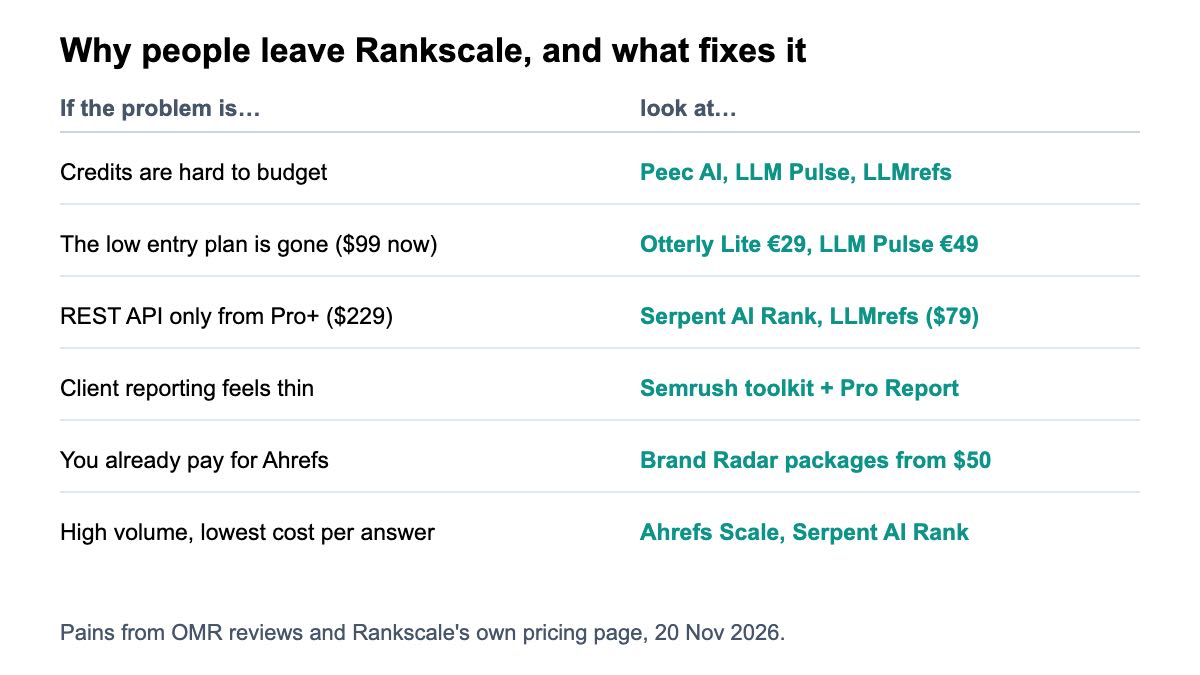
Four reasons come up in reviews and on Rankscale’s own pricing page. None is a scandal; each is a fit problem for a particular kind of buyer.
- Credits are hard to budget. One credit is four answers on some engines and a quarter of an answer on others. Competitors make this point loudly, and they have a motive, but the arithmetic is on Rankscale’s own page.
- The cheap entry plan is gone. One OMR reviewer listed the “removal of lower subscription tier, it was very useful for smaller companies or teams” as a con. The floor is now $99.
- The API and white-label sit on higher plans. The REST API starts on Pro+ at $229, and white-label links on Growth at $385.
- Client reporting and UX. Another OMR reviewer wrote, “What I really miss is a proper reporting functionality that I can use for my customers,” and a third that “the tool’s user experience still needs improvement.”
The eight Rankscale alternatives
I kept tools that track your brand in AI answers on prompts you choose, with prices on a public page. Prices are monthly list prices on 20 November 2026.
1. Peec AI: best for answers counted for you
Peec AI states the number that Rankscale makes you calculate. Starter is $95 for 50 prompts and 4,500 answers a month, Pro $245 for 150 prompts and 13,500 answers, and Advanced $495 for 350 prompts and 31,500 answers. Competitors and users are unlimited on every plan. The catch: you activate three engines out of eight below Enterprise, and the API starts on Pro.
2. Otterly: best low-cost start
Otterly starts at €29 a month for 16 prompts and 2,000 credits, with €189 for 120 prompts and 15,000 credits and €489 for 403 prompts and 50,000 credits. One answer is one credit, except Claude at three. Brands, competitors, countries and team members are unlimited, and the API arrives on Standard with 2,000 requests a month. It also uses credits, but the exchange rate is simpler: almost always one credit per answer.
3. LLM Pulse: best fixed-price prompt plans
LLM Pulse prices by tracked prompt, not credit: €49 for 50 prompts and one project, €99 for 150 prompts and two projects, €299 for 450 prompts and five projects, each with five AI models included and weekly tracking. Its page says 50 prompts on Starter is over 1,000 stored AI responses a month, and a monthly cadence holds four times the prompts at the same price. It publishes its own Rankscale comparison, so read that one as a competitor’s pitch.
4. LLMrefs: best keyword-first tracking
LLMrefs starts from SEO keywords and generates prompts around them. Its single plan was $79 a month, marked “limited time only”, for 500 prompts across all its AI engines, refreshed weekly, with CSV export, API access, 50+ countries and unlimited team members. If you think in keywords rather than questions, it is the shortest path from a rank tracker.
5. Ahrefs Brand Radar: best if you already pay for Ahrefs
Ahrefs sells custom prompt tracking in checks, one prompt on one platform in one location, per its pricing page. Basic is $50 for 2,500 checks, Growth $100 for 7,000 and Scale $250 for 25,000, with overage at $0.020, $0.015 and $0.010 a check. Lite, Standard and Advanced plans include 150, 300 and 600 checks, and Brand Radar data is in Ahrefs’ API v3, which its help centre opens to the Lite plan ($129) and up. At volume it is the cheapest dashboard here.
6. Semrush AI Visibility Toolkit: best for narrative client reports
Semrush’s toolkit is $99 a month per domain with 25 tracked prompts; 50 more cost $60. Its Brand Performance reports cover share of voice, sentiment and the narratives around a brand, which answers the “thin client reporting” complaint directly. It has no free trial, and each extra teammate needs a $99 licence.
7. Profound: best for enterprise budgets
Profound lists only a custom-priced Enterprise plan, with up to ten answer engines and API access. Some ranking pages still show its old self-serve plans; on 20 November there were none. Our Profound alternative guide covers what that buys.
8. Serpent AI Rank API: best for your own pipeline
If the reason you are leaving is that the dashboard sits between you and the data, use an API. AI Rank tracks brand citations and positions across ChatGPT, Claude, Gemini and Perplexity as JSON. You send a keyword and your domain, and each engine returns target_found, target_position and its full citations list, per the AI Rank docs.
There is no plan to unlock: the first call works the same as the millionth, and every account starts with 10 free API calls. What you give up is the dashboard, recommendations and sentiment; you build the charts.
What does each alternative cost per 1,000 answers?
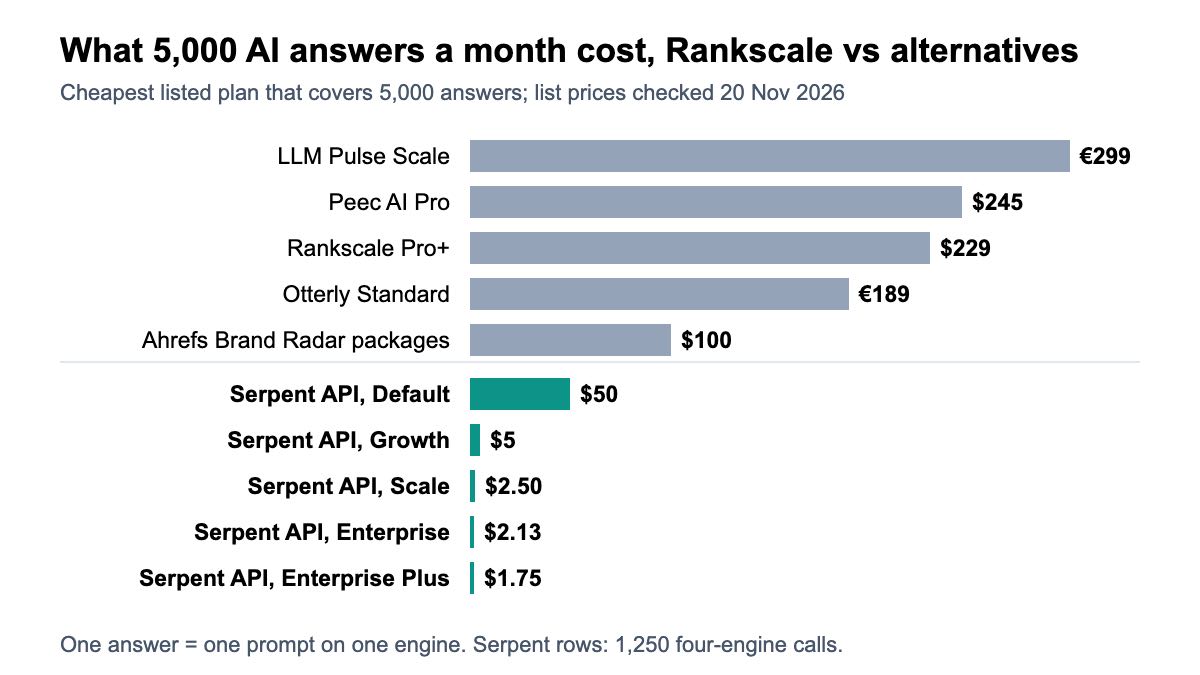
Normalising to answers is the only fair way to compare credit plans, prompt plans and APIs. One answer is one prompt answered by one engine. Each cell uses the cheapest listed plan that covers the volume.
| Tool and plan rule | 1,000 answers | 5,000 answers | 20,000 answers |
|---|---|---|---|
| Rankscale (0.25-credit engines: Pro 4,800, Pro+ 12,000, Growth 22,000 answers) | $99 ($99.00/1K) | $229 ($45.80/1K) | $385 ($19.25/1K) |
| Peec AI (Starter 4,500, Pro 13,500, Advanced 31,500 answers) | $95 ($95.00/1K) | $245 ($49.00/1K) | $495 ($24.75/1K) |
| Otterly (Lite 2,000, Standard 15,000, Premium 50,000 credits) | €29 (€29.00/1K) | €189 (€37.80/1K) | €489 (€24.45/1K) |
| LLM Pulse (weekly, 5 models: about 1,080 / 3,250 / 9,750 / 26,000 answers on Starter / Growth / Scale / Scale+) | €49 (€49.00/1K) | €299 (€59.80/1K) | €599 (€29.95/1K) |
| Ahrefs Brand Radar packages (Basic, Growth or Scale plus overage) | $50 ($50.00/1K) | $100 ($20.00/1K) | $250 ($12.50/1K) |
| Serpent API — Default (four-engine call, $40 per 1,000 calls) | $10 ($10.00/1K) | $50 ($10.00/1K) | $200 ($10.00/1K) |
| Serpent API — Growth ($100 deposit; $4 per 1,000 calls) | $1 ($1.00/1K) | $5 ($1.00/1K) | $20 ($1.00/1K) |
| Serpent API — Scale ($500 deposit; $2 per 1,000 calls) | $0.50 ($0.50/1K) | $2.50 ($0.50/1K) | $10 ($0.50/1K) |
| Serpent API — Enterprise ($1,000 deposit; $1.70 per 1,000 calls) | $0.43 ($0.425/1K) | $2.13 ($0.425/1K) | $8.50 ($0.425/1K) |
| Serpent API — Enterprise Plus ($1,250 deposit; $1.40 per 1,000 calls) | $0.35 ($0.35/1K) | $1.75 ($0.35/1K) | $7 ($0.35/1K) |
Read the table with three caveats. First, Rankscale’s rows assume every answer comes from a 0.25-credit engine; mix in the 1-to-4-credit models and its cost per answer rises fast. Second, Semrush and LLMrefs are left out because neither page states how many answers a prompt produces, so a per-answer figure would be a guess. Third, Serpent rows divide the four-engine call price by four answers, and an API price includes no dashboard; compare it with what you would spend building one.
Per prompt rather than per answer, the cheapest entry points are LLMrefs at $79 for 500 weekly prompts and LLM Pulse at €49 for 50. Per answer at volume, Ahrefs Scale and per-call APIs lead.
When should you stay on Rankscale?
Stay if engine breadth is the point. Rankscale includes 17+ engines and every country and language on every plan, where Peec activates three engines below Enterprise and Otterly four of seven. If a client needs DeepSeek, Mistral or Meta’s assistant tracked next to ChatGPT, Rankscale includes them on every plan, where several alternatives sell them as add-ons or leave them out.
Stay, too, if you track many brands lightly. Ten brand dashboards on Pro and 50 on Growth, with unlimited prompt creation and rolling credits, suit an agency that checks many brands a few times a month. And if you were on the old low plan and only object to the new price, the Black Friday half-price offer on the first two months gives you a cheap window to decide.
The case to leave is strongest when you track a fixed set of prompts daily on a few engines, need an API on a small budget, or need client reports out of the box.
How do you switch without losing history?
Export first, then run both tools in parallel for two to four weeks. AI answers move from run to run, so the first week on any new tool is noise; our citation repeatability study shows how much. Overlap lets you see whether the new tool’s numbers sit above or below the old ones before you tell a client anything changed.
- Export your prompt list and history from each brand dashboard while your plan is active.
- Re-create the same prompts, engines and countries in the new tool. Different engines produce different numbers, so match them before you compare.
- Write down the metric definitions. “Visibility” and “share of voice” are calculated differently by each vendor; our guide to AI search visibility metrics sets out the common ones.
- Mark the switch on every chart so a step change from the new method is not read as a real change in visibility.
If you are moving to an API, the free AI rank tracker guide shows a minimal daily schedule and its cost, and our audit of 14 AI rank trackers lists the questions to ask any vendor about method before you commit.
Which Rankscale alternative should you pick?
- You want the bill to read in answers, not credits: Peec AI.
- You need the smallest monthly bill: Otterly Lite at €29, or LLM Pulse Starter at €49 for 50 prompts.
- You think in SEO keywords: LLMrefs at $79 for 500 prompts.
- You already pay for Ahrefs, or run high volume: Brand Radar prompt packages.
- Your clients want narrative reports with sentiment: Semrush’s AI Visibility Toolkit.
- You have an enterprise budget and want a managed vendor: Profound.
- You want the data in your own reports, by API, without a plan threshold: Serpent AI Rank.
- You need 17+ engines in every market: stay on Rankscale.
For a wider field, including tools not built around prompts, see our AI visibility tools comparison.
How we checked this
On 20 November 2026 I opened four of the top five pages ranking for “Rankscale alternatives” (LLM Pulse, Rankability, Writesonic and RankAI; all are vendors that rank themselves first), then OMR Reviews for user comments and every vendor’s own pricing page. The Rankscale, LLM Pulse, LLMrefs and Ahrefs pages were read from their raw page text because their pricing cards render as tabs. That is 14 linked sources: 9 official vendor pages (including Ahrefs’ API help article), one review site and four ranking pages. Per-answer costs are my arithmetic on list prices, excluding tax and promotions.
What I could not verify: the price of Rankscale credit top-ups; whether LLM Pulse’s Scale+ and larger plans include the API it lists on Scale; how many answers a prompt produces on LLMrefs and Semrush; and whether LLMrefs’ $79 “limited time” price will last.
Track AI answers without a plan threshold
Your prompts, four engines, every citation as JSON, billed per call. From $0.70 per 1,000 — pay as you go, no subscription — and every account starts with 10 free API calls.
Get Your Free API KeyExplore: AI Rank API · Playground · Docs · Pricing
FAQ
Is there a cheaper alternative to Rankscale?
Yes, at small volumes. Otterly starts at €29 a month and LLM Pulse at €49, against Rankscale’s $99 Pro plan. At about 5,000 answers a month, Ahrefs Brand Radar prompt packages cost $100 and Otterly Standard €189, against $229 for Rankscale Pro+. Per answer, a per-call API such as Serpent’s AI Rank is cheaper again, but it comes without a dashboard.
How much does Rankscale cost in 2026?
On 20 November 2026 Rankscale listed Pro at $99 a month (1,200 credits), Pro+ at $229 (3,000 credits, REST API), Growth at $385 (5,500 credits, white-label links) and Enterprise at $780 (12,000 credits). Yearly billing saves about 15%. An answer costs 0.25 credits on engines such as ChatGPT and Google AI Mode, and 1 to 4 credits on the model-specific options.
Does Rankscale still have a $20 plan?
Not on its pricing page as of 20 November 2026; the lowest plan is Pro at $99 a month, with a 7-day trial. Several comparison articles still quote a $20 entry plan with 120 credits, and one OMR reviewer listed the removal of the lower tier as a downside for small teams.
Which Rankscale alternative has an API?
Peec AI includes an API from its $245 Pro plan, Otterly from its €189 Standard plan with 2,000 requests a month, LLMrefs on its $79 plan, and Ahrefs exposes Brand Radar in API v3 from its $129 Lite plan. Serpent’s AI Rank is an API from the first call. Rankscale itself includes its REST API from Pro+ at $229.
What do Rankscale credits mean?
Credits are Rankscale’s billing unit for answers. An answer from engines such as ChatGPT, Google AI Mode or AI Overviews costs 0.25 credits, so one credit buys four answers. Model-specific options cost 1 to 4 credits per answer, more with web search. Unused credits roll over, and you can top up at any time.
Sources
Official pricing pages (checked 20 November 2026):
- Rankscale pricing
- Peec AI pricing
- Otterly pricing
- LLM Pulse pricing
- LLMrefs pricing
- Ahrefs pricing (plans and prompt packages)
- Ahrefs help: about API v3 (plan access)
- Semrush AI Visibility Toolkit help article
- Profound pricing
Reviews (checked 20 November 2026):
Ranking pages read for the gap check (20 November 2026):