Ahrefs Brand Radar vs Semrush AI Visibility Toolkit: Which Fits Your Agency?

For most agencies, Ahrefs Brand Radar is the cheaper way to track your own prompts, and Semrush’s AI Visibility Toolkit is the simpler flat fee. Brand Radar bills checks, from $50 a month, and its data is in Ahrefs’ API. Semrush charges $99 a month per domain for 25 prompts, with sentiment and branded reports built in.
Short answer: If you are already on Ahrefs and track many clients, pick Brand Radar: custom prompt packages start at $50 for 2,500 checks, Lite and higher plans include some checks, and the data is reachable through API v3. If you are on Semrush with a few premium clients who want sentiment and narrative reports, pick the AI Visibility Toolkit at $99 a month per domain. If you need ten or more clients’ own prompts in your own reports, paying per call rather than per domain or per check package, skip both dashboards for that job and use an API such as Serpent’s AI Rank, from $0.70 per 1,000 — pay as you go, no subscription (pricing).
Why do the two tools bill in different units?
Because they measure different things, and you cannot compare prices until you convert one unit into the other. Semrush sells prompts: the AI Visibility Toolkit includes 25 prompts tracked daily, and you add 50 more for $60 a month, per its help centre. Ahrefs sells checks: one prompt on one platform in one location, each time it runs, per its pricing page.
A worked example makes the gap concrete. Ten prompts tracked daily on four platforms is 10 × 4 × 30 = 1,200 Ahrefs checks a month, comfortably inside the 2,500-check Basic package. On Semrush it is ten prompts, inside the 25 included, if one prompt uses one slot whatever the platform.
That “if” is the biggest open question in this comparison. Semrush’s help centre says “25 prompts for Prompt Tracking” and does not say whether a prompt watched on several platforms uses several slots. One agency-focused review by Sagnik Bhattacharya advises assuming that each platform uses its own slot until Semrush confirms otherwise in writing. I could not confirm either reading from Semrush’s own pages, so the cost section prices both.
How do Brand Radar and the AI Visibility Toolkit compare side by side?
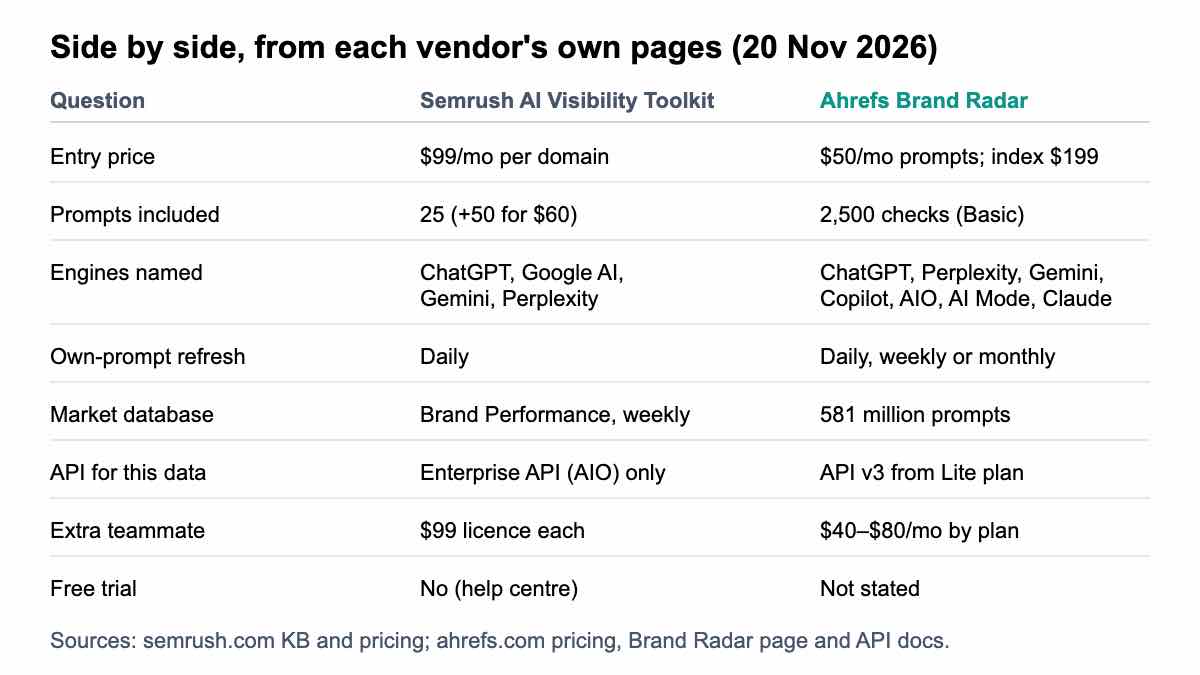
Here is every row I could fill from the vendors’ own pages on 20 November 2026. Where a page is silent, the cell says so.
| Question | Semrush AI Visibility Toolkit | Ahrefs Brand Radar |
|---|---|---|
| Entry price | $99/mo per domain (billed annually on the pricing page; “$99 per month” in the help centre) | Custom prompts from $50/mo; AI Visibility Index from $199/mo; the page also shows a $699/mo “for all models” price |
| Own prompts included | 25 prompts | Basic 2,500 checks; Lite, Standard and Advanced plans include 150, 300 and 600 checks |
| More capacity | +50 prompts for $60/mo; Semrush One Starter 50, Pro+ 100, Advanced 200 prompts | Growth $100 for 7,000 checks; Scale $250 for 25,000; overage $0.020, $0.015 or $0.010 a check |
| Engines named | ChatGPT, Google AI, Gemini, Perplexity | ChatGPT, Perplexity, Gemini, Copilot, AI Overviews, AI Mode; Claude on custom prompts |
| Own-prompt refresh | Daily | Daily, weekly or monthly |
| Market-wide view | Visibility Overview and Competitor Research, updated daily; Brand Performance, updated weekly | AI Visibility Index across 581 million prompts |
| Regions | 42 countries for research reports; 220+ for prompt tracking | Checks count per location; country list not stated on the pages I read |
| Extra teammate | $99 licence per sub-user | $40, $60 or $80/mo per user, by plan |
| Free trial of the AI tool | No, per the help centre | Not stated |
| API for this data | Prompt Tracking API for Semrush Enterprise AIO projects | Brand Radar endpoints in API v3, from the Lite plan |
What does each cost at three agency sizes?
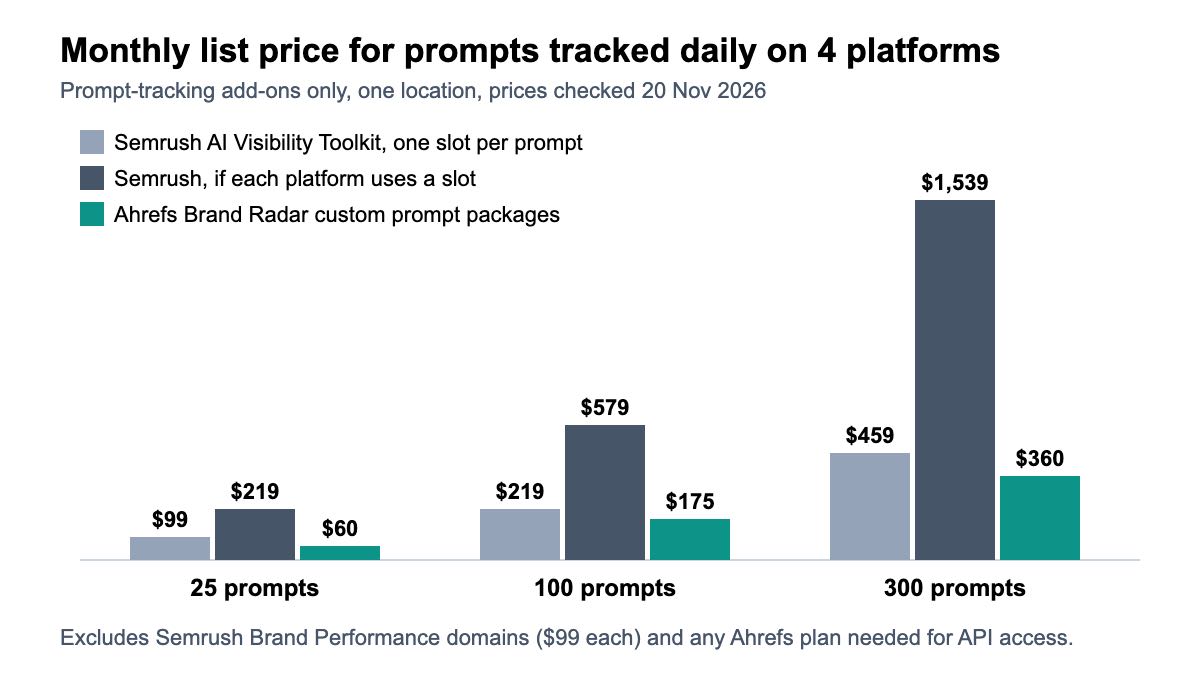
Take three agencies tracking 25, 100 and 300 prompts daily on four platforms in one location. That is 3,000, 12,000 and 36,000 answers a month. I priced only the prompt-tracking capacity, using the cheapest combination each vendor lists.
| Option and plan rule | 25 prompts (3,000 answers) | 100 prompts (12,000 answers) | 300 prompts (36,000 answers) |
|---|---|---|---|
| Semrush, one slot per prompt ($99 for 25, +$60 per 50) | $99 ($33.00/1K) | $219 ($18.25/1K) | $459 ($12.75/1K) |
| Semrush, one slot per prompt per platform | $219 ($73.00/1K) | $579 ($48.25/1K) | $1,539 ($42.75/1K) |
| Ahrefs custom prompt packages (cheapest of Basic, Growth, Scale plus overage) | $60 ($20.00/1K) | $175 ($14.58/1K) | $360 ($10.00/1K) |
| Serpent API — Default (four-engine call, $40 per 1,000 calls) | $30 ($10.00/1K) | $120 ($10.00/1K) | $360 ($10.00/1K) |
| Serpent API — Growth ($100 deposit; $4 per 1,000 calls) | $3 ($1.00/1K) | $12 ($1.00/1K) | $36 ($1.00/1K) |
| Serpent API — Scale ($500 deposit; $2 per 1,000 calls) | $1.50 ($0.50/1K) | $6 ($0.50/1K) | $18 ($0.50/1K) |
| Serpent API — Enterprise ($1,000 deposit; $1.70 per 1,000 calls) | $1.28 ($0.425/1K) | $5.10 ($0.425/1K) | $15.30 ($0.425/1K) |
| Serpent API — Enterprise Plus ($1,250 deposit; $1.40 per 1,000 calls) | $1.05 ($0.35/1K) | $4.20 ($0.35/1K) | $12.60 ($0.35/1K) |
How the Ahrefs row was built: at 25 prompts, Basic’s 2,500 checks plus 500 overage checks at $0.020 is $60. At 100 prompts, Growth’s 7,000 checks plus 5,000 at $0.015 is $175. At 300 prompts, Scale’s 25,000 checks plus 11,000 at $0.010 is $360. The Serpent rows divide the four-engine call price by four answers; they are API prices for the data itself, ready to go into your own reports.
What the table leaves out matters for agencies. Semrush’s Brand Performance reports cover one domain; each extra client domain is another $99 a month, and each teammate who needs the toolkit is another $99 licence. Ahrefs’ API access needs an Ahrefs plan from Lite at $129, though that plan also includes 150 checks. Claude is expensive on Ahrefs: its Brand Radar page says Claude consumes 8 checks per update.
If you already pay for Semrush One, the maths changes again: Starter includes 50 prompts and Pro+ 100, per the help centre, and Semrush’s pricing page lists those plans at $199 and $299 a month. The marginal cost of AI tracking there can be zero up to the included limit.
Which AI engines does each tool track?
Ahrefs names more. Its Brand Radar covers ChatGPT, Perplexity, Gemini, Copilot, Google AI Overviews and AI Mode, with Claude available for custom prompts. Its API reference also lists Grok as a data source.
Semrush’s AI pricing page lists mentions from ChatGPT, Google AI, Gemini and Perplexity. The help centre describes Prompt Tracking as working on “platforms like Google AI Mode and ChatGPT”, so check which engines your prompts can actually be tracked on before you promise a client four.
The engine list matters less than it looks for most clients. Ask which assistants their buyers use, then make sure those two or three are covered well. Paying for seven engines that your client’s market never opens is how AI tracking budgets drift.
How fresh and how deep is the data?
Both refresh your own prompts daily. Semrush’s help centre says its research reports update daily on a rolling basis, Brand Performance weekly and prompt tracking daily. Ahrefs lets you run custom prompts daily, weekly or monthly, which is a useful lever for cutting checks on low-stakes prompts.
The market-wide view is where they differ in kind. Ahrefs’ AI Visibility Index covers 581 million prompts and lets you look up any brand without setup; it starts at $199 a month, and the pricing section also shows $699 a month “for all models”. Semrush builds Brand Performance from “a vast collection of common queries” tied to the location and language you pick, with more than 68,000 location options.
Neither number tells you how stable the answers are. AI answers change between runs, so a single day’s result is a sample, not a fact. Our citation repeatability study shows how much answers move, and why a weekly average beats a daily headline in a client report.
Can you get the data out through an API?
On Ahrefs, yes. API v3 has a Brand Radar section with 22 endpoints: AI responses, cited pages, cited domains, mentions, impressions and share of voice, each with a history version. API access starts on the Lite plan with 200,000 units a month, per Ahrefs’ help centre, and requests that return only custom-prompt data are free.
On Semrush, the answer depends on the product. The Semrush API docs describe an Enterprise API (v4) that pulls Prompt Tracking data from AI Optimization projects: prompts, topics, brand visibility, mentions, sentiment and citations. That is Semrush Enterprise. I found no API documented for the $99 toolkit itself, which is the plan most agencies buy.
This is the deciding row for agencies with their own reporting stack. If client reports are built in Looker Studio, a spreadsheet or your own app, Brand Radar’s API is the practical choice of the two. If you want per-call data on your own prompts without a dashboard plan, or the raw answer text next to each number, an AI visibility API built for that job fits better: AI Rank tracks brand citations and positions across ChatGPT, Claude, Gemini and Perplexity as JSON, with per-engine target_found, target_position and citations fields described in the AI Rank docs. If you are weighing DataForSEO’s LLM Mentions API for the same job, the DataForSEO LLM Mentions alternatives guide compares it with the other API options.
What do clients actually receive?
Semrush leans toward the finished report. Brand Performance analyses share of voice, sentiment and the narratives around a brand and turns them into recommendations, and Semrush sells a Pro Report add-on at $20 a month with branding and white-labelling, per its AI pricing page. For a client who wants a PDF that explains itself, that is real value.
Ahrefs leans toward the data. Brand Radar shows mentions, citations and share of voice against competitors, and the API lets you put those numbers wherever your agency already reports. It also brings Ahrefs’ web data to the same screen: on its Brand Radar page, Ahrefs lists search demand and web visibility as bonuses for Ahrefs customers.
Whatever you choose, define the metric before the first report. “Visibility” means different things in each tool; Semrush’s AI Visibility Score compares your mentions with the median of your top competitors, per its help centre. Our guide to AI search visibility metrics sets out the common ones, and the audit of 14 AI rank trackers checks which vendors explain how their numbers are built.
How do you test both before committing?
Run them side by side on one client for two weeks, with the same prompts, before you sign an annual plan. A short test settles the two questions no pricing page answers: how each tool counts your prompts, and whether its numbers survive a hand check.
- Pick ten non-branded prompts a buyer would type, plus the client and three rivals.
- Load the same ten into both tools, on the same engines and the same country. Note how many Semrush prompt slots and how many Ahrefs checks the setup consumes; that settles the slot question for your account.
- Each Friday, open five answers by hand in each tool and check that the brand mentions and cited sources it reports are really there.
- After fourteen days, compare the share of voice each tool reports for the client, and how much it moved day to day.
If the two tools disagree by more than the day-to-day movement, trust the one whose hand-checked answers matched. If both match, choose on price and on how the data reaches your reports. Keep the test sheet: it becomes the method note in your first client report, and clients trust a number more when they can see how it was checked.
Pick Brand Radar if… pick Semrush if…
Pick Ahrefs Brand Radar if you already pay for Ahrefs, you track many clients or many prompts, you need Copilot, AI Mode or Claude, or your reports run off an API. Its check-based packages scale more cheaply, and custom-prompt API requests are free.
Pick the Semrush AI Visibility Toolkit if you already live in Semrush, you serve a few premium clients who value sentiment, narrative and branded PDFs, or you want one flat line item per client domain that finance can forecast.
Pick both only if different clients sit in different suites. Running both for one client doubles the cost and gives you two numbers that will never agree.
Pick neither for the reporting pipeline if you need your own prompts across ChatGPT, Claude, Gemini and Perplexity in your own reports, paying per call. That is an API job. For agency data stacks more generally, our guide to the best SERP API for agencies covers the search side, and the AI visibility tools comparison lists the dashboards beyond these two, including Profound, which our Profound alternative guide covers in depth.
How we checked this
On 20 November 2026 I opened the five top-ranking comparisons (Exploding Topics, which Semrush owns; Rework; Sagnik Bhattacharya; DataDab; TeachThought) and then the vendors’ own pages: Semrush’s AI pricing page, main pricing page, AI Visibility Toolkit help article and API docs; Ahrefs’ pricing page, Brand Radar page, API reference and API help article. Ahrefs’ pricing cards were read from the page’s raw text because the rendered layout splits each card. That is 13 linked sources, 9 of them official vendor pages; TeachThought was read but is not cited. Costs are my arithmetic on list prices, excluding tax.
One claim in circulation, that Brand Radar found a small fraction of a brand’s real mentions, did not appear in any source I could open, so it is not used here.
What I could not verify: whether Semrush counts a prompt tracked on several platforms as one slot or several; whether the $99 toolkit has any API access outside Semrush Enterprise; whether Ahrefs offers a free trial of Brand Radar; how many API units a Brand Radar request on Ahrefs’ own prompt data uses; and how often the Ahrefs AI Visibility Index refreshes.
Report your clients’ AI visibility from your own stack
Send each client prompt once and get every engine’s citations and the client’s position back as JSON. From $0.70 per 1,000 — pay as you go, no subscription — and every account starts with 10 free API calls.
Get Your Free API KeyExplore: AI Rank API · Playground · Docs · Pricing
FAQ
How much does Ahrefs Brand Radar cost?
Custom prompt tracking starts at $50 a month for 2,500 checks, with Growth at $100 for 7,000 and Scale at $250 for 25,000, plus overage of $0.020, $0.015 or $0.010 a check. Ahrefs’ Lite, Standard and Advanced plans include 150, 300 and 600 checks. The AI Visibility Index, which covers 581 million prompts, starts at $199 a month, and the Brand Radar page also shows a $699-a-month price for all models.
How much is the Semrush AI Visibility Toolkit?
$99 a month per domain, according to Semrush’s help centre and AI pricing page, which shows it billed annually. It includes 25 tracked prompts, one Brand Performance domain and 300 daily AI Analysis queries. Extra prompts cost $60 a month per 50, extra Brand Performance domains $99 each, and each extra teammate needs a $99 licence. There is no free trial of the toolkit.
Which tracks more AI engines, Brand Radar or Semrush?
Brand Radar. Ahrefs lists ChatGPT, Perplexity, Gemini, Copilot, Google AI Overviews and AI Mode, plus Claude on custom prompts, and its API also lists Grok. Semrush lists mentions from ChatGPT, Google AI, Gemini and Perplexity, and describes prompt tracking on platforms like Google AI Mode and ChatGPT. Confirm the exact engines for prompt tracking before promising them to a client.
Is Ahrefs Brand Radar available through the API?
Yes. Ahrefs’ API v3 has 22 Brand Radar endpoints, including AI responses, cited pages and domains, mentions and share of voice. API access starts on the Lite plan with 200,000 units a month. Requests that return only your custom-prompt data are free; requests that include Ahrefs’ own prompt data use standard API units.
Is Semrush or Ahrefs better for an SEO agency’s AI visibility reporting?
For many clients and an in-house reporting stack, Ahrefs: checks are cheaper at volume and the data is in the API. For a handful of premium clients who want sentiment, narrative and branded PDFs with little setup, Semrush. If client reports need per-call data on your own prompts, or the raw answers as evidence, use an AI visibility API alongside whichever suite you keep.
Sources
Semrush (checked 20 November 2026):
- AI Visibility Toolkit help article
- AI pricing page
- Pricing (SEO and Semrush One plans)
- API introduction (Enterprise API v4)
Ahrefs (checked 20 November 2026):
- Pricing (plans and custom prompt packages)
- Brand Radar
- Brand Radar API reference
- AI Responses endpoint
- About API v3
Comparisons read for the gap check (20 November 2026):