Leaving Outscraper? 9 Alternatives for Maps Leads

The best Outscraper alternative depends on why you are leaving. For unpredictable bills, pick a fixed plan such as Scrap.io or SerpApi; for volume from code, a per-call Maps API at under $1 per 1,000 places. For emails plus outreach, a lead platform. For Google’s own licensed data, the Places API.
Short answer: Developers pulling thousands of places a month: a per-call Maps API — Serpent API (pay as you go, from $7.35 per 1,000 calls of up to 20 enriched places), SerpApi (monthly plans) or DataForSEO (deep ranked lists for local rank tracking). No-code users who hate surprise invoices: Scrap.io’s flat plans. Teams that need emails and sequences in one place: a lead platform such as Apollo or Clay, or stay on Outscraper. Anyone bound by Google’s terms: the official Places API.
Why do people leave Outscraper?
Outscraper’s reviews are mostly positive, and the recurring complaints are less about the data than about the rest of the service. People leave because of how the bill is built, because they outgrew a no-code app, or because they need a step Outscraper does not do. It helps to name your reason first, because each one points to a different replacement.
Start with the fair picture. On Trustpilot, Outscraper scores 4.6 from 352 reviews, and 89% of them are five stars. It publishes its prices openly: the pricing page lists the first 500 places free every 30 days, $3 per 1,000 up to 100,000 and $1 per 1,000 after that. Plenty of people should stay.
The complaints that do recur fall into four groups:
- Bills that are hard to predict. Places, emails, email checks, phone lookups and reviews each run on their own meter. The FAQ confirms that a task finishes even when it uses more than your credits, and you are invoiced for the difference. A one-star Trustpilot review from 29 October 2026 describes unexpected charges for services the reviewer says they did not request; Outscraper replied with an apology and asked the reviewer to contact support. Our Outscraper pricing breakdown shows where those separate meters come from and how to cap them.
- Thin results on very broad searches. A two-star review from 27 October 2026 says a country-wide pull of bars and restaurants had “more holes than hits”. Outscraper replied that Google Maps caps how many places it shows for a broad query, and suggested splitting the search into smaller areas and categories. That is a real limit of Maps itself, and the section below explains why switching tools does not fix it on its own.
- Too many separate jobs. MapsLeads, a competitor, points out that a full lead list often needs three or four tasks merged in a spreadsheet.
- No outreach layer. Apollo and SyncGTM, both sales platforms, argue that Outscraper has no outreach layer: no email sequences and no CRM sync.
There is a fifth reason that the ranking lists rarely mention: price at volume for developers. If your code pulls places every day, $3 per 1,000 for most of the month is more than several Maps APIs charge for a comparable record.
Which kind of tool do you actually need?
“Outscraper alternatives” lists mix three different kinds of product, and comparing across them is how people end up disappointed. Decide the kind first, then the vendor.
- Maps scraper apps (Outscraper, Scrap.io, Apify, PhantomBuster, Bright Data’s scraper): you type a search and a place, and you download a spreadsheet. Some add emails from business websites. Good for marketers and one-off lists.
- Maps data APIs (Google Places API, SerpApi, DataForSEO, Serpent API): your code sends a query and gets JSON back for each call. Good for products, dashboards and scheduled jobs.
- Sales lead platforms (Apollo, Clay, Cognism, ZoomInfo): a contact database plus outreach tools. Most do not pull Google Maps listings at all; they sell people and companies from their own records.
Two of the five top-ranking “alternatives” pages are written by sales platforms and lean toward sales and outreach tools. That is useful if your real problem is outreach, and useless if you need local business listings by category and city. This guide covers the first two kinds in depth and points to the third where it fits.
What does each alternative cost per 1,000 places?
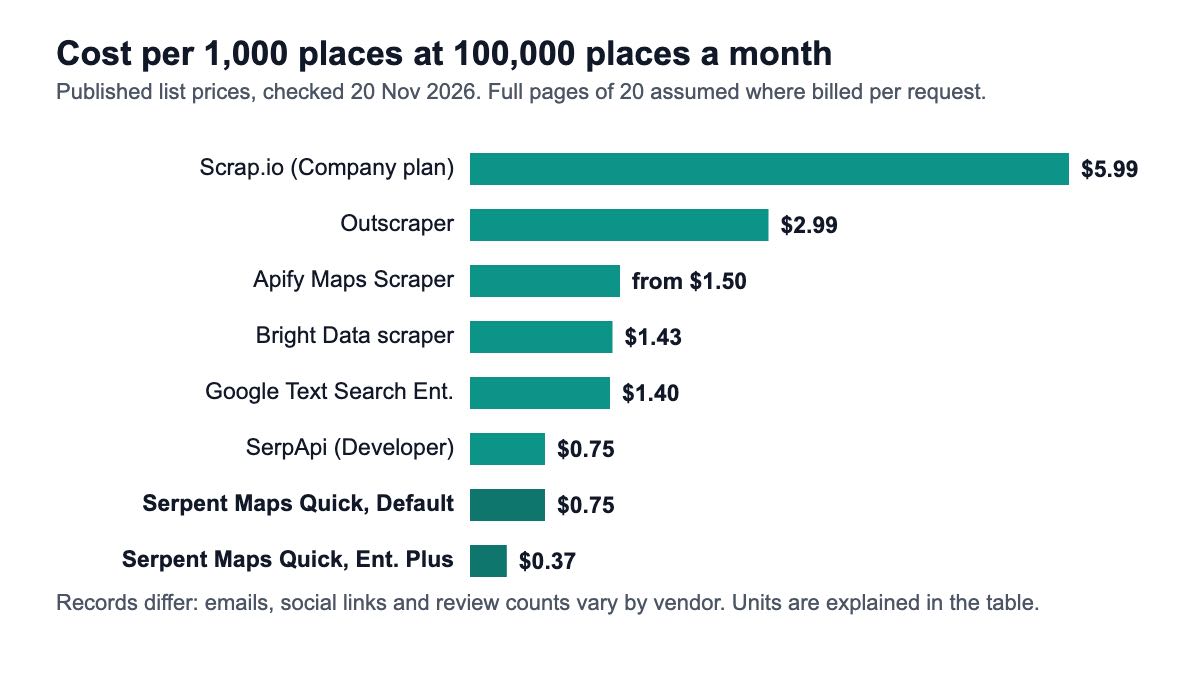
At 100,000 places a month, the published prices range from under $1 to about $6 per 1,000 places, and most of the spread comes from the billing model. The table puts every option on the same unit at three monthly volumes.
The rules: where a vendor bills per request, I assume full pages (20 places for Google, SerpApi and Serpent API; 100 listings for DataForSEO). Subscription products are priced at the smallest plan that covers the volume. A price I could not pin to a published page says so.
| Option (billing unit) | 1,000 / month | 100,000 / month | 1,000,000 / month | Model |
|---|---|---|---|---|
| Outscraper (per place) | $1.50 | $2.985 | $1.20 | Pay as you go, tiers reset every 30 days |
| Scrap.io (credit = one place exported per 30 days) | $59 (Basic plan, 10,000 credits) | $5.99 (Company, $599) | from $5.00 (Atlas, from $5,000) | Monthly plan |
| Apify Google Maps Scraper (per place) | from $1.50 | from $1.50 | from $1.50 | Pay per event; add-ons extra |
| Bright Data Google Maps scraper (per record) | $0 (5,000 free a month) | $1.43 | $1.30 (Scale, $499 incl. 384,000) | Pay as you go or plan |
| Google Places Text Search Enterprise (per request of up to 20) | $0 (1,000 free requests) | $1.40 | $1.72 | Pay as you go |
| SerpApi Google Maps (per search of up to 20) | $0 (Free, 250 searches) | $0.75 (Developer, $75) | $0.725 (Searcher, $725) | Monthly plan |
| DataForSEO Maps SERP, standard queue (per SERP of up to 100) | $0.006 | $0.006 | $0.006 | Prepaid, $50 minimum payment |
| PhantomBuster (execution hours) | Unverified per place: billed by run time, Start plan $69 a month for 20 hours | Monthly plan | ||
| gosom/google-maps-scraper (open source) | $0 software; you pay for your own servers and upkeep | Self-hosted | ||
| Serpent API — Maps Quick (per call of up to 20 fully enriched places) | $15.00 / $13.50 / $10.50 / $8.93 / $7.35 per 1,000 calls (Default / Growth / Scale / Enterprise / Enterprise Plus) = $0.75 / $0.675 / $0.525 / $0.447 / $0.368 per 1,000 places | Pay as you go, no subscription | ||
| Serpent API — Maps List (detail=0, per call of up to 20 places, not enriched) | $0.10 / $0.09 / $0.07 / $0.06 / $0.05 per 1,000 calls = $0.005 down to $0.0025 per 1,000 places | Pay as you go, no subscription | ||
Sources are linked in each section below and in the source list. Serpent API tiers follow deposit size ($100 Growth, $500 Scale, $1,000 Enterprise, $1,250 Enterprise Plus) and are listed on our pricing page.
Do not read the table as a quality ranking. DataForSEO’s $0.006 buys ranked listings, not the fuller record a scraper app returns, and Scrap.io’s price includes emails and social links. The column that matters is the one with your volume, and the row that matters is the one with the fields you need.
The nine alternatives, one by one
1. Serpent API Maps — best for developers who want pay-as-you-go place data
Fixes: high per-place cost at volume, and bills that arrive after the fact. Price: Maps Quick from $7.35 per 1,000 calls, each returning up to 20 ranked, fully enriched places; Maps List from $0.05 per 1,000 calls for a ranked list without enrichment — pay as you go, no subscription.
The Maps Quick endpoint takes a query and a location and returns up to 20 places, each with phone, website, rating, review count, opening hours, categories and a structured address. The Maps List mode returns the ranked list alone when that is all you need, and the reviews endpoint pages through public reviews 20 at a time. Credit is prepaid, so the bill is the balance you chose to add.
Building an email list? Each place carries its website, so you can add an email step of your own; our Maps-to-email pipeline shows one way.
2. SerpApi Google Maps — best for a fixed monthly budget
Fixes: unpredictable bills. Price: per SerpApi’s pricing, Free gives 250 searches a month, Developer is $75 for 5,000, Big Data $275 for 30,000 and Searcher $725 for 100,000.
Its Maps API pages through results 20 at a time and recommends going no further than about page six. You know the monthly cost before the month starts, which is exactly what Outscraper’s metered model does not give you.
The catch: it is a subscription, so a quiet month costs the same as a busy one. The docs sample shows a phone field but no website field, so check the fields on your own query before you commit.
3. DataForSEO Google Maps SERP — best for deep local rank tracking
Fixes: cost, when you need positions and names more than full records. Price: $0.60 per 1,000 SERPs on the standard queue, $1.20 priority and $2.00 live, with up to 100 listings per SERP. The minimum payment is $50, and new accounts get $1 of trial credit.
At a full 100 listings that is $0.006 per 1,000 listings. For local rank tracking, where you want to know who sits where for a keyword across up to 100 positions, that is a very low rate.
The catch: the standard queue averages about five minutes per task, and a SERP listing is not a full place record. Plan a second call per place if you need hours, reviews or contact fields.
4. Google Places API (New) — best when you need Google’s own terms
Fixes: licensing questions. Price: per Google’s price list, Text Search Pro is $32 per 1,000 requests and Enterprise $35, with 5,000 and 1,000 free requests a month respectively. Phone number, website and rating are Enterprise fields, and a request returns up to 20 places, per the Text Search docs.
That works out to about $1.40 per 1,000 places at 100,000 places a month, and free for a small test. Volume bands lower the rate to $28 per 1,000 requests after 100,000 requests and $21 after 500,000.
The catch: Google’s terms limit how long you can store the data, and the cheaper Pro tier does not return phone or website. Our free Google Maps API guide covers the storage rules and what the free allowance really buys.
5. Apify Google Maps Scraper — best for flexible add-ons
Fixes: missing extras such as social profiles and competitor data. Price: the store page lists “from $1.50 / 1,000 scraped places”, with add-ons for extra place details and company contacts at $1.50 to $2.00 per 1,000 each on the plans it shows.
Apify is the closest like-for-like replacement for Outscraper: the same idea of a per-place price with optional enrichment, plus scheduling and a full API. Its March 2025 help article listed $4 per 1,000 places at the launch of per-event pricing, so the rate has fallen since.
The catch: the price still stacks. Reviews, details, contacts and filters are separate events, so the bill shape is much like Outscraper’s.
6. Bright Data Google Maps scraper — best for very large pulls on a plan
Fixes: cost at a million places and up, plus a generous free tier. Price: per the product page, $1.50 per 1,000 records pay as you go, or $499 a month for 384,000 records and $1.30 per 1,000 after that. The free tier is 5,000 records a month with no card.
At one million records the plan works out at about $1.30 per 1,000. You pay only for successful deliveries, according to the page.
The catch: the page does not define exactly what one record is, and its FAQ calls the free allowance 5,000 credits while the price table says records. Check a sample before you size a budget on it.
7. Scrap.io — best for no-code users who want a flat bill
Fixes: surprise invoices and stacked enrichment. Price: per Scrap.io’s pricing page, Basic is $59 a month for 10,000 export credits, Professional $119 for 20,000, Agency $239 for 40,000 and Company $599 for 100,000. One credit is one place exported, and the same place is counted once in a 30-day period.
Emails are included (first email only on Basic, all emails from Professional), and higher plans add all social links. If you want to know your bill before the month starts and you never touch code, this is the most direct fix for Outscraper’s metering.
The catch: per place it is the most expensive option here, and a quiet month costs the same as a busy one. Scrap.io also publishes a long Outscraper pricing critique; read it as the competitor piece it is.
8. PhantomBuster — best if you already automate LinkedIn and other sites with it
Fixes: juggling several tools. Price: PhantomBuster’s July 2026 pricing explainer lists Start at $69 a month ($56 billed yearly) with 20 execution hours and 500 email credits, Grow at $159 and Scale at $439. The free plan gives 30 minutes a month.
It bills by time, not by place, so the cost per 1,000 places depends on how fast each run goes. I could not find a published per-place figure, so the table marks it unverified.
The catch: time-based billing is hard to compare and hard to forecast for Maps work specifically.
9. gosom/google-maps-scraper — best if you would rather run it yourself
Fixes: software cost. Price: free. The GitHub project is MIT-licensed, had about 8,260 stars on 20 November 2026 and was last updated on 15 November 2026. It extracts name, address, phone, website, rating, review counts, coordinates and emails.
The catch: you run it, host it, keep it working when Google Maps changes its pages, and absorb the engineering time. For a side project that is fine. For a product, compare a few days of upkeep with a year of API bills.
Which alternative fixes your reason for leaving?
Match the alternative to the pain, not to a ranking. The chart pairs each common reason with the kind of tool that removes it.
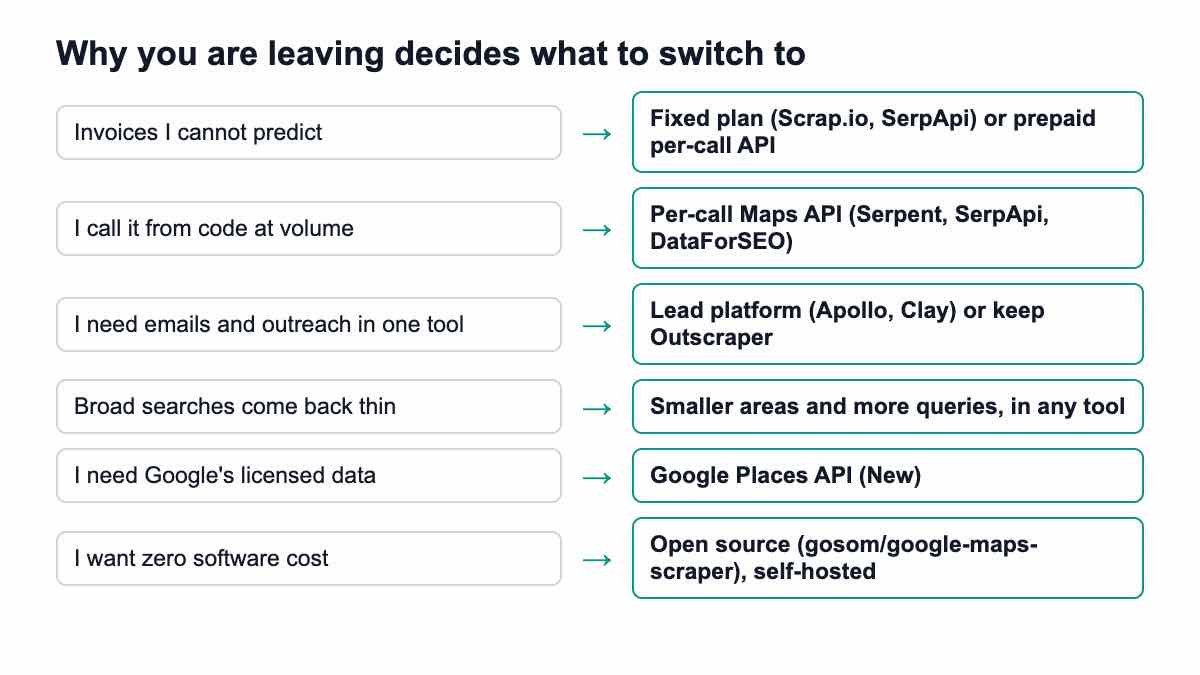
- “My invoices were higher than I expected”: choose a model where you set the ceiling. Scrap.io and SerpApi charge a fixed monthly fee; prepaid per-call APIs such as Serpent API stop at the balance you added.
- “I am calling it from code every day”: a Maps data API. At 100,000 places a month, Serpent API’s Maps Quick comes to from $0.37 per 1,000 places and SerpApi’s Developer plan to $0.75, against about $2.99 on Outscraper.
- “I need emails and a sequence tool”: a lead platform, or stay on Outscraper and add your own email step. Apollo and Clay sell the outreach part; Outscraper is still good at the data part.
- “Big searches come back thin”: change the search, not only the vendor (next section).
- “Legal says it has to be Google’s API”: the Places API, with field masks set so you pay only for the tier you need.
Will switching fix thin results on broad searches?
Not by itself. Google Maps shows a bounded ranked list for any one search area, so a query like “restaurants in Germany” can never list every restaurant, whichever tool sends it. Google’s own Text Search API returns at most 60 places across all pages of one query, and Outscraper’s Trustpilot reply describes the same kind of cap.
The fix is the same everywhere: search smaller areas and more of them. Split a country into cities, a city into districts, or a district into a grid of coordinates, and merge the results on the place ID. SerpApi’s Maps docs recommend a maximum offset of 100 (page six), warning that results beyond it may be duplicated or irrelevant.
With Serpent API you do this with documented parameters: pass lat and lng (or ll) for each grid point, set zoom higher to tighten the area, and page with start values of 0, 20, 40, 60 and 80. Each place carries a place_id, so de-duplication is a set operation. Our Python guide to Maps data walks through a full pull.
Expect overlap. Neighbouring grid cells return many of the same businesses, so budget for more calls than unique places. That applies to every vendor in the table, including Outscraper, where the “drop duplicates” setting does the same job inside one task.
Which one should you pick?
- A developer building a product on local business data: a per-call Maps API. Choose Serpent API for pay-as-you-go enriched places, SerpApi for a fixed monthly plan, or DataForSEO when ranked lists are enough.
- A marketer who wants a spreadsheet and a predictable bill: Scrap.io.
- A team that wants Outscraper’s model but more add-ons: Apify.
- A one-off pull of over a million places: Bright Data’s plan, or Outscraper inside one 30-day period at its $1 tier. Compare a sample of records first.
- A company that must use Google’s licence: the Places API.
- A hobby project with spare engineering time: the open-source scraper.
- You like Outscraper and only hate surprise bills: stay, but set an organizations-per-query limit and a total places limit on every task.
If you are weighing several Maps APIs side by side rather than replacing Outscraper, our best Google Maps business data API comparison goes field by field, and the cost-per-enriched-place guide shows when a bare list beats a full record.
How we checked this
I opened every vendor’s live pricing or product page on 20 November 2026: Outscraper (pricing and FAQ), Scrap.io, Apify (store page and help article), Bright Data, DataForSEO (pricing and minimum payment), Google Maps Platform (price list and Text Search docs), SerpApi (pricing and Maps docs) and PhantomBuster (its July 2026 pricing explainer). Repository facts come from GitHub’s API the same day. Serpent API prices come from our pricing page that day.
I also read the five top-ranking pages for “outscraper alternatives” and Outscraper’s Trustpilot page. Sources: 13 official vendor pages and docs, 1 code repository, 1 review site and 4 competitor articles. No API calls were made; every cost per 1,000 places is list-price arithmetic with the assumptions stated above the table.
What we could not verify: PhantomBuster’s cost per place; Apify’s base rate on each plan; whether Bright Data’s 5,000 free records stack with pay-as-you-go or Scale billing (the 100,000 and 1,000,000 cells assume they do); which contact fields every SerpApi and DataForSEO Maps result carries; and how many places a broad search returns on any given day, which changes with Google Maps itself.
Try a Maps API on your own query
Serpent API’s Maps calls start from $0.05 per 1,000 for a ranked list, and enriched place search from $7.35 per 1,000 calls — pay as you go, no subscription. A new account gets 10 free API calls, enough to compare a few searches with your Outscraper export.
Get Your Free API KeyExplore: Google Maps API · Playground · Docs · Pricing
FAQ
What is the cheapest alternative to Outscraper?
For bare ranked listings, the per-call list products are cheapest: Serpent API’s Maps List is from $0.05 per 1,000 calls of up to 20 places (about $0.0025 per 1,000 places), and DataForSEO’s Maps SERP is $0.60 per 1,000 SERPs of up to 100 listings (about $0.006 per 1,000 listings) after a $50 minimum payment. For places with phone and website, Serpent API’s Maps Quick works out from $0.37 per 1,000 places and SerpApi’s Developer plan at $0.75. Outscraper is about $2.99 per 1,000 at 100,000 places a month.
Is Apify cheaper than Outscraper?
Per place, usually yes. Apify’s Google Maps Scraper lists “from $1.50 / 1,000 scraped places”, while Outscraper charges $3 per 1,000 from the 501st to the 100,000th place in a period. Above 100,000, Outscraper drops to $1 per 1,000 and can be the cheaper of the two. Both charge extra for details, contacts and reviews, so compare the full stack you need, not the base rate.
Is there a free Outscraper alternative?
Several options have a free allowance: Google’s Places API gives 1,000 free Text Search Enterprise requests a month, SerpApi’s free plan gives 250 searches, Bright Data’s scraper gives 5,000 records a month, and Serpent API gives 10 free API calls on sign-up. The only fully free option is open source, such as gosom/google-maps-scraper under the MIT licence, where you pay for hosting and your own time instead.
Which Outscraper alternative has an API?
Most of them: Google Places, SerpApi, DataForSEO and Serpent API are APIs first: you send a request and get JSON back for each call. Apify and Bright Data run scrapers that you can start and read through their APIs. Scrap.io and PhantomBuster are mainly apps used in a browser. If your code will call it every day, choose a per-call API, because the cost scales with exactly what you request.
Do Outscraper alternatives include emails?
Some do. Scrap.io includes emails from business websites in its plans, Apify sells contact enrichment as an add-on, and the open-source scraper can extract emails too. Maps data APIs such as Google Places, SerpApi and Serpent API return place fields such as phone and website, so you add an email step yourself. Sales platforms such as Apollo sell contacts from their own databases instead of from Maps.
Why does my Google Maps scrape miss businesses?
Because Google Maps shows a limited ranked list for each search area, any tool returns only part of the businesses in a large region from one query. Split the region into smaller areas — cities, districts or a grid of coordinates — and merge the results on the place ID. Expect overlap between neighbouring areas and budget extra calls for it. This applies to Outscraper and every alternative listed here.
Sources
Official pricing and docs (checked 20 November 2026):
- Outscraper — Pricing
- Outscraper — FAQ
- Scrap.io — Pricing
- Apify — Google Maps Scraper
- Apify Help — pay-per-event pricing (March 2025)
- Bright Data — Google Maps scraper
- DataForSEO — Google Maps SERP API pricing
- DataForSEO — Minimum payment
- Google Maps Platform — Pricing
- Google — Places API Text Search (New)
- SerpApi — Pricing
- SerpApi — Google Maps API
- PhantomBuster — Pricing explained (July 2026)
- GitHub — gosom/google-maps-scraper
Reviews and third-party articles (checked 20 November 2026; several are by competing vendors):