Outscraper Pricing: What 1,000 Places Really Cost

Outscraper charges $3 per 1,000 Google Maps places after the first 500 free in each 30-day period, then $1 per 1,000 past 100,000. So 1,000 places cost $1.50, 100,000 cost $298.50 and one million cost $1,198.50. Emails, phone checks and reviews are billed as separate services on top.
Short answer: Outscraper is a fair buy if you need business emails and pull under about 100,000 places a month. For just phone, website and rating, a per-call Maps API is cheaper: Serpent API’s place search returns up to 20 places a call, from $7.35 per 1,000 calls — pay as you go, no subscription (Google Maps API). For Google’s licensed data, pay for the official Places API.
How does Outscraper actually bill you?
Outscraper is pay as you go: you pay per record for each service you use, with no plan to subscribe to. Its pricing page says it plainly: “No monthly fees. No recurring billing.” Every service has its own meter, its own free allowance and its own price steps.
For the Google Maps scraper, the unit is one business (Outscraper also says “place” or “record”). The first 500 are free. Records 501 to 100,000 cost $3 per 1,000. Everything after 100,000 costs $1 per 1,000.
Three rules sit behind those numbers, and they matter more than the headline:
- The tiers reset every 30 days. The free allowance and your position in the tiers start over with each billing period.
- Each service counts separately. Places, reviews, email lookups, email checks, phone lookups and photos each have their own free tier and their own price.
- You pay for what comes back, not for queries. The Outscraper FAQ says you “pay only for the results you extract, no matter how many queries you make.”
You can pay two ways. Prepaid means you add credits to your balance; Outscraper says those credits never expire. Postpaid means you get an invoice at the end of the period, and only if your usage went past the free tier.
A billing period starts when you launch a task and no period is open. It ends either when you click “Generate Invoice” or automatically after a month. Keep that second detail in mind; it comes back in the section on the reset.
What do 1,000, 100,000 and 1 million places cost?
The real price per 1,000 places depends on how many you pull in one period, because the free 500 and the $1 tier both shift the average. Here is the formula, as I read the pricing page:
cost = (min(N, 100,000) - 500) x $3 / 1,000
     + max(0, N - 100,000) x $1 / 1,000
The pricing page describes the $1 rate as the price for “the usage after 100k businesses”. I read that as a step: the first 100,000 in a period still cost $3 per 1,000, and only the records after them cost $1. The page does not show a worked invoice, so treat that reading as unconfirmed until you see your own bill.
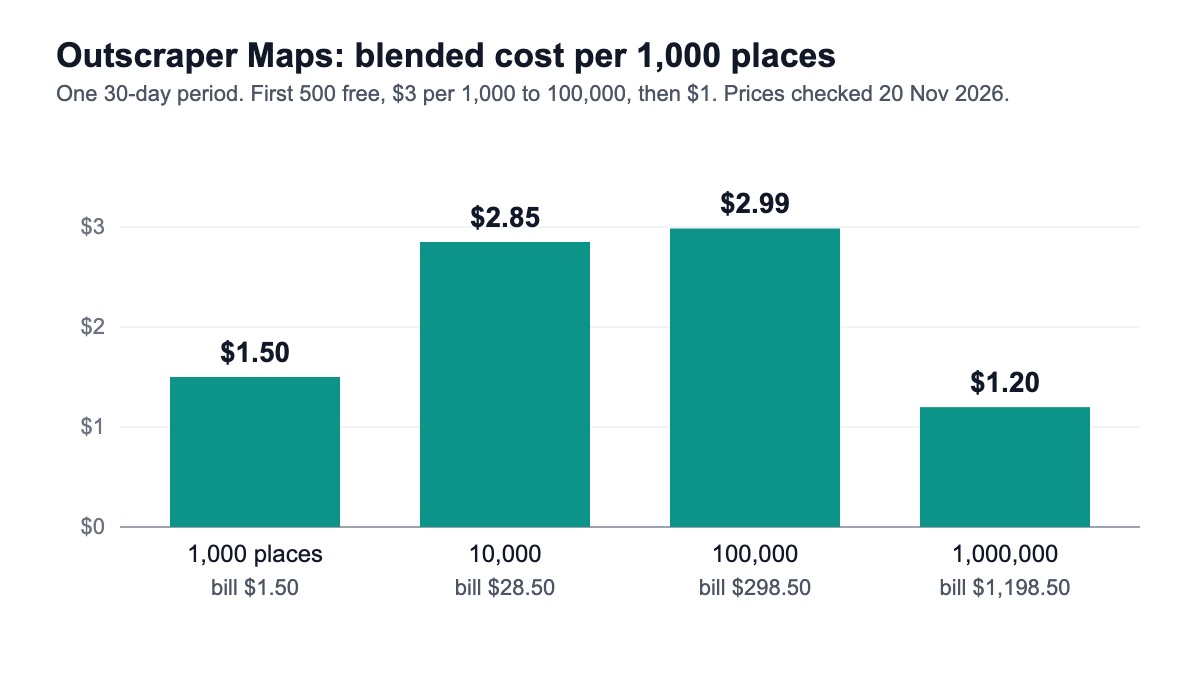
| Places in the period | Free | At $3 / 1,000 | At $1 / 1,000 | Bill | Per 1,000 places |
|---|---|---|---|---|---|
| 1,000 | 500 | 500 | 0 | $1.50 | $1.50 |
| 10,000 | 500 | 9,500 | 0 | $28.50 | $2.85 |
| 100,000 | 500 | 99,500 | 0 | $298.50 | $2.985 |
| 1,000,000 | 500 | 99,500 | 900,000 | $1,198.50 | $1.20 |
Two things stand out. First, the middle is the expensive part: anyone pulling between about 10,000 and 100,000 places a month pays close to the full $3 per 1,000. Second, the $1 tier only pulls the average down once you go well past 100,000. At 200,000 places the bill is $398.50, about $1.99 per 1,000.
If your volume is small, the free tier does a lot. A one-off pull of 500 places costs nothing, and the next 500 cost $1.50. That is a cheap way to see whether the records fit your use before you commit any budget.
Why does the 30-day reset change your bill?
Because the tiers count inside one period, the same total volume can cost different amounts depending on when you run it. That makes the calendar a cost lever, which none of the pricing write-ups I opened point out.
Take 200,000 places. Run them all inside one 30-day period and you pay $298.50 for the first 100,000 and $100 for the second, so $398.50. Split them across two periods, 100,000 each, and you pay $298.50 twice, so $597. Same data, $198.50 apart.
The reverse holds too. If you only ever need a few hundred places, spreading them so each period stays under 500 keeps them free. Outscraper offers that allowance openly, so there is nothing sly about using it.
Then there is the “Generate Invoice” button. The pricing page says a period ends when you click it, and a new period opens with your next task. As I read it, closing a period early would also reset your tier position, so a large job that you split around an early invoice would start again at $3. Check with Outscraper support before you plan a big run around it.
The practical rule: plan large pulls so they land inside one period, and do not close the period halfway through.
What does an enriched lead really cost?
A place record alone is rarely the whole job. Most people buying Outscraper want an email and a working phone number, and each of those is a separate service with its own meter. Outscraper’s own pricing explainer says enrichments “incur additional, service-specific costs”.
| Service | Unit | Free each period | Medium tier | Business tier |
|---|---|---|---|---|
| Google Maps scraper | place | 500 | $3 (501–100,000) | $1 (after 100,000) |
| Google Maps reviews | review | 500 | $3 (501–100,000) | $1 (after 100,000) |
| Emails & contacts | domain | 500 | $3 (501–100,000) | $1 (after 100,000) |
| Email address verifier | 25 | $3 (26–100,000) | $1 (after 100,000) | |
| Phone number lookup | phone | 25 | $5 (26–50,000) | $3 (after 50,000) |
| Google Maps photos | image | 500 | $2 | $1 (after 50,000) |
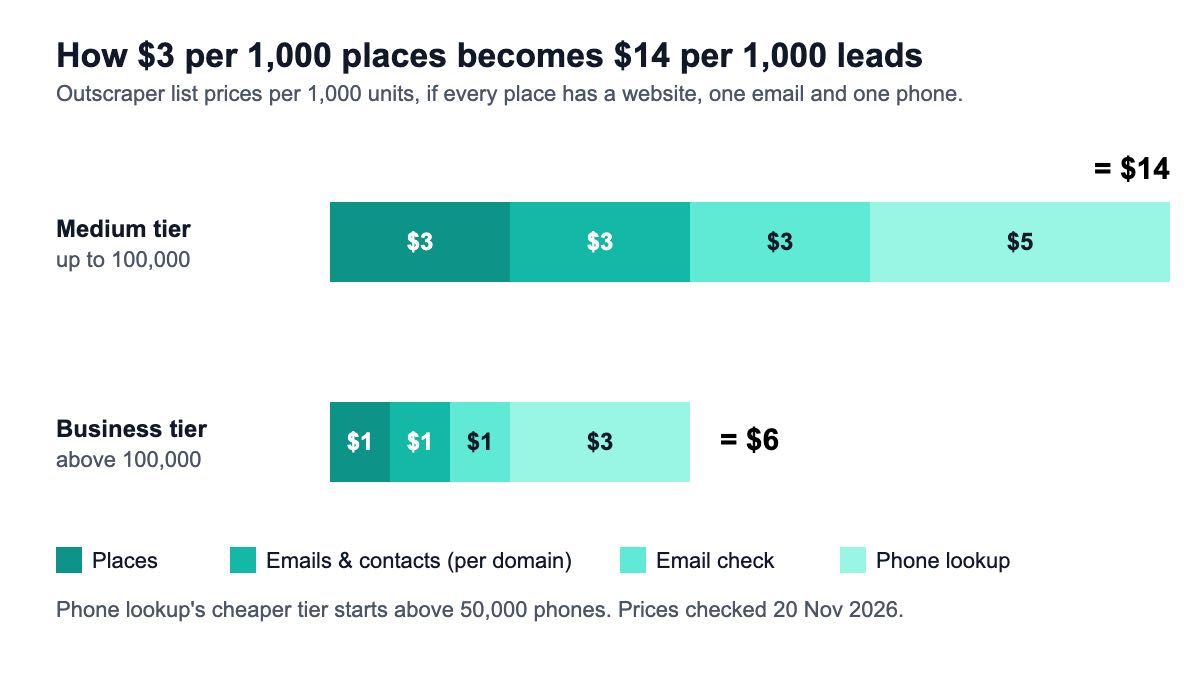
Stack the four services and the Medium-tier price per 1,000 complete leads is $3 + $3 + $3 + $5 = $14. Scrap.io builds the same $14 from the same four services, and Prospeo reaches about $14 with a different mix (emails, verification, photos and reviews); both are competitors selling their own tools. At the Business tier the same stack is $1 + $1 + $1 + $3 = $6.
That $14 is a ceiling, not a typical bill, and the reason is the unit. Emails & contacts is billed per domain, so a place with no website costs nothing to enrich. Verification is billed per email found, not per place. If 60% of your places have a website, the email step costs 60% of the headline.
Reviews follow the same per-unit logic. Pulling 100 reviews for each of 1,000 places is 100,000 reviews, which is $298.50 in one period. Reviews, not places, are usually the biggest line on a reputation or sentiment project.
For a feel of how the counts pile up, MapsLeads works through 500 leads with places, details, reviews and email enrichment and counts about 6,500 billable records. That is a competitor’s example, but the arithmetic method is sound: count units per service, not leads.
If you want to build the email step yourself instead, our Google Maps to verified email pipeline shows how a website crawl and an MX check fit after a place search.
Where do surprise invoices come from?
Most complaints about Outscraper’s billing are not about the rates. They are about how easy it is to use more than you meant to. Three mechanics explain nearly all of them.
Tasks finish even when your balance runs out. The FAQ says “The task will be finished, and if the task usage is greater than your account credits” you get an invoice for the difference. Neither the pricing page nor the FAQ describes a dollar spending cap.
Enrichments are ticked inside the same task. Adding emails, phone lookups or company insights to a Maps task adds separate meters to the bill. Prospeo summarises an AppSumo review in which a user who selected “Lead Gen Packs” was charged $7.24 they had not expected. The amount is small; the surprise is the point.
The count is known only after the run. The FAQ is honest about this: the exact number of places is “known only after the extraction.” A query for “restaurants in Texas” can return far more than you pictured.
Outscraper gives you the controls to stop this, and they are worth using every time:
- Organizations per query limit caps how many places each query can return. The FAQ’s example: a limit of 80 across 6 queries means “no more than 480 organizations”.
- Total places limit caps the whole task.
- Drop duplicates removes repeats inside a task, so overlapping queries do not bill the same business twice.
- Prepaid credits make the bill visible before it happens, even though a task can still run past them.
One more term to know: the pricing page offers a full refund within 3 days of purchase “if Outscraper’s tools fail to retrieve data from the web.” That covers failed retrieval, not records you did not want.
If you bought the AppSumo lifetime deal, the rules differ. Outscraper’s explainer says AppSumo credit does not roll over and expires each 30-day cycle, and usage above it is invoiced at the normal pay-as-you-go rates. Its own example: 5,000 places and 8,000 emails come to $39 against a $30 monthly credit, leaving a $9 invoice.
Is it cheaper than other Maps data sources?
Per place, Outscraper is rarely the cheapest for plain place data: Google’s free allowance beats it at small volume, Google and per-call Maps APIs beat it at 100,000 places a month, and it only undercuts Google at around a million. Its edge is the contact data it can add, not the place price. The catch is that the units differ, so the table below converts every option to dollars per 1,000 places at three monthly volumes.
The rules I used: Google’s Text Search and SerpApi’s Maps search return up to 20 places per request, so 1,000 places is 50 requests; Serpent API’s place search also returns up to 20 per call. Prices assume full pages. Plans that need a subscription are priced at the smallest plan that covers the volume.
| Provider and unit | 1,000 places / month | 100,000 / month | 1,000,000 / month | Billing |
|---|---|---|---|---|
| Outscraper Maps scraper (per place) | $1.50 | $2.985 | $1.20 | Pay as you go; tiers reset every 30 days |
| Google Places Text Search Enterprise ($35 per 1,000 requests; phone and website need this tier) | $0 (inside 1,000 free requests) | $1.40 | $1.72 | Pay as you go; volume bands by requests |
| Apify Google Maps Scraper (per place) | from $1.50 | from $1.50 | from $1.50 | Pay per event; lower on paid Apify plans; add-ons extra |
| SerpApi Google Maps (per search of up to 20) | $0 (Free plan, 250 searches) | $0.75 (Developer, $75 for 5,000) | $0.725 (Searcher, $725 for 100,000) | Monthly subscription |
| Serpent API — Maps Quick, per call of up to 20 enriched places | $15.00 / $13.50 / $10.50 / $8.93 / $7.35 per 1,000 calls (Default / Growth / Scale / Enterprise / Enterprise Plus) = $0.75 / $0.675 / $0.525 / $0.447 / $0.368 per 1,000 places, at any volume | Pay as you go, no subscription | ||
| Serpent API — Maps Reviews, per call of up to 20 reviews | $3.00 / $2.70 / $2.10 / $1.79 / $1.47 per 1,000 calls = $0.15 / $0.135 / $0.105 / $0.090 / $0.074 per 1,000 reviews | Pay as you go, no subscription | ||
Sources: Google Maps Platform pricing and the Text Search docs (page size 1–20; phone, website and rating are Enterprise fields), Apify’s Google Maps Scraper page, SerpApi pricing and its Maps API docs, and our pricing page. Serpent tiers are set by deposit size ($100 Growth, $500 Scale, $1,000 Enterprise, $1,250 Enterprise Plus), not by a subscription.
Read the table with three cautions.
First, the records are not identical. Outscraper and Apify can bolt on emails and social profiles; Google’s fields depend on which tier you pay for; per-call APIs return what the Maps listing shows, such as phone and website.
Second, Apify’s store page lists only “from $1.50 / 1,000 scraped places”, and its add-ons for extra place details and contacts run $1.50 to $2.00 per 1,000 each on the plans it shows. Third, SerpApi’s docs sample shows a phone field but no website field, so I have not confirmed which contact fields every result carries.
On the official API, Google’s volume bands help large users: Text Search Enterprise drops from $35 to $28 per 1,000 requests after 100,000 requests and to $21 after 500,000. At 1 million places (50,000 requests) you never leave the first band, which is why the cost per place goes up from the 100,000 column, where the 1,000 free requests carry more weight.
For every vendor at every volume, including DataForSEO, Scrapingdog and Bright Data, see how much a Google Maps API costs in 2026. For the question of when to pay for a full record versus a bare list, read what an enriched place really costs.
So is Outscraper worth it?
Yes, for the job it is built for. If you are a marketer or agency who wants a spreadsheet of local businesses with emails, without writing code, Outscraper’s app does that, and $3 per 1,000 places with 500 free each period is an honest, published price. Review sites are broadly positive; Prospeo’s round-up cites Trustpilot at 4.7 out of 5.
It is less of a bargain in two cases. The first is high-volume place data without emails, where per-call APIs come in at well under $1 per 1,000 places. The second is any team that needs a predictable monthly number, because the tiers, the reset and the separate meters make the invoice hard to forecast unless you set limits on every task.
Be fair to the competitor pieces too. Several pages that rank for this query are written by vendors selling a flat plan, and their worst-case stories are partly marketing. The rates they quote do match Outscraper’s page; one review site, SyncGTM, says phone lookup and photos have no free tier, while Outscraper lists 25 free phones and 500 free images.
Which one should you pick?
- You want emails and you work in a browser: Outscraper. Use the per-query limit and the total limit on every task, and enrich only places that have a website.
- One big job of 100,000+ places: still Outscraper if you need its contact data, but run it inside one 30-day period so the $1 tier applies, and do not generate an invoice partway through.
- Places with phone, website and rating, called from code, at any volume: a per-call Maps API. Serpent API’s Maps Quick endpoint returns up to 20 ranked, fully enriched places per call, and the reviews endpoint returns up to 20 reviews per call, both pay as you go.
- A fixed monthly budget and a steady query count: SerpApi’s subscription plans give you a known number of searches for a known price.
- You need Google’s official data and its licence terms: the Places API, with field masks set so you only pay for the tier you need.
- A few hundred places, once: any free tier will do; see the options in our free Google Maps API guide.
How we checked this
I read Outscraper’s pricing page, FAQ and pricing explainer on 20 November 2026, and the live pricing pages and docs of Google Maps Platform, Apify and SerpApi on the same day. Serpent prices come from our own pricing page that day.
I also opened the five top-ranking pages for “outscraper pricing” (Outscraper, Scrap.io, Prospeo, MapsLeads and SyncGTM) and checked their figures against Outscraper’s page. Sources: 7 official vendor pages, 2 official docs pages, 4 third-party articles. No API calls were made for this post; every cost is list-price arithmetic, shown above.
What we could not verify: whether the $1 tier is a step on usage above 100,000 (our reading) or applies to the whole volume; whether API usage is billed exactly like app usage; whether clicking “Generate Invoice” early resets your tier position; Apify’s base per-place rate on each plan; and whether every SerpApi Maps result carries a website field. All five are marked as unconfirmed in the text.
Price your own Maps workload
Serpent API’s Maps calls start from $0.05 per 1,000 for a ranked list of up to 20 places, and enriched place search from $7.35 per 1,000 calls — pay as you go, no subscription. Sign up and you get 10 free API calls to compare the records with your current source.
Get Your Free API KeyExplore: Google Maps API · Playground · Docs · Pricing
FAQ
Does Outscraper have a free plan?
There is no free plan as such, but every service has a free tier that resets every 30 days. For the Google Maps scraper it is the first 500 places, for reviews the first 500 reviews, and for email verification and phone lookup the first 25. If you stay inside those limits you are not charged. Outscraper describes the free tier as “the amount of usage you can use for free each month,” and postpaid accounts are only invoiced when usage goes past it.
How much does Outscraper cost per 1,000 places?
The list price is $3 per 1,000 places for records 501 to 100,000 in a 30-day period, and $1 per 1,000 after that. Because the first 500 are free, the average comes out at $1.50 per 1,000 if you pull 1,000 places, about $2.99 at 100,000 and about $1.20 at one million. Emails, verification and phone lookups are extra services, which is how a full lead can reach $14 per 1,000 at the Medium tier.
Does Outscraper charge for reviews separately?
Yes. The Google Maps reviews scraper is its own service, billed per review, not per place. The first 500 reviews in a period are free, then $3 per 1,000 up to 100,000 reviews and $1 per 1,000 after that. Pulling 100 reviews for each of 1,000 businesses is 100,000 reviews, or $298.50 in one period, so set a reviews-per-place limit before you run a task, because reviews add up much faster than places.
Do Outscraper credits expire?
Credits you buy directly do not expire; the pricing page says they “never expire.” AppSumo lifetime-deal credit works differently: Outscraper’s explainer says it does not roll over and expires at the end of each 30-day cycle, with usage beyond it invoiced at normal pay-as-you-go rates. The free tier also resets every 30 days, so unused free records do not carry over either.
Can I set a spending limit on Outscraper?
Outscraper’s pricing page and FAQ do not describe a dollar spending cap, and a task that goes past your prepaid credits still finishes, with the difference invoiced. What you can limit is data: set an organizations-per-query limit, a total places limit and drop duplicates on each task. Those three settings put a ceiling on the record count, and therefore on the bill, before the task starts.
Is Outscraper cheaper than the Google Places API?
Usually not, for plain place data. Google’s Text Search Enterprise, the tier that returns phone and website, costs $35 per 1,000 requests of up to 20 places after 1,000 free requests a month, which is about $1.40 per 1,000 places at 100,000 places a month. Outscraper costs about $2.99 per 1,000 at that volume, so Google is cheaper there if full pages come back. Outscraper wins at around a million places ($1.20 against about $1.72) and adds emails, which Google does not return at all.
Sources
Official pricing and docs (checked 20 November 2026):
- Outscraper — Pricing
- Outscraper — FAQ
- Outscraper — Outscraper pricing explained
- Google Maps Platform — Pricing
- Google — Places API Text Search (New)
- Apify — Google Maps Scraper
- Apify Help — Google Maps Scraper pay-per-event pricing (March 2025)
- SerpApi — Pricing
- SerpApi — Google Maps API
Third-party articles (checked 20 November 2026; several are by competing vendors):