Grounding with Bing Search pricing: $14 per 1,000, and what else you pay
Grounding with Bing Search costs $14 per 1,000 transactions, the same as Grounding with Bing Custom Search. That price took effect on 1 January 2026, replacing $35. A transaction is one tool call, a single question can trigger several, and model tokens are billed on top. Microsoft now steers new projects to Web IQ at $7.
Short answer: If you are building an Azure AI Foundry agent that needs current web answers with Bing citations, budget $14 per 1,000 tool calls plus tokens, and test Web IQ first, since its web search is $7 per 1,000. If you need the ranked list of Bing results itself, to store, analyse or track, neither product returns it; use a results API such as Serpent API's Bing SERP API, from $0.03 per 1,000 — pay as you go, no subscription (pricing).
What does Grounding with Bing cost today?
Both versions cost $14 per 1,000 transactions. Microsoft's Bing APIs page lists them side by side with the same limits and price, and the old grounding-pricing URL now redirects there.
| Product | Price | Max calls per second | Max calls per day | Price-feed start date |
|---|---|---|---|---|
| Grounding with Bing Search | $14 per 1,000 transactions | 150 | 1 million | 1 Jan 2026 |
| Grounding with Bing Custom Search | $14 per 1,000 transactions | 150 | 1 million | 1 Jan 2026 |
The machine-readable source agrees. Querying the public Azure Retail Prices API for "Grounding" returns two meters under the service "MS Bing Services": Search Transactions and Custom Search Transactions, each at 14.0 per 1K, with an effectiveStartDate of 2026-01-01.
Microsoft's page lists no free tier, and none appears in the price feed. The $14 is also only the search fee. The model that decides to search, reads the results and writes the answer is billed separately at its own token rates.
The same page now opens with a banner: "Grounding with Bing is upgrading to Web IQ". It adds that "Existing Grounding with Bing customers: no action is required today, and your solutions continue to work." Web IQ is covered further down; it matters because its web search is half the price.
Why do some pages still say $35?
Because $35 was the official price for most of 2025. Archived copies of Microsoft's grounding pricing page show "$35 per 1,000 transactions" for Grounding with Bing Search in January 2025 and for both versions in November 2025. The 13 February 2026 copy shows $14 for both.
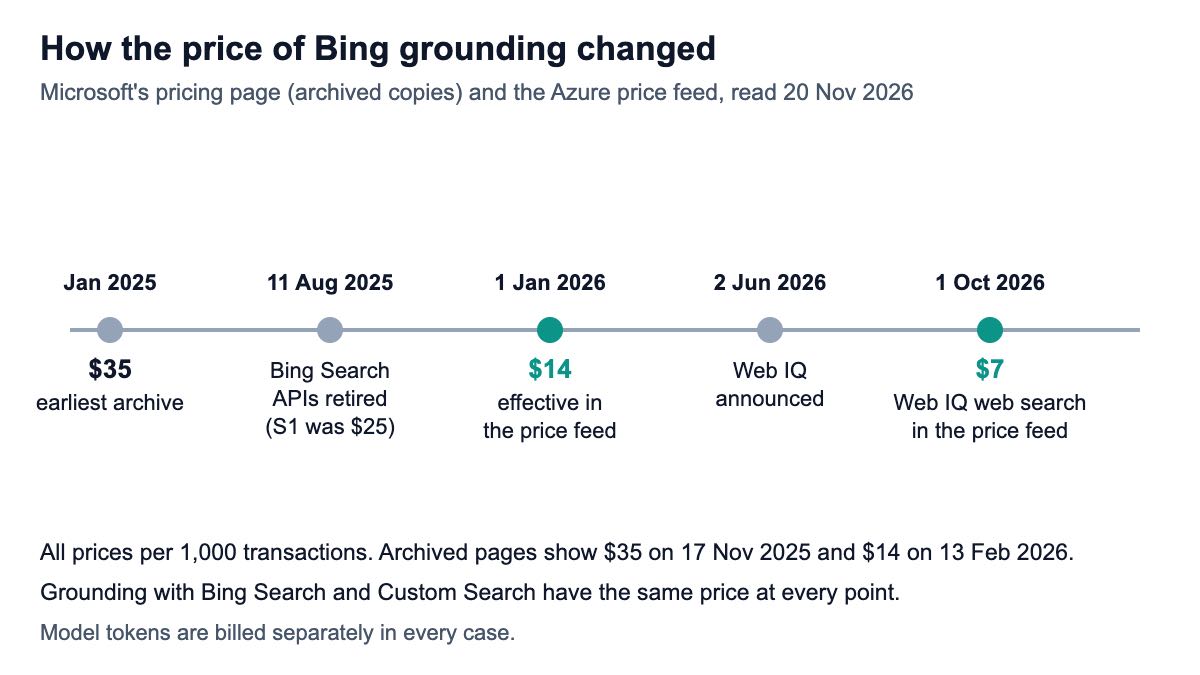
So the price fell by 60%, and the price feed dates the cut to 1 January 2026. The archive has no copy of the page between mid-November 2025 and mid-February 2026, so I cannot say on which day the public page changed.
Plenty of pages were written while $35 was correct and have not been updated. PPC Land's retirement story from June 2025 quotes $35, which was right at the time. A Microsoft Q&A moderator also quoted "$35 per 1K transactions" in September 2025. Even code lagged behind: the LiteLLM project only changed its built-in cost from $0.035 to $0.014 per call in a pull request merged on 26 September 2026.
One more correction while we are here. PPC Land's headline figure of "40–483% more" compared grounding with an S3 price of $6 per 1,000 for the old Bing Search API. Microsoft's own archived pricing page from January 2025 lists S3 at $18, with S1 at $25 and S2 at $15, so the upper end of that range does not hold.
What counts as a transaction?
A transaction is one call of the grounding tool, and one user question can produce several. Microsoft's Foundry docs for the Bing tools say: "Transactions with your Grounding with Bing resource are counted by the number of tool calls per run." You can see the count in the run step.
The model decides how many calls to make. The classic agent docs explain that within one run the model evaluates the tool output and may decide to call the tool again. A question that needs two or three searches costs two or three transactions.
Three things therefore set your real bill, not one:
- Search fees: $14 per 1,000 tool calls, times the average number of calls per question.
- Model tokens: the search results the model reads count as input, and the answer counts as output. The Foundry overview of web tools says these tools "incur costs beyond standard Azure OpenAI usage".
- No prompt-cache savings: the bing-tools page warns that prompt caching gives no cache hits with these tools, because "Both tools add an instruction with the current timestamp to every request."
A worked example: an agent that answers 10,000 questions a month, averaging two searches each, makes 20,000 transactions. That is $280 a month in search fees before a single token is counted.
What will it cost at your volume?
At 100,000 searches a month, Grounding with Bing costs $1,400 in search fees, Web IQ's web search $700, and a Bing results API from $3 to $725 depending on the vendor and tier. These products do not return the same thing, so read the table as "what each search costs", not "which is better".
Rules: list prices on 20 November 2026. Microsoft rows exclude model tokens. Results-API rows are one page of results per search. Monthly plans are priced at the plan that covers the volume.
| Option | What one search returns | Per 1,000 | 1,000 a month | 100,000 a month | 1,000,000 a month |
|---|---|---|---|---|---|
| Grounding with Bing Search or Custom Search | A model answer with citations | $14 + tokens | $14 | $1,400 | $14,000 |
Microsoft Web IQ, /web | Passages and evidence for a model | $7 | $7 | $700 | $7,000 |
| SerpApi, Bing engine | Bing results page as JSON | $25 to $3.75 | $25 | $725 | $3,750 |
| DataForSEO Bing organic (Live mode) | Bing results page, 10 results | $2.00 | $2 | $200 | $2,000 |
| DataForSEO Bing organic, standard queue | Same, delivered in about 5 minutes | $0.60 | $0.60 | $60 | $600 |
| Brave Search API | Brave's own index, not Bing | $5 | $5 | $500 | $5,000 |
| Serpent API, Default | Bing results as JSON | $0.60 | $0.60 | $60 | $600 |
| Serpent API, Growth ($100 deposit) | Same | $0.30 | $0.30 | $30 | $300 |
| Serpent API, Scale ($500 deposit) | Same | $0.10 | $0.10 | $10 | $100 |
| Serpent API, Enterprise ($1,000 deposit) | Same | $0.05 | $0.05 | $5 | $50 |
| Serpent API, Enterprise Plus ($1,250 deposit) | Same | $0.03 | $0.03 | $3 | $30 |
Sources: SerpApi pricing, DataForSEO Bing pricing, Brave Search API, Web IQ pricing and our pricing page.
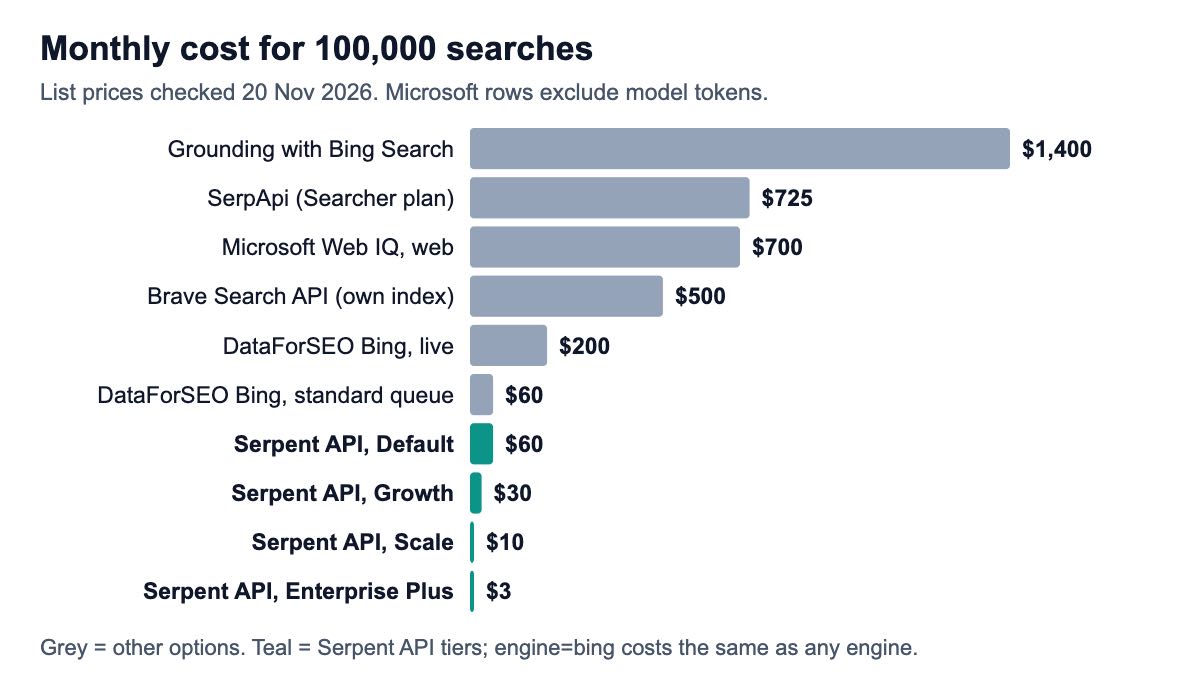
The gap is not a sign that grounding is overpriced. Grounding with Bing includes the work of reading results inside an agent run and handing the model evidence it is allowed to use. A results API hands you a list and leaves the rest to your code. Price is only a fair comparison once you know which of those two jobs you need done.
What you get back, and what you may not do with it
You get the model's answer with citations, not the search results. The bing-tools page is explicit: "Developers and end users don't have access to raw content returned from Grounding with Bing Search." The response includes citations with links to the websites used and a link to the Bing query, and "These two references must be retained and displayed in the exact form provided by Microsoft".
The Grounding with Bing terms of use (last updated November 2025) add firm limits. You may not "Copy, store, cache, archive, or create a database of Output." You "may only use the Output in Applications that are internet search experiences." And "you may not use any Output to train any AI Models". The pricing page sums it up: "Outputs are not directly accessible for use in other applications or programs."
There are useful controls. The tool takes a count of results to consider ("The default is 5 and the maximum value is 50"), a freshness setting, a market and a language. But the results stay inside the run.
One compliance point to raise with your security team: the web tools overview says "The Microsoft Data Protection Addendum doesn't apply to data sent to Grounding with Bing Search or Grounding with Bing Custom Search", and that your data "flows outside the Azure compliance" boundary when you use them.
What is Web IQ, and should you switch?
Web IQ is Microsoft's newer family of web search APIs for AI applications, and its web search costs $7 per 1,000 calls, half of Grounding with Bing. Microsoft announced Web IQ on 2 June 2026, saying it "does not just return documents; it returns passages and structured evidence objects". At Ignite in November, Microsoft said Web IQ "is now available to all Azure customers with new, lower pricing".
| Endpoint | What it does | Price per 1,000 calls |
|---|---|---|
/web | Ranked web search for AI use | $7.00 |
/news, /video, images, places | Vertical searches | $7.00 |
/browse | Content from live URLs | $1.00 |
| Auto | Picks the search for you | $8.00 (charged from 17 Nov 2026) |
| Auto Advanced | Auto with an advanced mode | $9.00 (charged from 17 Nov 2026) |
Inside Foundry the switch is partly made for you. The web tools overview says general search in Foundry's web search tool now runs on Web IQ, while domain-restricted custom search still uses Grounding with Bing Custom Search. The web search tool page notes one exception: web search added to a toolbox still uses Grounding with Bing Search.
My view: if you are starting today, prototype on Web IQ, because it is cheaper and it is where Microsoft is investing. Keep Grounding with Bing Custom Search if you need search restricted to a list of your own domains, since that path has not moved. And read Web IQ's own terms before you plan to store anything it returns.
When is a Bing results API the better fit?
A results API is the better fit when the results themselves are what you need. Grounding with Bing and Web IQ are built to feed a model inside an answer. They are the wrong tool for these jobs:
- Rank tracking and SEO. You need each URL's position on Bing for a keyword and market, and you need to keep the history. The grounding terms forbid storing output, and no raw list is returned.
- Analysis and datasets. Competitive research, SERP feature studies and price monitoring all need the list in a database.
- Your own retrieval pipeline. If you want to pick which pages to fetch and how to prompt your model, you need the list first.
- Comparing engines. Bing next to Google, Yahoo, DuckDuckGo or Brave, on the same schema.
Serpent API returns Bing search results as JSON: set engine=bing on the web search endpoint, with country and language to choose the market. On the full web search endpoint, Bing results include ads, People Also Ask and inline videos where present, as listed under engines. The price is the same on every engine, from $0.03 per 1,000 — pay as you go, no subscription.
If you are replacing the retired Bing Search API, our comparison of six Bing Search API replacements covers more vendors, the migration acceptance checklist shows how to test one, and the Bing search API Python tutorial has working code. For the wider cost question of letting a model search for itself versus searching first and prompting after, see how to cut LLM web search costs.
Which option should you pick?
- Grounding with Bing Search if you have an existing Foundry agent that works and the bill is acceptable. Microsoft says no action is needed, so there is no rush to migrate.
- Grounding with Bing Custom Search if your agent must search only a fixed set of domains. It is still the custom-search path in Foundry.
- Web IQ for new Azure agent projects that need web evidence for a model. At $7 per 1,000 it halves the search fee.
- A Bing results API if you need positions, snippets and URLs you can store, analyse or feed into your own pipeline. Our free Bing SERP API guide shows how to try one before paying.
How we checked this
On 20 November 2026 I read Microsoft's current Bing APIs pricing page, the grounding terms of use, five Microsoft Learn pages (Bing tools, classic Bing grounding, web tools overview, web search tool and Web IQ pricing), the Web IQ product page, announcement and Ignite post, and the Bing Search API retirement notice (11 Microsoft pages). I queried the public Azure Retail Prices API and read five archived copies of the grounding pricing page and one of the old Bing Search API pricing page on the Wayback Machine (three of the grounding copies are linked below). I also read SerpApi, DataForSEO and Brave pricing, PPC Land, a Microsoft Q&A thread and a LiteLLM pull request.
No calls were made to any of these services for this post; all costs are arithmetic on list prices. What we could not verify: the exact day the public page changed from $35 to $14 (the feed says 1 January 2026; no archive copy exists between 17 November 2025 and 13 February 2026), and the meaning of a "Classic" Web IQ meter at $16 per 1,000 that appears in the price feed but on no Microsoft page, so it is left out.
Need the Bing results themselves?
Serpent API returns Bing, Google, Yahoo, DuckDuckGo and Brave search results as JSON, by country and language, from $0.03 per 1,000 — pay as you go, no subscription. Try it with 10 free API calls.
Get Your Free API KeyExplore: Bing SERP API · Playground · Docs · Pricing
FAQ
How much does Grounding with Bing Search cost?
Grounding with Bing Search costs $14 per 1,000 transactions, and Grounding with Bing Custom Search costs the same. Microsoft's pricing page and the Azure price feed both show $14, effective 1 January 2026, with limits of 150 calls per second and 1 million per day. The fee covers the search tool only. The model that uses the results is billed at its own token rates, and Microsoft lists no free tier.
Is Grounding with Bing $14 or $35 per 1,000?
It is $14 today. It was $35 per 1,000 through 2025: archived copies of Microsoft's pricing page show $35 in January and November 2025 and $14 from February 2026, and the Azure price feed dates the $14 price to 1 January 2026. Articles and forum answers written in 2025 still quote $35, and some cost-tracking tools only updated their tables in late 2026.
What is a transaction in Grounding with Bing?
A transaction is one call of the grounding tool during an agent run. Microsoft's Foundry docs say transactions "are counted by the number of tool calls per run", and the model can call the tool more than once while answering a single question. You can see the number of calls in each run step. To estimate cost, multiply your monthly questions by the average number of tool calls per question, then by $14 per 1,000.
Can I get raw Bing search results from Grounding with Bing?
No. Microsoft's docs say developers and end users don't have access to the raw content it returns; you get the model's answer with citation links and a link to the Bing query, which you must display. The terms also forbid copying, storing, caching or building a database of the output, and using it to train AI models. If you need the ranked list of Bing results as data, use a Bing results API instead.
Is Grounding with Bing being replaced by Web IQ?
Microsoft's pricing page says Grounding with Bing "is upgrading to Web IQ" and that existing customers need to take no action today. Web IQ's web search costs $7 per 1,000 calls, and general search in Foundry's web search tool now runs on it. Grounding with Bing Custom Search remains the path for domain-restricted search, and web search added to a toolbox still uses Grounding with Bing Search.
What replaced the Bing Search API?
Microsoft retired the Bing Search APIs on 11 August 2025 and pointed customers to Grounding with Bing, which only returns model answers inside Azure agents. Microsoft's newer option is Web IQ. For the ranked results list the old API returned, developers use third-party Bing results APIs; our comparison of Bing Search API replacements covers six of them with published prices.
Sources
Microsoft official (checked 20 November 2026):
- Bing APIs pricing: Grounding with Bing Search and Custom Search
- Azure Retail Prices API query for Grounding with Bing
- Foundry: Grounding with Bing tools
- Foundry (classic): Grounding with Bing Search
- Foundry: web tools overview
- Foundry: web search tool
- Grounding with Bing terms of use
- Web IQ pricing and Web IQ product page
- Announcing Microsoft Web IQ (2 Jun 2026)
- What's new with Web IQ, Ignite 2026
- Bing Search API retirement notice
Archived Microsoft pages (Wayback Machine, read 20 November 2026):
- Grounding pricing, 21 Jan 2025 ($35)
- Grounding pricing, 17 Nov 2025 ($35)
- Grounding pricing, 13 Feb 2026 ($14)
- Old Bing Search API pricing, January 2025
Other vendors and commentary (checked 20 November 2026):