DataForSEO LLM Mentions API Alternatives, Priced for Developers

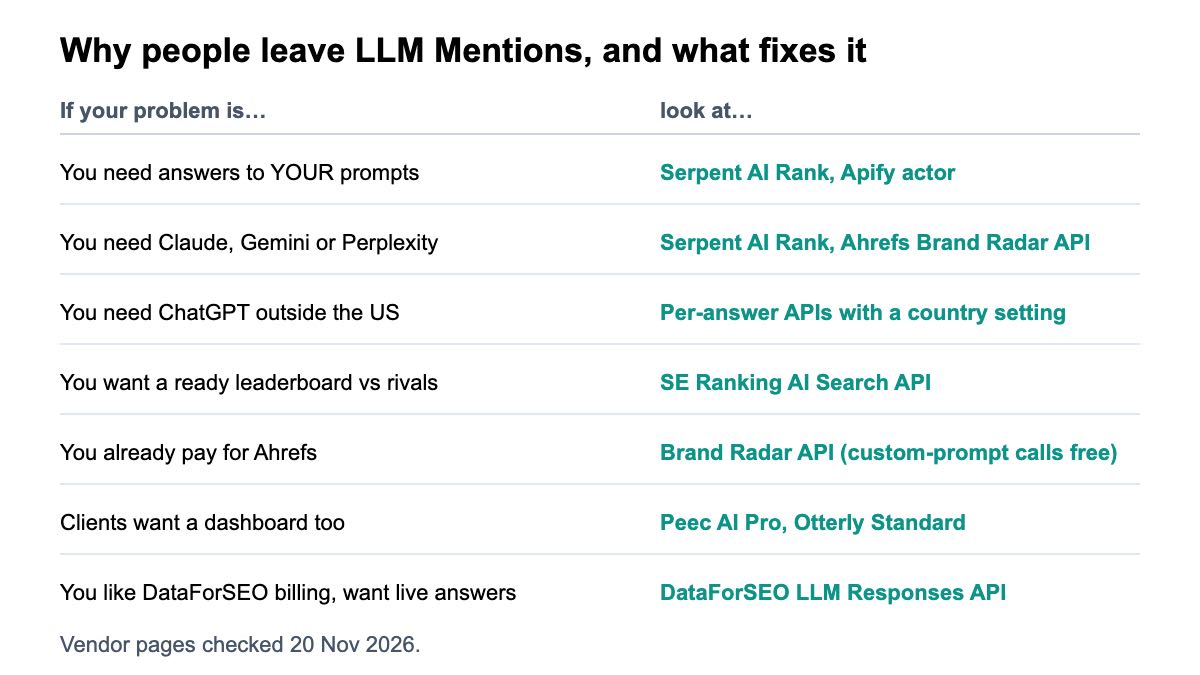
The best DataForSEO LLM Mentions alternative depends on what made you look. If you need your own prompts, use a per-answer API such as Serpent’s AI Rank; for a ready competitor leaderboard, SE Ranking; if you pay for Ahrefs, its Brand Radar API. Peec and Otterly suit dashboard-first teams.
Short answer: Stay on DataForSEO LLM Mentions if you research the market across millions of answers and Google AI Overviews plus US ChatGPT cover it; since July 2026 there is no monthly commitment. Move to a per-answer API if you need your own prompts, Claude, Gemini or Perplexity, or ChatGPT outside the US; Serpent’s AI Rank API runs from $0.70 per 1,000 — pay as you go, no subscription (pricing). Pick SE Ranking for a one-request leaderboard, the Ahrefs Brand Radar API if you hold an Ahrefs plan, and Peec AI or Otterly if clients want a dashboard too.
What does DataForSEO’s LLM Mentions API do, and what does it cost now?
It is a searchable database of AI answers. You ask which answers mention a keyword or a domain, and it returns the mentions, the sources the model cited, and aggregate counts. You do not choose the prompts: they come from DataForSEO’s collection, which its product page put at 426,390,041 prompts when I checked on 20 November 2026, 398.6 million of them for Google AI Overviews and 27.8 million for ChatGPT.
The price is simple to read and harder to forecast. The pricing page charges $0.10 per task plus $0.001 per returned row on every llm_mentions endpoint, all in Live mode. One row is one object about one mention, so the same request can cost $0.11 or $1.10 depending on how much it returns.
Two changes in July 2026 matter if you last looked earlier. On 1 July DataForSEO removed the $100 monthly commitment for LLM Mentions and Backlinks, so access is now pay as you go from the usual $50 minimum top-up. On 7 July it renamed and extended the endpoints: Aggregated Metrics became Target Metrics, Cross Aggregated Metrics became Multi-Target Metrics, and Top Mentioned Brands, a Historical endpoint, Timeseries Delta, Timeseries New and Lost, and cheaper Lite versions were added. The old cross_aggregated_metrics path is marked legacy, and new integrations must use the new one.
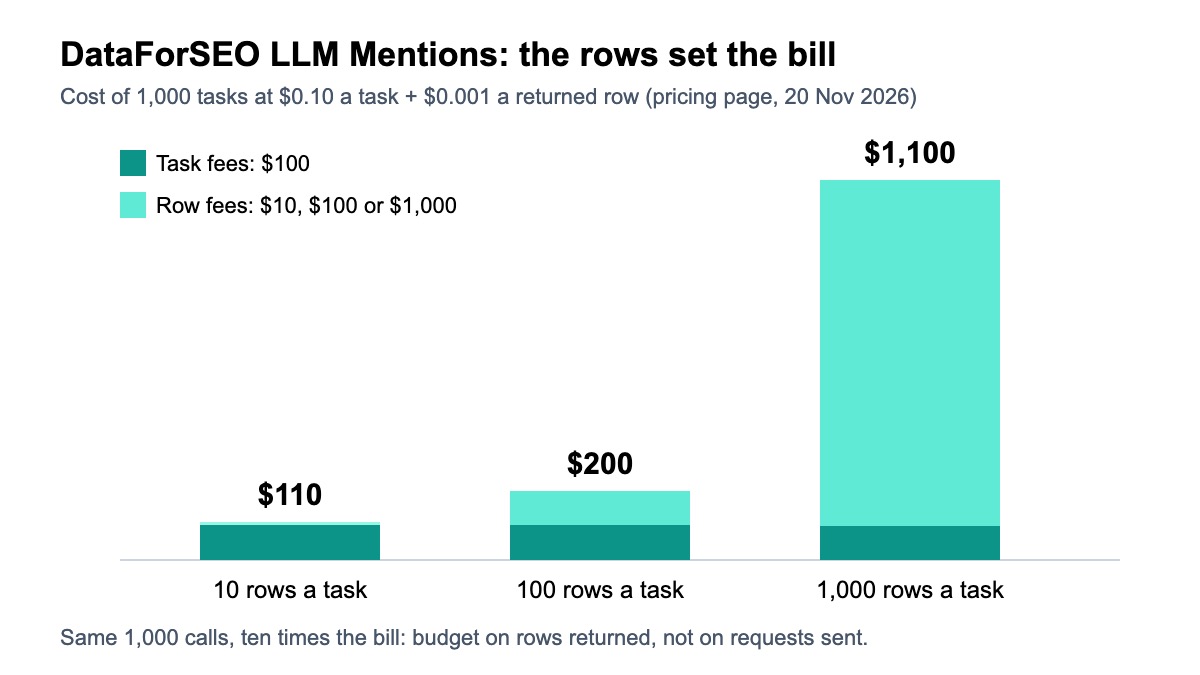
So the first budgeting rule is to cap rows. Cap the number of results you request, prefer the Lite and aggregate endpoints when you only need counts, and log the cost field in each task response so you can see what each call really cost. That one habit removes most bill surprises.
Why do developers look for an alternative?
Most of the reasons come from what the product is: a large dataset with a specific coverage. None of them is a flaw if your question fits the dataset, which is why the “stay” section below is a real option.
- The prompts are not yours. DataForSEO describes the source as “a database of millions of real AI responses” in its help article on citation data. If a client asks “what does ChatGPT say when someone asks our question”, the database may not hold that exact question.
- Two platforms. The same article says citation data is available for Google AI Overview and ChatGPT. Claude, Gemini and Perplexity are not in LLM Mentions.
- ChatGPT is US only. “The only supported location is the United States” for ChatGPT, per the help article; the endpoint docs add English only.
- The bill follows the rows. As the chart shows, a request that returns a long list costs ten times one that returns a short list.
- It is not live. Every request reads stored data. That is fast, and the product page lists a turnaround of up to two seconds, but the answer you get is not one generated for your call.
The eight alternatives, and the pain each one fixes
I kept products that give a developer AI brand-mention or citation data through an API, with a public page that says so. Dashboards without a documented API are left out.
1. Serpent AI Rank API: best for your own prompts on four engines
AI Rank tracks brand citations and positions across ChatGPT, Claude, Gemini and Perplexity as JSON. You send a keyword and, optionally, your domain; each engine comes back under its own name with target_found, target_position, the full citations list and the response_text. engines picks a subset, prompt_type switches between standard, deep and brand styles, and country and language set the market. The AI Rank docs list every field, and a URL check at /api/ai/brand-mentions takes a website address instead of a keyword.
Where LLM Mentions answers questions about the market, AI Rank answers questions about your own prompt list: you choose every keyword it checks, which is what client reporting needs. It costs from $0.70 per 1,000 — pay as you go, no subscription (pricing), and a new account gets 10 free API calls to try it.
2. SE Ranking AI Search API: best for a one-request competitor leaderboard
SE Ranking’s AI Search API is the closest like-for-like swap: a vendor dataset, queried by domain, with a leaderboard request that ranks you against one to ten competitors by share of voice. Engines in the docs are AI Overviews, AI Mode, ChatGPT and Gemini, and data refreshes monthly.
Billing is in credits. Per its credit table, a leaderboard costs 7,500 credits, an aggregated overview 1,800, a by-engine time series 800, brand discovery 100, and prompt lists 200 credits per prompt returned. Credits cost $50 for 250,000 on the Wallet plan, which never expire, or from $179 down to $85 per million on annual packs.
3. Ahrefs Brand Radar API: best if you already pay for Ahrefs
Ahrefs’ API v3 has a full Brand Radar section: AI responses, cited pages and domains, mentions, impressions and share of voice, each with a history version. Its data sources include ChatGPT, Perplexity, Gemini, Copilot, Grok, AI Overviews and AI Mode, and Claude for custom prompts only, according to the AI Responses reference.
The billing detail is generous: requests that return only your custom-prompt data are free, and only Ahrefs’ own prompt data uses API units. API access starts on the Lite plan with 200,000 units a month, per Ahrefs’ help centre. On the pricing page, Lite is $129 a month and includes 150 prompt checks; the AI Visibility Index on Ahrefs’ own prompts starts at $199; and custom prompt packages cost $50 for 2,500 checks, $100 for 7,000 or $250 for 25,000, where one check is one prompt on one platform in one location. If you are deciding between Ahrefs and Semrush for this job, our Brand Radar vs Semrush AI Visibility Toolkit comparison sets the two side by side.
4. DataForSEO LLM Responses API: best if you want to stay with DataForSEO
The same vendor sells live answers. The LLM Responses API sends your prompt to a model and returns its answer, priced on its pricing page at $0.0006 a task in Live mode plus whatever the model provider charges for the tokens. You keep one balance and one invoice, and you choose the prompts.
The catch is that the total is not knowable from DataForSEO’s page alone: the model charge depends on the model and the answer length, so you price it from each provider’s own rate card. You also write the mention and citation parsing yourself.
5. Apify LLM Visibility Tracker: best for a quick, no-code-required run
Several Apify actors do this job. The LLM Visibility Tracker listing charges $0.09 per keyword-and-engine check for ChatGPT and Claude, with Perplexity and Gemini checks at $0.05 from 27 November 2026, and does not bill failed checks. It takes up to ten competitor names and returns share of voice, citations and sentiment per check. It is a community actor, so judge the maintainer as well as the price.
6. Peec AI API: best for a dashboard plus an API
Peec’s pricing page lists the API on Pro ($245 a month, 150 prompts, 13,500 answers) and Advanced ($495, 350 prompts, 31,500 answers), with unlimited competitors and users. Starter at $95 has no API. You manage prompts in the app and pull results into your own stack.
7. Otterly API: best for small teams that want share-of-voice KPIs
Otterly includes 2,000 API requests a month on Standard (€189, 120 prompts, 15,000 credits) and 5,000 on Premium (€489, 403 prompts, 50,000 credits). One answer is one credit, except Claude, which costs three. Lite at €29 has no API.
8. Profound and seoClarity: enterprise contracts
Profound lists only a custom-priced Enterprise plan, with API access and up to ten engines. seoClarity’s ArcAI API is included with its subscription and covers nine engines. Neither publishes a per-request price, so they only belong on your list if a sales process is acceptable.
What does each alternative cost at your volume?
Because the products price different things, there are two tables. For tools that answer your prompts, the unit is one answer: one prompt answered by one engine. For dataset APIs, the unit is one request. Prices were read on 20 November 2026 from each vendor’s live page.
| Tool and plan rule | 1,000 answers | 10,000 answers | 30,000 answers |
|---|---|---|---|
| Apify LLM Visibility Tracker ($0.09 a ChatGPT or Claude check, free tier) | $90 ($90.00/1K) | $900 ($90.00/1K) | $2,700 ($90.00/1K) |
| DataForSEO LLM Responses (Live $0.0006 a task + model charge) | $0.60 + model charge | $6 + model charge | $18 + model charge |
| Peec AI (cheapest plan with API: Pro $245; Advanced $495 above 13,500) | $245 ($245.00/1K) | $245 ($24.50/1K) | $495 ($16.50/1K) |
| Otterly (Standard €189 up to 15,000 credits; Premium €489) | €189 (€189.00/1K) | €189 (€18.90/1K) | €489 (€16.30/1K) |
| Ahrefs Brand Radar custom prompts via API (Lite plan $129, plus the cheapest package: Basic $50 for 2,500 checks; Growth $100 for 7,000, then $0.015; Scale $250 for 25,000, then $0.010) | $179 ($179.00/1K) | $274 ($27.40/1K) | $429 ($14.30/1K) |
| Serpent API — Default (four-engine call, $40 per 1,000 calls) | $10 ($10.00/1K) | $100 ($10.00/1K) | $300 ($10.00/1K) |
| Serpent API — Growth ($100 deposit; $4 per 1,000 calls) | $1 ($1.00/1K) | $10 ($1.00/1K) | $30 ($1.00/1K) |
| Serpent API — Scale ($500 deposit; $2 per 1,000 calls) | $0.50 ($0.50/1K) | $5 ($0.50/1K) | $15 ($0.50/1K) |
| Serpent API — Enterprise ($1,000 deposit; $1.70 per 1,000 calls) | $0.43 ($0.425/1K) | $4.25 ($0.425/1K) | $12.75 ($0.425/1K) |
| Serpent API — Enterprise Plus ($1,250 deposit; $1.40 per 1,000 calls) | $0.35 ($0.35/1K) | $3.50 ($0.35/1K) | $10.50 ($0.35/1K) |
Notes on the rules. Serpent rows divide the four-engine call price by four answers. The Apify row ignores Apify’s own platform plans, which lower the per-check rate on Silver and Gold, and the cheaper Perplexity and Gemini checks that start on 27 November. Dashboards include a UI, alerts and sentiment, which a raw API leaves to you; the lowest row is not automatically the right buy.
| Request | Small result | Medium result | Large result |
|---|---|---|---|
| DataForSEO LLM Mentions, any endpoint ($0.10 + $0.001 a row) | $110 (10 rows) | $200 (100 rows) | $1,100 (1,000 rows) |
| SE Ranking leaderboard (7,500 credits) | $1,500 on Wallet ($200 per 1M credits); $637.50 on the 120M annual pack ($85 per 1M) | ||
| SE Ranking aggregated overview (1,800 credits) | $360 on Wallet; $153 on the 120M annual pack | ||
| SE Ranking prompt list (200 credits per prompt returned) | $400 (10 prompts each) | $4,000 (100 prompts each) | $40,000 (1,000 prompts each) |
The second table is why LLM Mentions stays attractive for research. A Target Metrics call that returns a handful of aggregate rows costs about eleven cents and summarises thousands of stored answers. The your-prompts tools are built for a different job: they report on the prompts you send, not on a market-wide index.
When should you stay on DataForSEO LLM Mentions?
Stay if your question is about the market rather than your prompt list. “Which domains does ChatGPT cite most for running shoes in the US?” is a database question, and LLM Mentions answers it in one request across more prompts than you could afford to run yourself.
Stay, too, if you already run DataForSEO for SERP data. One balance, one auth scheme and one rate limit are worth something; the overview docs allow up to 10,000 calls a minute with 30 in parallel. If you are weighing DataForSEO for search results as well, our DataForSEO pricing explainer and the SERP API alternatives guide cover that side.
A sensible pattern is to keep both: LLM Mentions for the market view and a per-answer API for the client’s own prompts. They answer different questions, and the reports are clearer when they are kept on separate charts.
What does switching actually involve?
Less than a SERP migration, because there is no shared schema to map. The work is in three places.
- Define your prompt set. A dataset gave you prompts for free; a per-answer API needs your list. Start with 25 to 50 non-branded questions per product category, written the way buyers ask them.
- Rewrite the counting. LLM Mentions hands you counts. With answers, you decide what a mention is (name in the text) and what a citation is (domain in the sources), and you keep the two apart. Our citations versus recommendations study shows why they diverge.
- Plan the cadence. Answers vary between runs, so a weekly or daily schedule beats a single snapshot. The free AI rank tracker guide shows what a minimal schedule looks like and what it costs.
If you are comparing full dashboards instead, the AI visibility tools comparison covers Profound, Peec, Otterly and others, and our audit of 14 AI rank trackers checks which ones explain their method.
Which one should you pick?
- Client reporting on the client’s own questions, four engines, a fixed price per call: Serpent AI Rank.
- A competitor leaderboard by Monday, no prompt writing: SE Ranking’s AI Search API.
- You hold an Ahrefs Lite plan or higher: the Brand Radar API, especially for custom prompts, whose requests are free.
- One vendor, one invoice, live answers: DataForSEO LLM Responses, if you can live with model charges you price separately.
- A one-off audit without writing code: an Apify actor.
- Marketing wants logins and charts: Peec AI Pro or Otterly Standard.
- Market research across millions of answers in the US: stay on LLM Mentions.
How we checked this
On 20 November 2026 I opened the pages ranking for “DataForSEO LLM Mentions API alternatives” (SE Ranking, Dageno and ScrapeGraphAI guides, plus DataForSEO’s own product page) and then every vendor’s official pricing, docs or changelog page linked in the sources: 21 linked pages, 20 of them official vendor pages or docs and one a marketplace listing, plus three ranking guides read for the gap check. Serpent prices come from our pricing page on the same day. Per-answer and per-request costs are my arithmetic on each vendor’s published rates. No API was called for this page.
Two pages disagree with each other: DataForSEO’s product page shows an example of $0.05 for 1,000 rows, while its pricing page lists $0.10 a task plus $0.001 a row. I used the pricing page.
What I could not verify: how many rows a typical LLM Mentions task returns; the model charges added to LLM Responses tasks; how many API units a Brand Radar request on Ahrefs’ own prompt data uses; and how often DataForSEO refreshes its mention database.
Track your own prompts across four engines
Send a keyword, get each engine’s citations and your position back as JSON. From $0.70 per 1,000 — pay as you go, no subscription — and every account starts with 10 free API calls.
Get Your Free API KeyExplore: AI Rank API · Playground · Docs · Pricing
FAQ
How much does the DataForSEO LLM Mentions API cost?
$0.10 per task plus $0.001 per returned row, on every LLM Mentions endpoint, in Live mode, per DataForSEO’s pricing page on 20 November 2026. A task returning 10 rows costs $0.11; one returning 1,000 rows costs $1.10. Since 1 July 2026 there is no $100 monthly commitment; you top up from a $50 minimum and pay as you go.
Which platforms does LLM Mentions cover?
Google AI Overview and ChatGPT. DataForSEO’s help article says citation data is available for those two, and that the only supported location for ChatGPT is the United States, in English. If you need Claude, Gemini or Perplexity, or ChatGPT in another market, use a per-answer API or the Ahrefs Brand Radar API, which lists more data sources.
Is there a cheaper alternative to DataForSEO LLM Mentions?
It depends on the unit. For a market summary, LLM Mentions is hard to beat: an aggregate request with a few rows costs about eleven cents. For answers to your own prompts, a per-answer API is cheaper per answer than the dashboards, and Ahrefs Brand Radar requests on custom prompts are free if you already hold a Lite plan or higher.
What happened to cross_aggregated_metrics?
DataForSEO renamed it on 7 July 2026. Cross Aggregated Metrics is now Multi-Target Metrics, at /v3/ai_optimization/llm_mentions/multi_target_metrics/live/, and the old path is marked legacy. Aggregated Metrics became Target Metrics, and Top Pages and Top Domains became Top Mentioned Pages and Top Mentioned Domains. New integrations should use the new paths.
Does the Ahrefs API include Brand Radar?
Yes. Ahrefs’ API v3 has a Brand Radar section with AI responses, cited pages and domains, mentions, impressions and share of voice. API access starts on the Lite plan with 200,000 units a month, and requests that return only custom-prompt data are free; requests that include Ahrefs’ own prompt data use standard API units.
Can I compare my brand against competitors with LLM Mentions?
Yes. The Multi-Target Metrics endpoint takes between two and ten target sets, each with up to ten domains or keywords, and returns mention counts for each. The comparison covers DataForSEO’s stored answers for Google AI Overview and US-English ChatGPT, so it measures the market rather than your own prompt list.
Sources
DataForSEO (checked 20 November 2026):
- LLM Mentions pricing
- LLM Mentions API product page
- Pricing update, 1 July 2026
- Extended LLM Mentions release, 7 July 2026
- How to get LLM citation data (help centre)
- LLM Mentions API overview (docs)
- Multi-Target Metrics (docs)
- Minimum payment
- LLM Responses pricing
Alternatives, official pages (checked 20 November 2026):
- SE Ranking AI Search API reference
- SE Ranking credit costs
- SE Ranking API pricing
- Ahrefs Brand Radar API reference
- Ahrefs AI Responses endpoint
- Ahrefs: About API v3
- Ahrefs pricing
- Peec AI pricing
- Otterly pricing
- Profound pricing
- seoClarity ArcAI API
Marketplace listing (checked 20 November 2026):