Which API Compares Your AI Visibility Against Competitors?

Three kinds of API can compare your AI visibility against competitors. SE Ranking and DataForSEO return a ready-made comparison from their own databases of AI answers. Peec AI and Otterly open their dashboards to an API on paid plans. A per-answer API, such as Serpent’s AI Rank, lets you compute share of voice on your own prompts.
Short answer: For a monthly leaderboard without writing prompts, use SE Ranking’s leaderboard endpoint (about $1.50 a comparison on its Wallet plan). For Google AI Overview and ChatGPT mention counts only, DataForSEO’s LLM Mentions call is $0.10 a task plus $0.001 a row. For your own prompts, rivals and raw answers, Serpent’s AI Rank API runs from $0.70 per 1,000 — pay as you go, no subscription.
What does an AI share-of-voice API actually return?
It returns how often your brand shows up in AI answers compared with the brands you name as rivals. Every vendor phrases it differently, but the useful output is always the same: per brand, a count of answers it appeared in, and that count as a share of all brand appearances.
Two numbers hide inside that sentence, and mixing them up is the most common reporting mistake. Presence rate is the share of answers that include your brand: 30 of 100 answers is 30%. Share of voice is your slice of all tracked-brand appearances: if you appeared 30 times and your three rivals 70 times between them, your share of voice is 30%. If one rival then disappears from the answers, your presence rate stays put but your share of voice rises.
Ahrefs defines AI share of voice as “how often your brand is mentioned in AI responses compared to competitors” in its competitor analysis guide, and its Brand Radar page counts an answer if it “mentions or cites” you. That “or” matters.
A mention is your name in the answer text. A citation is your page in the answer’s source list. They move independently, which is why this page keeps them in separate columns.
This page is about one job: putting your brand next to named competitors and getting comparable numbers out of an API. If you want the full list of AI visibility metrics, read AI search visibility metrics. If you want to know how a single 0–100 score is built, read AI visibility scoring explained.
Which APIs can compare you against named competitors?
Nine products came up when I looked for this, and they split into two groups. Dataset APIs answer from a prompt library the vendor maintains, so you get a comparison in one request but you do not choose the questions. Your-prompts APIs run the prompts you define, so you choose the questions but you compute or configure the comparison.
| Product | You send | You get back | Rivals per request | Engines listed | Price unit |
|---|---|---|---|---|---|
| SE Ranking AI Search API (leaderboard) | Your domain + rivals | Leaderboard sorted by share of voice, with brand and link presence | 1–10 | AI Overviews, AI Mode, ChatGPT, Gemini | 7,500 credits a request |
| DataForSEO LLM Mentions (multi-target metrics) | 2–10 target sets of domains or keywords | Mention counts per target set | Up to 10 sets | Google AI Overview, ChatGPT (US English) | $0.10 a task + $0.001 a row |
| Peec AI API | Your tracked prompts (set in the app) | Visibility and share of voice for your brand and rivals | Unlimited competitors | 3 of 8 on Starter–Advanced | Monthly plan; API from Pro |
| Otterly API | Your tracked prompts | Share of voice KPIs for brands and competitors | Unlimited | 4 of 7 per plan | Monthly plan; API from Standard |
| seoClarity ArcAI API | Your account’s tracked data | Competitor visibility, citations, share of voice | Not stated | Nine listed, incl. ChatGPT, Claude, Gemini, Perplexity | Included with a subscription; price not listed |
| Profound | Custom prompts | Visibility and competitive presence | Not stated | Up to 10 | Enterprise only, custom |
| Semrush AI Visibility Toolkit | 25 prompts on the base plan | Share of voice in Brand Performance | Not stated | ChatGPT, Google AI Mode (per its help page) | $99 a month; prompt-tracking API documented for Semrush Enterprise AIO projects |
| Ahrefs Brand Radar | Custom prompts or Ahrefs’ index | AI share of voice vs competitors; API has Share of Voice and Mentions endpoints | Not stated | ChatGPT, Perplexity, Gemini, Copilot, AI Overviews, AI Mode, Claude | From $50 a month (custom prompts); API v3 from the Lite plan |
| Serpent API (AI Rank) | One keyword + your domain | Per engine: whether and where your domain is cited, every cited source, the answer text | Every cited domain in one call | ChatGPT, Claude, Gemini, Perplexity | Per call, from $0.70 per 1,000 |
SE Ranking is the closest thing to a one-call answer to the question in the title. Its AI Search docs describe a leaderboard request that takes a primary domain plus one to ten competitors and returns them ranked by share of voice. Two limits to know: the prompts are SE Ranking’s, not yours, and the data is refreshed monthly.
DataForSEO sells the same idea as raw counts. Its LLM Mentions docs take between two and ten target sets, each holding up to ten domains or keywords, on either the google platform (AI Overview) or chat_gpt, with ChatGPT data limited to the United States and English. If you want the full picture of the vendor’s other prices, our AI visibility tools comparison covers the dashboards around it.
Peec AI and Otterly are dashboards first. You type your prompts and rivals into the app, and the API hands the results to your own reporting. Peec lists API access on Pro and above; Otterly lists 2,000 API requests a month on Standard and 5,000 on Premium.
A per-answer API works the other way round. You send one question and get back, per engine, the answer and every source it cited. Nothing is pre-aggregated, so you write twenty lines of code, and in exchange you choose every prompt, every rival and every country. AI Rank tracks brand citations and positions across ChatGPT, Claude, Gemini and Perplexity as JSON; the fields are listed in the AI Rank docs.
What does a competitor benchmark cost at your volume?
For your-prompts tools, the fair unit is one answer: one prompt answered by one engine. Fifty prompts on four engines, checked daily, is 6,000 answers a month. The table below prices three program sizes using each vendor’s cheapest plan that includes API access.
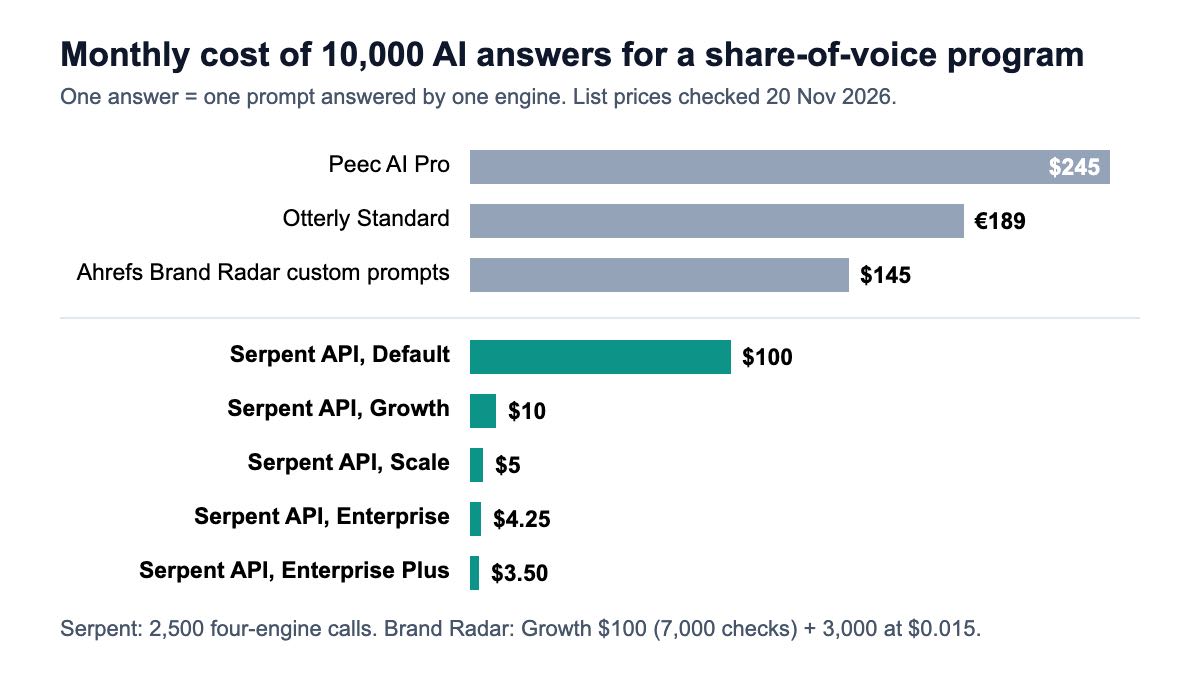
| Tool and plan rule | 1,000 answers a month | 10,000 answers a month | 30,000 answers a month |
|---|---|---|---|
| Peec AI (Pro $245: 13,500 answers; Advanced $495: 31,500) | $245 ($245.00/1K) | $245 ($24.50/1K) | $495 ($16.50/1K) |
| Otterly (Standard €189: 15,000 credits; Premium €489: 50,000) | €189 (€189.00/1K) | €189 (€18.90/1K) | €489 (€16.30/1K) |
| Ahrefs Brand Radar custom prompts (Basic $50: 2,500 checks; Growth $100: 7,000, then $0.015; Scale $250: 25,000, then $0.010) | $50 ($50.00/1K) | $145 ($14.50/1K) | $300 ($10.00/1K) |
| Serpent API — Default (four-engine call $40 per 1,000 calls) | $10 ($10.00/1K) | $100 ($10.00/1K) | $300 ($10.00/1K) |
| Serpent API — Growth ($100 deposit; $4 per 1,000 calls) | $1 ($1.00/1K) | $10 ($1.00/1K) | $30 ($1.00/1K) |
| Serpent API — Scale ($500 deposit; $2 per 1,000 calls) | $0.50 ($0.50/1K) | $5 ($0.50/1K) | $15 ($0.50/1K) |
| Serpent API — Enterprise ($1,000 deposit; $1.70 per 1,000 calls) | $0.43 ($0.425/1K) | $4.25 ($0.425/1K) | $12.75 ($0.425/1K) |
| Serpent API — Enterprise Plus ($1,250 deposit; $1.40 per 1,000 calls) | $0.35 ($0.35/1K) | $3.50 ($0.35/1K) | $10.50 ($0.35/1K) |
How the rows were built: Peec’s and Otterly’s cheapest plans (Starter at $95, Lite at €29) do not include the API, so the 1,000-answer column uses the next plan up. Otterly counts a Claude answer as three credits, so a mix with Claude costs more than shown.
Ahrefs’ API v3 has Brand Radar endpoints, including Share of Voice, and its docs say requests that return only custom-prompt data are free, so the custom-prompt package is the main cost. Its row uses the cheapest package for each volume on Ahrefs’ pricing page, where one check is one prompt on one platform in one location; API access itself needs an Ahrefs plan from Lite at $129.
Serpent rows divide the four-engine call price by four answers. Dashboards include things a raw API does not, such as a UI, alerts and sentiment, so the cheapest row is not automatically the best buy.
And the dataset APIs?
SE Ranking and DataForSEO price per comparison, not per answer, because one request already summarises many prompts. A comparison is one request with your brand and up to ten rivals.
| API and rate | 100 requests | 1,000 requests | 10,000 requests |
|---|---|---|---|
| SE Ranking leaderboard, Wallet ($50 = 250,000 credits, so $1.50 a request) | $150 | $1,500 | $15,000 |
| SE Ranking leaderboard, 120M-credit annual pack ($85 per 1M, so $0.64 a request) | $63.75 | $637.50 | $6,375 |
| DataForSEO multi-target metrics ($0.10 a task, plus $0.001 a returned row) | $10 + rows | $100 + rows | $1,000 + rows |
Two rules change the real bill. SE Ranking’s 120M pack is an annual commitment of $10,200, per its credit table; the Wallet is a top-up whose credits never expire. DataForSEO removed its $100 monthly commitment for LLM Mentions on 1 July 2026, but its minimum top-up is still $50.
How do you turn raw AI answers into share of voice?
Count answers, not mentions, and write your rules down before the first run. A brand named three times in one answer is still one answer, and a rule you change mid-quarter breaks the trend line.
- The unit is one answer: one prompt, one engine, one run.
- Cited means one of the brand’s domains, or a subdomain of one, is in the answer’s source list.
shop.example.comcounts forexample.com; AI Rank reports this astarget_match_type=subdomainfor your own domain. - Named means the brand name, or an alias you listed, is in the answer text. Keep it in its own column.
- Presence rate = answers where the brand is cited ÷ answers scored.
- Share of voice = answers where the brand is cited ÷ the sum of that count across every tracked brand.
- An engine that returned no answer leaves the denominator. An answer that cited none of your brands stays in it for presence rate.
- Report per engine as well as overall. Engines cite differently, and one engine can carry the whole blended number.
Position weighting is optional. Some guides give full credit to a first-place mention and less to later ones; Metehan Yesilyurt’s benchmarking methods describe a weighted version without fixing the weights. If you weight, publish the weights next to the chart.
Keep citations and recommendations apart too. Being in the source list is not the same as being the answer’s pick; our study of citations versus recommendations found that 81% of the cited domains were never named once in the answers.
Can one call per prompt cover every competitor?
Yes, and that is the cheapest design. Each AI Rank call returns every source each engine cited, so your rivals’ domains are already in the response. Put your own domain in domain to get your target_found and target_position, then read rivals out of citations[].domain. Adding a fifth rival costs nothing extra.
The script below does exactly that for three fictional brands. It runs on Python 3.15.2 with requests 2.34.2 (20 Nov 2026); the HTTP call was replaced by a stub that returns the response shape shown on the AI Rank API page (a results object with one row per engine), filled with illustrative data, not a real answer. The full run log is kept with this post’s evidence.
import os
import re
from collections import defaultdict

import requests

API_KEY = os.environ.get("SERPENT_API_KEY", "sk_live_your_api_key")
BASE = "https://apiserpent.com"
ENGINES = ["chatgpt", "claude", "gemini", "perplexity"]

# One brand per row: the domains that count as "cited" and the names that count as "mentioned".
BRANDS = {
    "North Trail": {"domains": ["northtrailgear.com"], "names": ["North Trail"]},
    "Summit Pack": {"domains": ["summitpack.com"], "names": ["Summit Pack"]},
    "Ridgeline": {"domains": ["ridgelineoutfitters.com"], "names": ["Ridgeline"]},
}
YOU = "North Trail"
PROMPTS = [
    "best trail running shoes",
    "trail running shoes for wide feet",
    "waterproof trail running shoes",
]


def ai_rank(keyword, domain):
    resp = requests.get(
        f"{BASE}/api/ai/rank",
        headers={"X-API-Key": API_KEY},
        params={"keyword": keyword, "domain": domain, "engines": ",".join(ENGINES)},
        timeout=120,
    )
    resp.raise_for_status()
    return resp.json()


def cites(citations, domains):
    """Position of the first citation on one of the brand's domains or a subdomain, else None."""
    for c in citations:
        d = c["domain"].lower().removeprefix("www.")
        if any(d == x or d.endswith("." + x) for x in domains):
            return c["position"]
    return None


def mentions(text, names):
    return any(re.search(r"\b" + re.escape(n) + r"\b", text, re.I) for n in names)


def benchmark(prompts):
    answers = 0
    cited, named = defaultdict(int), defaultdict(int)
    positions = defaultdict(list)
    per_engine = defaultdict(lambda: defaultdict(int))
    for p in prompts:
        data = ai_rank(p, BRANDS[YOU]["domains"][0])
        for engine, row in data["results"].items():
            if row.get("error"):
                continue  # no answer: leave it out of the denominator
            answers += 1
            per_engine[engine]["answers"] += 1
            for brand, b in BRANDS.items():
                pos = cites(row["citations"], b["domains"])
                if pos is not None:
                    cited[brand] += 1
                    positions[brand].append(pos)
                    per_engine[engine][brand] += 1
                if mentions(row["response_text"], b["names"]):
                    named[brand] += 1
    return answers, cited, named, positions, per_engine


if __name__ == "__main__":
    answers, cited, named, positions, per_engine = benchmark(PROMPTS)
    total_cited = sum(cited.values()) or 1
    total_named = sum(named.values()) or 1
    print(f"answers scored: {answers}")
    print(f"{'brand':<12}{'cited in':>9}{'cite SOV':>10}{'named in':>10}{'name SOV':>10}{'avg pos':>9}")
    for brand in BRANDS:
        avg = sum(positions[brand]) / len(positions[brand]) if positions[brand] else float("nan")
        print(f"{brand:<12}{cited[brand]:>9}{cited[brand] / total_cited:>10.0%}"
              f"{named[brand]:>10}{named[brand] / total_named:>10.0%}{avg:>9.1f}")
    print("\nper engine (answers citing each brand):")
    for engine in ENGINES:
        row = per_engine[engine]
        print(f"  {engine:<11}" + "  ".join(f"{b}={row[b]}/{row['answers']}" for b in BRANDS))
Output with the stubbed responses:
answers scored: 12
brand        cited in  cite SOV  named in  name SOV  avg pos
North Trail         4       25%         5       25%      2.0
Summit Pack         8       50%        10       50%      1.8
Ridgeline           4       25%         5       25%      2.0

per engine (answers citing each brand):
  chatgpt    North Trail=1/3  Summit Pack=2/3  Ridgeline=1/3
  claude     North Trail=1/3  Summit Pack=1/3  Ridgeline=1/3
  gemini     North Trail=1/3  Summit Pack=2/3  Ridgeline=1/3
  perplexity North Trail=1/3  Summit Pack=3/3  Ridgeline=1/3
Read it the way a client would. Summit Pack holds half the share of voice and is cited in every Perplexity answer; North Trail is cited in 4 of 12 answers, a presence rate of 33%, and a 25% share. One of North Trail’s four citations came from shop.northtrailgear.com, which the subdomain rule counted. Three prompts is far too few to act on, which is the next question.
To store runs and diff them week by week, the AI citation tracker tutorial adds SQLite and a schedule around the same call.
How many prompts and runs do you need?
Enough answers that the month-on-month change you report is bigger than the noise. AI answers change between runs; our citation repeatability study shows how much. The 95% range around a measured 30% rate, from the standard Wilson interval, shrinks like this:
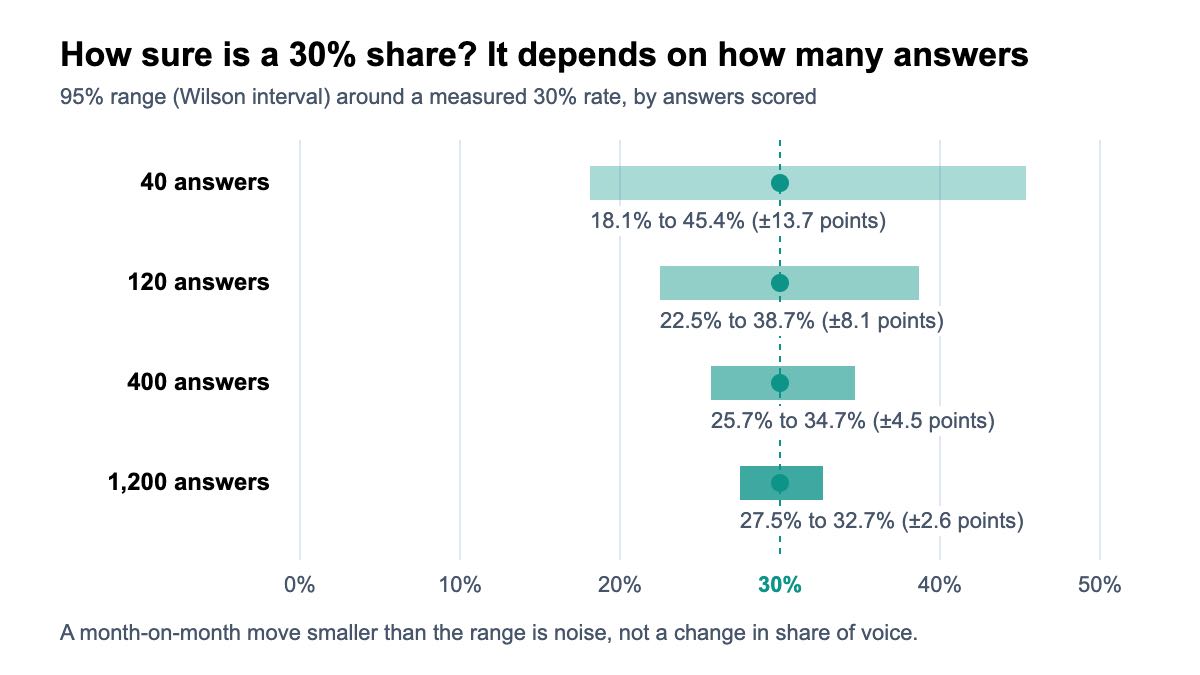
| Answers scored | Example program | Range | Plus or minus |
|---|---|---|---|
| 40 | 10 prompts × 4 engines, once | 18.1% to 45.4% | 13.7 points |
| 120 | 30 prompts × 4 engines, once | 22.5% to 38.7% | 8.1 points |
| 400 | 25 prompts × 4 engines, 4 runs a month | 25.7% to 34.7% | 4.5 points |
| 1,200 | 50 prompts × 4 engines, 6 runs a month | 27.5% to 32.7% | 2.6 points |
The practical floor I would use is about 400 answers per period for each comparison you report. That matches the common advice of 25 to 50 prompts per competitive category with repeated runs. Below that, report the range next to the number, or the client will read noise as a trend.
Answers on one prompt are correlated, so the true range is a little wider than these figures. More prompts beat more reruns of the same prompt.
What breaks a competitor comparison?
- Incomplete brand definitions. A rival with a regional domain, a docs subdomain or a product name that differs from the company name will be under-counted. List every domain and alias per brand before the first run.
- A rival list that drifts. Adding a sixth rival lowers everyone’s share of voice. Freeze the set per quarter and note changes on the chart.
- Branded prompts. “Is North Trail good for wide feet” will cite North Trail. Keep prompts that name a brand out of the share-of-voice set.
- One market for all. Answers differ by country. AI Rank takes a
countryand alanguageparameter; run each market as its own benchmark. - Mixing dataset numbers with your own. A vendor’s library and your prompts measure different questions. Never put the two on one chart.
- Treating presence as preference. Share of voice does not say whether the answer praised you. Read a sample of the answer text each month.
If you are choosing a tool partly on how it measures, our audit of 14 AI rank trackers scores each one on whether it discloses its method.
Which one should you pick?
- You need a leaderboard for a pitch this week: SE Ranking’s leaderboard. One request, up to ten rivals, no prompt design.
- You already have a DataForSEO balance: multi-target LLM Mentions, if Google AI Overview and US-English ChatGPT cover your market.
- The client wants a login and charts: Peec AI Pro or Otterly Standard, both with API access for your own reports. Peec has unlimited users; Otterly bills Claude answers at three credits.
- You already pay for Ahrefs: Brand Radar’s Share of Voice endpoint is in API v3 from the Lite plan, per Ahrefs’ help centre. On Semrush, try the AI Visibility Toolkit, but confirm API access before you build on it.
- You want your own prompts, rivals and evidence at the lowest cost per answer: a per-answer API with the counting rules above. It is the only option here where the raw answer travels with the number.
How we checked this
On 20 November 2026 I opened the top five results for “which API lets me compare my AI visibility against competitors” and “AI share of voice” (Ahrefs, Metehan Yesilyurt, Passionfruit, Olostep, Addlly), then the official pricing or docs pages of SE Ranking, DataForSEO, Peec AI, Otterly, Ahrefs Brand Radar (product page, API docs and help centre), Semrush, Profound and seoClarity. That is 21 linked sources, 18 of them official vendor pages; the Passionfruit and Addlly guides were read for the gap check but are not cited. Serpent prices come from our pricing page on the same day. Per-answer costs are my normalisation of each vendor’s plan limits, not a vendor figure.
The share-of-voice script was executed locally against a stub that returns the response shape shown on the AI Rank API page, with fictional brands; no live API was called for this page. The Wilson intervals were computed with the standard formula and are exact for the inputs shown.
What I could not verify: whether the $99 Semrush AI Visibility Toolkit (as opposed to Semrush Enterprise) has API access; how many API units an Ahrefs Brand Radar request on Ahrefs’ own prompt index uses; Profound’s Enterprise price; seoClarity’s subscription price; how many answers a month Semrush’s toolkit includes; and how many rows a typical DataForSEO multi-target task returns.
Benchmark your brand against your rivals
Track brand citations and positions across ChatGPT, Claude, Gemini and Perplexity as JSON, for your own prompts and rivals. From $0.70 per 1,000 — pay as you go, no subscription — and every account starts with 10 free API calls.
Get Your Free API KeyExplore: AI Rank API · Playground · Docs · Pricing
FAQ
What is AI share of voice?
AI share of voice is your brand’s slice of all the appearances your tracked brands make in AI answers. If your brand is cited in 30 answers and your three rivals in 70 between them, your share is 30%. It differs from presence rate, which is the share of all answers that include you. Report both, per engine and overall, and say whether you counted citations, mentions or both.
Which API lets me compare my AI visibility against competitors?
SE Ranking’s AI Search API has a leaderboard request that ranks your domain against up to ten rivals by share of voice, and Ahrefs’ API v3 has a Brand Radar Share of Voice endpoint. DataForSEO’s LLM Mentions API compares up to ten target sets by mention count. Peec AI and Otterly expose their competitor dashboards through an API on paid plans. A per-answer API such as Serpent’s AI Rank returns every cited source per engine, so you compute the comparison on your own prompts.
How do you calculate share of voice in ChatGPT, Gemini and Perplexity?
Run a fixed prompt set on each engine and treat each answer as one unit. For each brand, count the answers whose source list includes one of its domains, or whose text names it. Divide each brand’s count by the sum across all tracked brands. Leave out engines that returned no answer, keep citation and mention counts in separate columns, and report per engine as well as blended.
How many prompts do I need for a reliable AI share of voice?
Aim for about 400 answers per period for each comparison, for example 25 prompts on four engines run four times a month. At that size a 30% rate has a 95% range of about plus or minus 4.5 points. With only 40 answers the range is plus or minus 13.7 points, which is too wide to report month-on-month changes with a straight face.
Is a citation the same as a mention?
No. A citation is your page in the answer’s source list, while a mention is your brand name in the answer text. An answer can cite a review of your product without naming you, or name you while citing only other sites. Track both: citations show which of your pages engines use, while mentions are closer to what a reader actually sees.
Do I need one API call per competitor?
Not with a per-answer API. One call per prompt returns every source each engine cited, so all your rivals are scored from the same response at no extra cost. With dataset APIs, one request covers up to ten rivals on SE Ranking and up to ten target sets on DataForSEO, but the prompts come from the vendor’s library rather than yours.
Sources
Official pricing and docs (checked 20 November 2026):
- SE Ranking — AI Search API reference (leaderboard)
- SE Ranking — API credit costs and annual packs
- SE Ranking — API pricing (Wallet, Standalone)
- DataForSEO — LLM Mentions pricing
- DataForSEO — LLM Mentions multi-target docs
- DataForSEO — pricing update, 1 July 2026
- DataForSEO — minimum payment
- Peec AI — pricing
- Otterly — pricing
- Ahrefs — Brand Radar
- Ahrefs — pricing (plans and custom prompt packages)
- Ahrefs — Brand Radar API reference
- Ahrefs — AI Responses endpoint (billing note)
- Ahrefs — About API v3 (plans and units)
- Semrush — AI Visibility Toolkit knowledge base
- Semrush — API introduction (Enterprise API v4, Prompt Tracking)
- Profound — pricing
- seoClarity — ArcAI API
Guides and methods (read 20 November 2026):