Cheapest Jobs API in 2026: From $0.004 per 1,000 Jobs

Serpent is the cheapest jobs API: $0.004 per 1,000 jobs on its top tier, the lowest per-job price of any jobs data seller I checked (read 24 Nov 2026). Pay as you go is $0.025 per 1,000 jobs, a little above one LinkedIn-only seller at $0.02. The other sellers charge $0.04 to $19.60.
Short answer: For a steady feed of jobs from employers' own career pages, pick Serpent and move up its tiers as your deposit grows: a million jobs a month is $25 pay as you go and $4 on the top tier. For LinkedIn listings only, at small volume, the johnvc actor at $0.02 per 1,000 is the lowest per-job price for that one site.
Job data is sold in at least four units. Apify actors charge per result, sometimes with a start fee per run and sometimes with your compute bill on top. TheirStack and Coresignal sell monthly credits, and Fantastic.jobs sells plans with a set number of jobs. Serpent charges per call.
A price list in one unit cannot be read against a price list in another, so I converted every public price I could read on 24 November 2026 to one number: the cost of 1,000 jobs.
Every rate below links to the page it came from, every conversion is spelled out, and the method section says what I could not check.
How do you compare a per-call price with a per-job price?
You count the jobs a call returns, then divide. A call to Serpent's /api/jobs/search returns up to 20 jobs by default, newest first, and costs the same whether it returns 20 jobs or fewer. At a full page of 20 jobs, $0.50 per 1,000 calls is $0.025 per 1,000 jobs.
A full page is the normal case for a broad search. In 60 realistic searches from answers saved before launch, not live calls, the median search returned a full page of 20 jobs. A narrow search, such as one job title in one small city, returns fewer at the same price per call, so its cost per job is higher. The detail endpoint, /api/jobs/job, reads one job again by its id at the same price per call.
| Serpent tier | Deposit for the tier | Per 1,000 calls | Per 1,000 jobs |
|---|---|---|---|
| Serpent API: Pay as you go | $10 minimum deposit | $0.50 | $0.025 |
| Serpent API: Growth | $100 | $0.32 | $0.016 |
| Serpent API: Scale | $500 | $0.20 | $0.010 |
| Serpent API: Enterprise | $1,000 | $0.13 | $0.0065 |
| Serpent API: Enterprise Plus | $1,250 | $0.08 | $0.004 |
The deposit sets the rate on that credit and stays as spendable balance; it is not a fee, and there is no subscription. The rest of the post uses the per-1,000-jobs column.
What do 10,000, 100,000 and 1,000,000 jobs a month cost?
A million jobs a month costs $4 on Serpent's top tier and $25 pay as you go. The lowest-priced rival in the tables below, johnvc's LinkedIn-only Jobs API, is $20 for the same million, and the plan sellers start at $1,399.
The arithmetic is the same at every volume. At 20 jobs per call, 10,000 jobs is 500 calls, 100,000 jobs is 5,000 calls and 1,000,000 jobs is 50,000 calls. On pay as you go that is 500 × $0.0005 = $0.25, then $2.50, then $25.
On Enterprise Plus it is 500 × $0.00008 = $0.04, then $0.40, then $4. Per-result sellers multiply their rate per 1,000 jobs by the thousands of jobs: johnvc's $0.02 is $0.20, $2 and $20.
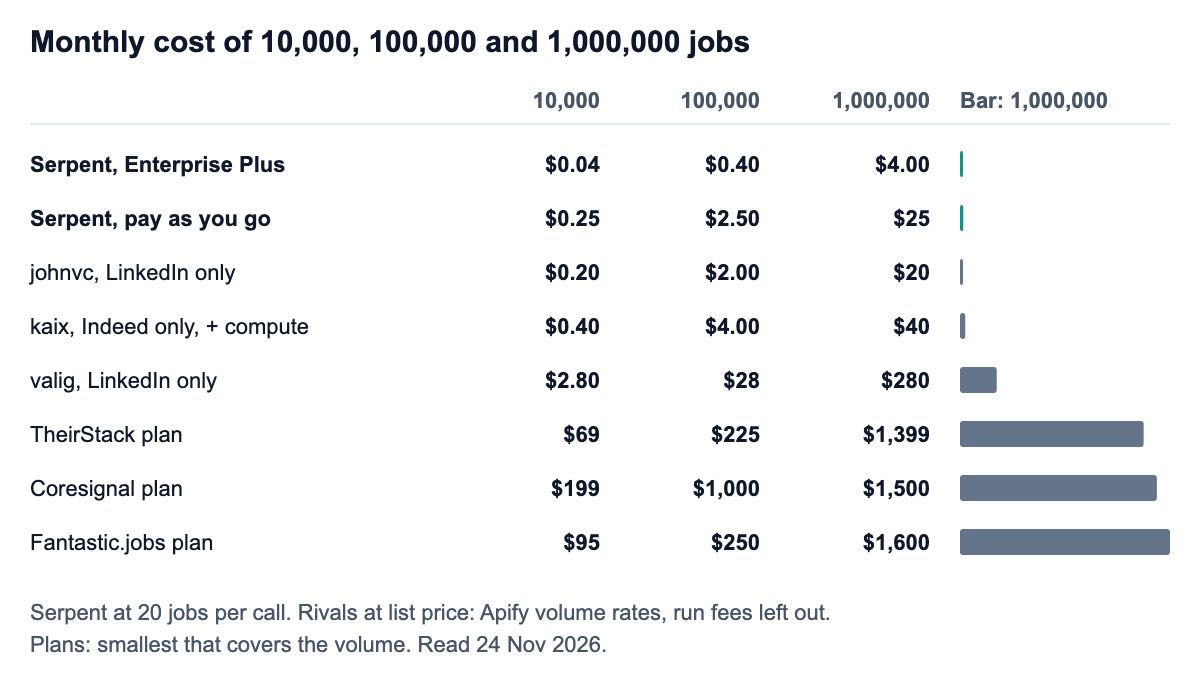
| Provider and plan | 10,000 a month | 100,000 a month | 1,000,000 a month |
|---|---|---|---|
| Serpent API: Pay as you go ($10 minimum deposit) | $0.25 | $2.50 | $25.00 |
| Serpent API: Growth ($100 deposit) | $0.16 | $1.60 | $16.00 |
| Serpent API: Scale ($500 deposit) | $0.10 | $1.00 | $10.00 |
| Serpent API: Enterprise ($1,000 deposit) | $0.065 | $0.65 | $6.50 |
| Serpent API: Enterprise Plus ($1,250 deposit) | $0.04 | $0.40 | $4.00 |
| Apify: johnvc LinkedIn Jobs API, $0.02 per 1,000 (LinkedIn only) | $0.20 | $2.00 | $20.00 |
| Apify: kaix Indeed Jobs Scraper, $0.04 volume rate, plus compute (Indeed only) | $0.40 | $4.00 | $40.00 |
| Apify: kaix Indeed Jobs Scraper, $0.05 free-plan rate, plus compute | $0.50 | $5.00 | $50.00 |
| Apify: valig Indeed, $0.07 volume rate (Indeed only) | $0.70 | $7.00 | $70.00 |
| Apify: valig LinkedIn, $0.28 volume rate (LinkedIn only) | $2.80 | $28.00 | $280 |
| Apify: Career Site Job Listing Feed, $0.80 volume rate | $8.00 | $80.00 | $800 |
| Apify: curious_coder LinkedIn, $1.00 volume rate | $10.00 | $100 | $1,000 |
| TheirStack: monthly API credits, one credit per job | $69 | $225 | $1,399 |
| Coresignal: monthly plan, one credit per job posting | $199 | $1,000 | $1,500 |
| Fantastic.jobs: monthly plan | $95 | $250 | $1,600 |
| Apify: Career Site Job Listing API, $4.00 volume rate | $40.00 | $400 | $4,000 |
Each cell is list price, before tax, with no free credit subtracted. Here is how each row was built, so you can audit it:
- Serpent API. Calls at 20 jobs each, times the rate per call for the tier. Growth takes one qualifying $100 deposit, Scale $500, Enterprise $1,000 and Enterprise Plus $1,250 for new credit.
- Apify actors. The rate per result times the number of jobs. The volume rate is Apify's top Store discount tier, Diamond, which Apify's pricing page does not show next to its public plans; those run up to Business at $999 a month with the Gold discount. On a free plan, use the entry rates in the next section.
- TheirStack. One API credit per job. Its monthly subscription is $69 for 10,000 credits, $225 for 100,000 and $1,399 for 1,000,000.
- Coresignal. One credit per job posting. The smallest plan that covers each volume: Starter at $199 a month with 12,000 credits, Growth at $1,000 with 150,000 and Premium at $1,500 with 1,000,000.
- Fantastic.jobs. The smallest plan that covers each volume: $95 a month for 20,000 jobs, $250 for 100,000 and $1,600 for 1,000,000.
At 10,000 jobs a month, the three lowest-priced Apify actors here cost less than a dollar a month, and the difference between Serpent's pay-as-you-go row and johnvc's row is five cents. The gap that matters opens at volume and against the plan sellers: at 100,000 jobs a month, $2.50 pay as you go against $225 to $1,000 a month for a plan.
Who sells job data, and at what price per 1,000 jobs?
Three kinds of seller come up. Apify is a marketplace where independent developers publish scrapers as actors and set their own prices; most job actors read one job board, such as Indeed or LinkedIn. TheirStack, Coresignal and Fantastic.jobs sell job data as a subscription. Serpent sells one search across about 200,000 open jobs from more than 600 companies, taken from the employers' own career pages.
| Service | Users, last 30 days | Jobs from | Entry rate | Lowest rate | How it is billed |
|---|---|---|---|---|---|
| Serpent API | n/a | Employers' own career pages | $0.025 | $0.004 | Per call of up to 20 jobs: $0.025 pay as you go, $0.016 Growth, $0.010 Scale, $0.0065 Enterprise, $0.004 Enterprise Plus |
| Apify: johnvc LinkedIn Jobs API | 84 | $0.02 | $0.02 | Per job plus a per-row charge, same at every tier | |
| Apify: kaix Indeed Jobs Scraper | 1,487 | Indeed | $0.05 | $0.04 | Per job, plus your Apify compute |
| Apify: valig Indeed Jobs Scraper | 6,298 | Indeed | $0.10 | $0.07 | Per job, plus a start fee per run |
| Apify: curious_coder Indeed | 590 | Indeed | $0.10 | $0.10 | Per job, flat |
| Apify: worldunboxer LinkedIn | 812 | $0.10 | $0.10 | Per job, flat; enrichment extra | |
| Apify: valig LinkedIn Jobs Scraper | 9,530 | $0.40 | $0.28 | Per job | |
| Apify: valig Glassdoor | 1,252 | Glassdoor | $0.40 | $0.28 | Per job |
| Apify: Career Site Job Listing Feed | 279 | Company career sites | $2.50 | $0.80 | Per job, plus $0.10 per run |
| Apify: bebity LinkedIn | 4,116 | $1.50 | $1.00 | Per job | |
| Apify: curious_coder LinkedIn | 13,150 | $2.00 | $1.00 | Per job | |
| Apify: misceres Indeed Scraper | 1,941 | Indeed | $6.00 | $1.00 | Per job |
| Apify: Career Site Job Listing API | 1,613 | Company career sites | $12.00 | $4.00 | Per job, plus $0.01 per run |
| TheirStack | n/a | Many sources | $12.67 | $1.10 | Monthly credits, one per job; $19 for 1,500, $5,500 for 5,000,000 |
| Coresignal | n/a | Many sources | $19.60 | $0.50 | Monthly credits, one per job posting; $49 for 2,500, $5,000 for 10,000,000 |
| Fantastic.jobs | n/a | Company career sites | $9.00 | $1.40 | Monthly plan; $45 for 5,000 jobs, $2,800 for 2,000,000 |
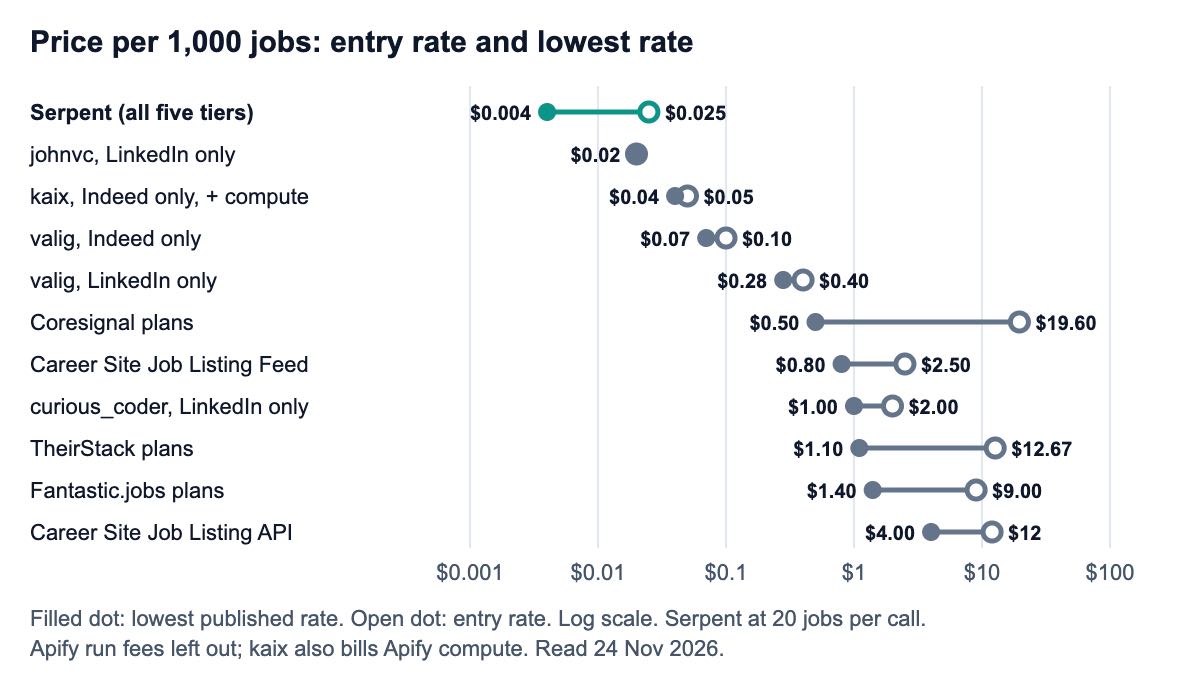
Read the table per job, and the lowest per-job price belongs to Serpent's top tier at $0.004 per 1,000 jobs, 5 times below johnvc's $0.02 and 10 times below kaix's $0.04 volume rate. From Growth up, every Serpent tier is under $0.02: Growth $0.016, Scale $0.010, Enterprise $0.0065.
At pay as you go the order changes. Serpent's $0.025 per 1,000 jobs is a quarter above johnvc's $0.02, which charges the same at every tier, so for a small LinkedIn-only job that actor is the lower price. Serpent's pay-as-you-go rate is still half of kaix's $0.05 free-plan rate before compute, and a fraction of every plan seller's entry price: $12.67 at TheirStack, $9.00 at Fantastic.jobs and $19.60 at Coresignal.
The sellers do not sell the same jobs. An Indeed actor returns what Indeed shows, and a LinkedIn actor returns what LinkedIn shows. Serpent's jobs come from employers' own career pages, so each one keeps the employer's own apply link; if you need LinkedIn's or Indeed's listings themselves, a single-site actor is the tool for that site. The two Career Site actors and Fantastic.jobs are the closest to Serpent in what they cover, and their lowest rates are $0.80 to $4.00 per 1,000 jobs.
What do the headline prices leave out?
Three things can push a real bill above the per-job number: compute charged on top, fees per run and plan sizes you do not fill.
- Compute on top. Apify lets an actor charge "Pay per event + usage", and its documentation says that then "users pay for both the defined events and the underlying platform usage." kaix's Indeed actor is one of them; its page says "You are charged both the fixed price for specific events and for Apify platform usage." Apify's pricing page lists compute at $0.2 per compute unit on the free plan. I did not run the actor, so I cannot put its compute in cents per 1,000 jobs.
- No actor fee at all. One small LinkedIn actor with 55 users, shahidirfan's Fast LinkedIn Job Scraper, charges no fee per job; you pay only Apify compute. Its cost depends entirely on that compute, which its listing does not convert into a price per job, so it is not in the tables.
- Fees per run. valig's Indeed actor adds $0.001 per run on the free plan, the Career Site Job Listing Feed adds $0.10 per run and the Career Site Job Listing API $0.01. A $0.10 start fee is the price of 4,000 jobs on Serpent pay as you go, so many small runs cost more than the table suggests.
- Plans you do not fill. A plan is priced for its full allowance. Coresignal's $199 Starter plan carries 12,000 credits; use 10,000 and you have still paid $199. Fantastic.jobs' $45 plan says no overage, and its $250 plan lists overage at $0.0025 per job.
- Extra events. Some actors bill more than one event per job. openclawai's job-board actor lists a dataset charge of $0.00001 that looks cheap, but its per-job event makes the real price $6.01 per 1,000 jobs on the free plan and $4.01 at volume.
Serpent has none of these: one call is one charge, there is no plan to fill and no compute bill. A missing or invalid parameter returns an error that is never charged.
What is in a row?
A cheap row with half the fields is not a cheap job. Each Serpent job carries its id, title, employer name, logo and website, location with city, state and country, a remote flag and workplace type, employment type, salary minimum, maximum, currency and period when the employer publishes it, the full description, qualifications, responsibilities and benefits, required skills, the apply link to the employer's own site, the posted date, the dates it was first and last seen, the date it closed if it has, and an open or closed status.
Every key is present on every row with the same type, and a value the employer does not publish comes back empty, so one parser covers every answer. The Jobs API page lists every field and the filters for location, country, remote work, seniority, employment type, salary and posting date; the search docs and the job detail docs give the parameters.
For the rivals I checked one thing per seller only where it decides the comparison. johnvc's page documents a description field as "The full job description text," so its $0.02 row is a full posting. For the other actors I did not check row by row which fields come back, and a seller's sample can differ from what a given search returns. If one field matters to you, such as salary or the closed date, check a sample from each shortlisted seller before you commit.
For the code route, see how to scrape job listings with Python and Node; for what teams build with this data, see using job data to track recruiting and hiring trends.
Which free options are worth using?
All of them, for a prototype. Serpent gives a new account 10 free API calls, shared across every free-eligible endpoint, and both Jobs endpoints can spend them: at 20 jobs a call, that is up to 200 jobs to test with.
TheirStack's free plan includes 200 API credits a month, which is 200 jobs. Fantastic.jobs is free for 14 days with no card, up to 500 jobs and 100 requests. Apify's actors draw on its free plan's monthly credit.
Free allowances are for testing your parser and your filters, not for running a feed. Once you know what you need, compare the paid rates in the tables above. If you are only after LinkedIn postings, the LinkedIn jobs API pricing post prices that narrower job the same way.
Which one should you pick?
Here are named picks by scenario:
- A job board, alert service or hiring tracker built on employers' own postings: Serpent. A million jobs a month is $25 pay as you go and $4 on Enterprise Plus, with the employer's apply link on every job.
- A steady 100,000 jobs a month or more: Serpent from Growth up. At $1.60 a month on Growth and $0.40 on Enterprise Plus, it is below every per-job price in the tables above.
- LinkedIn listings only, a few thousand a month: johnvc's LinkedIn Jobs API at $0.02 per 1,000 jobs, the lowest per-job price I found for that one site.
- Indeed listings only: kaix's actor at $0.05 to $0.04 per 1,000 plus compute, or valig's at $0.10 to $0.07 if you prefer no compute bill.
- Company data next to the jobs, at enterprise scale: TheirStack, which also sells company records at 3 credits each, or Coresignal; budget $1,399 to $1,500 a month for a million postings.
The Jobs API page has a live search box, so you can see the JSON for a job title you care about before you write any code.
How we checked this
What I read. On 24 November 2026 I read Apify's public Store listings for job scrapers (searches for job scraper, indeed, linkedin jobs, glassdoor, career site, jobs and job listings, plus the Jobs category by popularity): 1,646 distinct actors, of which 162 had 50 or more users in the last 30 days. For each, I recorded the price of the per-job event on the free plan and on the top Diamond tier, any per-run start fee and whether compute is billed on top. I also read the pricing pages of TheirStack, Coresignal and Fantastic.jobs, Apify's pricing page and its pay-per-event documentation, and the actor pages of johnvc and kaix.
How the rows were built. Price per 1,000 jobs is the per-job event price times 1,000; where an actor also bills a per-row charge, it is added in. Plan sellers are their plan price divided by the jobs or credits included.
Rival rates are list prices with no free credit subtracted; Apify plan fees, run fees and compute are left out of every Apify cell. Users are Apify's count for the last 30 days, read 24 November 2026; the tables list only actors with 50 or more.
Serpent's own numbers. The five rates are the published rates. The 20 jobs per call is the default page size; the median of 20 comes from 60 realistic searches in answers saved before launch, not live calls.
What I could not verify. Which fields each rival returns on every row (except johnvc's full description); the compute cost per 1,000 jobs for kaix's actor and for the no-fee LinkedIn actor; what an Apify plan with the Diamond discount costs; and Coresignal's free-tier credit count, which its page does not label clearly. Two Apify actors with fewer than 50 users list lower headline rates than some rows here and are left out by the 50-user rule: a career-site actor at $0.016 per 1,000 postings without descriptions, and a Google Jobs actor at $0.25 per 1,000 requests, which its page works out at $0.025 per 1,000 jobs.
Price your own volume
Serpent's Jobs API is from $0.08 per 1K API calls, which is $0.004 per 1,000 jobs at 20 jobs a call. Pay as you go, no subscription, with 10 free API calls to start.
Get Your Free API KeyFAQ
What is the cheapest jobs API?
Serpent is the cheapest jobs API by price per job: $0.004 per 1,000 jobs on its Enterprise Plus tier, the lowest per-job price of any jobs data seller checked on 24 November 2026. Pay as you go is $0.025 per 1,000 jobs, a little above johnvc's LinkedIn-only actor at $0.02. Other sellers range from $0.04 per 1,000 jobs on an Indeed actor, plus compute, to $19.60 on a Coresignal starter plan.
How much do 1,000 job postings cost?
With Serpent, 1,000 jobs is 50 calls at 20 jobs each: $0.025 pay as you go, $0.016 on Growth, $0.010 on Scale, $0.0065 on Enterprise and $0.004 on Enterprise Plus. The Apify job actors in this post charge $0.02 to $12.00 per 1,000 jobs at their entry rate. TheirStack, Coresignal and Fantastic.jobs sell plans that work out between $0.50 and $19.60 per 1,000, depending on plan size.
Can you compare a price per call with a price per job?
Yes, once you know how many jobs a call returns. A Serpent search returns up to 20 jobs by default at one price per call, so at a full page the price per job is the call price divided by 20. A narrow search that returns fewer jobs costs the same per call, so its price per job is higher. Apify actors bill each job, so their price per job is fixed, but some add run fees or compute.
Is there a free jobs API?
Serpent gives a new account 10 free API calls, up to 200 jobs at 20 a call. TheirStack's free plan includes 200 API credits a month, Fantastic.jobs is free for 14 days with up to 500 jobs, and Apify actors draw on Apify's free plan credit. One Apify LinkedIn actor charges no per-job fee and bills only compute. Free allowances are for testing; at volume, compare the paid rates.
Does a cheap jobs API return the full job description?
Serpent's does, at every tier: each job carries the full description, qualifications, responsibilities, benefits, skills, salary when the employer publishes it, the apply link and its open or closed status. A higher tier changes only the rate. johnvc's LinkedIn actor documents a full description too. For other sellers, check a sample answer before you commit, because some cheap rows carry listing fields only.
How often do job data prices change?
Often enough to re-check before you sign. Between 23 and 24 November 2026 no job actor in these tables changed its price, but user counts moved: curious_coder's LinkedIn actor went from 13,255 to 13,150 users in a day. The prices here were read on 24 November 2026, and Serpent's own rates are on its pricing page.
Sources
Apify Store listings, actor pages and documentation (read 24 Nov 2026):
- Apify Store listing for “job scraper” (prices and users in the last 30 days)
- Apify Store listing for “linkedin jobs”
- Apify Store listing for “indeed”
- johnvc LinkedIn Jobs API
- kaix Indeed Jobs Scraper
- valig Indeed Jobs Scraper
- valig LinkedIn Jobs Scraper
- valig Glassdoor Jobs Scraper
- curious_coder LinkedIn Jobs Scraper
- curious_coder Indeed jobs scraper
- worldunboxer LinkedIn Jobs Scraper
- bebity LinkedIn Jobs Scraper
- misceres Indeed Scraper
- Career Site Job Listing Feed
- Career Site Job Listing API
- openclawai job board actor
- Apify pricing, plans and Store discount tiers
- Apify documentation: pay per event and “Pay per event + usage”
Job data vendors (read 24 Nov 2026):
Considered and excluded (read 24 Nov 2026):
- mobiusengine Job Postings API and litescrape Google Jobs: fewer than 50 users in the last 30 days
- shahidirfan Fast LinkedIn Job Scraper: no per-job fee, compute only, so no price per job to compare
- Apify actors with fewer than 50 users in the last 30 days are not listed in the tables