LinkedIn Jobs API Pricing per 1,000 Postings Compared

LinkedIn does not sell an API for reading job postings, so LinkedIn jobs data comes from third-party APIs priced from about $0.28 to $10 per 1,000 full postings at 100,000 a month. The spread depends on the unit — per job, per credit, per record or per call — and on whether you need the description or just the search card.
Short answer: For a job board or alerts product that needs full postings from code, pay per call: Serpent API’s job search and job details endpoints are from $0.25 per 1,000 calls — pay as you go, no subscription — about $0.28 to $0.55 per 1,000 full postings. For a no-code export with 40-plus fields, an Apify jobs actor at from $1.00 per 1,000. For multi-source job data with company tech stacks, TheirStack. For historical job datasets alongside employee data, Coresignal.
Is there an official LinkedIn jobs API?
Not one you can use to read jobs. LinkedIn’s Job Posting API exists, but it does the opposite of what most buyers want: it lets approved partners such as applicant tracking systems post jobs to LinkedIn on behalf of their customers.
Access is also closed. The documentation opens with: “We are currently not accepting new partnerships for LinkedIn’s Job Posting API.” It adds that use “is restricted to those developers approved by LinkedIn”, under a signed agreement with data restrictions. No price is published, because it is not a product you can buy.
So every “LinkedIn jobs API” on the market is a third-party service that returns public job postings. The question is not whether to use one, but which billing unit fits your workload. If you want the wider comparison of official and third-party LinkedIn access, read our official LinkedIn API comparison.
What are you actually paying for?
Before comparing prices, separate two things that vendors often blur: the job card and the full posting.
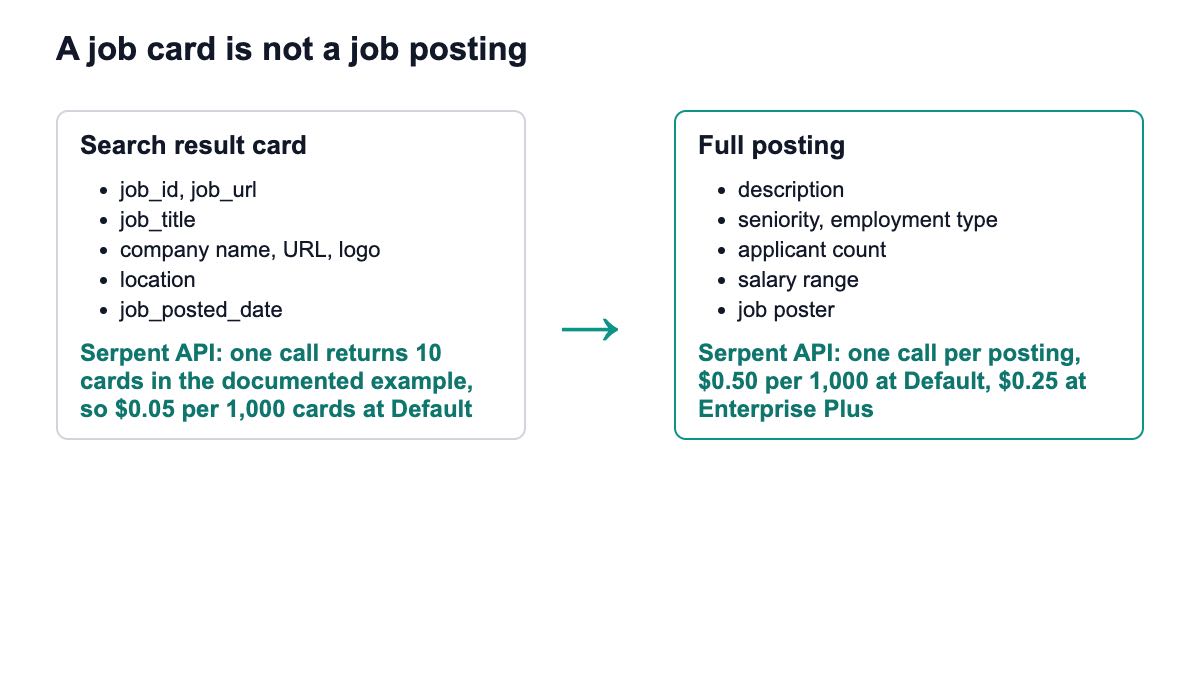
- A job card is one row from a search: the job ID and link, title, company, location and posting date. It is enough to count openings, track which companies are hiring, or show a list.
- A full posting adds the description, seniority, employment type, applicant count, salary range and the person who posted it. You need it to show a job page, classify roles or extract skills.
Then there is the billing unit, which differs by vendor:
- Per job (Apify actors, TheirStack): each posting returned costs the same, whatever was in it.
- Per credit (Coresignal, TheirStack, Scrapingdog): you buy a plan of credits and each record or call uses some.
- Per record (Bright Data): each delivered record is billed.
- Per call (Serpent API): a search call returns a page of cards — 10 in the documented example — and a detail call returns one full posting.
The per-call model makes the card cheap and the full posting a separate, explicit cost. The per-job model usually bundles both. Neither is better in general; the right one depends on how many cards you discard before you need a description.
What do 1,000 postings cost at your volume?
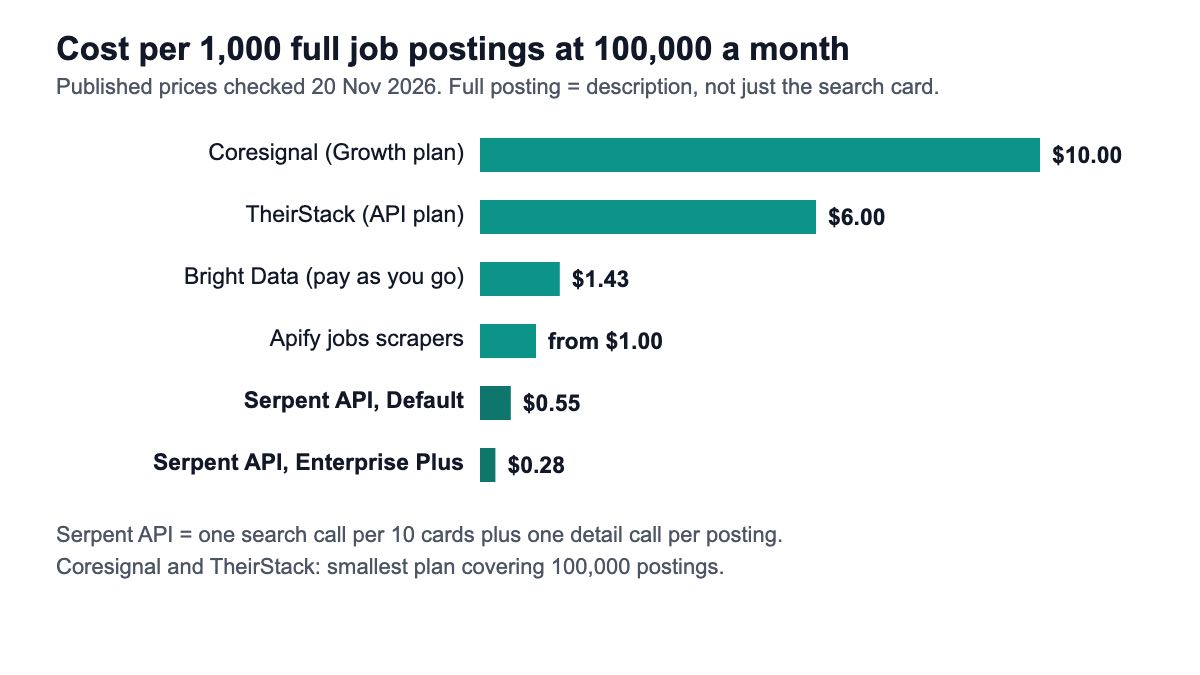
At 100,000 full postings a month, published prices run from about $0.28 to $10 per 1,000. At 1,000 a month, subscription minimums dominate and the range is $0.28 to $49.
| Provider (unit) | 1,000 / month | 100,000 / month | 1,000,000 / month | Model |
|---|---|---|---|---|
| TheirStack (1 API credit per job) | $49 (Starter, 1,500 credits) | $6.00 ($600 plan) | $1.50 ($1,500 plan) | Monthly plan; 200 free credits |
| Coresignal (1 credit per job posting) | $49 (Mini, 2,500 credits) | $10.00 (Growth, $1,000) | $1.50 (Premium, $1,500) | Monthly plan |
| Bright Data LinkedIn scraper (per record) | $0 (5,000 free a month) | $1.43 | $1.30 (Scale, $499 incl. 384,000) | Pay as you go or plan |
| Apify LinkedIn jobs actors (per job) | from $1.00 | from $1.00 | from $1.00 | Pay per event; lower on paid Apify plans |
| Scrapingdog LinkedIn Jobs API (credits per call) | Unverified: plans from $40 for 200,000 credits, credits per jobs call not stated | Monthly plan | ||
| Serpent API — job search (per call; 10 cards in the documented example) | $0.50 / $0.45 / $0.35 / $0.30 / $0.25 per 1,000 calls (Default / Growth / Scale / Enterprise / Enterprise Plus) = $0.05 down to $0.025 per 1,000 cards | Pay as you go, no subscription | ||
| Serpent API — job details (per posting) | $0.50 / $0.45 / $0.35 / $0.30 / $0.25 per 1,000 postings | Pay as you go, no subscription | ||
| Serpent API — search plus details (full posting) | $0.55 / $0.495 / $0.385 / $0.33 / $0.275 per 1,000 full postings, at any volume | Pay as you go, no subscription | ||
Sources: TheirStack pricing, Coresignal pricing, Bright Data’s LinkedIn scraper, the Apify actors by curious_coder and bebity, Scrapingdog’s LinkedIn Jobs API, and our pricing page. Serpent API tiers follow deposit size ($100 Growth, $500 Scale, $1,000 Enterprise, $1,250 Enterprise Plus).
As monthly bills, the same numbers read like this. For 1,000 full postings: Serpent API about $0.55 on Default, Apify about $1, TheirStack and Coresignal $49 each for their smallest fitting plans, Bright Data $0 inside its free tier. For 100,000: Serpent API $55 (or $27.50 on Enterprise Plus), Apify about $100, Bright Data $142.50, TheirStack $600, Coresignal $1,000. For 1,000,000: Serpent API $550 (or $275), Apify about $1,000, Bright Data about $1,300, TheirStack and Coresignal $1,500 each.
Two cautions. The plans include things a per-call API does not: TheirStack merges jobs from many sources and adds company technographics, and Coresignal keeps history you can query later. And if you only need cards, Serpent API’s search alone is $0.05 per 1,000 cards on Default, which no per-job vendor matches, because they bill the full record either way.
The providers, one by one
Serpent API — per call, cards and postings priced separately
Two endpoints. GET /api/linkedin/jobs takes keywords and returns public job cards, narrowed by location or an exact geo_id, date_posted (past hour, 24 hours, week or month), job_type, experience_level, remote, company_id, easy_apply, early_applicant and sort, with start to page. Every response echoes the filters it applied in a filters object, so you can see what you paid for. GET /api/linkedin/job takes a job_id and returns the description, seniority, employment type, applicant count, salary range and poster.
Both are from $0.25 per 1,000 calls, pay as you go, and a new account gets 10 free API calls. For how each filter behaves, see our LinkedIn jobs API filters guide; for working code, LinkedIn jobs in Python.
Apify LinkedIn jobs actors — per job, many fields
The two most used actors both list “from $1.00 / 1,000” job results. The curious_coder actor shows 182,915 total users; the bebity actor lists 42 fields per job, including salary, applicant count and company profile, and gives $5 of free credits each month. Prices fall on higher Apify plans. The curious_coder page also notes that LinkedIn “limits number of jobs per search to 1000”, and offers a split-by-location option to get past it.
Pick one if you want a spreadsheet-style export with many fields per job and no code. The bebity actor sells hiring-contact enrichment as an add-on, priced separately.
TheirStack — jobs from many sources, plus technographics
TheirStack’s API plans charge 1 credit per job and 3 per company. They run from a free 200 credits to $49 for 1,500, $600 for 100,000, $1,500 for 1,000,000 and $5,500 for 5,000,000 a month. It is the only option here built around job data from many boards at once, with company technology signals on top.
Pick it for sales intelligence (“which companies are hiring for Snowflake engineers?”) rather than a LinkedIn-only feed.
Coresignal — jobs alongside employee and company data
Coresignal charges 1 credit for a full job posting record, from the same credit plans as its employee and company data: Mini $49 for 2,500 credits up to Premium $1,500 for 1,000,000. If you already use Coresignal for people or firmographics, jobs come out of the same pool. Our Coresignal pricing breakdown explains its tiers.
Bright Data — per record, with a large free tier
Bright Data’s LinkedIn scraper covers people, companies, job listings and posts at one rate: $1.50 per 1,000 records pay as you go, or $499 a month for 384,000 records and $1.30 per 1,000 after that. The 5,000 free records a month cover a real pilot. The page does not set a separate price for job records. See our Bright Data LinkedIn pricing guide.
Scrapingdog and dataset vendors
Scrapingdog sells a LinkedIn Jobs API on credit plans from $40 a month for 200,000 credits, with 100 free credits, but the page does not state how many credits a jobs call uses, so I could not price it per posting. People Data Labs says its job posting data is “Refreshed and delivered daily” and its changelog counts 56,305,894 job posting records in its November 2026 release (v36.1). It says that dataset is sourced from company career pages, and its site lists no job data price.
How do you cut the bill without losing jobs?
Most of a jobs bill is waste: postings you already have, cards you never needed in full, and searches too broad to return everything. Four habits fix most of it.
- Pull only new jobs. Run each search daily with a recency filter —
date_posted=past_24hon Serpent API — instead of re-reading the whole result set. - De-duplicate on the job ID before buying detail. Store every
job_idyou have seen and call the detail endpoint only for new ones. With per-job vendors, de-duplicate before export where they allow it. - Split broad searches. With roughly 1,000 jobs visible per search, “software engineer, United States” cannot return every posting. Split by location or
geo_id, byexperience_levelor by date, and merge on job ID. - Buy detail only where you use it. If you classify jobs by title and company, cards are enough; fetch the full posting only for jobs a person or model will read.
A worked example: a niche board tracking 50 searches daily, 3 pages of 10 cards each, makes 150 search calls a day, 4,500 a month, which is $2.25 at Default and returns up to 45,000 cards. If 20% of those cards are new jobs that need detail, that is 9,000 detail calls, $4.50. The whole month costs $6.75 at Default list prices. Our job board build guide shows the pipeline, and hiring-trend tracking shows a cards-only use.
Which one should you pick?
- A job board, alerts product or internal tool, built in code: Serpent API. Cards are $0.05 per 1,000 and full postings $0.50 per 1,000 on Default, with no subscription.
- A one-off export with every field, no code: an Apify jobs actor, from $1.00 per 1,000.
- Sales intelligence across many job boards: TheirStack.
- Labour-market research that also needs employee and company history: Coresignal.
- Very large monthly pulls on one vendor across LinkedIn record types: Bright Data’s plan.
- Posting your own jobs to LinkedIn: the official Job Posting API through an approved partner — though it is not taking new partners.
For every LinkedIn data type in one comparison, see the best LinkedIn data APIs guide.
How we checked this
On 20 November 2026 I read LinkedIn’s Job Posting API documentation on Microsoft Learn and the live pricing pages of TheirStack, Coresignal, Bright Data, both Apify actors, Scrapingdog and People Data Labs (home page and changelog). Serpent API endpoints and prices come from our docs and pricing page the same day. Sources: 1 official LinkedIn page and 8 vendor pages.
I could not run a fresh web search for the current top-ranking pages, so the comparison covers the providers I could identify and open; a RapidAPI listing for a LinkedIn job search API returned no pricing content. No API calls were made; monthly bills are list-price arithmetic at the volumes shown, with subscriptions priced at the smallest fitting plan.
What we could not verify: Scrapingdog’s credits per LinkedIn jobs call; RapidAPI plan prices; Apify rates on each paid plan; whether every Serpent API search call returns 10 cards (the documented example does); People Data Labs’ job data price; and the credit amounts of Coresignal’s free tier and 7-day trial, which its pricing page lists without clear labels.
Price your jobs pipeline per call
Serpent API’s LinkedIn job search and job details are from $0.25 per 1,000 calls — pay as you go, no subscription. Sign up for 10 free API calls and run your own searches.
Get Your Free API KeyExplore: LinkedIn API · Playground · Docs · Pricing
FAQ
Does LinkedIn have a public jobs API?
No. LinkedIn’s Job Posting API lets approved partners, such as applicant tracking systems, post jobs to LinkedIn for their customers; it is not for reading or searching postings. Its documentation also says LinkedIn is “currently not accepting new partnerships” for it. To read public LinkedIn job postings from code, you use a third-party API that returns them as JSON, priced per job, per credit, per record or per call.
How much does LinkedIn job data cost per 1,000 postings?
On 20 November 2026 list prices, full postings cost from about $0.28 per 1,000 (Serpent API on Enterprise Plus, search plus detail) and $0.55 on Default, to from $1.00 on Apify actors, $1.30 to $1.50 on Bright Data, and $1.50 to $49 on TheirStack and Coresignal plans depending on volume. Search cards alone cost less: $0.05 per 1,000 on Serpent API’s Default rate.
Is there a free LinkedIn jobs API?
Several providers have a free allowance: Bright Data gives 5,000 records a month, TheirStack 200 API credits, the bebity Apify actor $5 of credits a month, Scrapingdog 100 credits, and Serpent API 10 free API calls on sign-up. That is enough to test field coverage on your own searches. For production volumes every option is paid, and the cheapest depends on whether you need full postings or only cards.
Why can't I get every job from one LinkedIn search?
LinkedIn shows a limited number of results per search — about 1,000, according to a widely used Apify actor’s documentation — so a broad search such as a job title across a whole country stops short of the full count. Split the search by location or geo ID, seniority, job type or posting date, then merge the results on the job ID. Plan for it whichever provider you use.
Should I pay per job or per API call?
Pay per call if you discard many cards before you need a description, or if you poll often for new postings: you pay a small amount for each page of cards and a separate amount only for postings you open in full. Pay per job if you always want every field for every posting in a one-off export, where a bundled record is simpler to budget.
Sources
Official documentation and pricing (checked 20 November 2026):