Cheapest Google Ads Transparency API in 2026

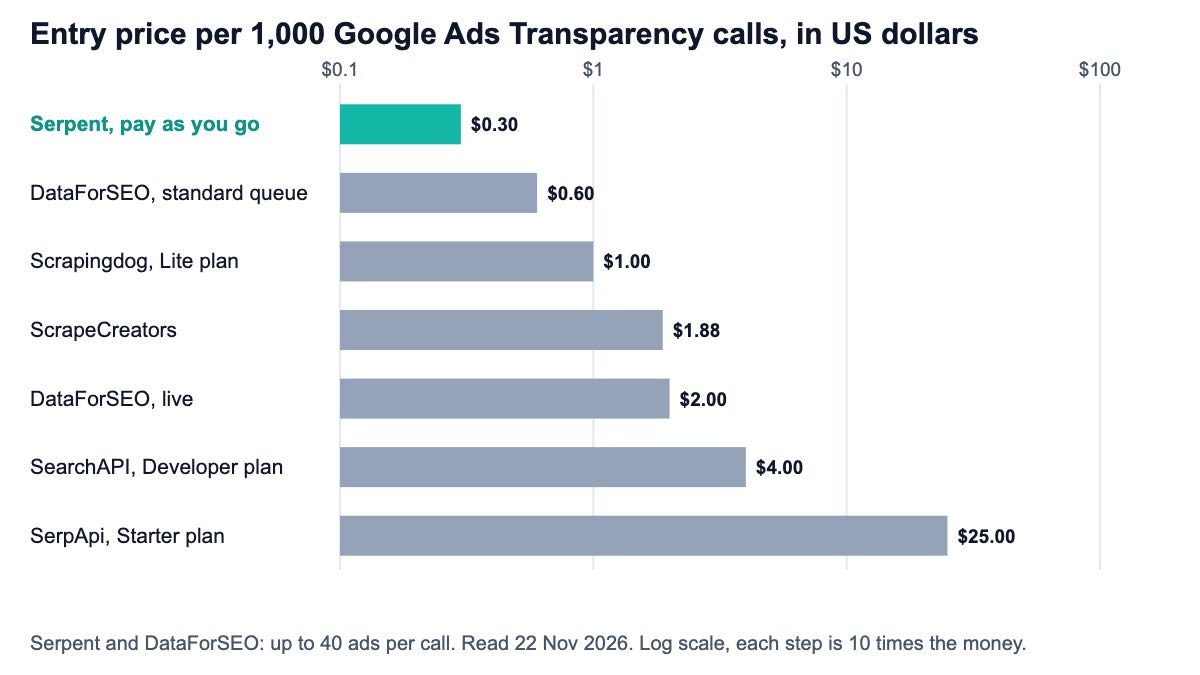
On public prices read on 22 November 2026, Serpent API has the lowest entry price of any Google Ads Transparency API I could find: $0.30 per 1,000 calls pay as you go, with up to 40 ads in every call. That is half of DataForSEO’s $0.60 per 1,000 results pages of up to 40 ads in its standard queue, and more than six times below its $2.00 live price. No subscription. One call returns up to 40 ads with the advertiser, the format and the first and last date each ad was shown.
Short answer: For a prototype or a few hundred thousand ads, use Serpent’s pay-as-you-go rate of $0.30 per 1,000 calls: a million ads is $7.50. If you will spend a deposit, the tiers take that to $0.16 per 1,000 calls. If you need a date window, political ads or several advertisers in one request, look at Scrapingdog’s endpoint, which has those options. An Apify actor can fit a one-off pull if you can live with per-ad billing and a start fee.
Google keeps a public archive of ads, the Ads Transparency Center, and a handful of services turn that archive into an API. They do not sell the same unit. One bills a results page, another a request that burns five credits, another a search from a monthly bundle, and the Apify marketplace bills each ad separately. A price per 1,000 means a different thing on each page.
So I read every public price I could find on 22 November 2026 and put the entry prices on two rulers: dollars per 1,000 calls and dollars per one million ads. Where a seller does not publish enough to do the sum, the cell says so rather than guessing. Each rate links to the page it came from. If you want the code side, see how to get Google Ads Transparency data with Python and Node.
What does a call cost at each seller’s entry price?
Serpent’s entry price is $0.30 per 1,000 calls. The next lowest I found is DataForSEO’s standard queue at $0.60, then Scrapingdog’s Lite plan at $1.00, ScrapeCreators at $1.88, SearchAPI at $4.00 and SerpApi at $25.00.
| Seller and plan | What one unit is | Entry price per 1,000 units | Ads per unit | Per 1,000 ads at a full page |
|---|---|---|---|---|
| Serpent API: pay as you go | 1 call | $0.30 | Up to 40 | $0.0075 |
| DataForSEO, standard queue | 1 results page (“SERP”) | $0.60 | Up to 40 | $0.015 |
| DataForSEO, priority queue | 1 results page | $1.20 | Up to 40 | $0.03 |
| DataForSEO, live | 1 results page | $2.00 | Up to 40 | $0.05 |
| Scrapingdog, Lite ($40 a month) | 1 request, 5 credits | $1.00 | Default 40 | $0.025 |
| ScrapeCreators, 25,000-credit pack ($47) | 1 request; credits for this endpoint not stated | $1.88 | Not stated | Not stated |
| SearchAPI, Developer ($40 a month) | 1 search | $4.00 | Default 40, up to 100 | $0.10 |
| SerpApi, Starter ($25 a month) | 1 search | $25.00 | Not stated | Not stated |
How each row was built, so you can audit it:
- Serpent API. One call is one charge, however many ads it returns, so the price per 1,000 ads is the call price divided by 40 for a full page. A call is $0.0003 at pay as you go.
- DataForSEO. Its Google Ads Search pricing page says one results page of up to 40 ads costs $0.0006 in the Standard queue, $0.0012 in the Priority queue and $0.002 in Live mode, which is $0.60, $1.20 and $2.00 per 1,000. The standard queue averages about five minutes.
- Scrapingdog. Its Google Ads Transparency documentation says a request costs 5 credits and returns up to
numads, 40 by default. On the pricing page the Lite plan is $40 for 200,000 credits, which is 40,000 requests, or $1.00 per 1,000. - ScrapeCreators. Its home page lists $47 for 25,000 credits, shown as $1.88 per 1,000 requests, and a general rule of one credit per request for most endpoints. It does not state the credits for its Google Ad Library endpoint, so the row takes the headline rate.
- SearchAPI. Its pricing page lists Developer at $40 for 10,000 searches, $4 per 1,000. Its Transparency Center documentation gives
numa default of 40 and a maximum of 100, and does not state a credit cost. - SerpApi. Its pricing page lists Starter at $25 a month for 1,000 searches. I could not read how many ads one search returns.
Why is a price per 1,000 never the same thing twice?
Because the unit moves. A “SERP” at DataForSEO is a page of up to 40 ads. A Scrapingdog request is 5 credits, so a plan’s credit count is five times its request count. A SerpApi search is whatever one search returns, and an Apify run bills every ad on top of a start fee. Put them all on one ruler and the order changes.
The ruler I find fairest is the cost of one million ads, because it is what a monitoring job actually buys. At a full page of 40 ads, a million ads is 25,000 calls. That is $7.50 on Serpent’s pay-as-you-go rate and $15.00 in DataForSEO’s standard queue, $50.00 live. On Scrapingdog Lite it is 25,000 requests at $1.00 per 1,000, $25.00, if each request returns 40 ads, and the sample on its documentation page returns 10. A full page is the best case for every seller, which is why the sums say “at a full page”.
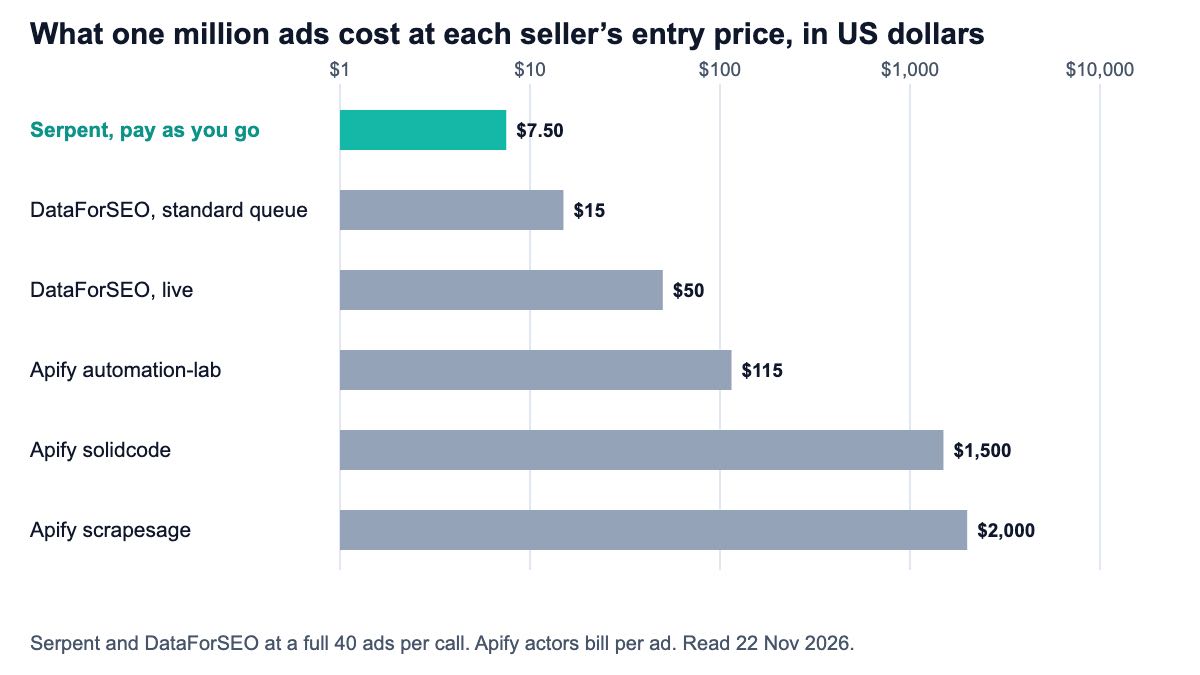
The chart compares entry prices per ad. Whoever you buy from, check how many ads one request returns before you commit, because that number sets the price per ad.
How close is DataForSEO?
DataForSEO is the closest, and the only seller I found that publishes a price in the same unit as Serpent: one page of up to 40 ads. Its standard queue is $0.60 per 1,000, twice Serpent’s entry price, and it returns results after a wait that averages about five minutes. Priority at $1.20 is four times Serpent’s, and live at $2.00 is more than six times.
The queue matters for what you build. A nightly job can wait five minutes; a dashboard a person is watching, or a tool that checks an ad when a customer asks, cannot. With Serpent the answer comes back in the same request, so the price you compare against for an interactive product is DataForSEO’s live rate, not its queue.
If you already buy from DataForSEO and your ad volume is small, one invoice may be worth more than the difference. At a million ads a month the difference is $7.50 against $15 in the queue, so it is real money only when the volume is large.
What do credit and plan sellers really charge?
The plan sellers publish a headline that looks cheap and a unit that is not what you buy. Scrapingdog is the clearest case because it publishes every plan. Because a request costs 5 credits, the per-1,000-requests rate is five times the per-1,000-credits rate on its pricing page.
| Scrapingdog plan | Monthly price | Credits | Requests | Per 1,000 requests |
|---|---|---|---|---|
| Lite | $40 | 200,000 | 40,000 | $1.00 |
| Standard | $90 | 1,000,000 | 200,000 | $0.45 |
| Pro | $200 | 3,000,000 | 600,000 | $0.33 |
| Premium | $350 | 6,000,000 | 1,200,000 | $0.29 |
| Business | $500 | 9,000,000 | 1,800,000 | $0.28 |
| Global Elite | $10,000 | 295,000,000 | 59,000,000 | $0.17 |
| Titan Starter | $18,000 | 580,000,000 | 116,000,000 | $0.155 |
| Nova Pro | $30,000 | 1,100,000,000 | 220,000,000 | $0.136 |
Read that table the way a buyer would. The entry plan is $1.00 per 1,000 requests, and you have to commit to a monthly plan to get any of the lower rows. To get below Serpent’s $0.30 pay-as-you-go rate you need at least the $350-a-month Premium plan and its 1,200,000 requests, about $0.29 per 1,000, whether or not you use them. Scrapingdog’s own rate falls below Serpent’s lowest tier, $0.16, only from its $18,000-a-month plan, which is why this post compares entry prices and does not claim a lower price at every size.
SearchAPI works the same way on a smaller scale: $4 per 1,000 searches on Developer, falling to $1 on its $5,000-a-month Octo 5M plan. SerpApi’s Starter plan is $25 a month for 1,000 searches, and its larger plans reach 54 million searches a month at $106,050. ScrapeCreators sells one-off credit packs rather than a monthly plan: $1.88 per 1,000 requests on the $47 pack and $0.99 on the $497 pack of 500,000.
None of that is a criticism. A monthly plan is a good deal if you use all of it. It is the wrong comparison for a project that runs a few hundred thousand ads one month and none the next, which is where pay as you go earns its place.
What is the catch with the Apify actors?
Apify is a marketplace where independent developers publish scrapers as “actors”. Each sets its own price and unit, and most bill every ad. Three actors cover the Transparency Center with real usage, and they sit far above the call-priced APIs on the one-million-ads ruler.
| Actor | Billed unit | Price per 1,000 ads | Start fee | Monthly users |
|---|---|---|---|---|
| automation-lab/google-ads-transparency-center-scraper | Ad | $0.115 on the free tier, down to $0.028 on the top tier (from 29 Nov 2026: $1.00 down to $0.80) | $0.005 per run | 74 |
| solidcode/ads-transparency-scraper | Result | $1.50 with no discount, down to $0.80 on Gold | $0.001 per run | 541 |
| scrapesage/google-ads-transparency-scraper | Ad result | From $2.00 | None | 1,601 |
Three things stand out. First, the unit: an actor that bills per ad turns a page of 40 into 40 charges, so automation-lab’s free-tier $0.115 per 1,000 ads is $4.60 for the 1,000 calls’ worth of ads that Serpent sells at $0.30. Its best tier, $0.028, needs a paid Apify plan, and the $0.0075 per 1,000 ads Serpent charges at pay as you go is still about 3.7 times below it. Its page also announces new prices from 29 November 2026: $1.00 per 1,000 ads on the free and Bronze plans and $0.80 at the top, so the automation-lab figures in this post are as of 22 November.
Second, the busiest actors are not the cheapest. The two with the most users charge $1.50 and $2.00 per 1,000 ads before any discount, 200 and 267 times Serpent’s price per ad. People pick them for reasons other than price, such as a dataset delivered to Apify’s storage or an integration they already run.
Third, an Apify bill is more than the actor price. Actors run on Apify’s platform, and the platform’s own plan and usage fees are separate; I did not research them, so a real bill may sit above the numbers here. A marketplace actor also depends on one developer, so a price or a feature can change overnight.
What do the five Serpent rates look like?
Serpent’s rate falls as your deposit tier rises. The deposit is spendable balance, not a fee, and there is no monthly plan. One call is one charge however many ads it returns, and a call that returns no ads is not billed.
| Tier | Deposit | Per 1,000 calls | Per call | Per 1,000 ads at 40 a call | One million ads |
|---|---|---|---|---|---|
| Pay as you go | $10 minimum | $0.30 | $0.0003 | $0.0075 | $7.50 |
| Growth | $100 | $0.26 | $0.00026 | $0.0065 | $6.50 |
| Scale | $500 | $0.22 | $0.00022 | $0.0055 | $5.50 |
| Enterprise | $1,000 | $0.19 | $0.00019 | $0.00475 | $4.75 |
| Enterprise Plus | $1,250 | $0.16 | $0.00016 | $0.004 | $4.00 |
The honest point about this table is that the money is small at every row. A million ads costs between $4 and $7.50. The decision at that scale is not price but whether the data arrives in the shape you can use, which the next section covers. The pricing page lists every tier for every endpoint, and the SERP API pricing comparison shows how the same ladder works for web search.
What do you get for the money?
With Serpent, one GET request to /api/google-ads/transparency returns ads from the Google Ads Transparency Center for a website domain or an advertiser. You send q as a domain such as nike.com, or as a Google advertiser id, which is AR followed by 20 digits. Optional parameters are region as a two-letter country code, default US; ad_format as all, text, image or video; and page_token to get the next 40.
Each ad carries its id and the advertiser id and name, its format, the first and last date it was shown as ISO dates, an image link when Google publishes the ad as an image, a preview link, and the address of the ad’s own page in the Transparency Center. A domain search returns ads that point to the domain from any advertiser, so a retailer’s agency or an affiliate can appear next to the brand; an advertiser id returns that advertiser’s own ads.
Some honest edges. image_url is filled when Google publishes the ad as a still image, and it is null otherwise, including for every video in the answers I read. The ads come in the order Google shows them, which is a ranking and not a promise of newest first.
On a fixed set of 64 requests drawn before measuring, 58 returned ads and 56 of those a full 40, in answers saved on 22 November 2026 rather than live calls. The set spanned 36 domains in six industries, 10 regions outside the United States, five format filters and five advertiser lookups.
Other vendors do more, and if you need these features you should price them instead of the cheapest row. Scrapingdog’s endpoint takes start_date and end_date, a political_ads switch, several advertiser ids in one request and a raw-HTML option. Serpent’s does not filter by date; you read first_shown and last_shown from the answer instead.
Which free tiers are worth using?
For a prototype, any of them. Serpent gives a new account 10 free API calls, which is 10 requests and up to 400 ads. Scrapingdog’s Free plan has 100 credits, which is 20 requests at 5 credits each, and SerpApi’s has 250 searches a month. DataForSEO, SearchAPI and ScrapeCreators publish their own entry points; I did not size them.
Count requests and ads, not credits, before you decide what fits the free allowance. If your prototype is a competitor-ad monitor, 10 calls cover about ten domains once, and the playground lets you run a real domain before you write code.
The same key also covers other data verticals, so a team already pulling web search results does not need a second account. See the SERP APIs, the Google Maps API and the Shopping API. For the use case itself, Google Ads Transparency data for competitor ad research shows what a domain’s ads look like in real answers.
Which one should you pick?
Named picks by scenario, on the evidence I have:
- Prototype, or a few hundred thousand ads a month: Serpent’s pay-as-you-go rate. A million ads is $7.50, and you start with 10 free API calls.
- A steady monitoring job on many domains: Serpent, with a deposit tier once you spend it: Growth at $100 takes the rate to $0.26 per 1,000 calls.
- Batch work where a five-minute wait is fine and you already buy from DataForSEO: its standard queue at $0.60 per 1,000 pages.
- A date window, political ads, or several advertisers in one request: Scrapingdog’s endpoint, after checking how many ads a request returns.
- An enormous monthly volume of requests: price Scrapingdog’s largest plans, which list a lower per-request rate than Serpent’s top tier from $18,000 a month.
- A one-off pull where you can live with per-ad billing and a start fee: an Apify actor, after reading its page.
The one situation where I would not choose on price is a product whose users wait on the result. Check hit rate and speed on your own list of domains before you commit; the best SERP API comparison asks the same question for web search.
How we checked this
What I checked. On 22 November 2026 the sellers’ own pricing and documentation pages and the Apify store listings were read for this comparison, and the rows were put on the two rulers above. Apify user counts are the store’s own figure and drift daily. No account was opened at any seller, and no seller’s service was used.
Serpent’s own numbers. The five Serpent rates are the published rates. The 64-request check is a fixed list drawn before any request was made: 58 returned ads and 56 a full 40, in answers saved on 22 November 2026 rather than live calls. Three of the requests were deliberately invalid inputs. It is the vendor’s own result, so test it against your own list.
What I could not verify:
- How many ads one ScrapeCreators request or one SerpApi search returns, and the credits ScrapeCreators charges for its Google Ad Library endpoint, so those rows have no per-ad price.
- Whether a Scrapingdog request returns 40 ads: its documentation page’s sample shows 10, and its per-ad figure holds only at 40.
- Apify’s plan fees, the size of its free credit and which plan unlocks each actor’s best tier.
- DataForSEO and SearchAPI rates for anything other than the Transparency Center products named here.
- That a typical Serpent call returns 40 ads is the result of a fixed-set run, not a promise for every domain; a small advertiser returns fewer.
Prices change often, so re-check any seller within a week of buying.
Price your own volume
Serpent’s Google Ads Transparency API is $0.30 per 1,000 calls pay as you go, no subscription, with 10 free API calls to start. Try a real domain in the playground before you write any code.
Get Your Free API KeyExplore: Google Ads Transparency API · Playground · Docs · Pricing
FAQ
What is the cheapest Google Ads Transparency API?
On public prices read on 22 November 2026, Serpent API has the lowest entry price of any Google Ads Transparency API I could find: $0.30 per 1,000 calls pay as you go, with up to 40 ads in every call. That is half of DataForSEO's $0.60 per 1,000 results pages of up to 40 ads in its standard queue, and more than six times below its $2.00 live price. Scrapingdog's biggest plans list a lower per-request rate than Serpent's top tier, from $18,000 a month.
How much does it cost to get a million Google ads?
A full call returns 40 ads, so a million ads is 25,000 calls: $7.50 at Serpent's pay-as-you-go rate of $0.30 per 1,000 calls, and $4.00 at its highest tier. DataForSEO's standard queue comes to $15 for the same number of full pages, and its live mode to $50. Apify actors bill each ad, from $115 per million at the entry price of the cheapest actor (announced to rise to $1,000 from 29 November 2026) to $2,000 at the dearest.
Is there a free Google Ads Transparency API?
Several services have free allowances: 10 free API calls at Serpent, which is up to 400 ads, 100 credits on Scrapingdog's Free plan, which is 20 requests at 5 credits each, and 250 searches a month on SerpApi's Free plan. Free allowances are meant for testing a prototype, so count requests and ads, not credits, before you decide what fits.
What is the difference between a call, a SERP and a credit?
They are different units. A Serpent call is one request that returns up to 40 ads and is one charge. A DataForSEO SERP is one results page of up to 40 ads. A Scrapingdog request costs 5 credits, so its plan's credit count is five times its request count. Convert every price to calls or ads before you compare, as the tables here do.
Are Apify's Google Ads Transparency actors cheaper?
Not at entry prices. Apify actors bill each ad: $0.115 per 1,000 ads on the free tier of the cheapest of the three actors with real usage (announced to rise to $1.00 from 29 November 2026), $1.50 and $2.00 for the other two, against about $0.0075 per 1,000 ads on Serpent's pay-as-you-go rate at a full 40-ad call. Actors also charge a start fee per run, and their best prices need a paid Apify plan.
How often do these prices change?
Often enough to matter. Plans, credit counts and queue prices at the sellers named here were read on 22 November 2026, and Apify actors can change a price overnight. Treat any price in a comparison, including this one, as a snapshot, and open the seller's pricing page within a week of buying.
Sources
API provider pricing and documentation (read 22 Nov 2026):
- DataForSEO Google Ads Search API pricing
- Scrapingdog Google Ads Transparency API documentation
- Scrapingdog pricing
- SearchAPI pricing
- SearchAPI Google Ads Transparency Center documentation
- SerpApi pricing
- ScrapeCreators credit packs
Apify store listings (read 22 Nov 2026):
- automation-lab/google-ads-transparency-center-scraper
- solidcode/ads-transparency-scraper
- scrapesage/google-ads-transparency-scraper
The public archive: