Cheapest Amazon Offers API in 2026

On public prices checked on 20 November 2026, Serpent API has the lowest standing price of any Amazon offers API I could find: $0.033 per 1,000 calls on its highest tier, about 2.1 times below the next lowest published rate ($0.0699 at scrape.do), and $0.058 pay as you go, half the lowest entry price of any API provider (scrape.do’s $0.116). No subscription. One call returns one page of a product’s offers, 11 on the first page and 10 per page after, up to 20 pages, and every rate in this post is sourced and dated.
Short answer: For a prototype or a few thousand products a month, use Serpent’s pay-as-you-go rate of $0.058 per 1,000 calls; ten thousand lookups cost 58 cents. At 100,000 to 2,500,000 lookups a month, the deposit tiers take 2.5 million from $145 down to $82.50, against $249 at scrape.do’s cheapest plan that fits. If your job is a long history or the full list of a product with dozens of offers, price Keepa or Rainforest API, because they page through offers and Keepa sells price history. If you already pay a scraping API for other sites, check its credits per offers call before you assume one bill is cheaper.
Amazon offers are the list of sellers behind a product: who sells it, new or used, at what price, shipping and delivery date. Prices for that list look simple and are not, because vendors do not sell the same unit. One bills a call, one bills a credit and takes five of them for an offers call, one bills a token, and the Apify marketplace bills every offer it hands back. A figure per 1,000 means a different thing on each page.
So I took every public price I could verify on 20 November 2026 and put it on one ruler: dollars per 1,000 calls, where a call is one product’s first page of offers. Where a vendor does not publish enough to do the sum, the cell says “unverified” rather than carrying a guess. Each rate links to the page it came from. For the do-it-yourself side, see how to scrape Amazon offers with Python and Node.
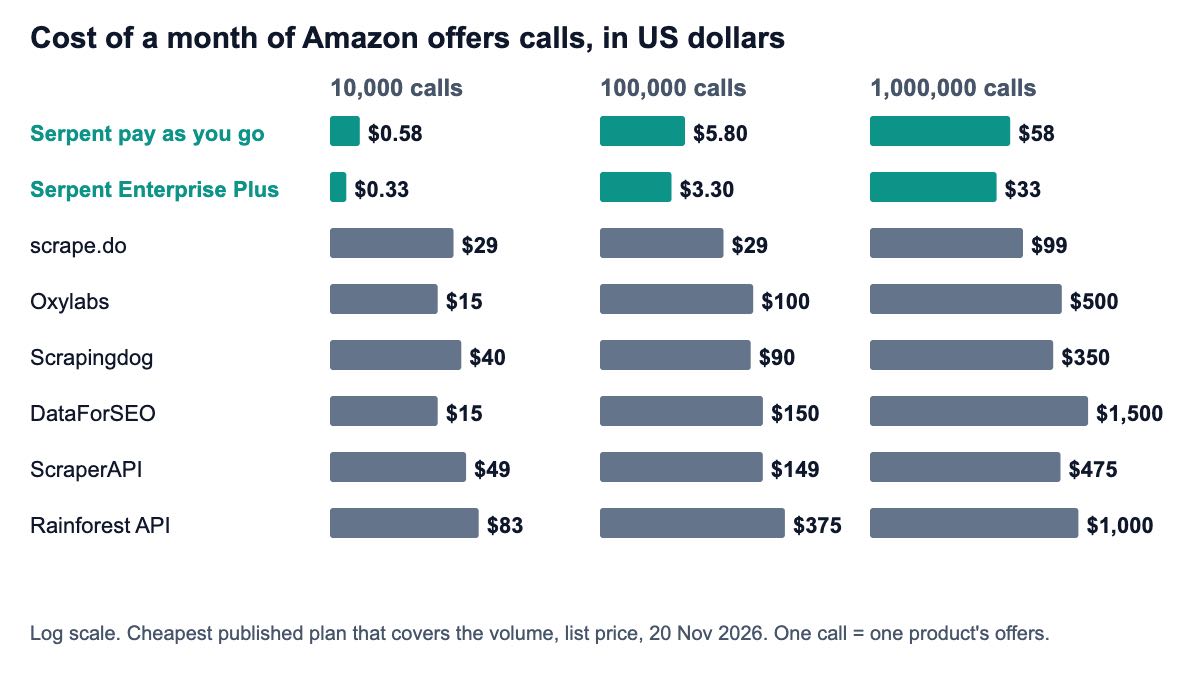
What does a month of offers lookups cost at 10,000, 100,000 and 1,000,000 calls?
At 100,000 lookups a month, Serpent costs between $3.30 and $5.80 depending on tier, while the API providers I could price cost $29 to $375. At a million, Serpent runs $33 to $58 against $99 to $1,500 at the providers that publish a plan that size.
| Provider and plan | 10,000 a month | 100,000 a month | 1,000,000 a month |
|---|---|---|---|
| Serpent API: Pay as you go | $0.58 | $5.80 | $58.00 |
| Serpent API: Growth ($100 deposit) | $0.50 | $5.00 | $50.00 |
| Serpent API: Scale ($500 deposit) | $0.44 | $4.40 | $44.00 |
| Serpent API: Enterprise ($1,000 deposit) | $0.38 | $3.80 | $38.00 |
| Serpent API: Enterprise Plus ($1,250 deposit) | $0.33 | $3.30 | $33.00 |
| scrape.do (1 credit per call) | $29.00 | $29.00 | $99.00 |
| Oxylabs (per result, assumes 1 per call) | $15.00 | $100.00 | $500.00 |
| Scrapingdog (5 credits per call) | $40.00 | $90.00 | $350.00 |
| DataForSEO (standard queue, per task) | $15.00 | $150.00 | $1,500.00 |
| ScraperAPI (5 credits per call) | $49.00 | $149.00 | $475.00 |
| Rainforest API (1 credit per call, annual billing) | $83.00 | $375.00 | $1,000.00 |
| HasData (15 credits per call) | $49.00 | $208.00 | Unverified |
| ScrapingBee (5 credits per call) | $19.00 | Unverified | Unverified |
| Keepa (7 tokens per call, in euros, third-party prices) | EUR 49 | EUR 49 | EUR 459 (unverified) |
| Apify junglee, best tier (10 offers per call; Apify plan fee not included) | $48.00 | $480.00 | $4,800.00 |
The rule behind each cell is the cheapest published plan or per-use rate that covers the volume, at list price, before tax, with no free credit subtracted. Here is how each row was built, so you can audit it:
- Serpent API. One call is one page of one product’s offers and one charge, so the cost is the rate times the volume. The size of a deposit sets the rate on that credit. The five rates are $0.058, $0.05, $0.044, $0.038 and $0.033 per 1,000 calls, which is $0.000058 down to $0.000033 per call.
- scrape.do. Its request-cost page lists Amazon at 1 credit, and its pricing page lists Hobby at $29 for 250,000 credits, Pro at $99 for 1,250,000, Business at $249 for 3,500,000 and Advanced at $699 for 10,000,000. Its Amazon documentation describes an offer-listing endpoint with no page parameter, and does not say how many offers one request returns.
- Oxylabs. Its Amazon pricing source returns seller offers, and its pricing page bills Amazon per 1,000 results: $0.50 up to 30,000, $0.45 up to 222,000 and $0.35 up to 1.43 million, on plans from $15. The page does not say whether this source bills per page or per call, so I assumed one result per call.
- Scrapingdog. Its Amazon Offers documentation prices the call at 5 credits. On its pricing page, Lite is $40 for 200,000 credits (40,000 calls), Standard is $90 for 1,000,000 (200,000 calls) and Premium is $350 for 6,000,000 (1,200,000 calls).
- DataForSEO. Its Amazon pricing page lists the sellers task at $0.0015 on the standard queue, $0.003 priority and $0.0033 live, so $1.50 per 1,000 tasks, with no volume table. Its documentation does not name a buy-box or fulfilment field.
- ScraperAPI. Amazon costs 5 credits per its credit table; the offers endpoint’s own cost is not stated. Hobby is $49 for 100,000 credits, Startup $149 for 1,000,000 and Scaling $475 for 5,000,000, per its pricing page.
- Rainforest API. A standard offers request is 1 credit. The pricing page shows annual-billed prices: Starter $83 for 10,000 credits, Production $375 for 250,000 and BigData $1,000 for 1,000,000. Monthly billing costs more.
- HasData. Other sellers come from a flag on its product endpoint: 10 credits for the product plus 5 for the sellers. Startup is $49 for 200,000 credits and Growth $208 for 3,000,000, per its Amazon API page. A million calls needs 15 million credits, above any plan listed, so that cell is unverified.
- ScrapingBee. Its Amazon offers page lists 5 credits for a light call, Hobby at $19 for 75,000 credits and large plans up to $5,799 for 120 million. I did not capture the plans in between, so the two larger volumes are unverified.
- Keepa. Keepa’s own price page needs JavaScript, so these figures come from a third-party summary updated 22 July 2026 and a token guide: 1 token for the product plus 6 for each page of 10 offers, so 7 per call. Starter is EUR 49 for 892,800 tokens a month; 7,000,000 tokens fits the Developer plan at EUR 459 for 11,160,000.
- Apify junglee. The actor bills a small fee per product plus a fee per offer. At 10 offers that is $30.00 per 1,000 products on the free Apify tier and $4.80 on the best tier, so $48, $480 and $4,800 at the three volumes. Apify plan fees are not in the cell.
Here is what the table does not say. At 10,000 lookups a month, a $1,250 Enterprise Plus deposit would take a long time to spend, so the honest Serpent number at that volume is the pay-as-you-go row. The deposit tiers earn their keep when you spend the deposit in a reasonable time. The pricing page shows how deposit size sets the rate.
Why is one call not always one credit, and what counts as an offer?
Because credits, tokens and offers are not calls. General scraping APIs meter everything in credits and charge several for an Amazon offers call, so a headline credit price understates the real cost by a factor of 5 or 15. Apify sellers go the other way and bill every offer, so one product with 10 offers is 10 charges plus a product fee.
Scrapingdog, ScrapingBee and ScraperAPI say 5 credits, HasData says 15, and Keepa’s tokens come to 7 per product with up to 10 offers and 13 for 11 to 20. scrape.do and Rainforest charge 1 credit. Serpent works like a plain request: one call, one page of a product’s offers (11 on page 1, 10 on each later page), one charge.
The number of offers per call is the hidden variable, and it changes what a fair ruler is. Serpent returns the featured offer and the first 10 others on page 1, then 10 per page after, up to 20 pages. In Serpent's own fixed-set check, a call for PC parts returned a median of 3 offers and a call for books a median of 7.5, because most products simply have few sellers. Divide the call price by the offers you actually get and the per-offer price moves: $0.058 per 1,000 calls is about $0.019 per 1,000 offers at 3 offers a call and $0.0053 at a full first page of 11. The Apify actor’s best-tier offer fee is $0.0004 each, which is $0.40 per 1,000 offers.
| Provider | What counts as one unit | Cheapest paid plan, per 1,000 | Best published plan, per 1,000 | Free allowance |
|---|---|---|---|---|
| Serpent API | 1 call, 11 offers on page 1, 10 per page after | $0.058 (pay as you go) | $0.033 (Enterprise Plus) | 10 free API calls |
| scrape.do | 1 credit per call | $0.116 (Hobby, $29) | $0.0699 (Advanced, $699) | 1,000 credits |
| Scrapingdog | 5 credits per call | $1.00 (Lite, $40) | $0.136 (Nova Pro, $30,000) | 100 credits, which is 20 calls |
| ScrapingBee | 5 credits per call | $1.27 (Hobby, $19) | $0.242 (Enterprise 120M, $5,799) | Not captured |
| Oxylabs | 1 result | $0.50 (Starter, $15) | $0.25 (Enterprise, from $2,500); rate unverified | $5 welcome credit |
| ScraperAPI | 5 credits per call | $2.45 (Hobby, $49) | $0.459 (Advanced, $1,975) | Not captured |
| Rainforest API | 1 credit per call | $46.00 (Hobbyist, $23); $8.30 on Starter | $0.45 (Volume, $9,000, annual) | Not captured |
| HasData | 15 credits per call | $3.68 (Startup, $49) | $1.04 (Growth, $208) | Not captured |
| DataForSEO | 1 task | $1.50 (standard queue) | $1.50 (no volume table) | Not captured |
| Keepa (EUR, third-party prices) | 7 tokens per call | EUR 0.384 (Starter, EUR 49) | EUR 0.174 (Enterprise, EUR 11,099); unverified | Not captured |
| Apify junglee/amazon-crawler | 1 product plus each offer | $30.00 (free Apify tier, 10 offers) | $4.80 (best tier, 10 offers) | Apify free-plan credit |
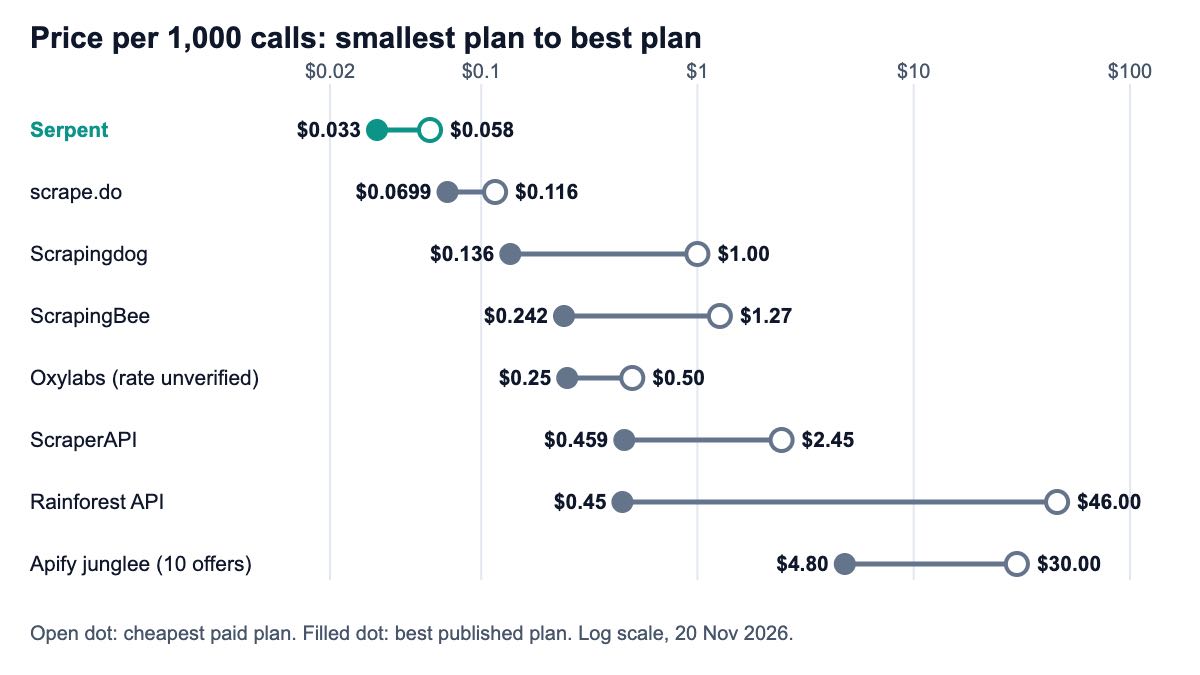
Look at the length of each line in the chart. Scrapingdog’s price falls from $1.00 to $0.136 per 1,000 calls, but you only reach the low end on a $30,000-a-month plan built for hundreds of millions of calls. The realistic comparison for most teams is the open dot on the left of each line. Serpent’s open dot sits at $0.058, half of scrape.do’s $0.116, and its filled dot at $0.033 is about 2.1 times below scrape.do’s best published $0.0699.
I would not decide on that alone. A cheaper call is worth little if the call does not return what you need, so read the sections on what you get and on picking before you do.
What does it cost at 2.5 million calls a month?
At 2.5 million calls a month, which is about one product a second around the clock, Serpent costs $82.50 on its highest tier and $145 at the pay-as-you-go rate, while the cheapest rival plan that fits is $249 at scrape.do. A volume that size is where a deposit tier is easy to justify, and where the unit matters most.
| Provider and plan | Per month | Per 1,000 calls | How it was worked out |
|---|---|---|---|
| Serpent API: Enterprise Plus | $82.50 | $0.033 | 2,500 x $0.033 |
| Serpent API: Pay as you go | $145.00 | $0.058 | 2,500 x $0.058 |
| scrape.do: Business | $249 | $0.0996 | 3,500,000 credits cover 2,500,000 calls |
| Keepa (third-party prices, unverified) | Not published at this volume | Not published at this volume | Keepa’s plans are sold by tokens per minute; no published plan at this volume was captured |
| ScrapingBee: Enterprise 14 | $999 | $0.40 | 14,000,000 credits cover 2,800,000 calls at 5 credits |
| Scrapingdog: Business Plus | $1,000 | $0.40 | 19,000,000 credits cover 3,800,000 calls at 5 credits; about $833 billed annually |
| ScraperAPI: Advanced | $1,975 | $0.79 | 21,500,000 credits cover 4,300,000 calls at 5 credits |
| Rainforest API: ScaleUp | $2,200 | $0.88 | 2,500,000 credits, annual billing |
| Oxylabs: Enterprise floor | $2,500 | $1.00 | Published floor; no lower rate published at this volume |
| DataForSEO: standard queue | $3,750 | $1.50 | 2,500 x $1.50 |
Two cautions on that table. First, the rivals’ plans are sized in credits, so each one has headroom Serpent’s per-call billing does not: you pay for 3.5 million credits at scrape.do to cover 2.5 million calls. Second, scrape.do and Scrapingdog document no page parameter and no offers-per-call count, so a job that needs more than the first page of offers may need several of their calls per product, which multiplies the bill. I could not test that, so it stays unverified.
If you are weighing a build at this volume, the cost of the data call is the small part. Plan the schedule too: Amazon offers data for repricing works out what a watch list of a few thousand products costs per month at each tier.
What is the catch with the Apify actors and the small sellers?
The other low numbers come from Apify, a marketplace where independent developers publish scrapers as “actors”. Each actor sets its own price and units, and almost all bill per offer, so read the actor page before you build on one. I pulled the store’s public listing on 20 November 2026 and priced the actors that mention offers or buy boxes.
| Actor | Billed unit | Per 1,000 products at 10 offers | Users, last 30 days |
|---|---|---|---|
| junglee/amazon-crawler | Result, plus each offer and each seller | $30.00 (free tier) to $4.80 (best tier) | 3,763 |
| radeance/keepa-scraper | Product, plus an offers add-on | About $8.00 to $5.00 if one add-on per product (unit unverified) | 108 |
| memo23/amazon-search | Product row, plus $0.001 per offer | $11.00 to $10.30 | 56 |
| clearpath/amazon-buybox-api | $2.99 per 1,000 offers | About $29.90 | 16 |
| axesso_data/amazon-product-offers-scraper | Per offer | $100.00 (free tier) to $3.50 (Bronze and above) | 21 |
| easyparser/amazon-product-offers | 1 credit per page of about 10 offers | About $2.00; about $1.00 with your own key | 8 |
| scrape.badger/amazon-product-scraper | Per offer plus a product fee | About $4.15 | 10 |
| ilborso/amazon-product-finder | Per offer-listing plus an item fee | About $2.49 | 2 |
Three things stand out.
First, the unit. Every actor bills an offer or a product row, so the headline price is per offer, and the cost of one product depends on how many sellers it has. For a book with ten sellers the best-tier junglee price is $4.80 per 1,000 products; for a graphics card with three sellers it is about $2.00, still more than thirty times Serpent’s $0.058.
Second, the cheapest rows belong to the smallest sellers. The sellers under 50 users in the last 30 days (clearpath, axesso, easyparser, scrape.badger, ilborso and others) are not counted in the lowest-price claim at the top of this post, which ignores sellers under 50 users and any time-limited promotion. They are named here so you can judge them yourself. Even the cheapest of them, easyparser at about $1.00 per 1,000 pages with your own key, is above Serpent’s $0.058 by a factor of about 17, and its price is unverified.
Third, the bill is more than the price. An actor’s cheapest tier usually needs a paid Apify plan, the cost of that plan is not in these cells, and the mapping of the store’s tier names to Apify’s plan names is not stated in the data I read. A real Apify bill may sit above the numbers here. A marketplace actor is fine for a one-off research run. For a service that has to answer within a few seconds, an API with one request per product is easier to fit.
Promotions deserve a mention for completeness. Scrapingdog’s page carried a Black Friday code for 15 percent off, and Bright Data’s pages carried codes worth up to 60 percent for a few months. I left both out of every cell. A 15 percent discount takes Scrapingdog’s best rate from $0.136 to about $0.116, which is still above Serpent’s highest-tier $0.033 and pay-as-you-go $0.058.
What do you get for the money?
With Serpent, one GET request to /api/amazon/offers returns a page of the offers on a product: its title, image, rating, the number of offers in total, the next page number and the offers themselves, 11 on page 1 and 10 per page after, up to 20 pages. Each offer carries its condition as a code and as Amazon shows it, the seller’s own condition note, price and shipping as numbers, the delivery estimate, ships-from and sold-by names, the seller id, whether Amazon sells or ships it, the seller’s rating and positive share, and the most units an order can take. The Amazon Offers API page lists every field and the docs explain each parameter.
You send asin and, if you want another marketplace, domain. It works in 10 marketplaces: amazon.com, .co.uk, .de, .fr, .co.jp, .ca, .it, .es, .com.mx and .com.br. Books work with their ISBN-10.
On a fixed set of products chosen before measuring, spread over PC parts, electronics and books, 243 offers came back from all 10 marketplaces. Every one had a condition, a price, a seller name and a ships-from name; 225 had a delivery estimate and shipping, 211 a seller id and 202 a seller rating. The median answered call took 3.8 seconds and 9 in 10 finished within 11.1. A product with no offers is a real answer and is billed; a call we could not complete is never billed.
Other vendors do more in places, and if you need these features you should price those vendors instead of the cheapest row:
- Rainforest API documents filters for each condition, on top of its
pageandmax_pageparameters. - Keepa sells price history, which is a different product altogether.
- Scrapingdog and scrape.do document the seller rating, fulfilment flag and buy-box winner on each offer, like Serpent.
If your job needs the featured offer and the competing offers, page by page, across ten marketplaces, with prices, conditions and seller ratings, the extras are cost you do not need to pay. For the code-level view see how to scrape Amazon offers with Python and Node, and for a worked use case see Amazon offers data for repricing.
Which free allowances are worth using?
For a prototype, any of them. Serpent gives a new account 10 free API calls, which is 10 products. scrape.do gives 1,000 credits, which is 1,000 offers calls. Scrapingdog gives 100 credits, which is only 20 offers calls at 5 credits each. Oxylabs gives a $5 welcome credit. Apify’s actors draw on its free plan’s monthly credit, and I did not research its size.
Free allowances reward careful reading. A vendor that looks generous in credits shrinks once you divide by the credits an offers call uses. Count products, not credits, before you decide which prototype fits in the free allowance, and test the one thing the price page cannot tell you: how many of the offers you need come back on the first call.
If you are choosing for a wider data stack, the same Serpent key also covers other verticals. See the Amazon Scraper API for the full product record, the eBay Data API and the Google Maps API. For per-1,000 prices in web search, the SERP API pricing comparison applies the same method.
Which one should you pick?
Here are named picks by scenario, on the evidence I have:
- Prototype or a few thousand products a month: Serpent’s pay-as-you-go rate. Ten thousand lookups is $0.58, and you start with 10 free API calls.
- A steady 100,000 lookups a month: Serpent. The pay-as-you-go row is $5.80 and the highest tier is $3.30, against $29 at scrape.do’s smallest plan.
- A million to 2.5 million a month: Serpent Enterprise Plus at $33 per million, $82.50 at 2.5 million. scrape.do’s Business plan is the nearest rival at $249, and it is the cheapest rival I could verify.
- The full list of offers on a product with dozens of sellers, or price history: Rainforest API for paged offers, Keepa for history, after checking each bill. Keepa’s prices here are unverified.
- A one-off research pull where you can live with per-offer billing: an Apify actor, after adding up the product fee and the Apify plan fee.
- You already pay a scraping API for other sites: use its Amazon offers endpoint to keep one bill, but multiply the credit price by its credits per offers call first.
The one situation where I would not choose on price is a product whose users wait on the result. Check hit rate and speed on your own list of products before you commit, which is easy because the playground lets you try a real lookup. The best Amazon scraping API comparison and the guide to ecommerce price intelligence cover the neighbouring decisions.
How we checked this
What I checked. On 20 November 2026 I read each vendor’s own pricing page or documentation, and the Apify store’s public listing through its API. Where a vendor’s page was unavailable, the figure is marked unverified and its source is named. The monthly costs, the per-1,000 conversions and the per-offer figures are my own arithmetic from those prices, shown above so you can repeat it. The research behind the table is dated 20 November 2026.
Serpent’s own numbers. The five Serpent rates are the published rates. The check of 243 offers is a fixed list of products drawn before any call was made, spread over PC parts, electronics and books in all 10 marketplaces, with a median of 3.8 seconds and 11.1 at the 90th percentile for an answered call. This is Serpent’s check of Serpent’s product, so treat it as a vendor claim and try your own list.
What I could not verify:
- Keepa’s own price page needs JavaScript, so its plan prices and the EUR 0.174 to EUR 0.384 range come from third-party pages, and the euro-to-dollar conversion is not done here.
- How many offers one request returns at scrape.do and Scrapingdog, and whether either has a way to page. Both documentation pages are silent.
- Whether Oxylabs bills its Amazon pricing source per call or per page, and whether ScraperAPI’s offers endpoint costs the general 5 credits for Amazon.
- The ScrapingBee and HasData cells at larger volumes, and every free allowance marked “not captured”.
- Apify plan fees, the size of its free credit and the mapping from store tiers to plan names. User counts drift by a few users from day to day.
- That a typical Serpent call returns a given number of offers is the result of our own fixed-set check, not a promise for every product; many products have only one or two sellers.
Prices change often, so re-check any vendor within a week of buying. Serpent is not affiliated with or endorsed by Amazon or any vendor named here.
Price your own volume
Serpent’s Amazon Offers API is from $0.033 per 1,000 calls — pay as you go, no subscription, with 10 free API calls to start. Try a real product in the playground before you write any code.
Get Your Free API KeyExplore: Amazon Offers API · Playground · Docs · Pricing
FAQ
What is the cheapest Amazon offers API?
On public prices checked on 20 November 2026, Serpent API has the lowest standing price of any Amazon offers API I could find: $0.033 per 1,000 calls on its highest tier, about 2.1 times below the next lowest published rate ($0.0699 at scrape.do), and $0.058 pay as you go, half the lowest entry price of any API provider (scrape.do's $0.116). Among the other providers I could price, entry prices run from $0.116 per 1,000 calls at scrape.do to $46.00 at Rainforest API.
How much does it cost to get the offers on 1,000 Amazon products?
On Serpent, 1,000 calls is the first page of offers for 1,000 products, so it costs $0.058 at the pay-as-you-go rate and $0.033 at the highest tier, whatever number of offers each call returns. At scrape.do, which charges 1 credit per call, it is $0.116 on its smallest plan and $0.0699 on its largest. At Scrapingdog, which charges 5 credits per call, it is $1.00 on the smallest plan and $0.136 on the largest.
Is there a free Amazon offers API?
Several services have free allowances: 10 free API calls at Serpent, 1,000 credits at scrape.do (1,000 offers calls), 100 credits at Scrapingdog (20 offers calls at 5 credits each) and a $5 welcome credit at Oxylabs. Free allowances are meant for testing a prototype. A real price-monitoring job outgrows them within a day, so compare the paid rates as well.
Why do some APIs charge 5 or 15 credits for an offers call?
They are general scraping APIs that meter every call in credits, and an Amazon offers call is one of many products on the same meter. Scrapingdog, ScrapingBee and ScraperAPI use 5 credits for an Amazon call, and HasData uses 15 for a product with its other sellers. A plan's credit count is therefore five to fifteen times its call count, so convert to a price per call before you compare.
Are the Apify actors cheaper?
Not in the ones I could price. The most-used actor, junglee/amazon-crawler, bills per offer plus a small fee per product, which comes to about $30.00 per 1,000 products at 10 offers each on the free Apify tier and $4.80 on its best tier. The cheapest small seller I found, easyparser, is about $2.00 per 1,000 pages, and about $1.00 with your own key. All of them sit above Serpent's $0.058.
Is Keepa cheaper than an offers API?
Keepa is a different product with a different bill. It sells price history and prices its API in tokens: about 7 tokens for a product with up to 10 offers. Third-party price pages put that at EUR 0.384 per 1,000 products on its EUR 49 plan and EUR 0.174 on its largest plan. Keepa's own price page needs JavaScript, so treat those figures as unverified and check them in your own account.
How often do Amazon offers API prices change?
Often enough to matter. Several of the pages I read carried promotions: a Black Friday code at Scrapingdog, codes at Bright Data and limited-time bonus credits on ScraperAPI's two largest plans. Treat any price in a comparison, including this one, as a snapshot taken on 20 November 2026, and open the vendor's pricing page within a week of buying.
Sources
API provider pricing and documentation (checked 20 Nov 2026):
- scrape.do pricing
- scrape.do Amazon API documentation
- scrape.do request costs
- scrape.do Amazon scraper API
- Scrapingdog Amazon Offers API documentation
- Scrapingdog pricing
- Oxylabs Amazon pricing source
- Oxylabs Web Scraper API pricing
- DataForSEO Amazon API pricing
- ScraperAPI pricing
- ScraperAPI credit costs
- ScraperAPI Amazon offers documentation
- Rainforest API pricing (Traject Data)
- Rainforest API offers parameters
- HasData Amazon API
- ScrapingBee Amazon offers API
- SerpApi Amazon product prices
- SerpApi pricing
- Bright Data Amazon scrapers
Keepa, through third-party pages (Keepa’s own page needs JavaScript):
Apify store listings (checked 20 Nov 2026):