Cheapest AliExpress API in 2026
On public prices read on 22 November 2026, Serpent API has the lowest standing price of any AliExpress API I could find that returns the results as parsed data: $0.24 per 1,000 calls on its highest tier, about 3.1 times below the next lowest published rate ($0.75 per 1,000 searches at ScrapeBadger), and $0.37 pay as you go, half of ScrapeBadger’s pay-as-you-go rate and about 11 times below SearchAPI.io’s $4.00 entry price. No subscription. One call returns up to 60 products with price, rating, units sold and shipping.
Short answer: For a prototype or a few thousand searches a month, use Serpent’s pay-as-you-go rate of $0.37 per 1,000 calls; the deposit tiers pay off once you spend the deposit. At 100,000 to 1,000,000 searches a month, the higher tiers take a million searches from $370 down to $240. If you only want a page of HTML to parse yourself, a page-fetch service can be cheaper at very large volume, and the section on those shows where. An Apify actor can fit a one-off crawl where you can live with per-product billing.
Pricing an AliExpress data API is harder than it looks, because the vendors do not sell the same thing. Some sell a search that returns a page of products. Others bill every product they hand back, a few count credits or “records” without saying what one of those is, and some sell the raw page and leave the reading to you. A price per 1,000 means four different things on four different pages.
So I took every public price I could find on 22 November 2026 and put it on two rulers: dollars per 1,000 search calls and dollars per 1,000 products returned. Where a vendor does not publish enough to do the sum, the cell says “unverified” rather than a guess. Each rate links to the page it came from. If you also want the do-it-yourself side, see how to scrape AliExpress with Python and Node.
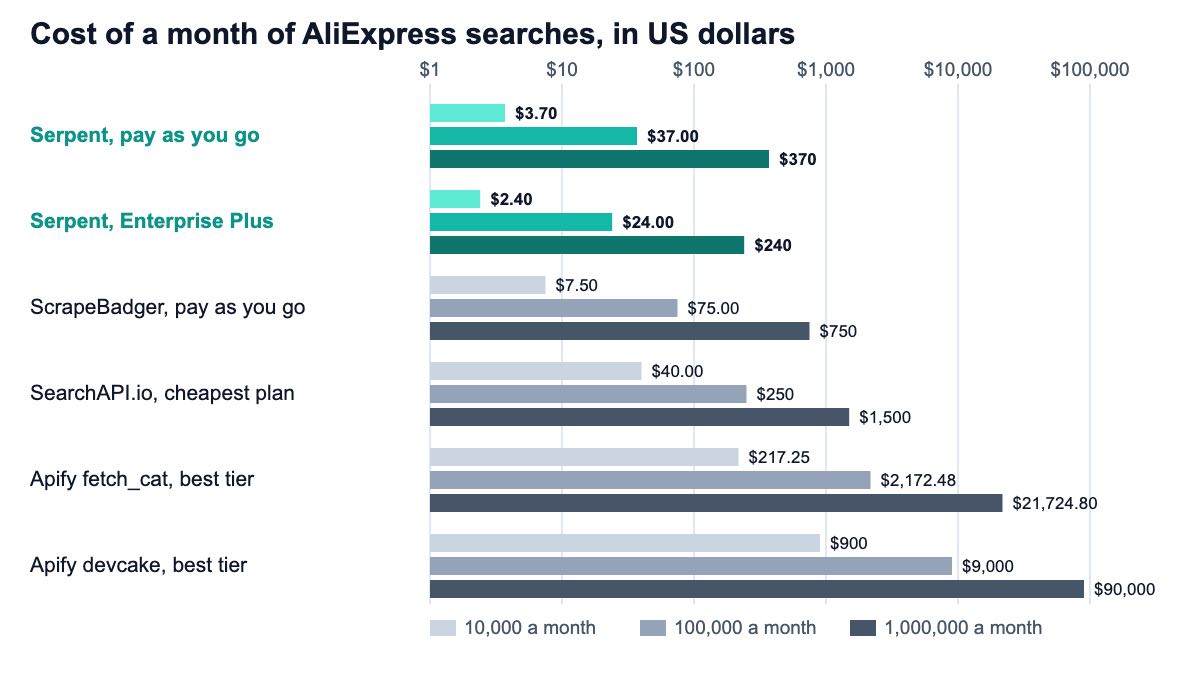
What does an AliExpress search cost at 10,000, 100,000 and 1,000,000 a month?
At 100,000 searches a month, Serpent costs between $24 and $37 depending on tier, while the structured-data providers I could price cost $75 to $250. At a million, Serpent runs $240 to $370 against $750 to $1,500 at the providers that publish a plan that size.
| Provider and plan | 10,000 a month | 100,000 a month | 1,000,000 a month |
|---|---|---|---|
| Serpent API: Pay as you go | $3.70 | $37.00 | $370.00 |
| Serpent API: Growth ($100 deposit) | $3.30 | $33.00 | $330.00 |
| Serpent API: Scale ($500 deposit) | $3.00 | $30.00 | $300.00 |
| Serpent API: Enterprise ($1,000 deposit) | $2.70 | $27.00 | $270.00 |
| Serpent API: Enterprise Plus ($1,250 deposit) | $2.40 | $24.00 | $240.00 |
| ScrapeBadger (pay as you go, assumes the same rate at every volume) | $7.50 | $75.00 | $750.00 |
| SearchAPI.io (assumes 1 search per request) | $40.00 | $250.00 | $1,500.00 |
| Apify fetch_cat, best tier, price from 27 Nov (60 products per search, product fee only) | $217.25 | $2,172.48 | $21,724.80 |
| Apify devcake, best tier (60 products per search, product fee only) | $900.00 | $9,000.00 | $90,000.00 |
The rule behind each cell is the cheapest published plan or per-use rate that covers the volume, at list price, before tax, with no free credit subtracted. Here is how each row was built, so you can audit it:
- Serpent API. One call is one search and one charge, so the cost is the rate times the volume. The size of a deposit sets the rate on that credit. The five rates are $0.37, $0.33, $0.30, $0.27 and $0.24 per 1,000 calls, which is $0.00037 down to $0.00024 per call.
- ScrapeBadger. Its AliExpress page prices a search at 5 credits, and its pricing page sells pay as you go at $0.15 per 1,000 credits, which is $0.75 per 1,000 searches, with a $10 minimum top-up. It says failed requests and empty result sets are not charged. Monthly subscriptions “from $49” are listed without prices or credit counts, so the cells assume the pay-as-you-go rate at every volume.
- SearchAPI.io. Plans are priced per successful search: Developer is $40 for 10,000, BigData is $250 for 100,000 and Octo 1M is $1,500. Its AliExpress documentation says each page returns up to 60 products and does not state a credit cost beyond the per-search price, so the cells assume one search per request.
- Apify fetch_cat. The seller bills per product saved, plus $0.005 each time a run starts. Its store record gives $0.575 per 1,000 products on the free tier and $0.14 on the top tier today, rising on 27 November to $0.694 and $0.362. The cells use the post-27-November top tier and 60 products per search, and leave out the start fee and the Apify plan fee.
- Apify devcake. $0.0015 per product on the Gold tier and above, $0.002 on the free tier, plus a small start fee per run. Same 60-product assumption.
Here is what the table does not say. At 10,000 searches a month, a $1,250 Enterprise Plus deposit would take a long time to spend, so the honest Serpent number at that volume is the pay-as-you-go row. The deposit tiers earn their keep when you spend the deposit within a reasonable time. The pricing page lists every tier and its deposit, and the SERP API pricing comparison shows how the same ladder works for web search.
Why is a request not always one charge, and what is a product worth?
Because credits, pages and products are not requests. Credit-based services meter everything on one scale and charge several credits for an AliExpress search, so a headline credit price understates the real cost by a factor of 5 or more. Apify sellers go the other way and bill every product, so one search that returns 60 products is 60 charges.
ScrapeBadger says 5 credits per search and SocialCrawl says 5 credits per call on its advanced tier. Bright Data prices a “record” at $1.50 per 1,000 on pay as you go and $1.30 on its Scale plan, and its AliExpress page lists scrapers that take a product link or a category link; it shows no keyword search, so a search page has no price there. A record can also be one variant of a product rather than one product, which I could not confirm.
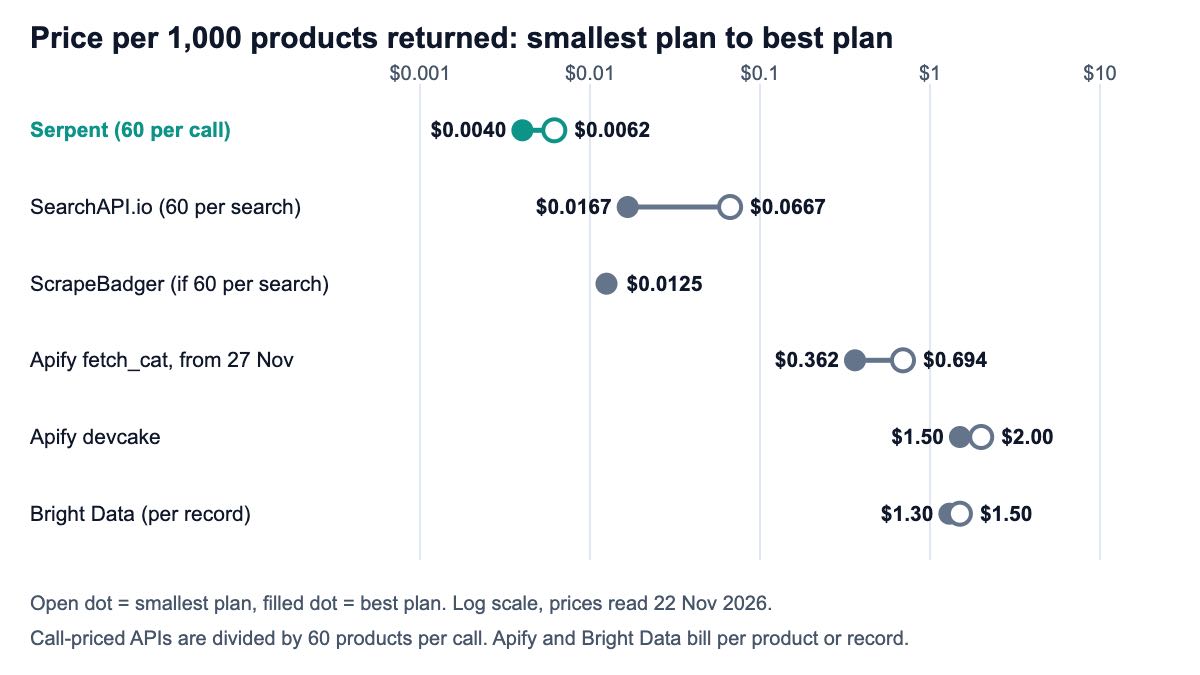
To compare a per-search price with a per-product price, put them on the same ruler. SearchAPI.io documents up to 60 products a page, and 60 is the median number Serpent returned on a fixed set of 75 searches, so dividing the search price by 60 gives a fair per-product figure for both. Serpent’s $0.37 per 1,000 calls is about $0.0062 per 1,000 products, and its top tier is $0.0040. SocialCrawl is the odd one out: its default page holds 10 products and its maximum is 50, so its per-product price depends on a setting you choose.
| Provider | What counts as one unit | Smallest plan, per 1,000 units | Best published plan, per 1,000 units | Free tier |
|---|---|---|---|---|
| Serpent API | 1 call, up to 60 products | $0.37 per 1,000 calls (about $0.0062 per 1,000 products) | $0.24 ($0.0040 per 1,000 products) | 10 free API calls |
| ScrapeBadger | 5 credits per search; products per search not stated | $0.75 (pay as you go); $0.0125 per 1,000 products if a search returns 60 | Not published | Not captured |
| SearchAPI.io | 1 search, up to 60 products (assumed) | $4.00 (Developer, $40, 10,000 searches); about $0.0667 per 1,000 products | $1.00 (Octo 5M, $5,000); about $0.0167 per 1,000 products | 100 requests |
| SocialCrawl | 5 credits per search, 10 to 50 products | £30.00 (Starter, £15 for 2,500 credits); £0.60 per 1,000 products at 50 a page | About £9.97 (Pro, £299 for 150,000 credits); about £0.20 at 50 a page | 100 credits |
| Bright Data | 1 record, not defined | $1.50 (pay as you go) | $1.30 (Scale, $499, 384,000 records) | 5,000 records a month |
| Apify fetch_cat | 1 product, plus $0.005 per run | $0.694 from 27 Nov ($0.575 until then) | $0.362 from 27 Nov ($0.14 until then) | Apify free-plan credit |
| Apify devcake | 1 product, plus a start fee | $2.00 | $1.50 | Apify free-plan credit |
Look at the length of each line in the chart. SearchAPI.io’s price falls from $0.0667 to $0.0167 per 1,000 products, but you only reach the low end with a $5,000-a-month plan, which very few teams need. The realistic comparison for most is the open dot on the left of each line, and there the pay-as-you-go rate here is about eleven times below SearchAPI.io’s $4.00 per 1,000 searches.
I would not decide on that alone. A cheaper price per product is worth little if the products are not the ones you need, so read the next three sections before you do.
What is the catch with the Apify actors?
The other low numbers come from Apify, a marketplace where independent developers publish scrapers as “actors”. Each actor sets its own price and units, and many bill a start fee per run, so read the actor page before you build on one. AliExpress is crowded there: 422 actors turned up on a search of the store, and the table lists the eight keyword-search ones with at least 50 users in the last 30 days.
| Actor | Billed unit | Price per 1,000 products | Users, last 30 days |
|---|---|---|---|
| pro100chok/aliexpress-scraper | Product listed | $2.00 (free tier) to $1.50 | 881 |
| zen-studio/aliexpress-scraper | Product, plus $0.05 per run | $2.49 to $1.99 | 525 |
| kawsar/aliexpress-search-scraper | Result | $9.00 to $6.00 | 332 |
| thirdwatch/aliexpress-product-scraper | Result | $3.00 to $1.80 | 240 |
| devcake/aliexpress-products-scraper | Product, plus a small start fee | $2.00 to $1.50 | 211 |
| piotrv1001/aliexpress-listings-scraper | Product, flat | $2.50 | 186 |
| fetch_cat/aliexpress-products-scraper | Product, plus $0.005 per run | $0.575 to $0.14 now; $0.694 to $0.362 from 27 Nov | 157 |
| khadinakbar/aliexpress-all-in-one-scraper | Result, flat; Apify platform usage billed on top | $2.00 | 87 |
Three things stand out.
First, the unit. Every actor bills a product or a result, so the price you see is per product. On the 60-product ruler, fetch_cat’s top tier from 27 November is about $21.72 per 1,000 searches, against $0.37 on Serpent’s pay-as-you-go rate and $0.24 on its top tier. fetch_cat’s own page says it will cost $0.69 per 1,000 products on the free plan from that date, and its price history shows four versions since June, so treat any figure here as a snapshot.
Second, the cheapest rows belong to the smallest sellers. Actors with fewer than 50 users in the last 30 days are not counted in the lowest-price claim at the top of this post, which follows the same rule as every comparison I publish, but they are worth naming: darknezz/aliexpress-products-scraper lists $0.01 per 1,000 products with 1 user, atlasdataworks/aliexpress-search-scraper $0.05 with 1, rel8ble/aliexpress-search-scraper $0.10 with 3, zaiq/aliexpress-scraper $0.12 to $0.096 with 1, and nice_dev/aliexpress-products-scraper $0.39 to $0.19 with 6. Even the lowest of those is above $0.0062 per 1,000 products, though a listing with one user tells you little about whether it works.
Third, the bill is more than the price. The cheapest tier on an actor usually needs a paid Apify plan, I did not research the cost of that plan, and the mapping of the store’s tier names to Apify’s plan names is not stated in the data I read. khadinakbar’s record says the Apify platform usage is billed to you on top of its $2.00. A real Apify bill may sit above the numbers here. A marketplace actor also depends on one developer, so a price or a feature can change overnight.
Are the services that return a raw page cheaper?
Some are, at very large volume, and the comparison needs care because they sell something else. A page-fetch service returns the AliExpress results page as HTML for your own code to read, so the price covers the download and nothing after it. You write the parser, keep it working when the page changes, and turn text such as “10,000+ sold” into a number.
| Service | What it returns | Entry, per 1,000 | Volume, per 1,000 | Notes |
|---|---|---|---|---|
| Oxylabs Web API | Raw HTML, or its own parser | $0.50 (Starter $15 a month, up to 10,000 results) | $0.25 at 10 million and up | An “Aliexpress: Search” target is listed; the page does not map it to this rate |
| Decodo Web Scraping API | HTML | About $0.50 ($19 a month, 38,000 pages) | About $0.15 ($1,499 a month, 9.9 million pages) | A search snippet quoted a lower plan the page did not show |
| ScrapingBee | Page, credits per request | $1.27 for a 5-credit call on Hobby ($19, 75,000 credits) | $0.24 for a 5-credit call on its largest plan | Credits for an AliExpress search not stated |
| ScraperAPI | Page, credits per request | Hobby $49 for 100,000 credits | About $0.092 per 1,000 credits at the top plan | Credits for an AliExpress call not stated |
| Zyte API | Page | $0.13 to $1.27 per 1,000 requests, general price | Not captured | Seen in a search snippet only; unverified for AliExpress |
On the figures that are clear, the picture is mixed. Oxylabs’ entry rate of $0.50 per 1,000 is above Serpent’s $0.37 pay-as-you-go rate, and at 10 million results a month its $0.25 sits close to Serpent’s top tier of $0.24. Decodo’s largest published plan works out to about $0.15 per 1,000 pages, which is lower than $0.24, but it needs a $1,499-a-month plan of 9.9 million pages and hands you HTML.
So the claim at the top of this post is deliberately narrow: lowest standing price among APIs that return parsed AliExpress search results. If you already run a parser and fetch tens of millions of pages a month, price those services too. If you want products as fields on the first call, they are not the same purchase.
What do you get for the money?
With Serpent, one GET request to /api/aliexpress/search returns AliExpress products for a search: the search text, the page and sort that were applied, how many products AliExpress says match, the currency, and up to 60 products. Each product carries its position, id and link, title, main image and photo gallery, the price as shown and as a number, the struck-through price and discount when the card shows one, a new-shopper label when there is one, the star rating, units sold as text and as a number, a free-shipping flag, the delivery estimate, card labels such as Top selling, and a flag for sponsored rows.
You send q as you would type it on AliExpress, in any language, and optionally page (1 to 60) and sort (best_match, orders, price_asc or price_desc). Prices are in US dollars and match what a first-time shopper in the United States sees on the search page, including new-shopper deals, which the label marks. Pages after the first can reorder between calls, and sorted pages carry no sponsored rows.
On a fixed set of 75 searches, 45 in English and 30 in six other languages, 73 returned products, 68 of them a full 60. The median call took 3.0 seconds and 9 in 10 finished within 3.7. A call that returns no products is not billed.
Other vendors do more, and if you need these features you should price those vendors instead of the cheapest row:
- piotrv1001’s product-details actor on Apify reads a single product page at a flat $8.00 per 1,000 products, with 1,234 users in the last 30 days.
- Image-search actors on Apify, such as piotrv1001/aliexpress-image-search-scraper, search by picture rather than by keyword.
- kestrel/aliexpress-reviews-scraper on Apify collects reviews, from $0.003 per review on the free tier.
If your project mostly needs the search results as data, with prices, ratings and sales, the extras are cost you do not need to pay. For the code-level view see how to scrape AliExpress with Python and Node, and for a worked use case see AliExpress data for dropshipping product research.
Which free tiers are worth using?
For a prototype, any of them. Serpent gives a new account 10 free API calls, which is 10 searches and up to 600 products. SearchAPI.io gives 100 requests at signup, SocialCrawl gives 100 credits, which is 20 searches at 5 credits each, and Bright Data lists 5,000 records a month. Apify actors run on the free credit of an Apify account, which I did not size.
Free tiers reward careful reading. A pool of credits looks generous until you divide by the credits one AliExpress search uses. Count searches, not credits, before you decide which prototype fits in the free allowance.
If you are choosing for a wider data stack, the same key also covers other verticals. See the Amazon Scraper API, the eBay Data API and the Shopping API. For marketplace pricing elsewhere, the best Amazon scraping API comparison and eBay API price per record use the same two-ruler method.
Which one should you pick?
Here are named picks by scenario, on the evidence I have:
- Prototype or a few thousand searches a month: Serpent’s pay-as-you-go rate. Ten thousand searches is $3.70, and you start with 10 free API calls.
- A steady 100,000 searches a month: Serpent. The pay-as-you-go row is $37 and the highest tier is $24, against $75 at ScrapeBadger’s pay-as-you-go rate and $250 on SearchAPI.io’s BigData plan.
- A million a month or more, as parsed fields: Serpent Enterprise Plus at $240 per million. SearchAPI.io’s Octo 1M plan is $1,500 for the same count.
- Tens of millions of pages a month and a parser of your own: a page-fetch service such as Decodo or Oxylabs, after confirming the AliExpress rate with the vendor.
- Product detail pages, reviews or search by image: an Apify actor built for that job, after reading the page.
- A one-off research pull where you can live with per-product billing: an Apify actor, after adding up the start fee and the plan fee.
The one situation where I would not choose on price is a product whose users wait on the result. Check hit rate and speed on your own list of searches before you commit, which is easy because the playground lets you try a real search. The best SERP API comparison covers the same question for web search.
How we checked this
What I checked. On 22 November 2026 the vendors’ own pricing pages and documentation and the Apify store’s public listing were read for this comparison, and the rows were put on the two rulers above. Apify user counts are the store’s own figure for the last 30 days and drift daily. No account was opened at any vendor, and no vendor’s service was used.
Serpent’s own numbers. The five Serpent rates are the published rates. The 75-search check is a fixed list drawn before any search was made: 73 searches returned products, 68 a full 60, with a median of 3.0 seconds and 3.7 at the 90th percentile. It is the vendor’s own result, so test it against your own list of searches.
What I could not verify:
- SearchAPI.io does not state a credit cost per search or whether a second page costs a second search, so its rows assume one search per request and up to 60 products. If it charges more, the real number is higher than mine.
- ScrapeBadger’s products per search and its subscription prices; its $0.0125 per 1,000 products holds only if a search returns 60.
- Bright Data’s “record” and whether it has a keyword search at all; the Oxylabs, ScrapingBee, ScraperAPI and Zyte rates for an AliExpress search, and the Decodo figure a search snippet quoted that its page did not show.
- SocialCrawl’s pound prices are shown in pounds because I did not convert them; its packs are one-off, not monthly.
- Apify’s plan fees, the size of its free credit, which plan unlocks the top tier, and how many products each actor returns per run.
- That a typical Serpent call returns 60 products is the result of a fixed-set run, not a promise for every search; a call can return fewer.
Prices change often, so re-check any vendor within a week of buying.
Price your own volume
Serpent’s AliExpress Search API is from $0.24 per 1,000 calls — pay as you go, no subscription, with 10 free API calls to start. Try a real keyword in the playground before you write any code.
Get Your Free API KeyExplore: AliExpress API · Playground · Docs · Pricing
FAQ
What is the cheapest AliExpress API?
On public prices read on 22 November 2026, Serpent API has the lowest standing price of any AliExpress API I could find that returns the results as parsed data: $0.24 per 1,000 calls on its highest tier, about 3.1 times below the next lowest published rate ($0.75 per 1,000 searches at ScrapeBadger), and $0.37 pay as you go, half of ScrapeBadger's pay-as-you-go rate and about 11 times below SearchAPI.io's $4.00 entry price. Services that return a raw page for you to read yourself are a different product, and at very large volume a few of them list a lower per-page rate.
How much does it cost to get 1,000 AliExpress products?
One Serpent call returns up to 60 products, so 1,000 products is about 17 calls: roughly $0.006 at the pay-as-you-go rate of $0.37 per 1,000 calls and $0.004 at the highest tier. SearchAPI.io's $4.00 per 1,000 searches works out to about $0.067 per 1,000 products at 60 a page. Apify sellers bill each product, from $0.362 per 1,000 at the best tier of the most affordable actor with at least 50 users to $6.00 at the best tier of the dearest.
Is there a free AliExpress API?
Several services have free tiers: 10 free API calls at Serpent, 100 requests at SearchAPI.io, 100 credits at SocialCrawl (20 searches) and 5,000 records a month at Bright Data. Free tiers are meant for testing a prototype, and the small allowances run out quickly when a search uses 5 credits.
Why do some AliExpress APIs charge 5 credits per search?
They meter every call in credits, and an AliExpress search is one product among many on the same meter. ScrapeBadger's page says 5 credits per search and SocialCrawl's says 5 credits per call on its advanced tier, so a plan's credit count is five times its search count. Convert to searches before you compare, as the tables here do.
Are Apify's AliExpress actors cheaper?
Per product, the best tier of the most affordable actor with at least 50 users is $0.362 per 1,000 products from 27 November, against about $0.0062 per 1,000 products on Serpent's pay-as-you-go rate at 60 products a call. Actors also charge a start fee per run, their best prices need a paid Apify plan, and the plan fee is not in the headline price. They are worth it for jobs Serpent does not cover, such as product detail pages.
How often do AliExpress API prices change?
Often enough to matter. fetch_cat on Apify has had four price versions since June and has told users its price rises on 27 November 2026, and the Decodo page and a search snippet about it disagreed on a plan. Treat any price in a comparison, including this one, as a snapshot, and open the vendor's pricing page within a week of buying.
Sources
API provider pricing and documentation (read 22 Nov 2026):
- SearchAPI.io AliExpress API
- SearchAPI.io pricing
- SearchAPI.io AliExpress search documentation
- ScrapeBadger AliExpress API
- ScrapeBadger pricing
- SocialCrawl AliExpress search
- SocialCrawl pricing
- Bright Data AliExpress scraper
Page-fetch services (read 22 Nov 2026):
- Oxylabs AliExpress target
- Decodo AliExpress scraper
- ScrapingBee AliExpress scraper
- ScraperAPI AliExpress scraper
Apify store listings (read 22 Nov 2026):