Rankscale pricing explained: what a credit buys at your volume

Rankscale sells four self-serve plans, from €99 to €780 a month, and every plan is a bundle of credits. An answer from an app engine such as ChatGPT costs 0.25 credits; an answer from an API model costs 1 to 4. Fifty prompts a day on three app engines fits Pro at €99; 500 prompts needs Enterprise.
Short answer: For one brand tracking up to 50 prompts on ChatGPT, Gemini and Google AI Mode, Rankscale Pro at €99 is good value. If you need Perplexity or Claude daily, Otterly Standard at €189 covers 150 prompts for less. For raw data in your reports, the Serpent API AI Rank API returns JSON from $0.70 per 1,000 queries — pay as you go, no subscription.
What are Rankscale's plans right now?
Rankscale has four plans with a public price and a fifth, Custom, that is quoted. I checked the Rankscale pricing page on 20 November 2026. The page has a currency switch, and the euro and dollar prices are the same numbers: Pro is €99 or $99.
Every plan includes every engine, unlimited prompts, unlimited seats and every country and language. What changes between plans is the monthly credit bundle, the number of brand dashboards, the number of page audits, and a few team features such as the REST API and white-label links.
| Plan | Monthly | Billed yearly (per month) | Credits a month | Most app answers a month | Brand dashboards | Page audits a month |
|---|---|---|---|---|---|---|
| Pro | €99 | €84.15 | 1,200 | 4,800 | 10 | 50 |
| Pro+ | €229 | €194.65 | 3,000 | 12,000 | 25 | 100 |
| Growth | €385 | €327.25 | 5,500 | 22,000 | 50 | 200 |
| Enterprise | €780 | €663 | 12,000 | 48,000 | 100 | 200 |
| Custom | Quote | Quote | Tailored | Tailored | Tailored | Tailored |
The "most app answers" column is Rankscale's own number. It is the credit bundle multiplied by four, which is what you get only if every answer comes from an app engine. Any API model in the mix lowers it.
Plan by plan, the differences that matter are short. Pro is described as "for a team tracking up to 10 brands" and is the only plan with a self-serve 7-day trial.
Pro+ is the first plan with the REST API and five prompt researches a month. Growth adds white-label links, a dedicated success manager and Rankscale's agency programme. Enterprise adds team training and 20 prompt researches a month. All four include the MCP server, sentiment, citation analysis, query fan-out, shopping and ad analysis, local results and Looker Studio exports.
How do Rankscale credits work?
A credit is what Rankscale charges for one AI answer, and the price of an answer depends on the engine. The pricing page lists two kinds of engines. App engines are the answers people see in the product: ChatGPT, Google AI Mode, Google AI Overviews, Gemini and Bing AI Mode. Each of those answers costs 0.25 credits, so one credit buys four answers.
API models are the model families Rankscale queries directly, from GPT-5 to Claude Sonnet 5.5 to DeepSeek V3. Each answer costs 1 to 4 credits, and some cost more again when web search is switched on. In Rankscale's words: "API models cost 1 to 4 credits, plus 1 to 3 with web search."
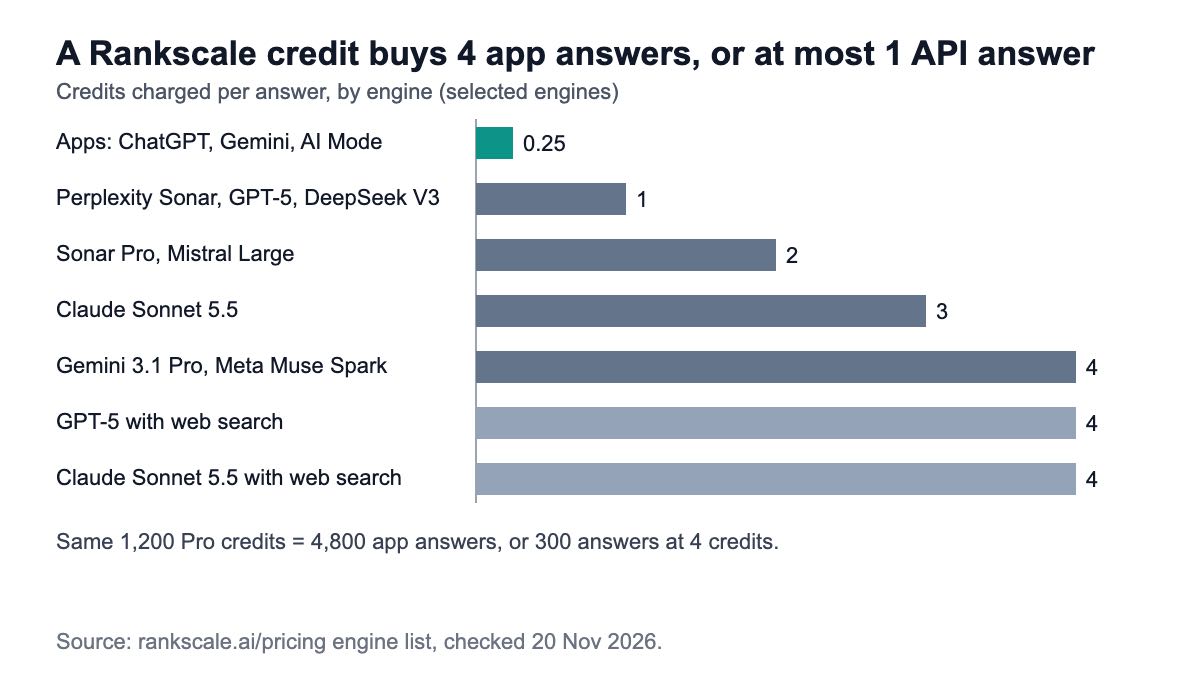
Here are the per-answer prices for the engines most buyers ask about, as listed on 20 November 2026:
| Engine | Type | Credits per answer | With web search |
|---|---|---|---|
| ChatGPT, Gemini, Google AI Mode, Google AI Overviews, Bing AI Mode | App | 0.25 | – |
| Perplexity Sonar | API | 1 | – |
| Sonar Pro, Sonar Reasoning Pro | API | 2 | – |
| GPT-5 | API | 1 | 4 |
| GPT-5.6 Terra, GPT-6.1 Sol | API | 1 | 3 |
| Claude Sonnet 5.5 | API | 3 | 4 |
| Claude Haiku 5.5 | API | 1 | 3 |
| Gemini 3 Flash | API | 1 | – |
| Gemini 3.1 Pro | API | 4 | – |
| DeepSeek V3 | API | 1 | – |
| Mistral Large | API | 2 | – |
| Meta Muse Spark (beta) | API | 4 | – |
Two things follow from that table. First, a prompt is not a unit of price on Rankscale. You can create as many prompts as you like; the credits are spent when a prompt runs, once per engine per run.
Second, how often a prompt runs matters as much as which engine it runs on. Rankscale lets you schedule each prompt hourly, every two hours, daily, every two days, weekly, every two weeks, monthly or every two months.
So the simplest way to size a plan is one line of arithmetic: prompts × runs a month × credits per answer, summed over your engines. One prompt run daily on ChatGPT costs 30 × 0.25 = 7.5 credits a month. The same prompt run daily on Claude Sonnet 5.5 with web search costs 30 × 4 = 120 credits a month, sixteen times as much.
Rankscale's help article on credits and usage adds a few rules the pricing page does not show. A run only uses credits "when it completes successfully".
Prompt research costs 50 credits per run, and page audits beyond your free allowance and the llms.txt generator also use credits. Credits you buy as a top-up do not expire while your subscription is active, and plan credits are spent first. If you cancel, "all your credits will be set to zero".
Rankscale has a credit calculator at the bottom of its pricing page that does this sum for you. Put in 50 prompts, daily, on ChatGPT, Google AI Mode and Gemini, and it recommends Pro, because the total is 1,125 credits and Pro holds 1,200.
What does Rankscale cost at 50, 150 and 500 prompts?
At 50 prompts run daily on three app engines, Rankscale costs €99 a month; at 150 prompts it costs €385; at 500 prompts it costs €780. Swap one app engine for Perplexity and the bill roughly doubles. Those are the two engine mixes most buyers end up choosing, so I priced both.
The rules are the same throughout this post. A month is 30 days. Each prompt runs once a day on three engines, so 50 prompts is 4,500 answers a month, 150 prompts is 13,500, and 500 prompts is 45,000.
Prices are list prices with monthly billing, before VAT, and the cheapest plan that holds the credits wins. I did not count rollover or top-ups, because a steady monthly workload cannot live on rollover, and Rankscale does not publish its top-up price.
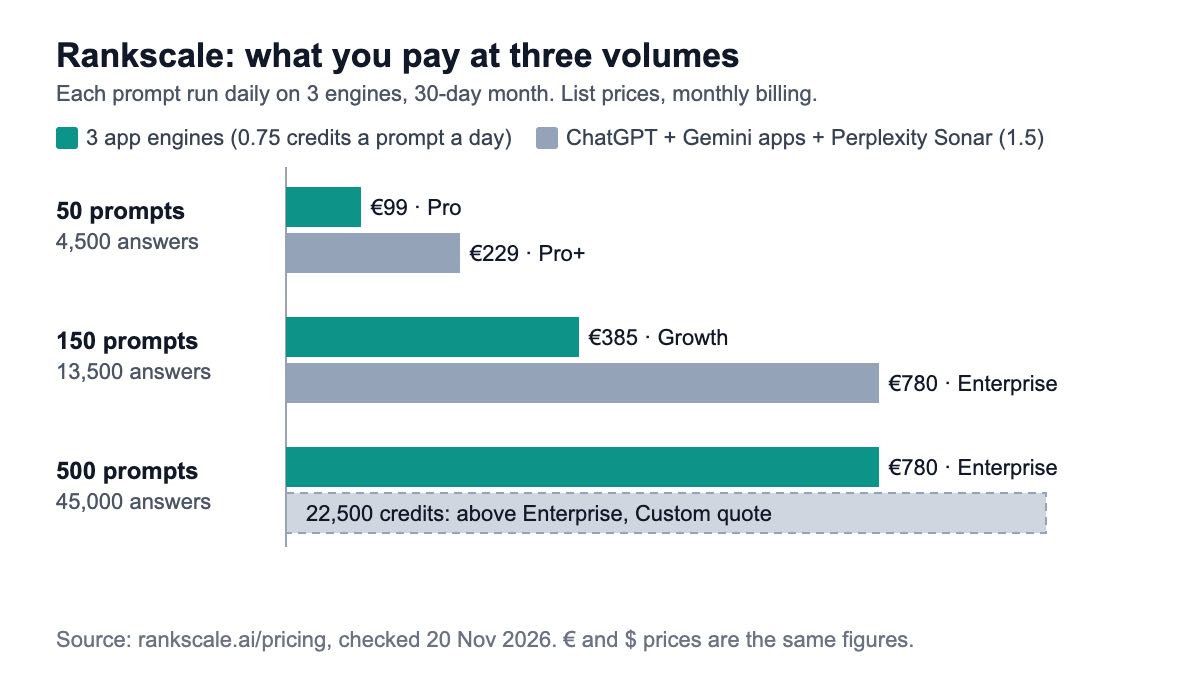
| Engine mix | Credits per prompt a day | 50 prompts (4,500 answers) | 150 prompts (13,500 answers) | 500 prompts (45,000 answers) |
|---|---|---|---|---|
| ChatGPT + Gemini + Google AI Mode (all app engines) | 0.75 | 1,125 credits → Pro, €99 (€22.00 per 1,000 answers) | 3,375 credits → Growth, €385 (€28.52 per 1,000) | 11,250 credits → Enterprise, €780 (€17.33 per 1,000) |
| ChatGPT + Gemini apps + Perplexity Sonar (API) | 1.5 | 2,250 credits → Pro+, €229 (€50.89 per 1,000) | 6,750 credits → Enterprise, €780 (€57.78 per 1,000) | 22,500 credits → Custom, quote only |
The 150-prompt row hides a trap. With three app engines you need 3,375 credits, and Pro+ holds 3,000.
That is only 375 credits short, but the next plan that fits is Growth at €385, not Pro+ at €229. If Rankscale's in-app top-up price is low, Pro+ plus a top-up would beat Growth. The top-up price is not on the public pricing page, so check it in the app before you upgrade.
The cost per 1,000 answers also does not fall smoothly as you grow. It is €22.00 at 50 prompts, rises to €28.52 at 150 because of that gap between plans, and drops to €17.33 at 500. Buyers near a plan boundary should run the calculator with their exact prompt count rather than a round number.
If you run prompts weekly instead of daily, divide every credit figure by about 7. A weekly 500-prompt set on three app engines is about 1,600 credits a month and fits Pro+. Many teams track a small daily core and a larger weekly set for exactly that reason.
How does it compare with Peec, Otterly, Omnia and Profound?
On the same workload, Peec AI Starter ($95) and Rankscale Pro (€99, or $99) are the two cheapest dashboards at 50 prompts if you stick to app engines, within a few dollars of each other, and Otterly is the cheapest at 150 and 500 prompts. Omnia charges per prompt with four engines included, which makes it dearer per answer but simpler to budget. Profound no longer publishes a price at all.
To keep the comparison fair, every tool below gets the same job: each prompt run daily on three engines (ChatGPT, Gemini and Perplexity, or the closest each tool offers), 30-day month, list price, monthly billing. I checked each vendor's own pricing page on 20 November 2026. The euro prices are not converted; at the European Central Bank's reference rate of $1.0992 per euro on 19 November 2026, €100 is about $110.
| Tool and plan | Engines in the example | 50 prompts (4,500 answers) | 150 prompts (13,500 answers) | 500 prompts (45,000 answers) |
|---|---|---|---|---|
| Rankscale, app engines only | ChatGPT, Gemini, Google AI Mode | €99 Pro (€22.00) | €385 Growth (€28.52) | €780 Enterprise (€17.33) |
| Rankscale, with Perplexity Sonar | ChatGPT, Gemini, Perplexity | €229 Pro+ (€50.89) | €780 Enterprise (€57.78) | Custom quote |
| Peec AI | Any 3 models | $95 Starter ($21.11) | $245 Pro ($18.15) | Enterprise, quote only |
| Otterly.AI | ChatGPT, Gemini, Perplexity | €189 Standard (€42.00) | €189 Standard (€14.00) | €489 Premium (€10.87) |
| Omnia | 4 default engines | €168 Growth + 25 prompts (€37.33) | €457 Pro + 50 prompts (€33.85) | About €1,248 Enterprise (€27.72) |
| Profound | Up to 10 engines | Custom only | Custom only | Custom only |
| Serpent API — AI Rank, Default | ChatGPT, Claude, Gemini, Perplexity | $60.00 ($13.33) | $180.00 ($13.33) | $600.00 ($13.33) |
| Serpent API — AI Rank, Growth ($100 deposit) | Same four | $6.00 ($1.33) | $18.00 ($1.33) | $60.00 ($1.33) |
| Serpent API — AI Rank, Scale ($500 deposit) | Same four | $3.00 ($0.67) | $9.00 ($0.67) | $30.00 ($0.67) |
| Serpent API — AI Rank, Enterprise ($1,000 deposit) | Same four | $2.55 ($0.57) | $7.65 ($0.57) | $25.50 ($0.57) |
| Serpent API — AI Rank, Enterprise Plus ($1,250 deposit) | Same four | $2.10 ($0.47) | $6.30 ($0.47) | $21.00 ($0.47) |
How each row was worked out, so you can redo it with your own numbers:
- Peec AI sells prompts by plan: Starter is 50 prompts on 3 models for $95, Pro is 150 prompts for $245, Advanced is 350 prompts for $495, all run daily (Peec AI pricing). Starter covers one country. 500 prompts is above Advanced, so it needs an Enterprise quote.
- Otterly.AI counts one credit per prompt, per engine, per check, and says "a prompt tracked daily on 1 engine uses 31 credits per month" (Otterly pricing). Fifty prompts on three engines is 4,650 credits, which is over Lite's 2,000, so it lands on Standard (15,000 credits, €189). 500 prompts is 46,500 credits, inside Premium's 50,000. Claude answers cost 3 credits on Otterly, so leave Claude out of this sum or triple its share.
- Omnia prices by monitored prompt, with ChatGPT, Google AI Overviews, Google AI Mode and Perplexity included on every prompt: Growth is 25 prompts for €79, Pro is 100 for €279, and extra prompts cost €89 per 25. Its machine-readable price sheet lists Enterprise at €499 for 200 prompts, €750 for 300 and €4,990 for 2,000, about €2.50 a prompt (Omnia pricing). The 500-prompt figure is that rate applied, so treat it as an estimate until you have a quote.
- Profound shows a single Enterprise plan at "Custom" and says it retired its Starter and Growth plans for brands in September 2026 (Profound pricing).
- Serpent API bills per call. An AI Rank call left on its default engine setting covers all four engines and is billed at the all-engines rate, so 50 prompts a day is 1,500 calls a month. Each tier's rate is in the table, and each higher tier unlocks after the one-time deposit shown there (Serpent API pricing).
Be clear about what the bracketed numbers compare. The dashboards price includes the dashboard: charts, sentiment, recommendations, page audits and shareable reports. An API price is for the data; you bring the spreadsheet, the database or the reporting tool. Both are fair ways to buy, and the right one depends on whether you already have somewhere to put the numbers.
What changes the bill: yearly billing, rollover and add-ons
Yearly billing takes about 15% off every plan: Pro drops from €99 to €84.15 a month (€1,009.80 a year) and Enterprise from €780 to €663 a month. That is the only permanent discount on the page.
There is also a temporary one. On 20 November 2026 the page carried a Black Friday banner: "50% off your first 2 months on every plan", ending Monday 30 November at 23:59 CET. That halves the first two invoices only, so it matters for a trial run and not for a yearly budget.
Rollover is generous. The plan table says unused credits carry into the next month, up to two times the monthly bundle on Pro and Pro+ and up to three times on Growth and Enterprise. The FAQ on the same page says only that "unused credits roll over from Pro", so confirm the cap for your plan before you count on it. That makes Rankscale forgiving for bursty work, such as a one-off audit of 2,000 prompts in a quiet month, but it does not make a plan bigger for steady daily tracking.
The add-ons are small but worth listing:
- Extra brand dashboards: €9 a month each, on any plan. An agency with 12 brands on Pro pays €99 + 2 × €9 = €117.
- Credit top-ups: available in the app on every plan. The price is not on the public page.
- Prompt research: pay per use on Pro; Pro+ includes 5 a month, Growth 10 and Enterprise 20.
- Page audits: 50 to 200 a month included, more can be bought at any time.
- REST API: from Pro+ only. If you want to pull Rankscale data into your own tools, the cheapest way is €229, not €99.
- White-label dashboards, SSO and SLAs: white label from Growth; SSO, custom integrations and SLAs are "on request" on Growth and Enterprise and included on Custom.
Did Rankscale's pricing change?
Yes, twice in 2026: a new Pro+ plan arrived in the autumn, and the cheap Essentials entry plan has gone. Archived copies of Rankscale's pricing page tell the story. In the 6 May 2026 copy, the lineup is Essentials from $20 a month, Pro at $99, Growth at $385 and Enterprise at $780, and the REST API starts on Growth. Pro+ is not there yet.
By the 5 October 2026 copy, Pro+ has arrived at $229 with 3,000 credits and the REST API, and Essentials has become "yearly only". The 28 October 2026 copy shows Essentials at $20 list, $17 a month billed yearly, with 120 credits. On 20 November the live page has no Essentials plan at all, so it was removed some time after 28 October.
That is why you will see "$20 a month" in many reviews, including pages updated this month. Toolradar, with prices "last confirmed on Nov 17, 2026", and OMR Reviews, edited in November 2026, both still list it. Comparison pages from competing vendors, such as Ranked AI and LLM Pulse, also quote Essentials and leave out Pro+, and some still place the API on Growth.
Engine prices moved too. The credit calculator in the 17 September 2026 copy priced Perplexity at 0.25 credits, DeepSeek at 1 and Claude at 2. Today Perplexity is an API model at 1 credit or more, and Claude Sonnet 5.5 costs 3. If you are comparing quotes, use only numbers dated after these changes.
Which Rankscale plan should you pick?
Pick by your daily answer count and by the one feature you cannot live without, in that order.
- Pick Pro (€99) if you track one to ten brands, up to about 50 daily prompts, mostly on ChatGPT, Gemini and Google's AI results. It is the only plan with a no-commitment 7-day trial, so start here even if you think you need more.
- Pick Pro+ (€229) if you need the REST API, or if Perplexity or another API model is part of your daily set. Its 3,000 credits cover 50 daily prompts with Perplexity in the mix.
- Pick Growth (€385) if you are an agency. White-label links, 50 brand dashboards, a success manager and the partner directory are the reasons, not the credits.
- Pick Enterprise (€780) if you track hundreds of daily prompts on app engines, or around 150 daily prompts with an API model in the mix.
- Ask for Custom if you need SSO as standard, an SLA, or more than 12,000 credits a month.
And pick something else when the arithmetic says so. If your daily set is 150 to 500 prompts on ChatGPT, Gemini and Perplexity, Otterly's Standard and Premium plans come out cheaper on list price. If you want a fixed number of prompts and a predictable bill, Peec's plans are easier to reason about. Our comparison of AI visibility tools covers what each dashboard does beyond price, and the audit of 14 AI rank trackers looks at how openly each one explains its method.
When is an API cheaper than a dashboard?
An API is cheaper when you already have somewhere to put the data and you mainly need the raw numbers: which brands an answer mentioned, which sources it cited, and where your domain appeared. In that case paying for a dashboard you will not open is waste.
The AI Rank API tracks brand citations and positions across ChatGPT, Claude, Gemini and Perplexity and returns them as JSON. You send a keyword and, optionally, your domain; the response tells you, per engine, whether your domain was cited, at what position, and the full list of citations. The parameters are in the AI Rank docs, and the single-engine endpoint lets you query one engine at a time when you only care about one.
At 500 prompts a day, the same daily workload that costs €780 on Rankscale costs less through the API at every tier in the comparison table above, with all four engines in every call. That is a large gap, and it is fair to say why. A Rankscale plan includes sentiment scoring, recommendations, page audits, query fan-out, local results, shareable dashboards and support. The API gives you the data, and the reporting is your job.
Two posts show what that job looks like in practice: building your own AI visibility tracker and an AI citation tracker in Python. If you want a score you can explain to a client, our guide to AI visibility scoring shows how to turn citations into one number. You can try the endpoint in the playground with the 10 free API calls every new account gets.
How we checked this
What I checked: the live pricing pages of Rankscale, Peec AI, Otterly.AI, Omnia and Profound, each opened on 20 November 2026, plus Omnia's machine-readable price sheet (last updated 29 October 2026), the European Central Bank reference rate for 19 November 2026, Serpent API's pricing page, Rankscale's credits help article, four archived copies of Rankscale's pricing page (6 May, 17 Sep, 5 Oct and 28 Oct 2026), and four third-party pages that rank for "rankscale pricing". That is 10 official or archived vendor sources and 4 third-party pages; G2 and Capterra could not be opened, so their listings are not used.
How the numbers were worked out: every cost is arithmetic on published list prices: prompts × 3 engines × 30 days, the cheapest plan that holds the volume, monthly billing, before tax. No product was used or bought for this post, and no answer quality was compared.
What we could not verify: Rankscale's credit top-up price (not on the public page); Rankscale's Custom pricing; Peec's and Profound's Enterprise prices; Omnia's 500-prompt price, which is the published linear rate applied rather than a quote. Engine lists and credit costs change often, so recheck the vendor page before you buy.
Track AI citations without a monthly plan
The AI Rank API returns citations and positions for ChatGPT, Claude, Gemini and Perplexity as JSON, from $0.70 per 1,000 queries — pay as you go, no subscription. Every new account gets 10 free API calls.
Get Your Free API KeyExplore: AI Rank API · Playground · Docs · Pricing
FAQ
How much does Rankscale cost per month?
Rankscale's self-serve plans cost €99 (Pro), €229 (Pro+), €385 (Growth) and €780 (Enterprise) a month on monthly billing, as listed on 20 November 2026. The dollar prices are the same figures. Yearly billing takes about 15% off, so Pro is €84.15 a month billed yearly. A Custom plan is quoted on request, and each plan is a monthly credit bundle, from 1,200 credits on Pro to 12,000 on Enterprise, and every plan includes every engine.
What is a Rankscale credit worth?
A credit pays for AI answers. An answer from an app engine such as ChatGPT, Gemini, Google AI Mode, Google AI Overviews or Bing AI Mode costs 0.25 credits, so one credit buys four answers. An answer from an API model costs 1 to 4 credits, and some cost more with web search on. On Pro, one credit works out at about 8 euro cents, so an app answer costs about 2 cents and a 4-credit answer about 33 cents.
Does Rankscale have a free plan or a free trial?
There is no free plan. Pro comes with a 7-day trial, and the other plans list the trial as "on request". During the trial you can import your current prompt list from a CSV file, through the Rankscale API or through its MCP server, and run it side by side with the tool you use now. Rankscale suggests comparing both after ten or more runs.
How many prompts can I track on Rankscale?
Prompts are unlimited on every plan. What is limited is how many answers your credits pay for. On Pro, 1,200 credits cover about 53 prompts run daily on three app engines in a 30-day month, or 13 prompts run daily on one 3-credit API model. Run prompts weekly instead of daily and the same credits stretch about seven times as far.
Is Rankscale cheaper than Peec AI or Otterly?
It depends on your volume and engines, and the arithmetic is short. At 50 daily prompts on app engines, Rankscale Pro (€99) and Peec Starter ($95) are close, and both are cheaper than Otterly, whose smallest plan that fits is Standard at €189. At 150 and 500 daily prompts on three engines, Otterly's Standard (€189) and Premium (€489) cost less than Rankscale's Growth (€385) and Enterprise (€780). Adding Perplexity or Claude raises Rankscale's cost more than the others.
Does Rankscale have an API?
Yes, from the Pro+ plan at €229 a month. Rankscale calls it the Metrics API, and Growth and Enterprise add a Share Links API. Pro does not include the REST API but does include the MCP server, which lets AI assistants such as Claude or ChatGPT read your tracking data. If you only need raw citation data in your own tools, a pay-per-call API such as the AI Rank API is another route.
Sources
Official pricing pages and price sheets (checked 20 November 2026):
- Rankscale pricing: plans, credits per engine, rollover, FAQ
- Peec AI pricing for brands
- Otterly.AI pricing and credit FAQ
- Omnia pricing
- Omnia machine-readable price sheet (updated 29 Oct 2026)
- Profound pricing and plan FAQ
- Rankscale help: Understanding Credits and Usage
Exchange rate:
Third-party reviews and history:
- Rankscale pricing, archived 6 May 2026
- Rankscale pricing, archived 17 Sep 2026
- Rankscale pricing, archived 5 Oct 2026
- Rankscale pricing, archived 28 Oct 2026
- Toolradar: Rankscale pricing (confirmed 17 Nov 2026)
- OMR Reviews: Rankscale.ai costs (edited Nov 2026)
- Ranked AI: Ranked AI vs Rankscale (competing vendor, updated 28 Sep 2026)
- LLM Pulse: Rankscale alternatives (competing vendor, updated 16 Nov 2026)