TikTok Research API in 2026: who qualifies, and what to use if you don't

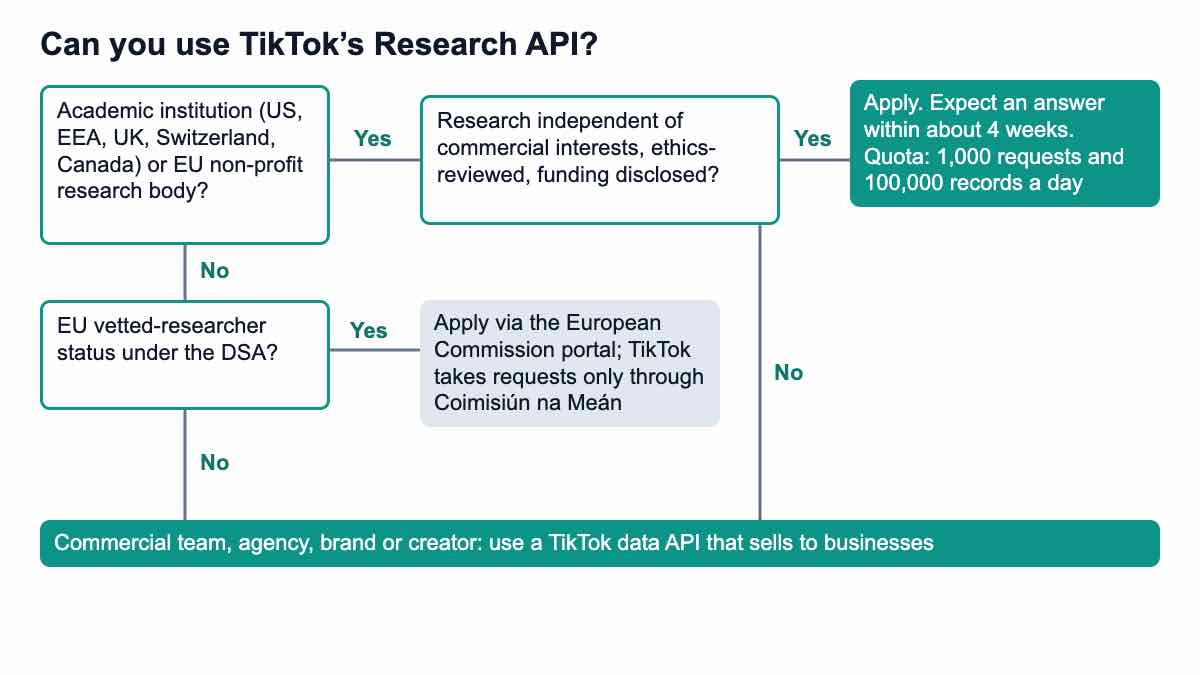
TikTok’s Research API is free, but only for non-commercial research: academic institutions in the US, EEA, UK, Switzerland or Canada, and not-for-profit research bodies in the EU, with ethics review and no commercial ties. Approved projects get 1,000 requests and up to 100,000 records a day. Brands and agencies need a commercial TikTok data API instead.
Short answer: If you are a university researcher in an eligible region, apply: it is free, and TikTok says to expect an answer in about four weeks. If you research systemic risks in the EU and hold vetted-researcher status, use the separate route through Ireland’s regulator. If you are a brand, agency, startup or creator, you do not qualify, so use a TikTok data API that sells to businesses: Serpent API from $0.05 per 1,000 calls for profiles and videos — pay as you go, no subscription (pricing), EnsembleData if you prefer daily unit plans, or an Apify actor for one-off pulls.
What is the TikTok Research API?
It is TikTok’s official, free programme for studying public TikTok data, run as part of what TikTok calls its Research Tools. Approved researchers get a client key and secret and can query public videos, comments and accounts as JSON.
The documented endpoints cover the main research needs. You can search videos with a structured query (keywords, hashtags, regions, dates and more), read a video’s comments, and look up a user’s profile, followers, following, liked videos, reposted videos and pinned videos. TikTok publishes a codebook describing every field, and community clients exist; the R package traktok is one widely used example.
Two things make it different from a normal commercial API. Access is by application, judged on who you are and what you are studying. And the terms bind you to research use: they forbid using the tools or data for any commercial purpose, with one exception for publishing papers about the approved research, so the data cannot feed a product, a client report or an ad campaign.
Who qualifies for the TikTok Research API in 2026?
Non-commercial researchers only. TikTok’s eligibility page, which I read on 20 November 2026, lists academic institutions in the United States, the European Economic Area, the United Kingdom, Canada and Switzerland, plus not-for-profit or independent research bodies in the EU. For that not-for-profit route TikTok says it is beta testing with select researchers in the US, UK, Switzerland, Norway, Iceland and Liechtenstein. It also lists Brazil-based academic institutions and not-for-profits studying online youth safety.
Being at the right kind of institution is not enough on its own. Applicants must show expertise in the research area and in data analysis, show that the research is independent of commercial interests, disclose how it is funded, submit a clearly defined proposal, commit to data-security requirements and provide evidence of an ethical review. PhD candidates also need an endorsement letter from a professor or dissertation advisor. Non-academic not-for-profits get access only under limited conditions: if approved, TikTok points them to its Virtual Compute Environment, which it describes as subject to strict security controls.
TikTok publishes two versions of the Research Tools terms. The global terms define eligible researchers by mission (not-for-profit, public-interest research) without naming regions. The US terms are issued by TikTok USDS Joint Venture and define eligible researchers as US-based institutions. Read the eligibility page and the terms that apply where you are before you apply.
Who does not qualify is clearer: anyone with a commercial interest. That covers brands, agencies, marketing tools, startups, consultancies and creators researching their own niche. A research team inside a company does not qualify either, even if the work looks academic.
What changed in 2025 and 2026?
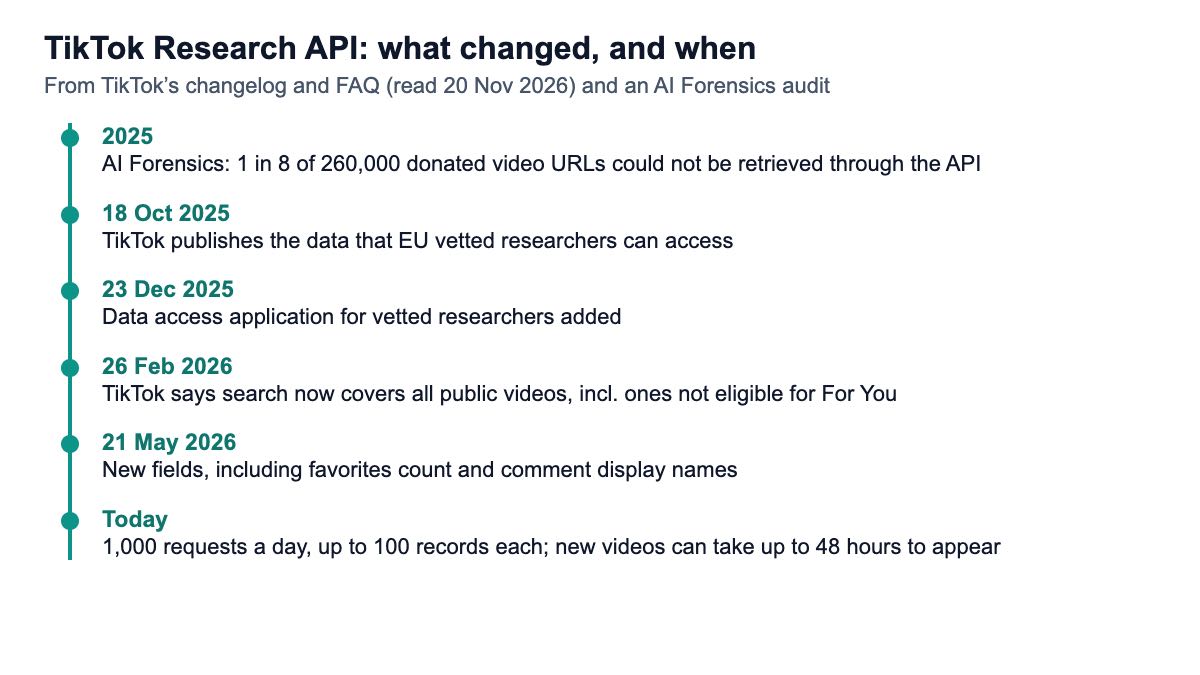
The biggest change is a second route for EU researchers. Under the EU Digital Services Act, researchers studying systemic risks can be granted “vetted researcher” status by a national Digital Services Coordinator. TikTok’s page for this route says it accepts access requests only when they are submitted by Coimisiún na Meán, Ireland’s regulator, and that researchers apply through the European Commission’s Data Access Application Portal. TikTok says it does not accept direct applications from researchers on this route, and that Coimisiún na Meán decides how the data is delivered; the suggested options are TikTok’s Virtual Compute Environment and Dropbox.
TikTok’s developer changelog dates the steps: on 18 October 2025 it published a page describing the data vetted researchers can access. On 23 December 2025 it added a data access application for vetted researchers. On 26 February 2026 it said it had updated its data pipeline to cover all public video content, including videos not eligible for recommendation to the For You feed. On 21 May 2026 it added new fields: a favorites_count on video queries and display names on comments and replies.
One date circulating in third-party summaries, a vetted-researcher change on 4 June 2026, does not match the changelog: the 4 June 2026 entry is about TikTok’s Data Portability API, not the Research Tools.
Outside audits also shaped the picture. AI Forensics reported in 2025 that one in eight videos from a set of 260,000 donated TikTok URLs could not be retrieved through the API, and that about 1% of creators appeared to be excluded without explanation. Because of the 1,000-calls-a-day limit, its team had to spread individual lookups over 64 days. That audit predates TikTok’s February 2026 coverage update, and I found no public re-test since.
What limits apply once you are in?
The quota is the first limit researchers hit. TikTok’s FAQ says the limit is currently 1,000 requests per day, allowing up to 100,000 records per day across its research APIs. Video and comment requests return up to 100 records each, and the quota resets at midnight UTC.
Follower and following lists have a separate budget: up to 20,000 calls and 2 million records a day. TikTok says it cannot grant exceptions to the quota.
That budget is smaller than it sounds. A month of daily pulls is about 30,000 requests. A study that needs individual video lookups, as the AI Forensics team did, spends one request per video.
Queries are bounded in time as well. The traktok documentation notes that a video search can cover a range of at most 30 days between its start and end dates, though you can go back as far as you like in 30-day steps.
Freshness is the limit people forget. TikTok’s FAQ says the video query searches archived data, so new videos can take up to 48 hours to appear in search, and statistics such as view and follower counts can take up to 10 days to update; the user info lookup reads current data. Fine for most academic work; a problem if you need to see a trend while it is happening.
The terms add data-handling duties. Where you can access or download personal data, you must refresh it at least every 30 days and delete anything no longer available from the tools at each refresh, keep it no longer than the approved research needs, and send TikTok a copy of any publication at least seven days before it comes out.
Finally, check coverage yourself. The AI Forensics findings above are the clearest public evidence that some videos and accounts did not come back without explanation; TikTok’s February 2026 changelog says coverage now includes all public videos.
How do you apply?
- Check eligibility on TikTok’s Research Tools page for your region and institution type, or start with the vetted-researcher route if your work is about systemic risks in the EU.
- Prepare the paperwork: a research proposal, proof of ethical review, a funding disclosure and, if you are a PhD candidate, an endorsement letter from a professor or dissertation advisor.
- Create a TikTok for Developers account and submit the application from the Research Tools page.
- Wait. TikTok says you can typically expect to hear back within four weeks.
- Once approved, generate your client key and secret, read the codebook, and plan your queries around the 1,000-requests-a-day budget and the 30-day query window.
Budget time for the data work too. Because statistics lag, items can go missing and the terms require a refresh at least every 30 days, careful studies re-query and record when each record was collected.
What if you do not qualify?
Then you use a commercial TikTok data API, which is what nearly every brand, agency and analytics product does. These APIs return public TikTok data as JSON to anyone with a key, billed per call, per result or per daily unit, with no application.
TikTok also runs other official APIs, such as the Commercial Content API for ads data in Europe, but none of them gives a business general access to public videos and accounts. Our guide to free TikTok API options covers each official API and what it allows.
Here is how the Research API’s main jobs map to Serpent API’s documented TikTok endpoints, if you are replacing one with the other:
| Research API job | Serpent API call | Notes |
|---|---|---|
| Query videos by keyword | /api/tiktok/search?q= | Up to 180 full video records per call with limit |
| Query videos by hashtag | /api/tiktok/hashtag?tag= | Same video record shape as a single video call |
| User info | /api/tiktok/profile?username= | Exact follower, like and video counts |
| User followers, following, liked videos | /api/tiktok/profile with include_followers, include_following, include_liked | A list that is not public comes back flagged restricted: true |
| Video comments | /api/tiktok/video with include_comments=true | Text, language, likes, reply counts, author |
| Videos using a sound | /api/tiktok/music?music_id= | Sound id comes from any video record’s music.music_id |
Every call above is documented in the TikTok section of our docs, and the list endpoints are described under hashtag, search and music. If hashtags are your main research object, read how to track a TikTok hashtag without inventing a trend before you design the study.
Commercial APIs are not a free pass on rules. TikTok’s terms and data-protection law still apply to what you collect and how you use it, so keep to public data, collect only what the project needs, and store personal data with care.
What do the alternatives cost?
The Research API costs nothing if you qualify. For everyone else, I priced commercial TikTok APIs from their live pricing pages on 20 November 2026, per 1,000 keyword searches or results at three monthly volumes. Units differ between vendors, so read the unit column first.
| Option | Unit | At 1K a month | At 100K a month | At 1M a month |
|---|---|---|---|---|
| TikTok Research API | Request (up to 100 records) | $0 (eligible researchers) | Over quota (about 30,000 a month) | Over quota |
| EnsembleData | Keyword search (1 unit, 20 posts) | $100.00 (Wood) | $2.00 (Bronze) | $1.40 (Platinum) |
| Apify TikTok Scraper | Result (one video) | from $1.70 | from $1.70 | from $1.70 |
| Xpoz | TikTok query (5 credits) | $16.00 (Pro) | $9.20 (Max + overage) | $9.92 (Max + overage) |
| Serpent API — search, hashtag, music | Call (up to 30 videos at limit=30) | Default $3.00 · Growth $2.70 · Scale $2.10 · Enterprise $1.79 · Enterprise Plus $1.47, at every volume | ||
| Serpent API — profile, video | Call (basic, no include groups) | Default $0.10 · Growth $0.09 · Scale $0.07 · Enterprise $0.06 · Enterprise Plus $0.05, at every volume | ||
How the plan rows were worked out. EnsembleData sells daily unit allowances: 1,000 searches a month fits the $100 Wood plan (1,500 units a day), 100,000 a month needs about 3,300 a day and the $200 Bronze plan (5,000), and 1,000,000 needs about 33,300 a day and the $1,400 Platinum plan (50,000). The mapping of its endpoint table to TikTok is my reading of the page. Xpoz charges 5 credits per TikTok query: Pro is $16 for 7,500 credits, Max $160 for 120,000 plus $2 per 1,000 extra.
Serpent API tiers follow deposit size, not monthly volume, and the list price scales with limit: limit=180 costs 2.5 times the limit=30 price. The pricing page has the full rules. For a vendor-by-vendor comparison at different depths, see the best TikTok scraping APIs by real cost.
Which route should you take?
- University researcher in an eligible region: apply for the Research API. It is free, official and accepted by ethics boards. Plan for the four-week wait, the 1,000-requests-a-day budget and the 48-hour to 10-day data lag.
- EU researcher studying systemic risks: seek vetted-researcher status through your Digital Services Coordinator and apply via the European Commission portal.
- Researcher waiting for approval: pilot your method on a small commercial pull with the free calls most APIs offer, then switch to the Research API for the study itself if your ethics board requires it.
- Brand, agency or analytics product: use a commercial TikTok API. Pick per-call pricing (Serpent API, from $0.05 per 1,000 calls for profiles and videos) if your volume varies, a daily-unit plan like EnsembleData if it is steady and high, or an Apify actor for a one-off export.
- Building it yourself: possible for small jobs, but expect maintenance; building a TikTok scraper in Python shows what it involves.
How we checked this
On 20 November 2026 I read the search results for “tiktok research api” and opened 17 sources: eight TikTok pages (the Research Tools eligibility page, About Research Tools, the Research API FAQ, the vetted-researcher page, the developer changelog, the codebook, and the global and US Research Tools terms), the AI Forensics audit, the traktok documentation, guides from Xpoz and Scrapfly, the live pricing pages of EnsembleData, Apify and Xpoz, and our own documentation and pricing page. No API calls were made for this article.
What I could not verify: the exact publication date of the AI Forensics audit (its page shows 12-06-2025, which could be June or December), how the vetted-researcher route is working in practice, and Apify’s per-plan prices beyond its stated “from” rate. The EnsembleData unit mapping is my reading of its endpoint table.
Not eligible? Get TikTok data without an application
Public TikTok profiles, videos, comments, hashtags, searches and sounds as JSON, from $0.05 per 1,000 calls — pay as you go, no subscription. Start with 10 free API calls.
Get Your Free API KeyExplore: TikTok API · Playground · Docs · Pricing
FAQ
Can businesses use the TikTok Research API?
No. TikTok’s eligibility criteria require researchers to be independent of commercial interests, and the programme is open to academic institutions and not-for-profit research bodies, not companies. That excludes brands, agencies, marketing and analytics tools, consultancies and creators, including research teams inside companies. Businesses that need public TikTok data use commercial TikTok data APIs instead, which sell access by the call, the result or a daily allowance without an application process.
Is the TikTok Research API free?
Yes, for approved researchers. There is no fee, but there is a quota: TikTok’s FAQ gives 1,000 requests a day and up to 100,000 records a day across its research APIs, resetting at midnight UTC, and says it cannot grant exceptions. The real cost is time and paperwork: an application with ethics review and a funding disclosure (plus an advisor’s endorsement letter for PhD candidates), a wait of about four weeks, a data lag of up to 48 hours for new videos and up to 10 days for updated counts, and a duty to refresh stored data at least every 30 days.
How long does TikTok Research API approval take?
TikTok says applicants can typically expect to hear back within four weeks of submitting. Third-party guides report waits from several weeks to a few months, and the timeline depends on how complete your paperwork is. Have the proposal, ethics approval and funding disclosure ready before you apply, plus an advisor’s endorsement letter if you are a PhD candidate. EU vetted researchers follow a different route through the European Commission portal and Ireland’s regulator, which runs on its own timeline.
What data does the TikTok Research API return?
Public video data from a structured video search (keywords, hashtags, region, dates and other fields), comments on videos, and account data: profile information, followers, following, liked, reposted and pinned videos. TikTok’s codebook lists every field, and in May 2026 its changelog added a favorites count and comment display names. It does not return private content. A 2025 audit found some public videos and accounts missing; TikTok said in February 2026 that search now covers all public videos.
What is the best alternative to the TikTok Research API?
For a business, a commercial TikTok data API that covers the same jobs: video search, hashtag lists, profiles, followers and comments. Pick by billing model: per-call pricing suits variable volume, and Serpent API starts from $0.05 per 1,000 calls for profiles and videos. Daily-unit plans such as EnsembleData suit steady high volume, and Apify actors suit one-off exports at from $1.70 per 1,000 results. Our TikTok scraping API comparison covers them in depth.
Sources
TikTok official pages (checked 20 November 2026):
- TikTok Research Tools: access and eligibility
- TikTok: About Research Tools
- TikTok: Research API FAQ
- TikTok: Vetted researcher data access
- TikTok for Developers changelog
- TikTok: Research API codebook
- TikTok Research Tools terms of service (global)
- TikTok Research Tools terms of service (US)
Audits and documentation (checked 20 November 2026):
- AI Forensics: TikTok’s Research API, problems without explanations
- traktok R package: Research API vignette
Vendor pricing and guides (checked 20 November 2026):