ScrapingBee pricing: what a credit buys in Google searches
ScrapingBee sells monthly credit plans from $19 for 75,000 credits to $5,799 for 120 million, and a Google search costs 10 credits in light mode or 15 in regular mode. That makes 1,000 Google searches cost between $0.48 and $3.80, depending on the plan and the mode. Credits expire every month.
Short answer: If you scrape ordinary web pages and run some Google searches on the side, Startup at $99 is ScrapingBee's sweet spot: 1,000,000 credits, or 100,000 light-mode searches. If Google search is most of your usage, a search-only API costs less per search: Scrapingdog Standard is $0.90 per 1,000 at 100,000 a month, DataForSEO's standard queue $0.60 if you can wait for results, and Serpent API is from $0.03 per 1,000 — pay as you go, no subscription. Under about 2,000 searches a month, any plan is mostly unused credit.
This page is the arithmetic of ScrapingBee's prices, read from its live pricing page, FAQ and documentation on 22 November 2026. If you have already decided to move your Google searches elsewhere, our ScrapingBee alternatives guide covers the switch. We sell a Google SERP API ourselves, so every ScrapingBee figure below links to ScrapingBee's own page.
What plans does ScrapingBee sell?
Ten monthly plans: five standard ones from $19 to $599 and five Enterprise plans from $999 to $5,799 (ScrapingBee pricing). Every plan includes JavaScript rendering, premium proxies, geotargeting, screenshots and the dedicated scraping APIs for Google, Amazon, Walmart, YouTube and others. What changes is the number of credits and how many requests you can run at the same time.
| Plan | Price a month | API credits a month | Concurrent requests | $ per 1,000 credits |
|---|---|---|---|---|
| Free trial | $0, once | 1,000 | — | — |
| Hobby | $19 | 75,000 | 25 | $0.25 |
| Freelance | $49 | 250,000 | 50 | $0.20 |
| Startup | $99 | 1,000,000 | 100 | $0.10 |
| Business | $249 | 3,000,000 | 200 | $0.083 |
| Business + | $599 | 8,000,000 | 400 | $0.075 |
| Enterprise 14 | $999 | 14,000,000 | 500 | $0.071 |
| Enterprise 24 | $1,599 | 24,000,000 | 600 | $0.067 |
| Enterprise 41 | $2,399 | 41,000,000 | 700 | $0.059 |
| Enterprise 69 | $3,599 | 69,000,000 | 800 | $0.052 |
| Enterprise 120 | $5,799 | 120,000,000 | 900 | $0.048 |
The biggest drop in price per credit is from Freelance to Startup: $0.20 to $0.10 per 1,000 credits, half the price for twice the plan. Above Startup each step saves a cent or two per 1,000 credits. Business and above add priority email support, an account manager and team management.
Several review pages are behind. Thunderbit's June 2026 review leaves out the $19 Hobby plan, and the Capterra and Software Advice listings still describe a single $49 plan. The live page on 22 November had the ten plans above.
How many credits does a request use?
Anywhere from 1 to 75, depending on what you switch on. The most important detail is the default: JavaScript rendering is on unless you turn it off, so an ordinary page request costs 5 credits, not 1.
| Request | Credits |
|---|---|
Web page, render_js=false | 1 |
| Web page, default (JavaScript rendering on) | 5 |
| Premium proxy, no JavaScript | 10 |
| Premium proxy with JavaScript | 25 |
| Stealth proxy | 75 |
| Google Search API, light mode (default) | 10 |
Google Search API, light_request=false | 15 |
| Google AI Overview expand | 15 |
| Fast Search API | 10 |
The documentation is explicit on each of these. render_js "is the default behavior and costs 5 credits per request"; premium proxies are 10 credits without JavaScript and 25 with it; a stealth proxy call costs 75 (ScrapingBee API documentation). Auto-Mode tries configurations from cheapest up and charges 1, 5, 10, 25 or 75 credits for the one that worked, or nothing if all of them fail.
So a Hobby plan's 75,000 credits is 75,000 plain pages, 15,000 pages with default settings, or 1,000 pages through the stealth proxy. Before you compare plans, decide which of those rows your traffic falls into.
So what does one Google search cost?
Ten credits in light mode, which is the default, or 15 with light_request=false. ScrapingBee's Google page states it plainly: "Each search can cost 10 credits with Light Request enabled, 15 otherwise" (ScrapingBee Google Search API). The same page lists searches per plan, from 7,500 on Hobby to 12,000,000 on Enterprise 120, which is the credit total divided by 10.
Divide the plan price by those searches and you get the price per 1,000. In light mode that is $2.53 on Hobby, $1.96 on Freelance, $0.99 on Startup, $0.83 on Business and $0.75 on Business +, falling to $0.48 on Enterprise 120.
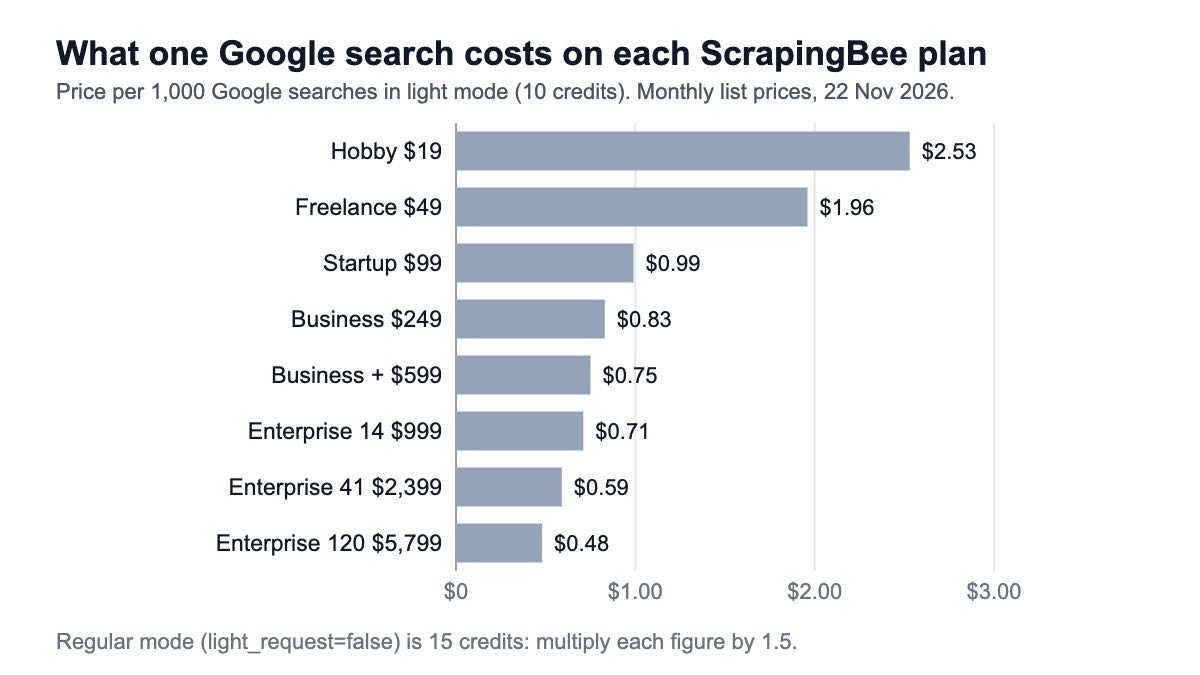
| Plan | Light searches (10 credits) | $ per 1,000 light | Regular searches (15 credits) | $ per 1,000 regular |
|---|---|---|---|---|
| Hobby $19 | 7,500 | $2.53 | 5,000 | $3.80 |
| Freelance $49 | 25,000 | $1.96 | 16,667 | $2.94 |
| Startup $99 | 100,000 | $0.99 | 66,667 | $1.49 |
| Business $249 | 300,000 | $0.83 | 200,000 | $1.25 |
| Business + $599 | 800,000 | $0.75 | 533,333 | $1.12 |
| Enterprise 14 $999 | 1,400,000 | $0.71 | 933,333 | $1.07 |
| Enterprise 24 $1,599 | 2,400,000 | $0.67 | 1,600,000 | $1.00 |
| Enterprise 41 $2,399 | 4,100,000 | $0.59 | 2,733,333 | $0.88 |
| Enterprise 69 $3,599 | 6,900,000 | $0.52 | 4,600,000 | $0.78 |
| Enterprise 120 $5,799 | 12,000,000 | $0.48 | 8,000,000 | $0.72 |
These are best-case prices: they assume every credit in the month goes to Google searches. Credits do not roll over, so a plan you use half of costs you twice the table price that month.
The Fast Search API is a separate, lighter Google endpoint at 10 credits per successful request, built for "sub-second responses" and returning organic results and top stories (ScrapingBee Fast Search API). It prices the same as a light-mode search.
Light or regular mode: which do you need?
Light mode for rank checks and link lists; regular mode if you need AI Overviews or the most complete page. ScrapingBee's Google API documentation says light requests "don't use a web browser" and may leave out some data that a regular request returns, and it suggests light_request=false when you need AI Overviews (ScrapingBee Google API docs).
The difference is 50% on every search. At 100,000 searches a month it decides whether you need Startup ($99) or Business ($249). If only some of your keywords need AI Overviews, send those with light_request=false and keep the rest light.
The docs also list an "expand AI Overview" option at 15 credits, a pages parameter that fetches up to 10 Google result pages into one response, and search types for news, maps, images, Lens, shopping, AI Mode and ads. The pages I read do not say whether a multi-page response costs more than one search, so test that on the free credits before you rely on it.
What will you pay at 1K, 100K and 1M searches?
About $19, $99 and $999 a month in light mode; $19, $249 and $1,599 in regular mode. Each figure is the cheapest plan whose credits cover the volume, assuming Google searches are all you run.
| Searches a month | Light mode: plan, bill, $ per 1,000 | Regular mode: plan, bill, $ per 1,000 |
|---|---|---|
| 1,000 | Hobby, $19, $19.00 | Hobby, $19, $19.00 |
| 10,000 | Freelance, $49, $4.90 | Freelance, $49, $4.90 |
| 100,000 | Startup, $99, $0.99 | Business, $249, $2.49 |
| 1,000,000 | Enterprise 14, $999, $1.00 | Enterprise 24, $1,599, $1.60 |
Two things stand out. At 1,000 searches a month, you pay for 7,500 and use 1,000, so the real price is $19 per 1,000. And at a million searches, the plan that fits is bigger than you need: Enterprise 14 covers 1,400,000 light searches, and nothing smaller covers 1,000,000.
The free trial's 1,000 credits are 100 light searches. That is enough to check the response format and fields, and not enough to judge a month of traffic.
What if you also scrape pages?
Then ScrapingBee's one-bucket model starts to pay off, because the same credits cover pages and searches. Add up credits for the whole month before choosing a plan.
A worked example. Say you run 20,000 light Google searches (200,000 credits), fetch 50,000 plain pages with render_js=false (50,000 credits) and 20,000 pages that need JavaScript (100,000 credits). That is 350,000 credits, which fits Startup's 1,000,000 with room to spare. Freelance's 250,000 does not cover it.
If you split that job, you would need a page-scraping plan anyway, so the question becomes whether moving the 20,000 searches to a search-only API saves more than it adds in a second bill and a second integration. For most mixed teams under 100,000 searches a month, it does not. Our web scraping vs SERP API comparison covers when splitting is worth it.
Do credits roll over, and what is billed?
No, they do not roll over. The pricing page says "API credits are valid for one month and don't roll over," and the Google page repeats that leftovers are not carried forward.
- What is billed: the FAQ says "We only charge for successful requests, i.e returning with a 200, 404 or 410 status code" (ScrapingBee FAQ). A 404 from the page you asked for is billed; a request that fails on ScrapingBee's side is not. A pricing tracker recorded the pricing page adding "Pay only for successful requests" to its subheadline in September 2026 (PricingSaaS diff).
- Running out: there is no pay-per-use top-up on the pricing page. The FAQ offers two routes: upgrade your plan for the month and downgrade later, or renew the subscription early.
- Overage: none is listed. For more credits or concurrency than Enterprise 120, the page sends you to a sales form.
- Cancelling: "Cancel anytime, no questions asked."
- Tax: list prices exclude VAT.
The monthly expiry is the rule that costs most teams money. If your search volume swings between 30,000 and 120,000 a month, you either buy for the peak and waste credits in quiet months, or upgrade mid-month during busy ones.
How does that compare with other Google APIs?
On search alone, ScrapingBee sits in the middle: cheaper than SerpApi and SearchApi at 100,000 searches, more expensive than search-only credit plans and pay-per-search APIs. The comparison below uses the same rule for everyone: the cheapest plan or pack that covers 100,000 Google searches, divided by 100,000.
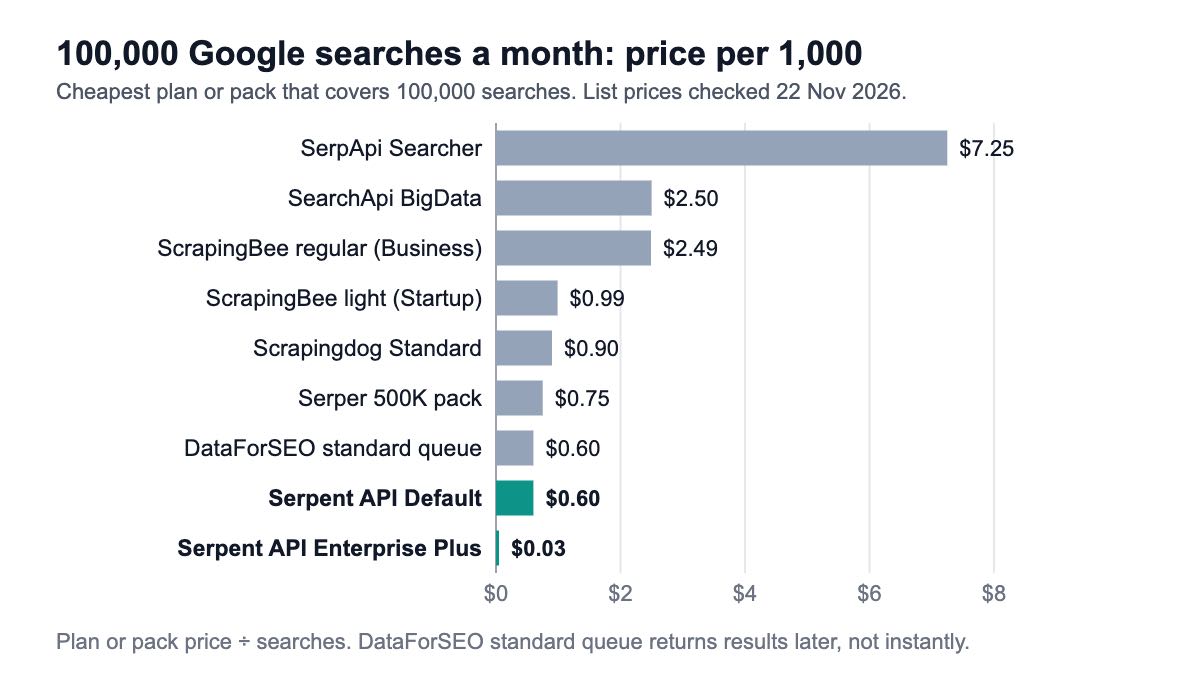
| Provider | Billing unit | 1,000 a month | 100,000 a month | 1,000,000 a month |
|---|---|---|---|---|
| ScrapingBee, light | 10 credits, monthly plan | $19.00 (Hobby) | $0.99 (Startup $99) | $1.00 (Enterprise 14 $999) |
| ScrapingBee, regular | 15 credits, monthly plan | $19.00 (Hobby) | $2.49 (Business $249) | $1.60 (Enterprise 24 $1,599) |
| SerpApi | 1 search, monthly plan | $25.00 (Starter) | $7.25 (Searcher $725) | $3.75 (Cloud 1M $3,750) |
| SearchApi | 1 search, monthly plan | $40.00 (Developer) | $2.50 (BigData $250) | $1.50 (Octo 1M $1,500) |
| Scrapingdog, Google SERP Light | 5 credits, monthly plan | $40.00 (Lite) | $0.90 (Standard $90) | $0.35 (Premium $350) |
| Serper | 1 credit, prepaid pack valid 6 months | $1.00 rate, $50 smallest pack | $0.75 (500K pack $375) | $0.50 (2.5M pack $1,250) |
| DataForSEO, standard queue | Per results page, $50 minimum top-up | $0.60 | $0.60 ($60) | $0.60 ($600) |
| DataForSEO, live | Per results page, instant | $2.00 | $2.00 ($200) | $2.00 ($2,000) |
| Serpent API — Default ($10 deposit) | 1 call, pay as you go | $0.60 | $0.60 ($60) | $0.60 ($600) |
| Serpent API — Growth ($100 deposit) | 1 call, pay as you go | $0.30 | $0.30 ($30) | $0.30 ($300) |
| Serpent API — Scale ($500 deposit) | 1 call, pay as you go | $0.20 | $0.20 ($20) | $0.20 ($200) |
| Serpent API — Enterprise ($1,000 deposit) | 1 call, pay as you go | $0.15 | $0.15 ($15) | $0.15 ($150) |
| Serpent API — Enterprise Plus ($1,250 deposit) | 1 call, pay as you go | $0.03 | $0.03 ($3) | $0.03 ($30) |
Sources for the other rows: SerpApi pricing, SearchApi pricing, Scrapingdog pricing, Serper and DataForSEO Google Organic pricing. Our own deposit is spendable balance and sets the price per 1,000; you can read the whole ladder on our pricing page.
Billing units still differ. SerpApi counts "only successful searches." Serper deducts credits when it returns a successful response. DataForSEO bills per results page and refunds results Google does not return. ScrapingBee bills 200, 404 and 410 responses.
On our side, requests we could not complete are refunded automatically, and a search that completes with no matches is a real answer and is charged. Our SERP API pricing comparison covers more vendors, and the cost calculator models depth and volume.
Two neighbouring explainers use the same arithmetic: ScraperAPI credits per Google search (25 credits a search) and Scrapingdog pricing explained.
How do you keep a ScrapingBee bill down?
Most of the savings come from settings, not from negotiating. Five habits cover nearly all of it.
- Turn JavaScript off where you can. A static page with
render_js=falsecosts 1 credit instead of 5. On a Hobby plan that is the difference between 75,000 and 15,000 pages. - Leave Google searches in light mode. It is the default and costs 10 credits. Switch to
light_request=falseonly for the keywords where you need AI Overviews or the fullest page. - Escalate proxies only on failure. Premium and stealth proxies cost 10, 25 or 75 credits. Auto-Mode with a
max_costcap does this for you and stops at the price you set. - Size the plan to a normal month. Credits expire monthly, so buying for your peak wastes money in every quiet month. Upgrading for one busy month and downgrading after is allowed.
- Log credits per request. Record the status code and credits for every call. A run of billed 404s usually means a broken URL list, and it is cheaper to fix the list than to pay for the misses.
If after all that Google searches are still most of the bill, that is the signal to price a search-only API for that part of the work.
Which plan should you pick?
Pick by how much of your usage is Google search, then by volume.
- Mostly page scraping, a few thousand searches: Freelance ($49) or Startup ($99), sized to your total credits. The searches ride along with the page work.
- A mixed job around 350,000 credits a month: Startup. It is the biggest single drop in price per credit on the ladder.
- 100,000 light searches and nothing else: Startup at $0.99 per 1,000 works, but Scrapingdog Standard ($0.90), Serper's 500K pack ($0.75) and DataForSEO's standard queue ($0.60) cost less per search, and our Google SERP API is from $0.03 per 1,000 calls.
- You need AI Overviews on every search: budget regular mode at 15 credits. At 100,000 searches that is Business ($249).
- A million searches a month: Enterprise 14 for light mode, Enterprise 24 for regular. Compare against search-only APIs first, because at that volume the gap is hundreds of dollars a month.
- Searching in bursts: monthly expiry works against you. A pay-as-you-go balance fits better; deposited credit on our pricing never expires.
If Google search is the bulk of your bill, try a search-only API on the same keywords. Our Google SERP API takes q, engine=google and country on GET /api/search/quick, one call is one charge, and the standard search docs list every parameter. You can run a query in the playground first.
How we checked this
On 22 November 2026 I read ScrapingBee's pricing page, FAQ, API documentation, Google Search API page, Google API documentation and Fast Search API reference (6 official sources), plus a pricing-change tracker entry. Competitor rows come from the live pricing pages of SerpApi, SearchApi, Scrapingdog, Serper and DataForSEO (5 more). Serpent's prices come from our own pricing page.
For the gap check I opened the pages ranking for "scrapingbee pricing": Thunderbit (June 2026, omits Hobby), DomScan (October 2026, two plans only), SyncGTM (October 2026, plans and multipliers correct), TwitterAPI.io (undated, the most complete), and the Capterra and Software Advice listings (one $49 plan, out of date). Every cost here is arithmetic on list prices assuming every credit is used unless stated; no API calls were made for this article.
What I could not verify: whether the Google API's pages parameter charges per page; the credit cost of search_type=ai_mode; whether annual billing exists; and whether the 200/404/410 billing rule applies to the Google API exactly as it does to page requests.
Price Google searches per call, not per credit
Google, Bing, Yahoo, DuckDuckGo and Brave results from $0.03 per 1,000 — pay as you go, no subscription. Start with 10 free calls.
Get Your Free API KeyExplore: Google SERP API · Playground · Docs · Pricing
FAQ
How much does ScrapingBee cost per month?
From $19 to $5,799. The standard plans are Hobby $19 (75,000 credits), Freelance $49 (250,000), Startup $99 (1,000,000), Business $249 (3,000,000) and Business + $599 (8,000,000). Enterprise plans run from $999 for 14 million credits to $5,799 for 120 million. Prices exclude VAT, and there is a one-time free trial of 1,000 credits with no card.
How many credits does a ScrapingBee Google search use?
Ten credits in light mode, which is the default, and 15 with light_request=false. Light mode skips the browser and may leave out some data; regular mode is the one ScrapingBee suggests for AI Overviews. Expanding an AI Overview is listed at 15 credits. The Fast Search API, a lighter Google endpoint, is also 10 credits per successful request.
How much does ScrapingBee cost per 1,000 Google searches?
In light mode: $2.53 on Hobby, $1.96 on Freelance, $0.99 on Startup, $0.83 on Business, $0.75 on Business + and $0.48 on Enterprise 120. Regular mode costs 1.5 times as much, from $3.80 down to $0.72. Those figures assume you use every credit; because credits expire monthly, a half-used plan doubles the real price.
Do ScrapingBee credits roll over?
No. The pricing page says "API credits are valid for one month and don't roll over." If you run out mid-month, the FAQ suggests upgrading for the month and downgrading later, or renewing your subscription early. There is no pay-as-you-go top-up on the pricing page, so plan for your typical month rather than your busiest one.
Does ScrapingBee charge for failed requests?
Not for requests that fail on its side. The FAQ says it only charges for responses with a 200, 404 or 410 status code. A 404 from the target page is billed because the request itself completed. Log the status code of each request so you can reconcile your credit use.
Why does a ScrapingBee page cost 5 credits instead of 1?
Because JavaScript rendering is on by default. The documentation says rendering "is the default behavior and costs 5 credits per request." Add render_js=false for static pages and the cost drops to 1 credit. Premium proxies raise it to 10 or 25 credits, and the stealth proxy to 75, so check which settings your code sends.
Sources
ScrapingBee, official (checked 22 November 2026):
- ScrapingBee pricing
- ScrapingBee FAQ (billing rule)
- ScrapingBee API documentation (credit costs)
- ScrapingBee Google Search API (searches per plan)
- ScrapingBee Google API documentation (light_request)
- ScrapingBee Fast Search API reference
Other providers, official pricing (checked 22 November 2026):
- SerpApi pricing
- SearchApi pricing
- Scrapingdog pricing
- Serper packs
- DataForSEO Google Organic SERP API pricing
- DataForSEO minimum top-up
Third-party pages (opened 22 November 2026):