How to Rate Thousands of Publisher Sites on One Scale
To rate thousands of publisher sites without a manual review, give every site one number and sort by it. The number we use is the share of about 16 Google searches, chosen to match what the site covers, in which the site itself appears. It runs from 0 to 1, it is the same method for every site, and it takes one call per site.
It is a measure of how findable a site is on Google. It is not a count of how often an AI assistant such as ChatGPT or Gemini mentions the site. This guide covers who needs this, how to decide between letting the score choose the searches and sending your own, a workflow you can copy, a small test we ran on 18 November 2026, and what rating 1,000 sites costs at each tier.
Short answer: Send each domain with a country to the AI visibility score API. Read score (topic searches only) for each site. Sort the list, pick a cut-off, send the sites well above it forward, spend human review on the ones near it, and put the rest in a lower-priority pile. Re-run on a schedule. At $0.20 down to $0.02 per site, 1,000 sites cost $200 to $20 depending on your tier.
Who needs to rate sites at this scale
Four jobs come up again and again.
- Agencies and ad networks that are sent lists of publisher or client sites, sometimes thousands a month, and have to decide which to work with first.
- SEO and marketing tools that want a single visibility figure next to each domain in their product, for each customer’s own list.
- Outreach teams pre-screening domains before they write to anyone, so the first emails go to sites that can actually be found by readers.
- Analysts sanity-checking a niche: score a handful of sites in one space and see who is findable for the topics they share, or follow one site over time.
The shared problem is that nobody can open 15,000 sites. You need a first filter that is cheap, consistent and the same for every site.
Why manual review stops working
Time. A person needs a few minutes per site just to form an opinion. Multiply by thousands and you have a full-time job that never finishes.
Consistency. Two reviewers look at the same site and disagree. The same reviewer disagrees with themselves on a Friday afternoon. A score does not get tired.
The list moves. New sites arrive every month. A review done in spring is out of date by autumn.
You do not need to take people out of the process. You need to point them at the right sites. A score does that.
What the number is
The detail is in the guide to what the score means; here is the version you need for a spreadsheet. For one domain and one country, about 16 searches are used: 14 topic searches that do not name the brand and 2 that do. Each runs on Google. score is the share of the 14 topic searches where the site appears. brandScore is the share of the brand searches, almost always near 1, kept apart so it cannot flatter the headline.
Sort on score. Keep the per-search rows (keywords[]) for any site where a person will look closer, because they show which topics were missed.
Derived or supplied searches
This is the one real decision you make. By default the searches are worked out from public information about each domain, and topicSource comes back as derived. If you send your own in topics (comma-separated, up to 30 phrases of 2 to 100 characters), every site is scored on exactly those and topicSource comes back as supplied.
| Your situation | Choose | Why |
|---|---|---|
| A mixed list: recipes, finance, travel and more | Derived | Each site is asked questions that fit what it covers, so a recipe blog is not marked down for lacking mortgage content |
| One niche, and you want a like-for-like comparison | Supplied | Every site gets the same questions, so differences in score are differences in findability for those topics |
| You will re-score the same sites every month | Supplied | A fixed set means any change comes from Google, not from a different set of searches |
| You have a definition of what a good publisher covers | Supplied | The score follows your definition, written into the topics |
| A quick first pass on an unfamiliar list | Derived | Nothing to prepare; you can supply topics later for the sites that matter |
Whichever you pick, do not mix the two in one sorted column. A derived score and a supplied score are answers to different questions. Keep topicSource beside the score in your sheet.
Also choose the country first. Results differ by country, so a score only means something for the country it was run in, and a list of German publishers should be run for Germany.
A workflow for a big list
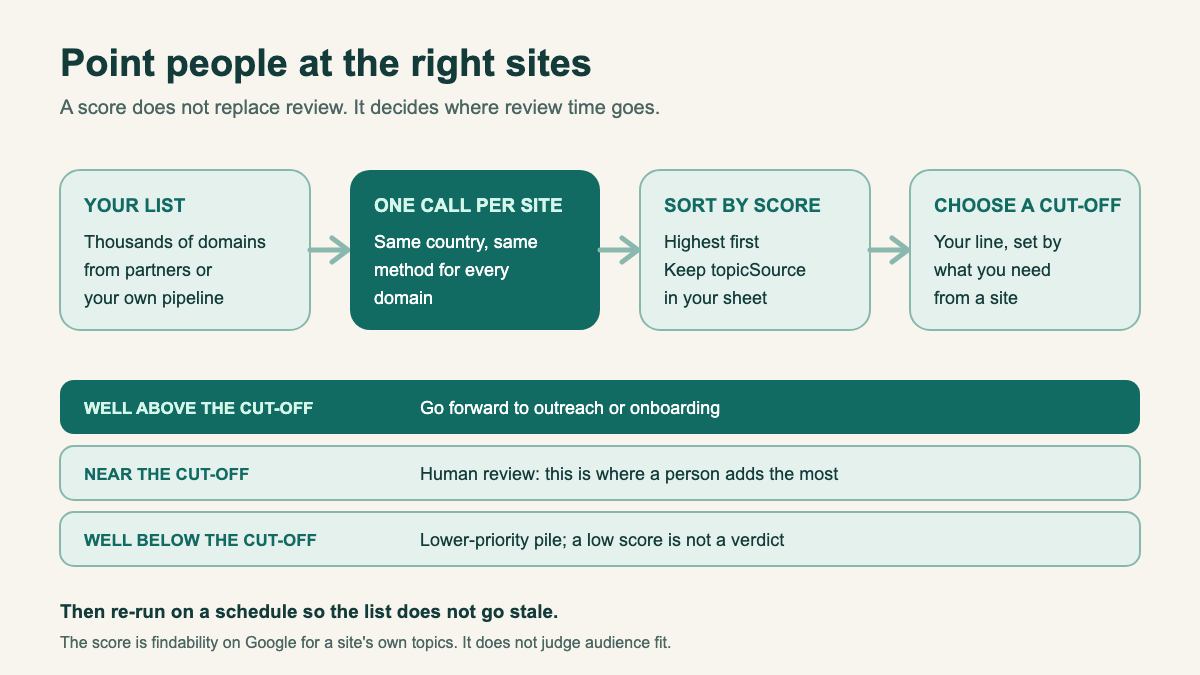
- Prepare the list. One domain per row. A full address is fine; it is reduced to the domain.
- Score every domain for the country you care about, one call per site. Store the whole response, not only the score: you will want
keywords[],searches,topicSourceandlandedDomainlater. - Check
landedDomain. If a domain redirects to another one, the domain it landed on is the one that was scored. For a partner list that is worth knowing: a parked or redirected domain is not the site you thought you were rating. - Sort by
scoreand choose a cut-off. Pick the line by what you need from a site, not by the average. - Split into three groups. Sites well above the cut-off go forward. Sites near it get a person. Sites well below it go to a lower-priority pile, not the bin.
- Re-run on a schedule so the list does not go stale, ideally with fixed topics for the sites you are tracking.
Here is the triage step as code. It was run on 18 November 2026 on the 16 scores from the test below (the four small sites are given placeholder names, because we do not name them), with an illustrative cut-off of 0.40 and a review band of 0.10 either side:
scores = {
    "zalando.de": 0.69, "reisereporter.de": 0.69, "schoener-wohnen.de": 0.63,
    "otto.de": 0.56, "finanztip.de": 0.56, "heise.de": 0.44, "utopia.de": 0.44,
    "eatsmarter.de": 0.38, "nettolohn.de": 0.38, "netzwelt.de": 0.31, "t3n.de": 0.19,
    "small-site-1": 0.06, "small-site-2": 0.06, "small-site-3": 0.06,
    "small-site-4": 0.06, "small-blog": 0.0,
}

CUTOFF, MARGIN = 0.40, 0.10
bands = {"forward": [], "review": [], "low priority": []}
for site, s in sorted(scores.items(), key=lambda kv: -kv[1]):
    if s >= CUTOFF + MARGIN:
        bands["forward"].append(site)
    elif s >= CUTOFF - MARGIN:
        bands["review"].append(site)
    else:
        bands["low priority"].append(site)

for name, sites in bands.items():
    print(f"{name} ({len(sites)}): {', '.join(sites)}")
print(f"average: {sum(scores.values()) / len(scores):.2f}")
forward (5): zalando.de, reisereporter.de, schoener-wohnen.de, otto.de, finanztip.de
review (5): heise.de, utopia.de, eatsmarter.de, nettolohn.de, netzwelt.de
low priority (6): t3n.de, small-site-1, small-site-2, small-site-3, small-site-4, small-blog
average: 0.34Notice that the review band is a third of the list. That is the point: the people on your team spend their time on the five sites where a person’s judgement changes the outcome, instead of reading all sixteen.
A small test: 20 German sites
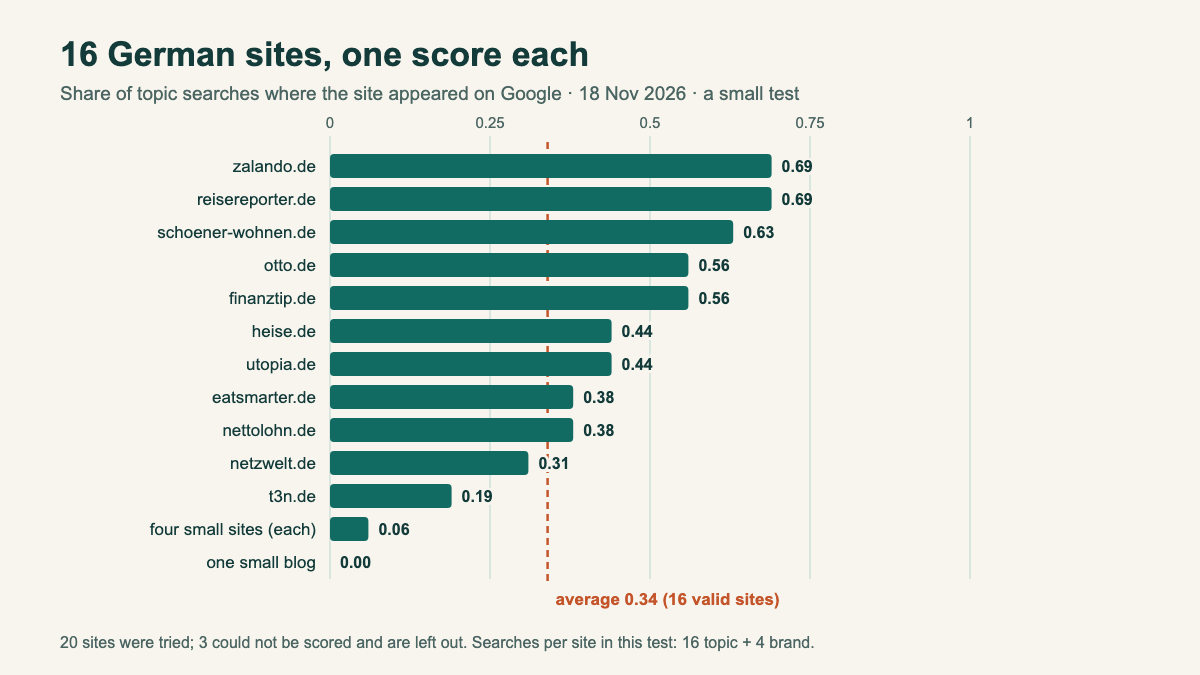
How we tested. On 18 November 2026 we scored 20 German publisher and e-commerce sites, using searches worked out from public information about each domain, 20 searches per site (today’s default is 16, so a current run uses fewer). The table shows the topic score. Three of the 20 sites could not be scored in that test and one had moved to another domain, so the figures below cover the other 16. This is a small test and an illustration, not a benchmark. Re-run it on your own list before you rely on it.
| Site | Topic score |
|---|---|
| zalando.de | 0.69 |
| reisereporter.de | 0.69 |
| schoener-wohnen.de | 0.63 |
| otto.de | 0.56 |
| finanztip.de | 0.56 |
| heise.de | 0.44 |
| utopia.de | 0.44 |
| eatsmarter.de | 0.38 |
| nettolohn.de | 0.38 |
| netzwelt.de | 0.31 |
| t3n.de | 0.19 |
| Four small sites | 0.06 each |
| One small blog | 0.00 |
| Average of the 16 | 0.34 |
What it shows. The ordering is the one you would expect. Large, well-known sites appear for many of their own topic searches, and small ones appear for few. That is a useful check on the method, because it means the number is not random.
What it does not show. It does not say the small sites are weak. A site at 0.06 is findable for one of its roughly 16 topic searches, which says it is small and specialised, not that its audience is wrong for you. It also says nothing about any AI assistant, and 16 sites is far too few to set a benchmark. For comparison, the same day’s default 16-search run on otto.de scored 0.64 against 0.56 here, so expect a few points of movement from the choice of searches alone.
Caveats before you rely on it
- Big sites score higher. Head terms favour size. If your list mixes large and small publishers, compare like with like, or accept that the top of the sort is the big names.
- It is a sample. About 16 searches cannot cover everything a site does. Use it to sort, not to certify.
- It depends on the country. Run each list for the country its audience is in. For how much results shift between countries, see our 40-country rank tracking guide.
- Some sites will not come back with a score. Keep them in their own list and do not treat them as zeros.
- One call is one site. The cost scales with the number of sites, which is what makes it easy to budget. See below.
- It measures findability, not fit. Audience, content quality and brand safety still need a person for the sites that matter.
- It is not an AI-assistant number. If you also want to know how a brand shows up in AI answers, that is a different measurement, covered by the AI Rank API. The two measure different things, so keep them in separate columns.
For a site’s exact position on a specific keyword, a rank tracking call is the better tool. The visibility score is for the wide first pass.
What it costs per 1,000 sites
You pay per site checked. One call covers one site, however many searches run for it, and there is no monthly fee. Pricing follows your deposit tier, like every endpoint; the tiers are explained on the pricing page.
| Tier | Per site | Per 1,000 sites | 15,000 sites |
|---|---|---|---|
| Default | $0.20 | $200 | $3,000 |
| Growth | $0.12 | $120 | $1,800 |
| Scale | $0.07 | $70 | $1,050 |
| Enterprise | $0.04 | $40 | $600 |
| Enterprise Plus | $0.02 | $20 | $300 |
The last column is plain arithmetic: 15,000 times the per-site price, as if every site were billed at that tier’s rate. A monthly list of 5,000 sites at the Scale rate is 5,000 × $0.07 = $350. New accounts get 10 free API calls, shared across every endpoint, with no card required, which is enough to score a few of your own sites and check that the output suits your workflow. You can also try one site in the playground.
Score a few of your own sites first
Pick five sites you already know well, score them for their country, and see whether the order matches your instinct. New accounts include 10 free API calls shared across all endpoints, with no subscription.
Get Your Free API KeyExplore: AI visibility score API · What the score means · Docs · Pricing
FAQ
Does a low score mean a publisher is bad?
No. The score measures how findable a site is on Google for its own topics. A small niche site can be an excellent fit for a campaign and still score low, because it is small. Use the score to decide where people look first, not to reject a site on its own.
Should I let the score work out the searches or send my own?
Leave out topics when your list is mixed and you want each site judged on its own subject. Send topics when you want every site judged on the same questions, or when you want to follow one site over time on a fixed set. Keep topicSource in your sheet so you never sort derived and supplied scores together by accident.
Does the score measure citations by ChatGPT, Gemini or Perplexity?
No. It is the share of about 16 Google searches, for the country you choose, where the site appears. No AI assistant is asked anything.
What does it cost to rate 15,000 sites?
Each site is one call, billed per site checked. At the five tiers that is $3,000 (Default, $0.20 a site), $1,800 (Growth, $0.12), $1,050 (Scale, $0.07), $600 (Enterprise, $0.04) and $300 (Enterprise Plus, $0.02), as if every site were billed at that tier’s rate. There is no monthly fee.
Can I track the same site over several months?
Yes. For a fair comparison, send the same topics every time and use the same country, so a change in the score reflects a change on Google and not a different set of searches.
What if a site comes back without a score?
Plan for it. In our test of 20 sites, 3 could not be scored. Put those in a separate list to re-run later or to look at by hand, and do not treat a missing score as a zero.