AI Visibility Score: What the Number Means and What It Doesn't

The AI visibility score is a number from 0 to 1 for one website. It is the share of about 16 Google searches, picked to match what the site covers, in which the site itself appears. A score of 0.64 means the site showed up in about two thirds of its topic searches.
That is a measure of how findable a site is on Google. It is not a count of how often ChatGPT, Gemini, Perplexity or any other AI assistant mentions or cites the site, and it is not a ranking position or a traffic estimate. This guide explains how the number is built, how to read its two parts, and where it stops being useful. It ends with a real example from our own data.
Short answer: You send a domain and a country. We work out about 16 searches for it (14 topic searches that do not name the brand and 2 that do), run them on Google for that country, and count in how many the site appears. score is the share of the topic searches. brandScore is the share of the brand searches. The score is one number per site, so it is useful for comparing many sites on one scale. See the AI visibility score API.
Why the name says AI
People are asking how visible their sites are in the new generation of search products, and they look for a single score. The name is there so those readers can find the tool. A name is not a method, though, and the method here is Google searches.
We would rather say that in plain words every time than let the name do the explaining. So here is the rule used throughout this page: whenever you see the number, read it as the share of about 16 Google searches where the site appears. If a report or a pitch deck shows the score as proof that an AI assistant mentions a site, it is being misused.
How the score is built in three steps
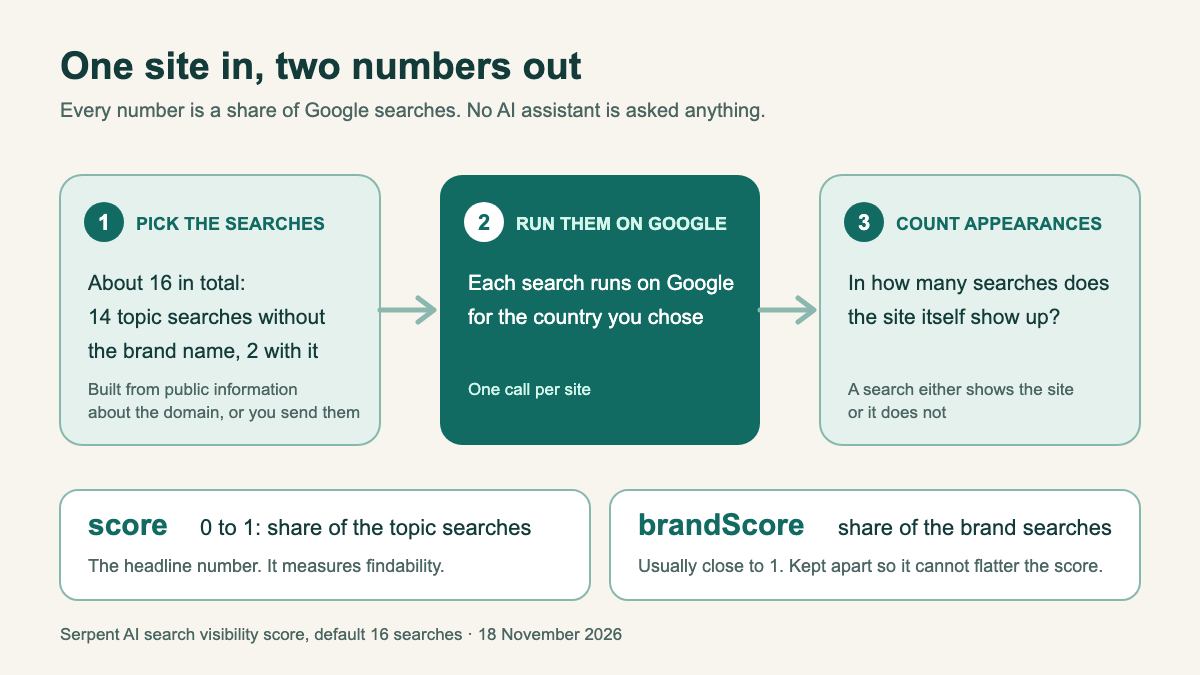
Everything the endpoint does fits in three steps, and the steps are the same for every site.
Step 1: pick about 16 searches
By default the score uses 16 searches: 14 topic searches and 2 brand searches. A topic search is something the site’s audience would type without naming the site, such as “matratze kaufen” for a German online shop that sells mattresses. A brand search names the site, such as “otto uhren”.
If you do not send any searches, they are worked out from public information about the domain. If you send your own, we use exactly those. The field topicSource tells you which happened: derived for worked out, supplied for yours. You can change the total with the keywords parameter, any whole number from 4 to 30.
Step 2: run them on Google for your country
Each search runs on Google for the country you chose. The default is us, and the country list is the same as for web search. Results differ a lot by country, so a score is only meaningful for the country it was run in. For languages, the language parameter takes a two-letter code; it defaults to German for Germany, Austria and Switzerland and to French, Spanish or Italian for France, Spain and Italy, and is otherwise unset.
Step 3: count the appearances
For each search, the question is simple: does the site itself appear in the results? If it does, we also record its best position, counting from 1. If it does not, that search counts as not seen. The score is the share of topic searches where the site appeared. It is not an average position: appearing at position 1 counts the same as appearing lower down in the results.
The two numbers: score and brandScore
score is the headline number. It covers only the topic searches, the ones that do not name the brand, because those are the searches where a site has to earn its appearance. A site that shows up for “matratze kaufen” is findable by people who do not yet know it exists.
brandScore covers the brand searches. It is almost always close to 1, because searching for a brand nearly always finds the brand. We keep it in its own field so nobody mistakes it for visibility. If it were blended into the headline, every site would look better than it is.
| Field | What it counts | How to use it |
|---|---|---|
score | Share of the topic searches where the site appeared (0 to 1) | Sort and compare sites on this |
brandScore | Share of the brand searches where the site appeared (0 to 1) | A check that the site is findable by name; rarely a way to rank sites |
keywords[] | Each search, with answered, appeared and bestPosition | Show your reader why a site got its score |
searches | run and answered: how many searches were run and answered | Spot a score built on fewer searches than planned |
topicSource | derived or supplied | Keep it beside the score so you know what you are comparing |
landedDomain | Empty, unless the domain redirects to another one | If set, that other domain is the one that was scored |
A worked example: otto.de
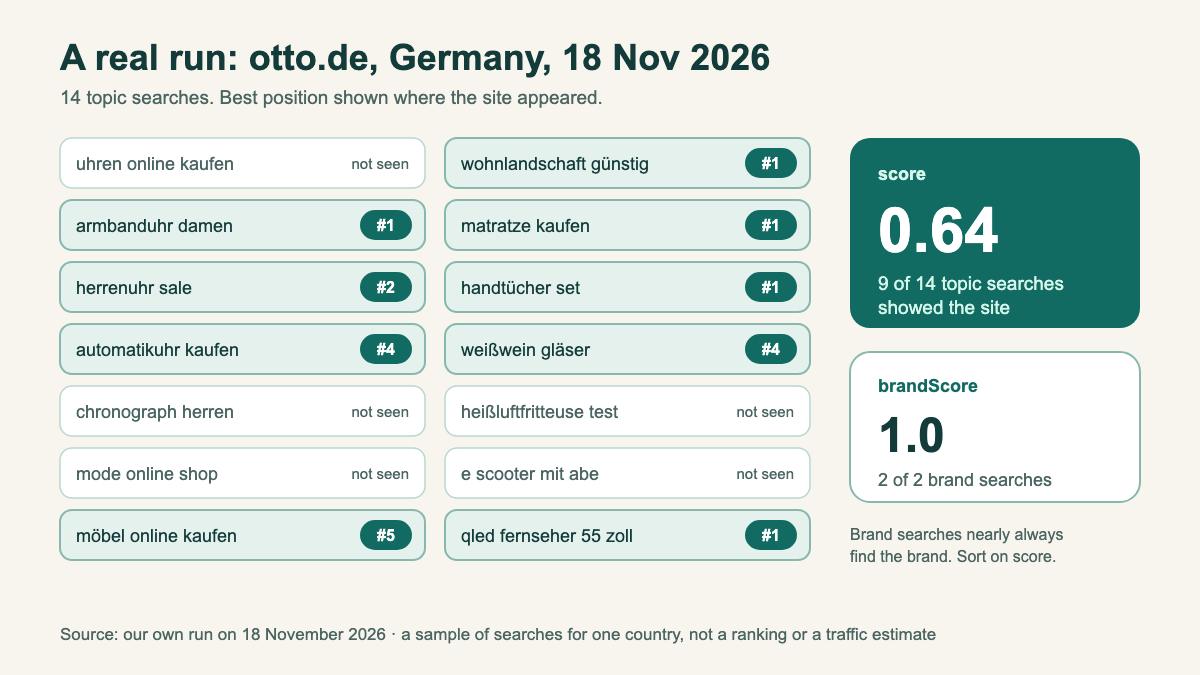
Here is a real run from our own data, for the German online retailer otto.de, with the default of 16 searches on 18 November 2026. The searches were worked out from public information about the domain, so topicSource is derived.
The response, shortened to three of the 16 searches and without the timing block:
{
  "success": true,
  "domain": "otto.de",
  "landedDomain": null,
  "topicSource": "derived",
  "score": 0.64,
  "brandScore": 1.0,
  "keywords": [
    { "q": "uhren online kaufen", "type": "topic", "answered": true,
      "appeared": false, "bestPosition": null },
    { "q": "matratze kaufen", "type": "topic", "answered": true,
      "appeared": true, "bestPosition": 1 },
    { "q": "otto uhren", "type": "brand", "answered": true,
      "appeared": true, "bestPosition": 1 }
    /* ...13 more searches... */
  ],
  "searches": { "run": 16, "answered": 16 }
}
Read it from the bottom up. All 16 searches were answered, so nothing is missing. Of the 14 topic searches, otto.de appeared in 9 (“armbanduhr damen”, “herrenuhr sale”, “automatikuhr kaufen”, “möbel online kaufen” and five more) and was not seen in 5, including “uhren online kaufen” and “heißluftfritteuse test”. Nine of 14 is 0.643, shown as 0.64. Both brand searches showed it, so brandScore is 1.0.
The useful part is the list of misses. A score alone says “about two thirds”. The per-search rows say where the gaps are: in this run, mostly some watch, fashion and small-electronics terms. That is a conversation you can have with a client, which a single number is not.
Calling it and checking the arithmetic
The endpoint is a plain GET with your key in a header. The domain can be a bare domain such as otto.de, or a full address such as https://www.otto.de/page, which is reduced to the domain.
curl -H "X-API-Key: YOUR_API_KEY" \
  "https://api.apiserpent.com/api/visibility/score?domain=otto.de&country=de"
To send your own searches, add them to the same request: &topics=matratze%20kaufen,handt%C3%BCcher%20set. The response has the same shape either way.
Because every search is in the response, you can recompute the headline yourself. This short script was run on the real example above, saved to a file, and checks the score against the rows:
import json

with open("example-response.json") as f:
    data = json.load(f)

topic = [k for k in data["keywords"] if k["type"] == "topic" and k["answered"]]
brand = [k for k in data["keywords"] if k["type"] == "brand" and k["answered"]]
seen = [k for k in topic if k["appeared"]]

print(f"topic: {len(seen)} of {len(topic)} appeared -> {len(seen) / len(topic):.2f}")
print(f"brand: {sum(k['appeared'] for k in brand)} of {len(brand)} appeared")
print("fields:", data["score"], data["brandScore"])
Output, run on 18 November 2026:
topic: 9 of 14 appeared -> 0.64
brand: 2 of 2 appeared
fields: 0.64 1.0
If you ever want to show a customer how a score was reached, this is the whole method in four lines.
What the score is not
- Not a count of AI assistant mentions or citations. No AI assistant is asked anything. If you need to know what a particular assistant says about a brand, that is a different number, covered by the AI Rank API. The two numbers measure different things and should not be added together or swapped. Our guide to AI visibility scoring goes into the second one.
- Not a ranking position. Appearing at position 1 and at position 9 both count as appearing. For one site’s exact position on one keyword, use rank tracking.
- Not a traffic estimate. A site can appear for a search and get few clicks, or get clicks without appearing in our sample.
- Not a verdict on quality. A small niche site can be exactly right for an audience and still score low.
Honest limits
It is a sample. About 16 searches cannot cover everything a site is about. Treat the score as a good comparison number, not an exact measurement.
You can see this in our own data. In a separate small test on the same day, otto.de scored 0.56 on 20 searches per site, against 0.64 in the worked example above. The searches were not identical, so a few searches more or fewer moved the number. If you want to compare one site with itself over time, send the same topics every time, so any change comes from Google and not from a different set of searches.
Big sites score higher. Large, well-known sites appear for more generic topic searches. In that test, zalando.de scored 0.69 and four small sites scored 0.06. That tells you who is more findable. It does not tell you who is better.
It depends on the country. The same domain can score very differently in two countries. Pick the country your audience is in. For a wider look at country differences, see rank tracking across 40 countries.
Some sites cannot be scored. In that test, 3 of the 20 sites could not be scored and one had moved to another domain, and the average of 0.34 is across the other 16. If you are scoring a long list, plan for some sites to come back without a score and re-run them later or look at them by hand.
One call is one site. Each call covers one domain, for one country, at one moment.
Derived or supplied searches
When you leave out topics, each site is judged on searches that fit what it covers. That is the right choice when you have a mixed list and you want each site judged on its own subject. A gardening blog and a travel magazine each get their own questions.
When you send topics, every site is judged on the same questions. That is the right choice when you care about one subject, or when you want to track a site over time on a fixed set. The cost is that a site that does not cover your topics will score low through no fault of its own. The next guide, rating thousands of publisher sites, goes into when to use which at scale.
When it is the right tool
- You have a long list of sites and need one comparable number for each, so people can start with the most promising ones.
- You want to check a niche: score a handful of sites in the same space and see who is findable for the shared topics.
- You want to watch a site over time with a fixed set of searches.
- You want a quick first look before a closer review.
It is the wrong tool if you need an exact position for a keyword, an answer about what any AI assistant says today, or a traffic forecast.
What it costs
You pay per site checked. One call is one site, however many searches run for it. The price falls with your deposit tier, like every endpoint, and there is no monthly fee.
| Tier | Per site checked | Per 1,000 sites |
|---|---|---|
| Default | $0.20 | $200 |
| Growth | $0.12 | $120 |
| Scale | $0.07 | $70 |
| Enterprise | $0.04 | $40 |
| Enterprise Plus | $0.02 | $20 |
The tiers are the same ones as on the pricing page. New accounts get 10 free API calls, shared across every endpoint, with no card required, so you can score a few of your own sites before you deposit anything. You can also try it in the playground.
Score one site and read both numbers
Send a domain and a country, then look at the per-search rows, not only the headline. New accounts include 10 free API calls shared across all endpoints, with no subscription.
Get Your Free API KeyExplore: AI visibility score API · Playground · Docs · Pricing
FAQ
Does the AI visibility score count mentions in ChatGPT, Gemini or Perplexity?
No. It does not ask any AI assistant anything. The score is the share of about 16 Google searches where the site itself appears in the results, so it measures findability on Google. A different tool is needed to find out what an AI assistant says about a site.
What is a good score?
There is no universal good score. A large retailer that appears for most of its topics will score far higher than a small niche blog that is excellent for its audience. Compare sites in the same niche and country, and use the same method for each. In our small test of 20 sites on 18 November 2026, the average score across the 16 sites that could be scored was 0.34.
Why is brandScore a separate number?
Searches that name the brand almost always show the brand, so that number sits close to 1 for most sites. Mixed into the headline it would make every site look more visible than it is. Sort and compare on score, and read brandScore as a sanity check that the site is findable by name.
Can I send my own searches instead of letting the score work them out?
Yes. Send them in the topics parameter, comma-separated, up to 30 phrases of 2 to 100 characters each. The score is then calculated on exactly those searches and topicSource reads supplied. Without it, the searches are worked out from public information about the domain and topicSource reads derived.
What happens if some searches cannot be answered?
The score uses the searches that were answered, and searches.answered is lower than searches.run, so you can see it.
Is one call one search or one site?
One call is one site, however many searches run for it. The price is per site checked.