People Data Labs Pricing, Explained With 5 Alternatives

People Data Labs has a free plan of 100 credits a month and a Pro plan from $98 a month for 350 credits, about $0.28 per record. Enrichment is charged per match and search per record returned. Any volume above Pro’s entry point is priced by quote, with 20% off for annual terms.
Short answer: If you need work emails and phone numbers for people you can only describe by name, title or company, People Data Labs (or Apollo, Crustdata) is the right kind of tool — budget about $0.28 a record at the entry price and ask for a quote above that. If you need public LinkedIn profiles and company pages you can point at by URL, at volume, a per-lookup API costs roughly $0.49 to $1.50 per 1,000 records: Serpent API (from $0.49 per 1,000 lookups — pay as you go, no subscription) or Bright Data. For large attribute searches with published credit prices, Coresignal.
What does People Data Labs cost?
People Data Labs (PDL) publishes three plans: Free, Pro and Enterprise. Only the bottom of the price curve is public. Here is what the pricing page and its person and company sub-pages said on 20 November 2026.
| Plan | Price | Volume | Notes |
|---|---|---|---|
| Free | $0 | Up to 100 credits a month | Emails, phone numbers and addresses are obfuscated |
| Pro | From $98 a month | From 350 credits a month | Contact data, CSV enrichment, email support, monthly or annual billing (premium fields: included on the plan card, an add-on in the comparison table) |
| Enterprise | Custom | Custom | Annual contracts, all APIs, data licence feeds, SSO |
Two details on those pages matter for budgeting.
First, PDL says to “Save 20% and access all of the data upfront with annual commitments”, and that “discounts trigger as your usage grows”, but it does not print the discounted prices. Second, the company pricing page disagrees with itself: its plan card says Pro is $100 a month starting at 1,000 monthly records, while its comparison table repeats $98 for 350. That is either $0.10 or $0.28 per company record. Ask PDL which applies before you sign.
So the honest answer to “how much does PDL cost” is: about $0.28 a person record at the entry price, and whatever your quote says above it. The rest of this guide shows how to estimate that quote and what you could pay elsewhere.
What uses a credit?
A credit is used when PDL returns data, not when you ask. The API reference states the rules endpoint by endpoint, and they differ in one important way.
- Person Enrichment (you send an email, a LinkedIn URL or a name plus company, and get one profile back): the reference says “We charge per match.” A match returns HTTP 200; no match returns 404. A
min_likelihoodparameter sets how confident a match must be to count. - Company Enrichment: also per match, per its reference.
- Person Search (you describe people by title, company, location and so on): the reference says “We charge per record retrieved”, and each person in the response counts as one credit. One request can return 1 to 100 records, set by
size.
The search rule is where budgets go wrong. A search with size=100 costs 100 credits if it fills, which is a third of the 350-credit entry plan in one call. Start every new search at a small size, check the records, then widen.
Rate limits are the other half of the cost. The references list 100 enrichment requests a minute for free accounts and 1,000 for paying customers, but a default of 10 requests a minute for Person Search. If your workload is mostly search, that ceiling, not the price, may set your speed.
Freshness is set by PDL’s release cycle. Its changelog lists version 36.1 on 17 November 2026, its release history runs roughly monthly, and it counts 818,832,390 resume records and 77,478,104 company records in that build. A person who changed jobs last week may not show it until a later release.
What does a record cost at your volume?
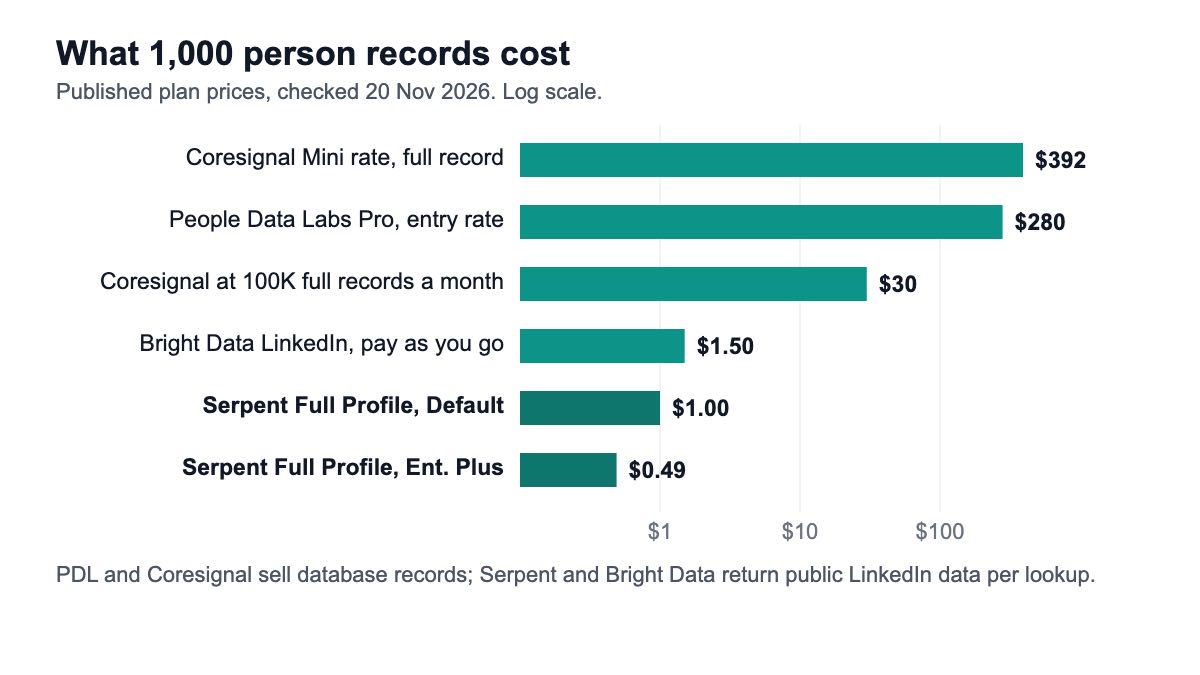
At 100,000 person records a month, published prices run from under $1 per 1,000 to about $30 per 1,000, and PDL’s own price at that volume is not published. The table normalises each option to dollars per 1,000 records at three monthly volumes.
The rules: a subscription is priced at the smallest plan that covers the volume. Coresignal is shown for its “full” employee record at 20 credits, per its pricing page. A cell no vendor page supports says “Unverified”.
| Option (record) | 1,000 / month | 100,000 / month | 1,000,000 / month | Model |
|---|---|---|---|---|
| People Data Labs Pro (person record, per match) | Unverified above 350 credits ($280 at the entry rate) | Unverified (quote) | Unverified (quote) | Monthly or annual plan |
| Coresignal (full employee record, 20 credits) | $499 (Pro plan) | $30 (Scale, $3,000) | Unverified (above Elite’s 10M credits) | Monthly plan |
| Crustdata (person enrich, 1–4 credits) | Unverified ($ per credit not published) | Unverified | Unverified | Credits; $20 free to start |
| Apollo (people enrichment) | Unverified (API on Custom plans) | Unverified | Unverified | Per-seat plans |
| Bright Data LinkedIn scraper (per record) | $0 (5,000 free a month) | $1.50 (pay as you go) | $1.30 (Scale, $499 incl. 384,000) | Pay as you go or plan |
| Serpent API — LinkedIn Full Profile (per lookup) | $1.00 / $0.90 / $0.70 / $0.60 / $0.49 per 1,000 (Default / Growth / Scale / Enterprise / Enterprise Plus), at any volume | Pay as you go, no subscription | ||
| Serpent API — LinkedIn Company (per lookup) | $1.00 / $0.90 / $0.70 / $0.60 / $0.49 per 1,000 | Pay as you go, no subscription | ||
| Serpent API — LinkedIn Profile Search, BETA (per search, up to 10 candidates) | $1.00 / $0.90 / $0.70 / $0.60 / $0.49 per 1,000 searches | Pay as you go, no subscription | ||
Serpent API tiers follow deposit size ($100 Growth, $500 Scale, $1,000 Enterprise, $1,250 Enterprise Plus); see pricing. Bright Data figures come from its LinkedIn scraper page.
The spread reflects what you buy.
A PDL or Coresignal record is a merged profile from a large database, with contact fields on paid plans. A per-lookup API returns the public LinkedIn profile or company page you point it at. If you need the first, the cheap rows do not replace it. If you need the second, the expensive rows are overkill.
Coresignal’s own pricing has a cliff worth knowing about: a core employee record is 10 credits and a full one 20, and the price per credit falls from about $0.02 on Mini to $0.0005 on Elite. At the Mini rate ($49 for 2,500 credits), 1,000 full records would cost $392. Our Coresignal pricing breakdown works through its tiers.
Why do teams look at PDL alternatives?
Most teams who shop around are not unhappy with the data quality. They want a published price at their volume, fresher records or a faster search limit. Here is what the evidence supports, and what it does not.
- The price above Pro is a quote. PDL publishes the entry point and the 20% annual discount, nothing between Pro and Enterprise. For a team planning 100,000 records a month, that means a sales call before a budget.
- Search is slow by default. Ten Person Search requests a minute is 600 an hour. At 100 records per request that is still 60,000 records an hour, but only if every request fills.
- Records follow a release cycle. Job changes reach PDL’s dataset through its release cycle. Crustdata, a competitor, builds its alternatives page on this point (“PDL updates its datasets monthly”); PDL’s changelog shows a roughly monthly release history.
- Free-plan contact data is masked. You cannot judge email quality on the free plan, because emails, phones and addresses are obfuscated there.
On reviews, the sample is too small to mean much. PDL’s Trustpilot page shows a 2.5 score from just 5 reviews; the newest, from 5 November 2026, complains about support and invoicing. Five reviews is an anecdote, not a rating, so weigh it lightly.
One former alternative is gone. Proxycurl, often named next to PDL for LinkedIn profiles, closed in 2025: its maker wrote “Today, we are shutting Proxycurl down” on 4 July 2025. Our Proxycurl alternatives guide covers what replaced it.
Five alternatives, by what they are good for
1. Coresignal — best for attribute search with published credit prices
Coresignal publishes every self-service tier: Mini $49 for 2,500 credits, Starter $199 for 12,000, Pro $499 for 35,000, Growth $1,000 for 150,000, Premium $1,500 for 1,000,000, Scale $3,000 for 4,000,000 and Elite $5,000 for 10,000,000. An employee or company record costs 10 credits (core) or 20 (full), a job posting 1, and an email found 10.
Pick it if you want to search employees and companies by attributes and need a price you can read before a sales call. The catch: small plans are dear per record; the per-credit price only drops sharply from Premium up.
2. Crustdata — best for fresher, signal-driven data
Per its pricing page, Crustdata gives $20 of credits to start. People search costs 0.03 credits per result, people enrichment 1 to 4 credits depending on the fields, company enrichment 2 credits, and live enrichment 7. Contact data and live search are sold through sales.
Pick it if you care about job changes and hiring signals soon after they happen. The catch: the page does not state what a credit costs in dollars, so you cannot price a volume without talking to them.
3. Apollo — best when the data feeds a sales team
Apollo is a sales platform with a contact database, sequences and a dialer. Its pricing page is clear on one point for developers: “API access is available on Custom plans.” Credits are pooled per team and do not roll over.
Pick it if the people you enrich go straight into outreach. The catch: it is priced per seat for sales users, and API use needs a custom contract.
4. Bright Data LinkedIn scraper — best for very large public-profile pulls
Bright Data lists $1.50 per 1,000 records pay as you go, a $499 monthly plan with 384,000 records and $1.30 per 1,000 after that, and a free tier of 5,000 records a month. It covers people profiles, companies, jobs and posts, and you pay only for successful deliveries.
Pick it if you need hundreds of thousands of public profiles a month and like a plan. The catch: one rate covers all record types, and the page does not say what counts as one record for each. Our Bright Data LinkedIn pricing guide goes deeper.
5. Serpent API LinkedIn — best for pay-as-you-go lookups by URL or name
Serpent API returns public LinkedIn data per call. The Full Profile endpoint takes a profile URL or username and returns identity, summary, experience history, education, photo and follower and connection counts. The Company endpoint returns firmographics such as industry, size, headcount, headquarters and specialities. The Profile Search endpoint (in beta) turns a name, with optional company, title and location, into up to 10 candidate profiles.
All three are from $0.49 per 1,000 calls — pay as you go, no subscription — and a new account gets 10 free API calls. The usual pattern is search by name, pick the right candidate, then call Full Profile with its identifier. Our guide to choosing the company or the profile endpoint shows which call answers which question.
Pick it if you have LinkedIn URLs, or names plus companies, and want public profile and company data without a contract. Pair it with PDL or Apollo when the same records also need work emails and phone numbers.
Which kind of people data do you need?
Choose by the input you have and the field you need, not by vendor fame. Four questions sort almost every case.
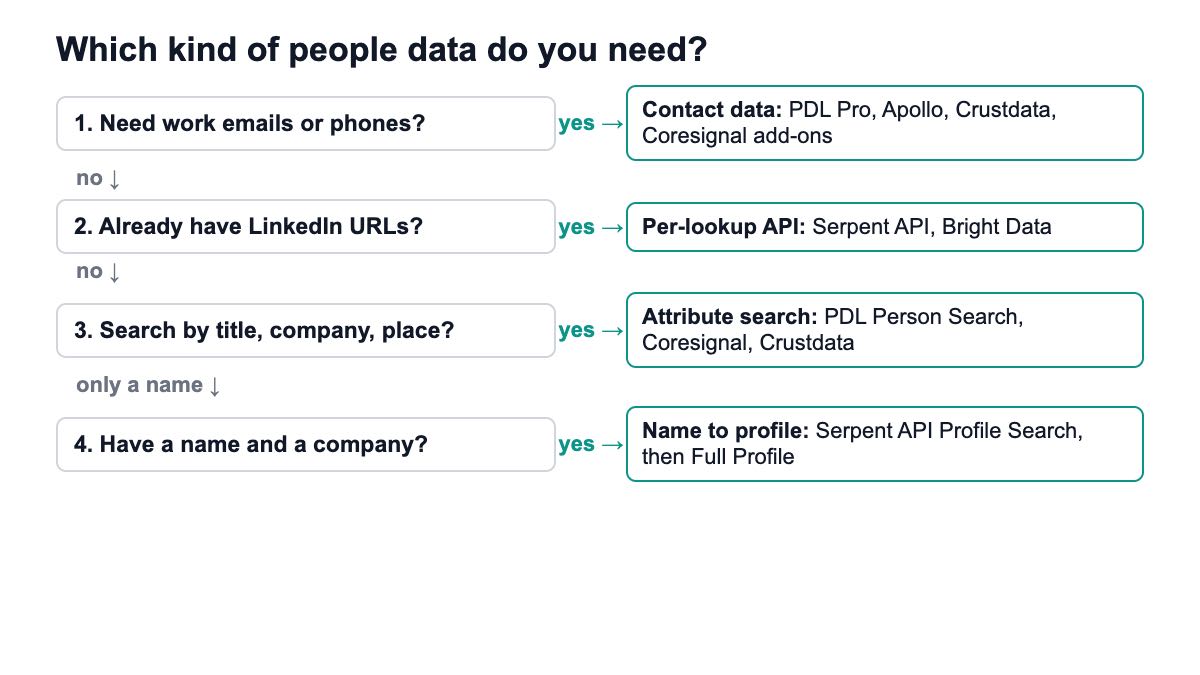
- Do you need work emails or phone numbers? Then you need a contact database: PDL Pro, Apollo, Crustdata’s contact add-ons or Coresignal’s email credits. Expect to pay more per record than for a public-profile lookup.
- Do you already have LinkedIn URLs? Then a per-lookup API is the cheapest route to public profile data: Serpent API or Bright Data, roughly $0.49 to $1.50 per 1,000 records.
- Do you need to find people by title, company or location? That is attribute search: PDL Person Search, Coresignal or Crustdata.
- Do you only have a name and a company? Resolve the name to a profile first, with Serpent API’s Profile Search, then fetch the profile.
For firmographics on a list of accounts, our Python guide to enriching leads with company data shows the whole loop. If compliance is part of the decision, read our summary of the legal position on public LinkedIn data.
Which one should you pick?
- A startup enriching sign-ups with work email and title: PDL Pro, from $98 a month. Start with Person Enrichment, which only charges for matches.
- A data team searching millions of employees by attribute: Coresignal for published prices, or ask PDL and Crustdata for quotes and compare at your exact volume.
- A sales team that will email the results: Apollo.
- A product that refreshes public LinkedIn profiles or company pages it already knows: Serpent API for pay-as-you-go lookups, or Bright Data on a plan at very high volume.
- A recruiter who has names, not URLs: Serpent API Profile Search, then Full Profile.
For the wider market of LinkedIn-focused APIs, our best LinkedIn data APIs comparison prices each one per 1,000 calls.
How we checked this
I read People Data Labs’ pricing pages (main, person, company), its API references for person enrichment, person search and company enrichment, and its changelog on 20 November 2026. On the same day I read the live pricing pages of Coresignal, Crustdata, Apollo and Bright Data, Nubela’s Proxycurl announcement, PDL’s Trustpilot page and Crustdata’s PDL alternatives article. Serpent API prices and endpoints come from our pricing page and docs that day.
Sources: 13 official vendor pages and docs, 1 review site, 1 competitor article. No API calls were made; every per-1,000 figure is list-price arithmetic with the rules stated above the table. I could not open G2, Capterra or Vendr pages for PDL, and I could not run a fresh search for the current top-ranking pages, so the pages compared here are the ones I could identify and open.
What we could not verify: any PDL price above the Pro entry point; which of PDL’s two company Pro prices is current; whether a person-enrichment 404 is always free (the reference says “per match”); Crustdata’s dollar price per credit; Apollo’s API price; Coresignal pricing above 10 million credits; Mini’s credit count (its plan box says 2,500, its table 2,000; we use 2,500); and whether Bright Data’s 5,000 free records also apply on pay as you go (the table assumes they do not). A second fact-check pass re-opened 15 of the cited pages on 20 November 2026.
Look up public LinkedIn profiles per call
Serpent API’s LinkedIn profile, company and profile-search calls are from $0.49 per 1,000 — pay as you go, no subscription. Sign up for 10 free API calls and compare a few records with what you get today.
Get Your Free API KeyExplore: LinkedIn API · Playground · Docs · Pricing
FAQ
Is People Data Labs free?
There is a free plan with up to 100 credits a month and no commitment. Its limit is the data, not only the volume: on the free plan, emails, phone numbers and addresses are obfuscated, so you cannot test contact quality there. Free accounts also get a lower enrichment rate limit, 100 requests a minute against 1,000 for paying customers. It is enough to test matching and the record shape before you pay.
How much does People Data Labs cost per record?
At the published entry price, Pro is $98 a month for 350 credits, which is about $0.28 per credit, and an enrichment match or a search result uses one credit. The company pricing page also shows $100 a month for 1,000 records, about $0.10, so confirm which applies to you. Above the entry point PDL quotes prices, with discounts as usage grows and 20% off annual terms.
Does People Data Labs charge for no-match lookups?
The enrichment references say “We charge per match”, and a lookup with no match returns HTTP 404, so a miss should not use a credit on Person or Company Enrichment. Search is different: it charges per record retrieved, so a search that returns 100 people uses 100 credits. Set the size parameter low while you test, and raise min_likelihood on enrichment to avoid paying for weak matches.
How often is People Data Labs data updated?
PDL’s changelog shows roughly monthly dataset releases and lists version 36.1 on 17 November 2026. A change such as a new job may therefore take until a later release to appear. PDL’s homepage says its job posting data is refreshed daily, which is a separate product. If you already know the profile URL, a per-lookup API is another way to read the public profile when you need it.
What is a cheaper alternative to People Data Labs?
It depends on what you need. For contact data, Coresignal publishes lower per-credit prices at high volume, and Crustdata and Apollo sell by quote or plan. For public LinkedIn profiles and company pages you can name by URL, per-lookup APIs are far cheaper: Bright Data lists $1.50 per 1,000 records, and Serpent API’s Full Profile is from $0.49 per 1,000 — pay as you go, no subscription (pricing).
Is Proxycurl still an alternative to PDL?
No. Nubela, the company behind Proxycurl, announced on 4 July 2025 that it was shutting Proxycurl down, so it is no longer an option for new projects. Teams that used it for LinkedIn profile and company lookups need another per-lookup API or a database vendor such as PDL or Coresignal. Our Proxycurl alternatives guide compares the replacements.
Sources
Official pricing and docs (checked 20 November 2026):
- People Data Labs — Pricing
- People Data Labs — Person pricing
- People Data Labs — Company pricing
- PDL docs — Person Enrichment reference
- PDL docs — Person Search reference
- PDL docs — Company Enrichment reference
- PDL docs — Changelog
- People Data Labs — Home
- Coresignal — Pricing
- Crustdata — Pricing
- Apollo — Pricing
- Bright Data — LinkedIn scraper
- Nubela — Goodbye, Proxycurl (4 July 2025)
Reviews and third-party articles (checked 20 November 2026):