Coresignal alternatives, matched to why you are leaving

The best Coresignal alternative depends on why you are leaving. For small or bursty volumes, a per-call LinkedIn API such as Bright Data or Serpent API costs far less per record. For job postings, TheirStack; for phones and emails, a contact-data tool; for history and bulk files, staying on Coresignal is usually right.
Short answer: Under about 100,000 company records a month, pick a per-call API: Serpent API (LinkedIn company lookups from $0.49 per 1,000 — pay as you go, no subscription; pricing) or Bright Data ($1.50 per 1,000). For job-posting feeds, TheirStack. For headcount history and bulk files at scale, stay on Coresignal at Premium or above.
This page is about switching. If you want the line-by-line teardown of Coresignal's own plans, read Coresignal pricing explained. If you want a ranked list of every LinkedIn data provider, read the best LinkedIn data APIs.
Here I start from the reason you are unhappy and work towards the tool that removes it. We sell one of the options below, so every price is linked to the vendor's own page and dated.
Why do teams look for a Coresignal alternative?
Mostly cost at low volume, credits that reset every month, and a data shape that does not match the job. Coresignal is a good product for data teams that pull a lot of records. It gets uncomfortable for everyone else.
Here are the reasons that come up again and again, with what the evidence actually says.
1. The entry plans are expensive per record
Coresignal sells monthly credit plans. Mini is $49 for 2,500 credits, Starter is $199 for 12,000, Pro is $499 for 35,000 and Growth is $1,000 for 150,000 (Coresignal pricing, checked 20 Nov 2026). A full company record costs 20 credits and a "core" record costs 10.
Do the division and Mini buys 125 full company records or 250 core ones. Pulling 1,000 core company records a month needs Starter, which works out to $199 per 1,000 records. The price per record only becomes competitive at Premium ($1,500 for 1,000,000 credits) and above. If your volume is small or irregular, you pay the steep end of the ladder every month.
2. Monthly credits reset
On monthly plans, Coresignal credits "are valid for one billing cycle and reset each month", with a three-month rollover only on Premium, Scale and Elite (Coresignal FAQ). TheirStack's comparison page lists the same point as a reason to switch. A team that needs 30,000 records in March and 2,000 in April pays for capacity it does not use.
3. You wanted live data, not a database snapshot
This one is often overstated. Coresignal's datasets update daily, weekly or monthly depending on the contract, but its FAQ says the database behind its APIs "is refreshed in real time", and it now sells a Real-time Employee API that fetches a profile at request time for 12 credits (Coresignal docs, pricing). Crustdata's alternatives article says Coresignal "delivers most dataset updates monthly by default", which is true of the datasets and not of the APIs. If freshness is your complaint, check which product you are on before you switch.
4. You needed contact data
Coresignal is a company, employee and jobs data company. ZoomInfo's alternatives article points out that it "lacks verified business phone numbers". If your sales team needs dial-ready phones, Coresignal was never the right tool, and no LinkedIn data API will be either. You want a contact-data platform.
5. The tool is built for engineers
Coresignal's search runs on an Elasticsearch-style query language. That is great for a data engineer and a wall for a sales operations team. Several of the top-ranking articles, including ZoomInfo's, note the lack of native CRM connectors. If the people using the data do not write code, a tool with a user interface may fit better.
Which alternative fixes which problem?
Match the reason to the tool. The table below names one fix per pain, and the figure shows the same map at a glance.
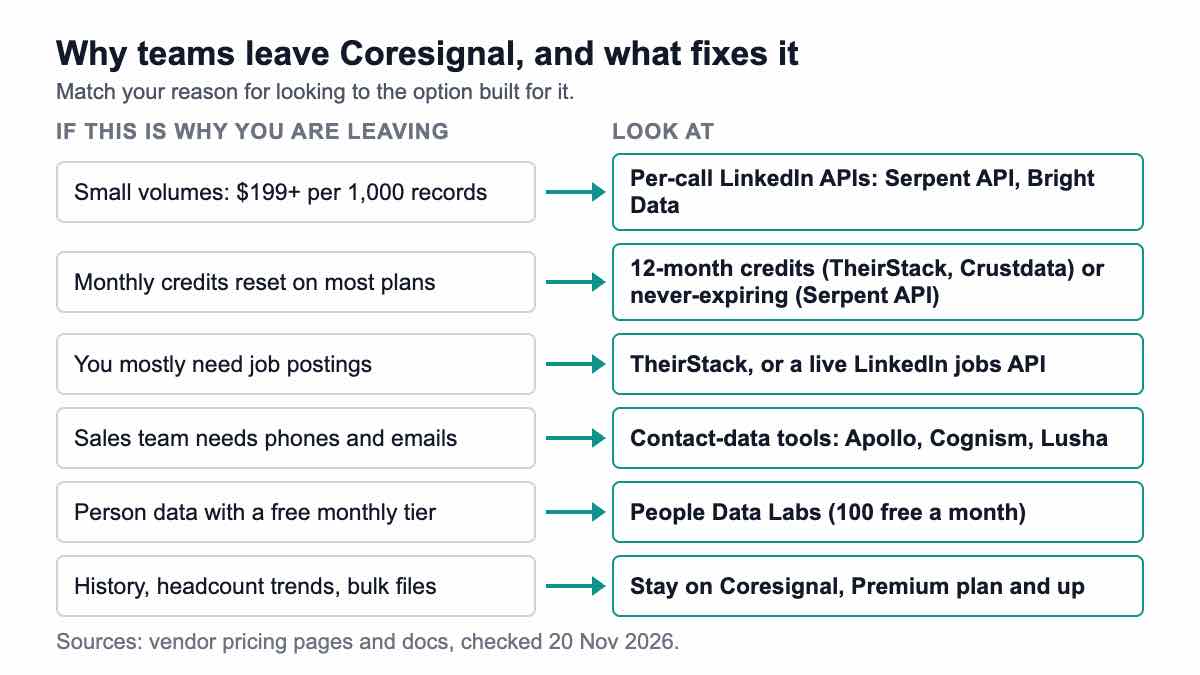
| Option | Record types | How you pay | Free to try | Credit life | Fixes |
|---|---|---|---|---|---|
| Serpent API | LinkedIn company, profile, jobs, job detail, posts | Per call, prepaid balance | 10 free API calls | Deposited credits never expire | Small or bursty volume |
| Bright Data Web Scraper API | LinkedIn company, profile, posts and more | Per record, pay as you go or $499/month plan | 5,000 records a month | Monthly plan | Small volume, wide site coverage |
| TheirStack | Jobs, companies, technographics | Monthly credit plans | 200 API credits a month | Paid credits roll over 12 months | Jobs feeds, expiring credits |
| People Data Labs | Person and company enrichment | Monthly plan per record | 100 records a month | Monthly plan | Person enrichment, free tier |
| Crustdata | Company, person, jobs, live endpoints | Credits | $20 in credits | 12 months | Signals and live data (enterprise) |
| Apify community actors | Varies by actor | Per result | Apify free credit | Pay per run | One-off scrapes |
| Apollo, Cognism, Lusha | Contacts: emails, phones | Per seat | Small free tiers | Per plan | Phones for sales teams |
| Coresignal (stay) | Company, employee, jobs, history, datasets | Monthly credit plans | 7-day trial | One cycle; 3 months on Premium+ | History and bulk |
What does a company record cost at your volume?
At 10,000 company records a month, the gap between a credit plan and a per-call API is close to a hundred times. At 100,000 it narrows a lot. Here is one job, priced three ways: pull N company records a month, buying the cheapest single plan that covers the month.
The rules I used: list prices, monthly billing, no annual discount, and the smallest plan whose credits cover the whole month. Coresignal's core company record is 10 credits and the full record is 20. TheirStack charges 3 credits per company.
Bright Data's pay-as-you-go rate is $1.50 per 1,000 records, and its $499 Scale plan includes 384,000 records (Bright Data pricing). People Data Labs lists its Company Pro plan at $100 a month for 1,000 records and does not publish a rate above that (PDL company pricing).
| Option | 1,000 a month | 10,000 a month | 100,000 a month |
|---|---|---|---|
| Coresignal, core record (10 credits) | $199.00 (Starter) | $100.00 (Growth) | $15.00 (Premium) |
| Coresignal, full record (20 credits) | $499.00 (Pro) | $150.00 (Premium) | $30.00 (Scale) |
| TheirStack (3 credits a company) | $100.00 ($100 plan) | $40.00 ($400 plan) | $12.00 ($1,200 plan) |
| People Data Labs, Company Pro | $100.00 | Unverified | Unverified |
| Bright Data Web Scraper API | $1.50 | $1.50 | $1.50 |
| Crustdata (2 credits a company) | Unverified | Unverified | Unverified |
| Serpent API, LinkedIn Company | $1.00 Default · $0.90 Growth ($100 deposit) · $0.70 Scale ($500) · $0.60 Enterprise ($1,000) · $0.49 Enterprise Plus ($1,250), flat at every volume | ||
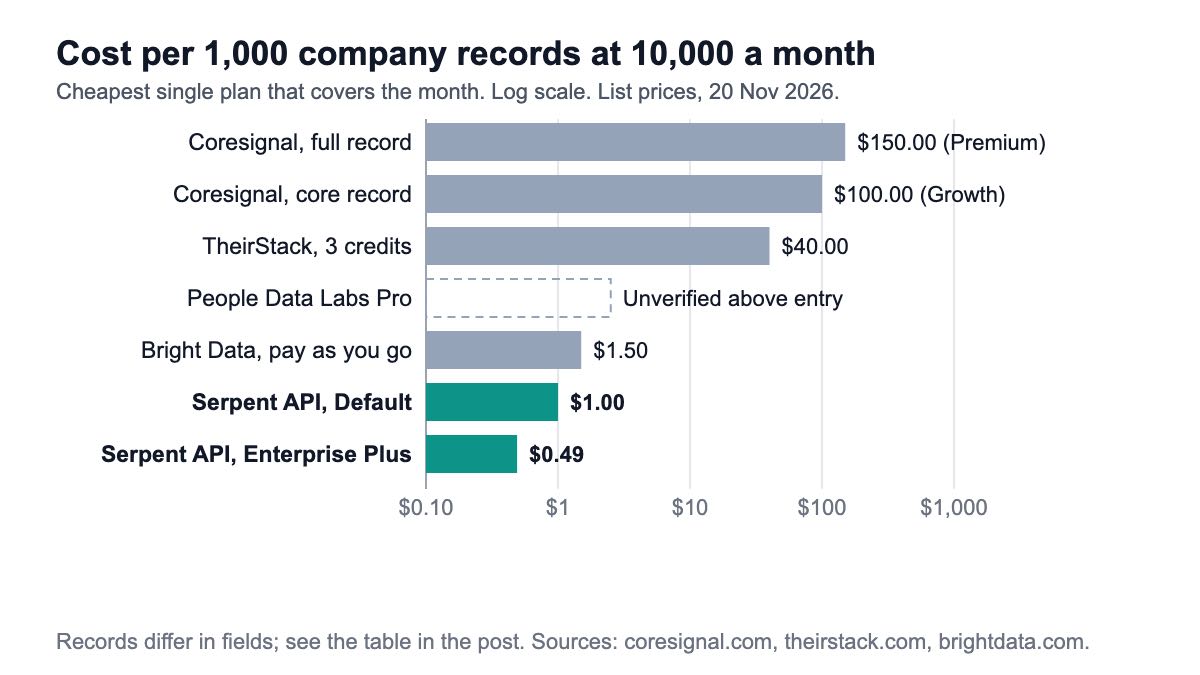
Two honest caveats. First, these records are not identical. A Coresignal full company record merges several public sources and can carry history; a TheirStack company record leans towards technographics and hiring signals; a LinkedIn company lookup returns what the public company page shows. Price per record only matters once the fields you need are in the record.
Second, Coresignal's own maths gets much better at the top. At 1,000,000 core records a month, Elite ($5,000 for 10,000,000 credits) works out to $5.00 per 1,000. That is still above a per-call API, but the gap is now a few times, not a hundred, and you get history and search that the others do not have.
For a deeper look at the LinkedIn side of this maths, see what a LinkedIn company lookup costs.
The alternatives, one by one
Each entry says what it is best for, what it costs, and the one thing to check before you move.
Serpent API: best for small and bursty LinkedIn lookups
Serpent API sells LinkedIn data per call from a prepaid balance. The Company endpoint takes a company's LinkedIn URL or vanity slug and returns public firmographics: name, industry, size, headcount, headquarters and specialities. The Jobs endpoint searches public job cards by keyword with filters for location, date posted, job type, experience level, workplace type and company, and the Job Details endpoint returns one posting's description, seniority, applicant count and salary range where shown.
Company lookups cost from $0.49 per 1,000, and jobs and job details from $0.25 per 1,000 — pay as you go, no subscription (pricing). Deposited credits never expire, and a new account gets 10 free API calls.
Best fit: you already know which companies, people or job searches you need, and you want the current public record back in one call. You can keep your list-building where it is and move only these single lookups, which is where most of the per-record cost sits.
Bright Data: best when LinkedIn is one of many sites you collect
Bright Data's Web Scraper API is priced per record: $1.50 per 1,000 pay as you go, or $499 a month for 384,000 records with extra records at $1.30 per 1,000, plus a free tier of 5,000 records a month (Bright Data pricing, checked 20 Nov 2026). Its scraper library lists LinkedIn people profile, company and post collectors next to hundreds of other sites.
Check before you move: Bright Data also sells pre-collected LinkedIn datasets with a separate rate card and minimum order. Our Bright Data LinkedIn pricing breakdown shows where each one is cheaper.
TheirStack: best for job postings and hiring signals
TheirStack is built around job data. One job costs 1 credit and one company costs 3. Monthly plans run from $49 for 1,500 API credits up to $5,500 for 5,000,000, and unused paid credits stay in your account for 12 months (TheirStack pricing). The free plan gives 200 API credits a month.
That 12-month life fixes the monthly-reset problem directly. Check before you move: TheirStack's own Coresignal comparison is written by TheirStack and ranks itself first, so compare sample records yourself.
People Data Labs: best for person enrichment with a free tier
People Data Labs sells person and company enrichment. The free plan gives up to 100 person credits a month without contact data, and Person Pro starts at $98 a month for 350 credits; annual commitments save 20% (PDL pricing). Company Pro is listed at $100 a month from 1,000 records, though the same page also shows a "starting at 350 records / $98" line, so confirm which applies to you.
Check before you move: PDL does not publish its per-record rate above the entry plan. For a forecast at 100,000 records you need a quote.
Crustdata: best for live signals if you can talk to sales
Crustdata prices in credits: a company enrichment is 2 credits (4 with technographics), a person enrichment is 1 to 9 depending on add-ons, and search costs 0.03 credits per result (Crustdata docs). Purchased credits are valid for 12 months, and new accounts start with $20 in credits (Crustdata pricing).
Check before you move: the dollar price of a credit is not published, and several live endpoints are enterprise-only. I could not turn its credits into a price per 1,000 records, so the table says "Unverified".
Apify community actors: best for a one-off pull
Apify hosts many LinkedIn company scrapers written by third-party developers. Prices vary by actor: one lists $0.30 per 1,000 results (thescrappa actor) and another $3 per 1,000 (up2data actor). For a one-time list of a few thousand companies, that can be the cheapest route.
Check before you move: each actor is maintained by a different person, with its own output format and its own support. That is fine for a one-off job and risky for a production pipeline.
Apollo, Cognism and Lusha: best when the real need is contacts
If you left Coresignal because your sales team needed phones and verified emails, these are the tools that sell them. They price per seat rather than per record, and most of the top-ranking alternatives articles cover them in detail. Treat them as a different category: they replace a prospecting workflow, not a data pipeline.
What if you only need job postings?
Then Coresignal is actually cheap per job, and the question is whether you need a database or a live search. A Coresignal job record costs 1 credit, so 10,000 jobs a month fits on Starter at $199, or $19.90 per 1,000 jobs. TheirStack's 10,000-credit plan is $169, or $16.90 per 1,000.
| Option | 1,000 a month | 10,000 a month | 100,000 a month |
|---|---|---|---|
| Coresignal Jobs API (1 credit) | $49.00 (Mini) | $19.90 (Starter) | $10.00 (Growth) |
| TheirStack (1 credit) | $49.00 ($49 plan) | $16.90 ($169 plan) | $6.00 ($600 plan) |
| Serpent API, LinkedIn Job Details | $0.50 Default · $0.45 Growth · $0.35 Scale · $0.30 Enterprise · $0.25 Enterprise Plus, per 1,000 postings, flat at every volume | ||
The difference is what you get. Coresignal and TheirStack keep a history of postings, deduplicated across sources, so you can ask "how many data engineering roles did this company post last year?" A live jobs API answers "what is posted right now?" If you are building a hiring-trends tracker, you can build the history yourself by storing each day's results.
When should you stay on Coresignal?
Stay if you need history, search across a large database, or bulk files, and your volume is high enough to sit at Premium or above. Those are things the cheaper per-call options do not try to do.
- Search is free. Coresignal's
/search/es_dsland/search/filterrequests cost nothing; you pay only to collect records, and only for requests that return a 200 (Coresignal docs). Building a target list is free. - History has its own endpoint. The Historical Headcount API costs 10 credits. No live lookup gives you last year's headcount.
- Bulk datasets exist. Datasets start from $1,000, paid monthly on a yearly contract (Coresignal pricing).
- Annual plans fix the reset problem. Annual credits are issued up front and last 12 months.
A common middle path: keep Coresignal for the quarterly bulk pull and move the day-to-day single lookups to a per-call API. That cuts the plan you need without giving up history. The pricing teardown linked at the top shows exactly where the plan steps fall.
So which one should you pick?
- Fewer than 100,000 company lookups a month, irregular volume: Serpent API or Bright Data. Both price per record with no monthly minimum.
- Job postings and hiring signals with history: TheirStack, or stay on the Coresignal Jobs API.
- Live job search and job details: Serpent API's jobs endpoints.
- Person enrichment with a free tier: People Data Labs.
- Phones and verified emails for a sales team: Apollo, Cognism or Lusha.
- A one-off list: an Apify actor.
- History, headcount trends, millions of records: stay on Coresignal, ideally on an annual plan.
If the LinkedIn data question is bigger than Coresignal, the full LinkedIn API comparison linked above covers more providers, and the Proxycurl alternative guide covers teams that lost Proxycurl in 2025.
How do you switch without breaking things?
Run both for a month on the same inputs, compare field by field, then move the workload in slices. Most switching pain comes from assuming two vendors fill the same field the same way.
- List the fields you actually use. Most teams read fewer than ten of the fields in a full record. Write them down; that list is your test.
- Pick 200 real inputs. Take company URLs or job searches from last month's production traffic, not a vendor's demo list.
- Pull them from both. Compare fill rate per field, not just whether a record came back.
- Put an adapter in front. One function in your code maps each vendor's response to your own schema. Swapping vendors then touches one file.
- Move the cheap, high-volume calls first. Single lookups are the easiest to move; history and bulk exports are the hardest.
A short note on legal risk, since it comes up in every switch: all of these vendors describe their data as public. If that question decides your choice, read our guide to the legal picture and ask your own counsel.
How we checked this
On 20 November 2026 I read the live pricing pages and docs of Coresignal, People Data Labs (person and company), TheirStack, Crustdata (pricing and docs) and Bright Data, plus two Apify actor listings: 10 official vendor pages in total. I also opened the five top-ranking "Coresignal alternatives" articles (Crustdata, ZoomInfo, Bright Data, TheirStack, Landbase); each is written by a vendor that ranks itself first. Every cost in the tables is arithmetic on list prices with monthly billing: the smallest single plan whose credits cover the month. No API calls were made for this article.
What I could not verify: Crustdata's dollar price per credit (not published); People Data Labs' per-record rate above its entry plan (quote only); Apollo, Cognism and Lusha seat prices (not used in any cost table); field-level fill rates for any vendor.
Try a per-call LinkedIn API before you renew
LinkedIn company, profile and job lookups from $0.25 per 1,000 — pay as you go, no subscription. Start with 10 free API calls and compare the fields against your current records.
Get Your Free API KeyExplore: LinkedIn API · Playground · Docs · Pricing
FAQ
What is the cheapest alternative to Coresignal?
For company records at small or medium volume, a per-call API is cheapest. Serpent API's LinkedIn company lookup costs from $0.49 per 1,000 — pay as you go, no subscription (pricing), and Bright Data's Web Scraper API costs $1.50 per 1,000 pay as you go. Coresignal's cheapest route to 1,000 core company records a month is Starter at $199. At very high volume the gap narrows: Coresignal Elite works out to $5.00 per 1,000 core records.
Is Coresignal worth the price?
It is worth it if you need searchable history, headcount trends or bulk datasets and your volume puts you on Premium or above, where a core record costs $15.00 per 1,000 or less. It is poor value for a few thousand single lookups a month, because the entry plans cost $199 to $499 per 1,000 records. The full plan-by-plan answer is in our Coresignal pricing explained article.
Coresignal vs People Data Labs: which is better?
They overlap on company and person enrichment but differ in how you buy. People Data Labs has a permanent free tier of 100 records a month and a Pro plan from $98 a month, and it sells contact data on paid plans. Coresignal has free search, job postings at 1 credit each and a historical headcount endpoint. For person enrichment at low volume, PDL is easier to start with; for company history and jobs, Coresignal.
Do Coresignal credits expire?
Yes. On monthly plans, credits last one billing cycle and reset; Premium, Scale and Elite keep unused credits for up to three months. Annual plans issue all credits up front and they last 12 months, and free-trial credits expire after 7 days. If expiring credits are the problem, TheirStack and Crustdata credits last 12 months, and Serpent API deposited credits never expire.
Is there a Coresignal alternative for job postings only?
Yes. TheirStack is built for job data at 1 credit per job, with monthly plans from $49 for 1,500 credits and 12-month credit rollover. If you want live LinkedIn job search and job details rather than a historical database, Serpent API's jobs endpoints cost from $0.25 per 1,000 calls — pay as you go, no subscription. Coresignal's own Jobs API is also inexpensive per job once you are on Starter or above.
Does Coresignal have real-time data?
Partly. Coresignal's FAQ says the database behind its APIs is refreshed in real time and that its Real-time Employee API fetches profile data at the moment of the request, for 12 credits. Its bulk datasets update daily, weekly or monthly depending on the contract. So the "monthly data" complaint applies to datasets, not to every Coresignal product.
Sources
Official pricing and docs (checked 20 November 2026):
- Coresignal pricing
- Coresignal docs: credits per endpoint
- Coresignal docs: FAQ (freshness, credit expiry)
- People Data Labs person pricing
- People Data Labs company pricing
- TheirStack pricing
- Crustdata pricing
- Crustdata docs: credit costs
- Bright Data Web Scraper API pricing
Marketplace listings (checked 20 November 2026):
Top-ranking alternatives articles, all vendor-written (opened 20 November 2026):