How to Get Cited by Perplexity, and Check You Are

To get cited by Perplexity, let its crawler reach your pages, put a direct answer in each page's first paragraph, and keep the facts current. Perplexity's own documentation backs only the first step. The rest comes from third-party studies that find correlation, so test your own prompts.
Short answer: If PerplexityBot is blocked or challenged by your firewall, fix that first, because in my view nothing else matters until it is fixed. If your site already ranks well, rewrite the first paragraph of your key pages so it states the answer. If your brand is new, earn mentions on the sites Perplexity cites most, such as Reddit, YouTube and Wikipedia, before polishing your own pages. Whichever you pick, run the same 10 to 20 prompts every week and write down the cited sources.
Perplexity shows numbered sources under almost every answer. Its help center says each answer "includes numbered citations linking to the original sources." This guide covers what Perplexity says you can do, what outside studies add, and how to check the result. For how retrieval works in general, see how ChatGPT, Perplexity and Gemini search the web and how AI search engines choose which sites to cite.
One rule for the whole post: a statement from Perplexity is labelled as Perplexity's, a study is named with its limits, and my own judgement is marked as opinion. Perplexity has not published how it ranks sources, so every ranking claim below is someone's correlation, not a rule.
Can Perplexity reach your pages?
Perplexity runs two declared bots, and only one of them follows robots.txt. Its crawler documentation says "PerplexityBot is designed to surface and link websites in search results on Perplexity" and that it "is not used to crawl content for AI foundation models." The same page says "we recommend allowing PerplexityBot in your site's robots.txt file."
The second bot is Perplexity-User. The docs say "Perplexity-User supports user actions within Perplexity" and, on robots.txt: "Since a user requested the fetch, this fetcher generally ignores robots.txt rules." In plain terms, someone asked Perplexity about a page and the fetch followed.
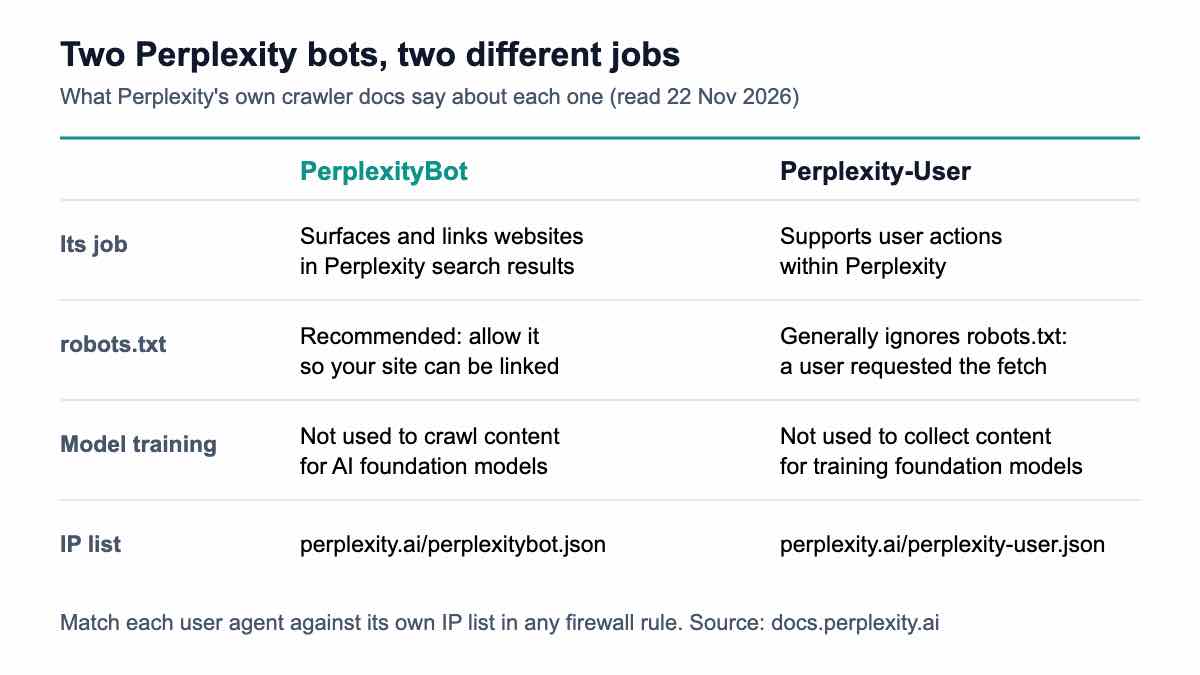
| Bot | User-agent string in the docs | robots.txt | IP list |
|---|---|---|---|
| PerplexityBot | Mozilla/5.0 (compatible; PerplexityBot/1.0; +https://perplexity.ai/perplexitybot) | Recommended: allow it | perplexity.ai/perplexitybot.json |
| Perplexity-User | Mozilla/5.0 (compatible; Perplexity-User/1.0; +https://perplexity.ai/perplexity-user) | Generally ignored, because a user asked for the fetch | perplexity.ai/perplexity-user.json |
To be sure the door is open, add this to robots.txt. Without any rule PerplexityBot is allowed by default, so the lines only matter if a broader rule elsewhere in the file blocks it.
User-agent: PerplexityBot
Allow: /
The firewall is the more common trap. The docs warn that "you may need to explicitly allow Perplexity's bots to ensure they can access your content." They give two rules: "Each bot has its own IP ranges, so match each User-Agent against its own IP ranges," and place the allow rule "above any custom rules that block or challenge requests."
They also say plainly that "Cloudflare's Bot Fight Mode can't be skipped with WAF custom rules," so if you run Cloudflare, check that setting first. The IP list is a live file: when I opened perplexitybot.json on 22 November 2026 it held 21 IPv4 ranges with a creation time of 18 November 2026. Copy it on a schedule instead of pasting it once.
Perplexity's pages do not say whether it renders JavaScript; its research article never mentions it. My opinion, not a documented fact: put the answer in the HTML your server sends, so nothing depends on rendering.
They also do not mention llms.txt, so treat it as optional (our llms.txt guide covers the format). If you are still deciding whether to allow AI crawlers at all, the block-or-allow guide sets out the trade-off.
What should the top of the page say?
State the answer to the page's question in the first paragraph. This is the best-supported content advice I found, though the support is correlation. Surfer's study scored more than 650,000 AI-generated answers from ChatGPT, Google AI Overviews, AI Mode and Perplexity against a 20-factor rubric, with data collected in April 2026. For Perplexity it reports that "Perplexity decides whether to cite you based mostly on your first paragraph," with Search Intent Alignment the single highest factor at 15.3% and the fourth-ranked factor at 10.6%.
Read that with its limits. Surfer sells content tools, and the study shows what cited pages look like, not why Perplexity picked them.
Perplexity's own research article points the same way for a different reason. It says the pipeline retrieves and scores at document and sub-document level and tries to "surface the most atomic units possible to the model." If a passage is retrieved on its own, the passage has to make sense on its own. My practical reading, and it is an opinion: write each section so its first sentence still works when someone quotes only that sentence.
Here is the difference, as an illustrative example and not a real page.
- Weak opening: "Rank tracking has changed a lot, and there are many things to consider before choosing a tool."
- Stronger opening: "A rank tracker records where your pages appear in Google for a list of keywords and charts the changes over time. The two choices that decide cost are how often it checks and how many keywords you track."
The second version names the topic in the first sentence and gives the short answer before the explanation, which is the advice Surfer draws from its data. Intent matters too: answer what the searcher is really deciding, not only the literal words of the query.
Do headings, tables and FAQs help?
Clear structure helps Perplexity parse your page, but decorative blocks do not appear to win citations. Perplexity's research article says its parsing splits pages into self-contained spans and stresses well-structured, clearly organised content. Surfer's data adds a counterweight: summary boxes, FAQ blocks, expert-quote blocks and tables of contents registered much lower weight for Perplexity citations than the opening of the page.
Those two fit together. Structure makes the text easy to split; it does not replace a good answer to split. My opinion: write headings as the question a reader would ask, keep one idea per paragraph, and use a table only for a real comparison.
Keep an FAQ if it helps people, as Surfer itself suggests, but do not expect it to carry your Perplexity plan. Our post on structured data for AI citations covers the markup side, and no Perplexity page I read says it uses schema.
Does freshness matter?
The Search product page says "Every search pulls from our live web index so there's no stale answers," which is a marketing line, not a ranking rule.
The research article (25 September 2025) is more useful. It says an index of over 200 billion unique URLs makes "refresh operations for existing pages" compete "with indexing operations for new unvisited pages," that a model predicts whether and when a URL should be indexed, and that sites with regular publishing schedules can have crawls timed to likely update points.
My opinion: a page you update on a predictable schedule is more likely to be re-read than one you touch once a year. Update the facts that actually change, such as prices and versions, and show the date. Never change a date without changing the content.
One consultant reported 6 of 15 updated pages cited against 3 of 35 untouched pages within six weeks, but the sample is small and the method unpublished, so I treat it as an anecdote. For ChatGPT, our freshness study goes further. I have not seen a Perplexity-specific study.
What makes a passage worth citing?
A specific, checkable claim with a source is easier to cite than a general one, and being retrieved is not the same as being cited. A Search Engine Journal report from 29 July 2026 captured Perplexity's answer data in 8 captures on one Pro account on 25 June 2026, with 3 repeat checks on 21 July 2026. It found that the pages retrieved and the pages cited are different lists. In the Deep Research capture, one page accounted for 20 of 30 citation markers.
The author calls the figures directional, because the sample is one account in one city. Treat it as a hint about shape, not a result to copy. My opinion on what to do with it:
- Put the number, the date and the source in the same sentence as the claim.
- Define a term the first time you use it, in one plain sentence.
- Publish original data when you have it. A page that is the only source for a figure has no substitute.
- Say who did the work and when, so a claim can be traced back.
Do mentions on other sites matter?
Yes, if the data from Ahrefs is a fair picture: the most-cited domains are community and reference sites, not brand blogs. Ahrefs' November 2026 ranking, updated on 3 November 2026 from more than 3.1 million US queries in its Brand Radar tool, puts Reddit first at 24.6% of citations among the top 50 domains, then YouTube at 14.2%, Wikipedia at 7.2%, Amazon at 4.3% and Facebook at 3.1%. The percentages are relative to the top 50 domains combined, not to all citations, and the page is a vendor's own dataset.
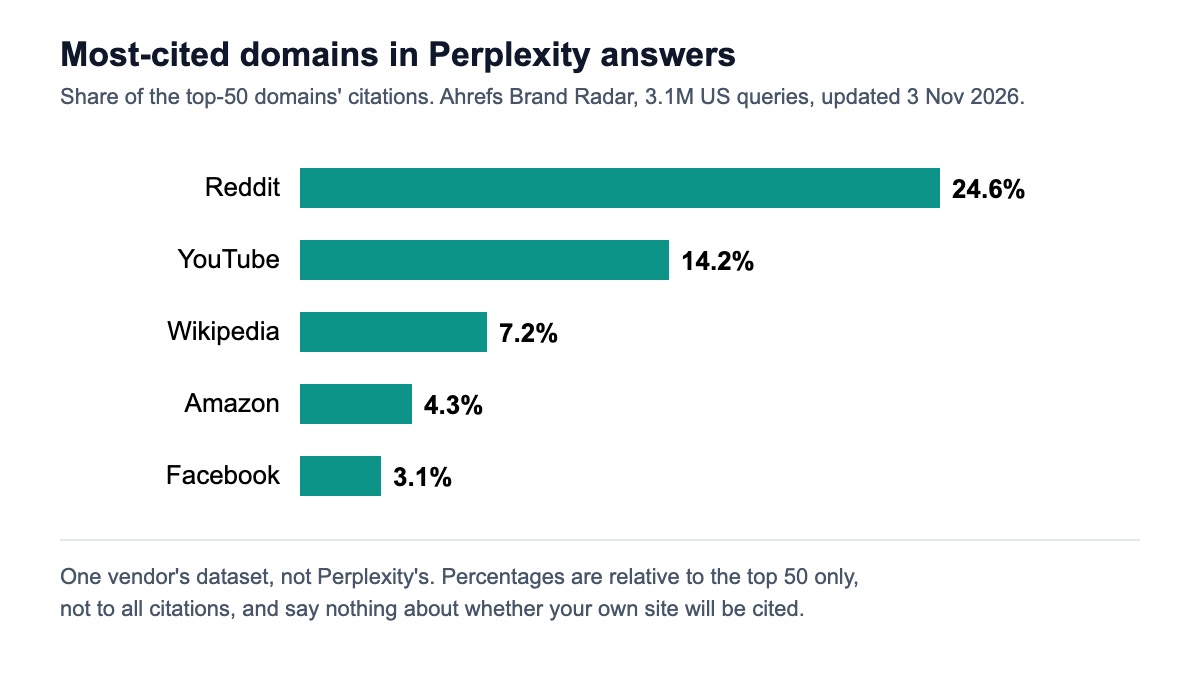
The sources disagree on one point. The Search Engine Journal capture found YouTube cited heavily on its video prompts while Reddit threads were retrieved but never cited, on a small sample. Ahrefs has Reddit first, so I would not build a plan on either order. The safer reading is that your own domain is not the only place Perplexity can pick you up.
Ranking in Google helps, but less than you might expect. An earlier Ahrefs study (11 August 2025, 15,000 long-tail queries) found 28.6% of Perplexity's cited URLs ranked in Google's top 10, and noted that Perplexity uses its own index.
For the community side, our post on tracking Reddit in AI citations shows how to see which threads appear. Take part honestly and follow each community's rules.
How do you check whether Perplexity cites you?
Run a fixed list of prompts by hand, record the cited sources, repeat weekly, and add two passive checks: your server logs and your analytics referrals.
- Write 10 to 20 prompts a buyer would type, without your brand name. Asking Perplexity about your own brand proves little, because you supplied the name. Ask the category question, such as "best ways to track keyword rankings."
- Run each prompt and record the sources. Note the date, the exact wording, and the cited domains in the order shown. A spreadsheet is enough.
- Repeat weekly with the same wording. Answers move between runs, and Ahrefs notes that personalisation and conversation history can change citations for the same query. Our post on citation repeatability explains why one snapshot is weak.
- Read your server logs. A request from PerplexityBot means you were crawled, which is not the same as being cited. A request from Perplexity-User suggests a person asked about that page, which is my reading of the docs, not something Perplexity states. Check the source IP against the published JSON lists before you believe either, because any client can type a user-agent string.
- Look for Perplexity referrals in analytics. Analytics Mania's GA4 guide (12 May 2026) builds a custom channel group with the condition "Source matches regex" and a pattern that includes
perplexity(?:\.ai)?, placed above Referral. It warns that this "only captures clicks that send a referrer," so it is a partial view.
This one-liner prints each IP behind PerplexityBot requests in a standard access log, with its hit count, most active first.
grep -i "PerplexityBot" access.log | awk '{print $1}' | sort | uniq -c | sort -rn | headCan an API track it for you?
Yes, once your prompt list outgrows a spreadsheet. Our Perplexity AI Rank endpoint (Serpent, the API this blog is published by), GET /api/ai/rank/perplexity, takes a keyword and an optional target domain. According to the product page it returns the Perplexity answer text and its cited sources as JSON, with each source's position, URL, domain, title and the passage around the reference.
With a domain it also returns target_found and target_position. The page lists up to 10 cited sources per call, or 15 with prompt_type=deep, and says to plan for 10 to 25 seconds.
The AI Visibility Score API measures something different. Per its page, it returns the share of about 16 searches where a site appears in search results, from 0 to 1. It is not a citation count and not a Perplexity number.
The broader AI Rank API covers four assistants in one call. If you are weighing Perplexity's own API instead, we priced it in Perplexity Search API pricing explained.
What is proven and what is a guess?
Only the crawler rules come from Perplexity itself. Here is each step with its evidence level, so you can decide how much effort to give it.
| Step | Where it comes from | Strength |
|---|---|---|
| Allow PerplexityBot, fix firewall rules | Perplexity's crawler docs | Stated by Perplexity |
| Well-structured, self-contained passages | Perplexity's research article | Stated by Perplexity, no ranking detail |
| Answer first, intent aligned | Surfer, 650,000+ answers | Vendor correlation |
| Update facts on a schedule | Perplexity's research article on crawl timing; my opinion | Partly stated, partly my judgement |
| Specific, sourced claims | Search Engine Journal capture; my opinion | Small sample, directional |
| Be present on Reddit, YouTube, reference sites | Ahrefs, 3.1 million queries | Vendor correlation, one other source disagrees on order |
| Rank well in Google | Ahrefs, 15,000 queries, August 2025 | 28.6% overlap with top 10 |
If you can do only one thing this week, confirm PerplexityBot is not blocked in your robots.txt or firewall. If you can do two, rewrite the first paragraph of your five most important pages. After that, I would measure before spending more.
How we checked this
On 22 November 2026 I read five Perplexity pages (crawler docs, help center, Search product page, research article and the PerplexityBot IP file), three vendor studies from Surfer and Ahrefs, one trade-press capture, one analytics tutorial and two how-to-get-cited guides. I also read the two Serpent product pages named above. I did not run any prompts for this post, so it has no first-hand results.
What I could not verify: Perplexity's technical FAQ on robots.txt returned a 404, so I do not cite it. No Perplexity page I read says whether it renders JavaScript or uses llms.txt or schema markup. I did not open perplexity-user.json, and most of Surfer's factor ranking is in images I could not read.
Perplexity does not publish how it ranks sources, so every ranking claim is a third-party correlation. Several sources update monthly, so re-check the links before you act.
Check your Perplexity citations
Run a Perplexity citation check from $0.70 per 1,000 single-engine queries at our lowest rate (checked 22 November 2026), pay as you go, no subscription. New accounts get 10 free API calls.
Get Your Free API KeyExplore: AI Search Visibility · Playground · Docs · Pricing
FAQ
Does Perplexity follow robots.txt?
PerplexityBot does, according to Perplexity: its research article says the crawler "complies with explicit limits set forth in robots.txt files." Perplexity-User generally does not, because Perplexity's docs say a user requested the fetch.
Should I block PerplexityBot?
Only if being linked in Perplexity is worth nothing to you. Perplexity says the bot is not used to crawl content for AI foundation models, and blocking it removes you from the search results it feeds. My opinion: allow it unless you have a licensing or privacy reason not to. The trade-off is in our block-or-allow guide.
How long until a new page gets cited?
I found no published figure, so I will not give one. Perplexity's research article says a model predicts whether and when to index a URL. Check your logs for a PerplexityBot visit first, then run your prompts, because a page that has not been crawled cannot be cited.
Does ranking in Google help me get cited?
It helps but is not required. In Ahrefs' study of 15,000 long-tail queries (11 August 2025), 28.6% of Perplexity's cited URLs ranked in Google's top 10, so most did not. The data is over a year old, so check your own prompts.
Do I need llms.txt or schema markup?
No Perplexity page I read says it uses either, so I would not rely on them for Perplexity. Both are cheap to add and may help other systems, and neither should replace a clear first paragraph. Our guides to llms.txt and structured data cover the details.
Why was my page cited yesterday and not today?
Answers change between runs. Surfer reports Perplexity has the highest source stability of the four assistants it studied, so some churn remains. Ahrefs notes that personalisation and conversation history can change citations. Track a set of prompts weekly and read the trend, not a single run.
Sources
Perplexity's own pages (read 22 November 2026):
- Perplexity crawler documentation (PerplexityBot and Perplexity-User)
- PerplexityBot published IP ranges (JSON)
- Help center: How does Perplexity work?
- Perplexity Search product page
- Architecting and evaluating an AI-first Search API (Perplexity Research, 25 September 2025)
Studies and reports, vendor and trade press (read 22 November 2026):
- Surfer: improve visibility in Perplexity (updated 17 September 2026)
- Ahrefs: the 50 most-cited websites in Perplexity (updated 3 November 2026)
- Ahrefs: AI search overlap with Google (11 August 2025)
- Search Engine Journal: how Perplexity actually picks sources (29 July 2026)
Tutorials and guides (read 22 November 2026):