Google search operators that still work in 2026, graded by evidence
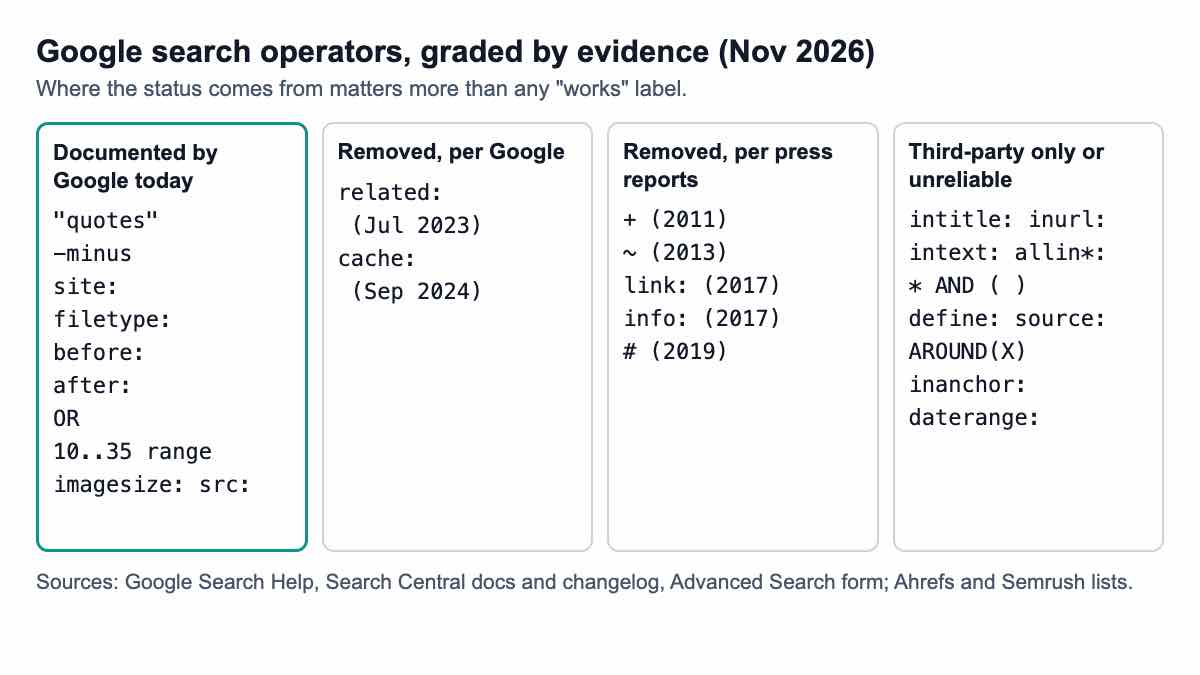
Google's search Help page documents six operators in 2026: quotes, minus, site:, filetype:, before: and after:. Two other Google pages add OR, number ranges and two Images-only operators. Google has also confirmed two removals, related: in July 2023 and cache: in September 2024. Popular operators such as intitle: and inurl: rest on third-party evidence only.
Short answer: For work you need to rely on, build queries from the operators Google documents: "exact phrase", -word, site:, filetype:, before:/after:, plus OR and number ranges from the Advanced Search form. Treat intitle:, inurl: and intext: as useful but undocumented. Stop using cache:, related:, link:, info:, + and ~.
Why most operator lists are out of date
Because they label operators "working" from experience, and experience ages. Two of the best-known lists, Ahrefs' "complete list" (25 April 2023) and Semrush's list (13 June 2023), both put cache: and related: in their working sections. Google has since said that neither is supported.
So this guide grades each operator by where its status comes from, not by whether it seemed to work once. There are four grades:
- Documented by Google today: listed on a current Google Help, Search Central or Advanced Search page.
- Removed, per Google: Google's own changelog says it is gone.
- Removed, per press reports: dated reports, mainly Search Engine Land articles cited by Ahrefs.
- Third-party only: SEO vendors say it works; Google says nothing. Treat it as unverified for 2026.
Which operators does Google document today?
Three Google pages, read on 20 November 2026, between them document ten operators or syntaxes. Google's Help page "Refine Google searches" lists six, with these examples:
- Quotes for an exact phrase:
"tallest building" site:to search one site or domain:site:youtube.com cat videos- Minus to exclude a word:
jaguar speed -car before:andafter:for dates:astronomy discovery before:2025/11/01, or a range such asavengers endgame after:2019-03-01 before:2019-03-05filetype:for a file format:photoelectric effect paper filetype:pdf
Google Search Central's operator overview adds two that only work in Google Images: imagesize:, which finds images of a given size, and src:, which finds pages that reference a given image URL. It also documents site: and filetype:, and warns that "search operators are bound by indexing and retrieval limits".
The third source is Google's Advanced Search form, whose hints spell out two more syntaxes: "Type OR between all the words you want" and "Put two full stops between the numbers", as in 10..35 kg. The form also offers "terms appearing" in the page title, text or URL. That is what intitle:, intext: and inurl: do, but the form never names those operators.
The full status table
Every row below has a source. Where two sources disagree, the row says so. "Unverified" means I found no current, dated evidence either way.
| Operator | Example | Status | Evidence |
|---|---|---|---|
"…" | "tallest building" | Documented by Google | Google Help |
- | jaguar speed -car | Documented by Google | Google Help |
site: | site:youtube.com cat videos | Documented by Google | Google Help, Search Central |
filetype: | filetype:pdf | Documented by Google | Google Help, Search Central |
before: / after: | after:2026/03/10 | Documented by Google | Google Help |
OR | miniature OR standard | Documented by Google | Advanced Search form |
.. | 10..35 kg | Documented by Google | Advanced Search form |
imagesize:, src: | (Google Images only) | Documented, Images only | Search Central |
related: | related:nytimes.com | Removed per Google, Jul 2023 | Search Central changelog |
cache: | cache:example.com | Removed per Google, Sep 2024 | Search Central changelog |
+ | +word | Removed per press reports, 2011 | Ahrefs, citing Search Engine Land |
~ | ~cheap | Removed per press reports, 2013 | Ahrefs, citing Search Engine Land |
link: | link:example.com | Removed per press reports, 2017 | Ahrefs; Semrush agrees |
info: | info:example.com | Removed per press reports, 2017 | Ahrefs; Semrush agrees |
# | #hashtag | Removed per press reports, 2019 | Ahrefs, citing a Google support page |
intitle:, allintitle: | intitle:"api pricing" | Third-party only | Ahrefs, Semrush (2023) |
inurl:, allinurl: | inurl:pricing | Third-party only | Ahrefs, Semrush (2023) |
intext:, allintext: | intext:"rate limit" | Third-party only | Ahrefs, Semrush (2023) |
*, AND, ( ) | "best * for" | Third-party only | Ahrefs, Semrush (2023) |
ext:, define:, source: | source:reuters | Third-party only | Ahrefs (2023) |
AROUND(X), location: | seo AROUND(3) api | Sources disagree | Ahrefs: unreliable; Semrush: working |
inanchor:, daterange: | inanchor:pricing | Unreliable | Ahrefs and Semrush |
Which operators has Google removed?
Google has confirmed two removals in writing, and press reports cover several older ones. The confirmed two are in the Search Central documentation changelog:
related:, 18 July 2023: "Removed therelated:operator from the search operators documentation, as it's no longer supported."cache:, 24 September 2024: "Thecache:search operator no longer works in Google Search."
For older removals, Ahrefs cites Search Engine Land articles: the + operator was dropped in 2011, the ~ synonym operator in 2013, and link: and info: in 2017. It ties the end of # hashtag search in 2019 to the shutdown of Google+. Google's own Help page links to a community thread about the plus sign being removed.
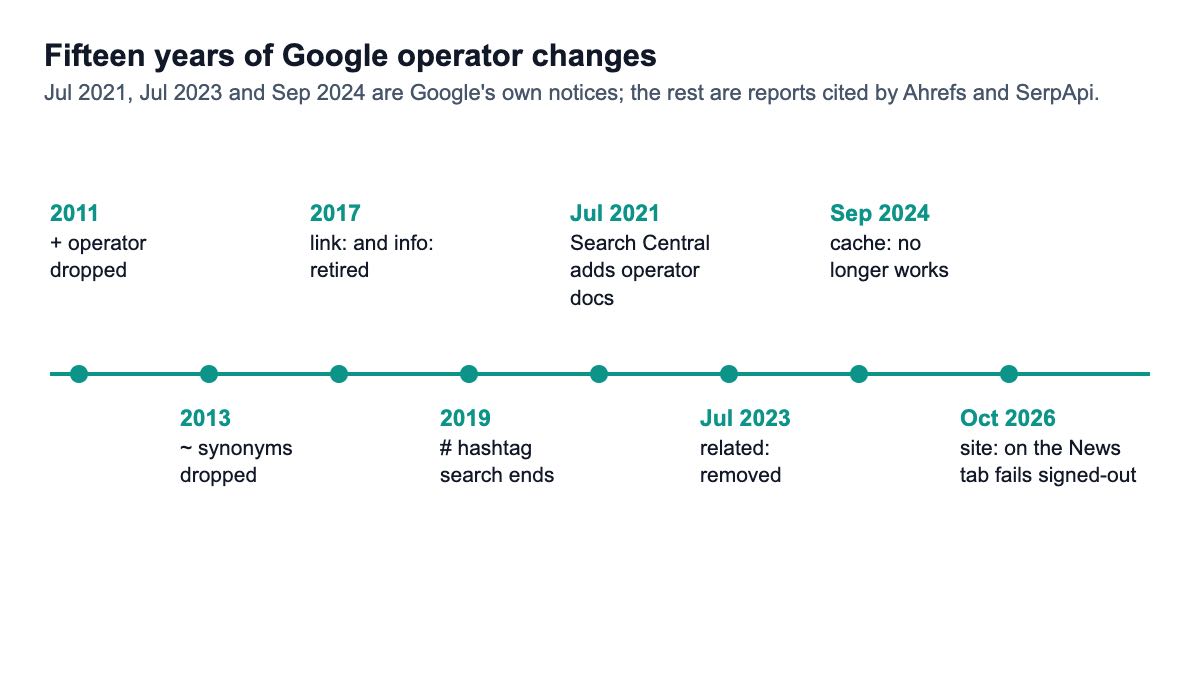
That July 2021 date matters. The same changelog says Google "added a set of new documentation about the search operators available in Google Search" on 21 July 2021. Google's Help page covered some operators before that, but Search Central's dated notices only start there, so older changes are known mostly from press reports.
Do intitle:, inurl: and intext: still work?
Google does not say. None of the three appears on Google's Help or Search Central operator pages in November 2026. Ahrefs and Semrush listed them as working in 2023, and Google's Advanced Search form still offers searching "in the title of the page", "in the text of the page" and "in the URL of the page".
That is reasonable evidence that Google still supports the underlying feature. It is not evidence that the operator syntax returns complete or stable results. If a workflow depends on intitle: or inurl:, such as recruiting x-ray searches, check results by hand now and then and keep a second query that does not use them. Our LinkedIn x-ray sourcing guide shows how those queries are built.
Why doesn't site: show all my pages?
Because it was never meant to. Google's site: documentation says the operator "doesn't necessarily return all the URLs that are indexed under the prefix specified in the query" and that "bigger sites shouldn't expect to see all their URLs in the results".
The same page adds two details that trip people up. A bare site:example.com with no other words "doesn't rank the results", so the order means nothing. And site:https://www.example.com does not return the same results as site:https://example.com/.
For index checks Google points you to Search Console's URL Inspection tool. For checking many URLs at once, see our guide to site: index checks.
How do before: and after: work?
They filter by date, and Google's Help page describes them as finding documents last updated before or after the date you give. Both accept a year (before:2019) or a full date (after:2026/03/10 or after:2019-03-01), and you can combine them into a window.
"Last updated" is Google's estimate, not the article's byline. Pages that change often can move in and out of a window. For news monitoring or anything time-sensitive, a time filter on a news search is more predictable; our search freshness filters guide compares the options.
Does site: work on Google News?
Not for signed-out users, according to SerpApi. Its changelog dated 19 October 2026 says "the site: operator and the as_sitesearch parameter can no longer be used with tbm=nws", because Google stopped showing the News tab for site-restricted queries to signed-out users. SerpApi suggests searching the bare domain name instead of site:example.com.
This is a recent change reported by one vendor, so treat it as provisional. It affects anyone who monitors a publication's coverage through Google News. A dedicated news API that searches by keyword is the simpler route for that job.
Small syntax mistakes that break a query
- No space after the colon. Google's Help page says
site:nytimes.comworks andsite: nytimes.comdoes not. - Protocol and www matter in site:. Per Search Central,
site:https://www.example.comandsite:https://example.com/are different queries. A more specific prefix can even return more results than a broader one. - Write OR in capitals. That is how Google's Advanced Search hint writes it:
miniature OR standard. - The minus goes right before the word. The form's hint: "Put a minus sign just before words that you don't want".
- Image operators only work in Images. Search Central says
imagesize:andsrc:each "only works on Google Images".
Running operator queries at scale
Operators are just text in the query, so any tool that accepts a query accepts them. With a SERP API you put them in the query parameter exactly as you would type them. With Serpent API that is q on /api/search, which takes up to 2,048 characters (docs):
curl "https://apiserpent.com/api/search?q=site%3Aexample.com+filetype%3Apdf+%22annual+report%22&engine=google&country=us" \
  -H "X-API-Key: YOUR_API_KEY"
URL-encode the query: : becomes %3A and quotes become %22. Any HTTP library does this for you if you pass the query as a parameter rather than pasting it into the URL by hand.
The response is parsed JSON, so you can count results, store URLs and compare runs over time instead of eyeballing a results page. Two things to keep in mind. The operator limits above still apply, because they come from Google's index, not from the tool. And documented operators make the most stable automated queries, for the same reason they make the most stable manual ones.
Which operators should you use?
- Finding pages on one site:
site:plus words, never a baresite:for counting. - Finding documents:
filetype:pdfwith quotes around the key phrase. - Excluding noise:
-wordand-site:example.com. - Date-bounded research:
after:andbefore:, keeping in mind they use Google's "last updated" estimate. - Alternatives in one query:
ORin capitals, with quotes around multi-word options. - Title or URL targeting:
intitle:andinurl:are worth trying, but verify by hand, since Google does not document them. - Finding similar sites or cached copies: no operator does this any more. Use the Wayback Machine for old copies and a competitor tool for similar sites.
For what the rest of a Google URL does once the query is set, such as gl, hl, tbs and udm, see the URL parameter guide in this series, and for the Google results API itself, the Google SERP API page.
How we checked this
On 20 November 2026 I read Google's "Refine Google searches" Help page, the Search Central operator overview and site: pages, the Search Central documentation changelog and the Advanced Search form (5 Google sources); the Ahrefs and Semrush operator lists (2 vendor sources, from 2023); and SerpApi's 19 October 2026 changelog. No searches were sent to Google to test operators, so no row in the table is based on my own observation.
What I could not verify: the 2026 behaviour of any operator graded "third-party only"; Google's own wording for the removals of +, ~, link: and info:, which I know only through Ahrefs' citations; and whether the October 2026 News change applies to every country. Moz's guide could not be fetched and Backlinko's returned 404, and my search tool's quota ran out during research, so the gap check used the pages listed rather than a fresh top-five list.
Run operator queries and get JSON back
Serpent API takes your query, operators included, and returns parsed Google results from $0.03 per 1,000 — pay as you go, no subscription. Start with 10 free API calls.
Get Your Free API KeyExplore: Google SERP API · Playground · Docs · Pricing
FAQ
Does the cache: operator still work?
No. Google's Search Central changelog entry of 24 September 2024 says "the cache: search operator no longer works in Google Search", and Google removed its documentation the same day. Guides from 2023, including the Ahrefs and Semrush lists, still show it as working, so check the date of any list you rely on. For an old copy of a page, the Internet Archive's Wayback Machine is a common replacement.
Why is the site: operator not working?
Usually it is working, but not doing what people expect. Google says site: does not necessarily return every indexed URL, and that a bare site:example.com does not rank results. Other common causes are a space after the colon, a different protocol or www prefix than the site uses, and, since October 2026 according to SerpApi, combining site: with the News tab while signed out.
How do I search Google between two dates?
Combine after: and before: in one query, as in Google's own example avengers endgame after:2019-03-01 before:2019-03-05. Both also accept a bare year, like before:2019. Google describes them as matching documents last updated in that window, so a page published earlier but edited recently can still appear.
What replaced the related: operator?
Nothing inside Google Search. Google removed related: from its documentation on 18 July 2023 because it was "no longer supported". To find sites similar to a competitor, people now use third-party SEO tools that compare overlapping keywords or backlinks, or they search the topic and note which domains keep appearing. The second approach is easy to automate with any SERP API.
Are Google search operators case-sensitive?
The operator names themselves are usually typed in lower case, such as site: and filetype:, while Google's Advanced Search hint writes OR in capitals. Google's Help page does not state a general case rule, so the safe habit is to copy the exact form from Google's examples: lower case for the colon operators and capitals for OR.
Sources
Google (checked 20 November 2026):
- Google Search Help: Refine Google searches
- Google Search Central: search operators overview
- Google Search Central: site: search operator
- Google Search Central: documentation updates (21 Jul 2021, 18 Jul 2023, 24 Sep 2024)
- Google Advanced Search form
Third-party lists and reports (checked 20 November 2026):