Google search URL parameters, and which ones still work in 2026

Google search URL parameters are the key=value pairs after /search? that set the query, language, country, page, time range and result type. The ones that matter in 2026 are q, hl, gl, lr, cr, start, tbs, udm, tbm, safe, filter, nfpr and uule. num=100 stopped working in September 2025.
Short answer: To localise a search, use gl (country) and hl (language), plus uule for a city. To page, use start in steps of 10, because num=100 is gone. To filter by time, use tbs=qdr:d, w, m or y; for plain links only, udm=14. If you need results as JSON at volume, a SERP API offers equivalent controls under its own documented parameter names.
What are Google search URL parameters?
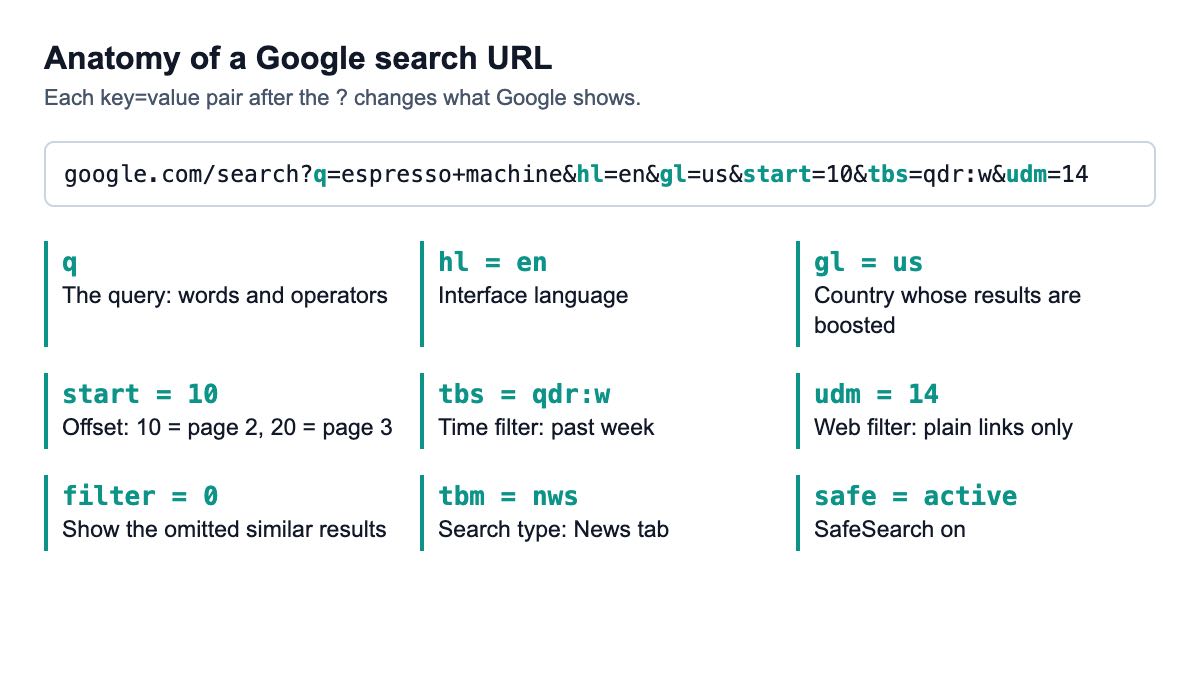
They are the settings Google writes into the address bar when you search. Search for "espresso machine", go to page two and pick "Past week", and the URL grows into something like google.com/search?q=espresso+machine&start=10&tbs=qdr:w. Every pair after the question mark is one parameter.
Parameters are not the same as search operators. An operator such as site: or intitle: goes inside the query text. A URL parameter sits outside it and changes how Google runs the query; typing gl=us into the search box does nothing useful; it only works in the URL. Operators such as site: are best checked separately; this guide sticks to the URL.
Which parameters does Google actually document?
Fewer than most guides imply. Google has never published a reference for the parameters on google.com/search. What it does document are the same names in its own search APIs, and that is the best official evidence for what they mean.
The Custom Search JSON API reference defines q, hl, gl, lr, cr, start, num, safe and filter. Google's older Site Search XML reference adds the advanced-search family: as_epq, as_eq, as_oq, as_qdr, as_sitesearch, plus ie and oe for character encoding.
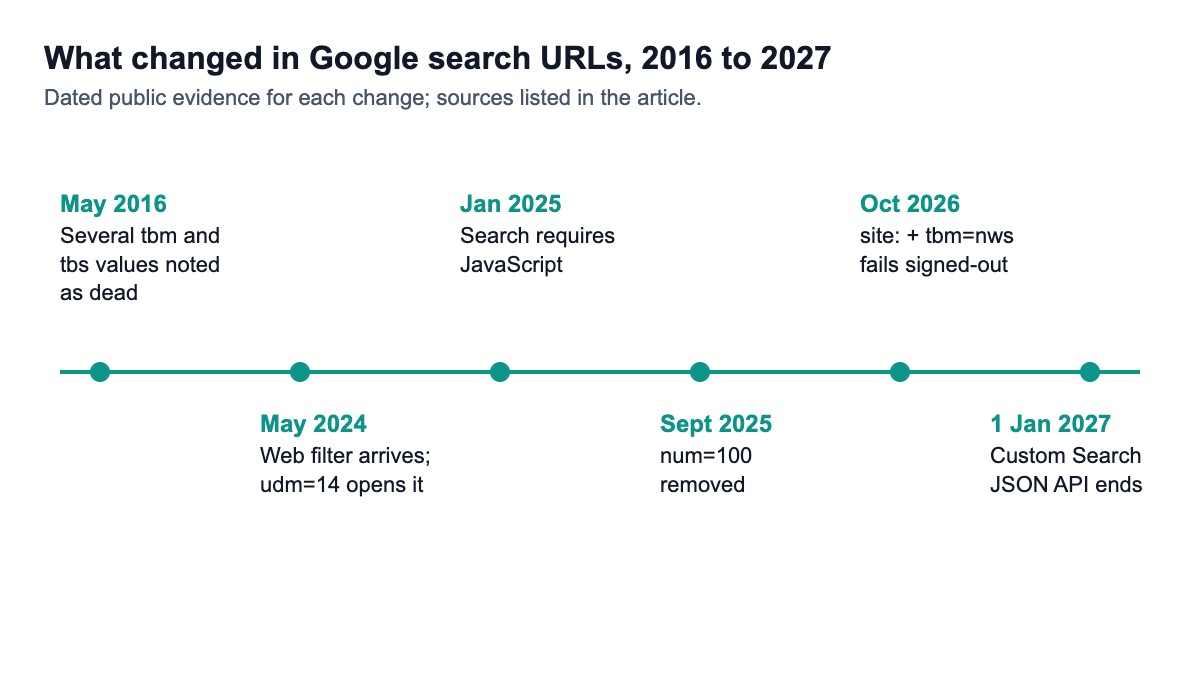
Both documents describe Google's APIs, not the public results page, and the JSON API is closed to new customers. Google's overview page says existing customers "have until January 1, 2027 to transition to an alternative solution". Our Custom Search API shutdown guide covers that move.
For newer parameters such as udm, the evidence is third-party: SerpApi's Google Search API documentation, which has to track what google.com accepts in order to work, and dated press reports. The table below grades each parameter so you know which kind of evidence stands behind it.
The parameter reference table
Each row gives the values, what the parameter does and the strongest evidence I could find on 20 November 2026. "Google API docs" means Google defines the parameter for its own search API; "third-party" means a SERP vendor's documentation or a dated press report.
| Parameter | Example values | What it does | Evidence |
|---|---|---|---|
q | any text | The query, including operators | Google API docs |
hl | en, en-gb, es-419 | Interface language | Google API docs |
gl | us, de | Country of the searcher; boosts results from that country | Google API docs |
lr | lang_fr | Restricts to documents in a language | Google API docs |
cr | countryFR | Restricts to documents from a country | Google API docs |
start | 0, 10, 20 | Result offset: 10 = page 2 | Google API docs |
num | 10 | Results per page; 100 per page removed Sept 2025 | Third-party (Botify) |
safe | active, off | SafeSearch | Google API docs |
filter | 0, 1 | 0 shows the "similar" and "omitted" results | Google API docs |
tbs | qdr:w, li:1 | Container for filters: time range, verbatim | Third-party |
udm | 14, 50, 39, 18 | Display mode: Web, AI Mode, short videos, forums | Third-party |
tbm | nws, isch, vid, shop, bks | Search type tab | Third-party |
nfpr | 1 | Turns off auto-correction | Third-party |
uule | encoded place | Location the search appears to come from | Third-party |
as_epq, as_eq, as_qdr, as_sitesearch | phrase, word, w, domain | Advanced-search form fields | Google API docs (Site Search) |
pws | 0 | Said to turn off personalisation | Unverified |
How do hl, gl, lr, cr and uule differ?
hl changes the language of Google's interface, gl changes which country's results get a boost, and lr and cr are hard filters. Mixing them up is the most common reason a "localised" check returns the wrong page.
hlsets the language of the buttons and labels. Google's API reference says it "sets the user interface language" and that setting it explicitly improves performance and result quality. It is not a filter.glis the "geolocation of end user" in Google's words, a two-letter country code. The same reference says it boosts results from that country rather than restricting to them.lrkeeps only documents in a language (lang_de).crkeeps only documents from a country (countryDE). Both remove results, so use them sparingly when you are measuring rankings.uulesets a precise location, down to a city. It is an encoded string, explained step by step in our uule guide.
For a rank check that matches what a person in Munich sees, you would send gl=de, hl=de and a Munich uule, and leave lr and cr off. One parameter Google has retired here: googlehost is marked "Deprecated. Use the gl parameter for a similar effect."
How do you page through results now that num=100 is gone?
With start, ten results at a time: start=0 is page one, start=10 page two, start=90 page ten. Botify reported that between 8 and 10 September 2025 "Google quietly removed the &num=100 parameter". Since then, a top-100 check costs ten requests instead of one.
The removal also changed Search Console data, because tools that loaded 100 results at once had been generating impressions for positions 11 to 100. Botify saw impression growth collapse by around 67% across its clients while click growth stayed largely flat. The full story, and what it did to rank-tracker bills, is in our num=100 post.
What does the tbs parameter do?
tbs is a container: one URL parameter that carries several filters as comma-separated sub-values. The two you will use most are the time range and verbatim mode. Google documents both filters in its Search Help as menu options, but not their URL form.
- Time range:
tbs=qdr:h(past hour),qdr:d(day),qdr:w(week),qdr:m(month),qdr:y(year). SerpApi's parameter guide givestbs=qdr:has "only the results from the last hour". - Verbatim:
tbs=li:1asks Google to use your exact words, without synonyms or spelling changes.
Older guides list dozens more tbs values. The best known of them, Theodor Stenevang Klemming's 2013 catalogue, had already marked many tbm and tbs values "Not working as of 2016 May 3", including the blog, discussion and recipe searches. I could not find current evidence for sbd:1 (sort by date), so treat it as unverified. Time filters as an API concept are covered in our freshness filters guide.
What are udm=14 and the other udm values?
udm picks a display mode, and udm=14 is the one people search for: Google's "Web" filter, which shows plain links without AI Overviews or other modules. Google added the filter on 14 May 2024, TechCrunch reported. Three days later, Ernie Smith at Tedium wrote that adding "udm=14" takes you "directly to the Web results in a search", and suggested making google.com/search?q=%s&udm=14 your browser's default.
SerpApi's documentation lists four values in use today: 14 (Web), 50 (AI Mode), 39 (short videos) and 18 (forums). It also notes that udm cannot be combined with tbm. Other numbers circulate on forums; I found no dated source for them, so they are left out here.
Is tbm still used?
Yes. tbm selects the search type tab: nws for News, isch for Images, vid for Videos, shop for Shopping, bks for Books, pts for Patents and lcl for local results, per SerpApi's docs. The newer udm modes and tbm tabs exist side by side.
One change from October 2026 matters if you monitor news. SerpApi's changelog dated 19 October 2026 says "the site: operator and the as_sitesearch parameter can no longer be used with tbm=nws". According to SerpApi, Google no longer shows the News tab for site-restricted queries to signed-out users; its suggested workaround is to search the bare domain name instead.
What do safe, filter and nfpr change?
safe=active turns SafeSearch on and safe=off turns it off; Google's API reference lists exactly those two values. filter=0 turns off Google's duplicate filter, so the "similar results" and "omitted results" come back. That makes pages deeper and noisier, which is what some audits want.
nfpr=1 stops Google from silently replacing your query with its spelling correction. SerpApi documents it as excluding "results from an auto-corrected query". Use it when you track misspelled brand names or product codes that Google likes to "fix".
Which parameters can you ignore?
Several parameters in a long Google URL record the session or how you reached the page, not what to search: ei, ved, sca_esv, sxsrf, gs_lp, iflsig, oq and sclient. None of them appears in Google's API references. When you store or share a search URL, keep the functional parameters from the table and drop the rest.
pws=0 needs a separate word. Many guides still say it turns off personalisation. I found no Google documentation for it and no dated test, so this guide treats it as unverified.
Decode any Google URL in a few lines of Python
The quickest way to understand a URL someone sends you is to split it and label each part. This script uses only the Python standard library, builds a URL from parameters and explains each one. It makes no network calls.
from urllib.parse import urlparse, parse_qs, urlencode

KNOWN = {
    "q": "the query",
    "hl": "interface language",
    "gl": "country to boost",
    "lr": "restrict to a document language",
    "cr": "restrict to a document country",
    "start": "result offset (10 = page 2)",
    "num": "results per page (100 removed Sept 2025)",
    "tbs": "filters: qdr = time range, li:1 = verbatim",
    "udm": "display mode: 14 = Web, 50 = AI Mode",
    "tbm": "search type: nws, isch, vid, shop, bks",
    "safe": "SafeSearch: active or off",
    "filter": "0 = show omitted similar results",
    "nfpr": "1 = no auto-correction",
    "uule": "encoded location",
}

def explain(url):
    params = parse_qs(urlparse(url).query)
    for key, values in params.items():
        print(f"{key:7} = {values[0]:22} -> {KNOWN.get(key, 'unknown or session-only')}")

def build(query, **params):
    return "https://www.google.com/search?" + urlencode({"q": query, **params})

url = build("espresso machine", hl="en", gl="us", start=10, tbs="qdr:w", udm=14)
print(url)
explain(url)
print()
explain("https://www.google.com/search?q=python&sca_esv=abc123&ei=XyZ&num=100&filter=0")
Output on Python 3.15.2, 20 November 2026:
https://www.google.com/search?q=espresso+machine&hl=en&gl=us&start=10&tbs=qdr%3Aw&udm=14
q       = espresso machine       -> the query
hl      = en                     -> interface language
gl      = us                     -> country to boost
start   = 10                     -> result offset (10 = page 2)
tbs     = qdr:w                  -> filters: qdr = time range, li:1 = verbatim
udm     = 14                     -> display mode: 14 = Web, 50 = AI Mode

q       = python                 -> the query
sca_esv = abc123                 -> unknown or session-only
ei      = XyZ                    -> unknown or session-only
num     = 100                    -> results per page (100 removed Sept 2025)
filter  = 0                      -> 0 = show omitted similar results
Note that urlencode writes the colon in qdr:w as %3A; standard URL decoding treats both forms the same. Building URLs this way also protects you from spaces and ampersands inside the query.
Getting the same controls through an API
Building the URL is the easy part. Fetching it at scale is not: since January 2025 Google requires JavaScript to search, and a spokesperson told TechCrunch the change helps "protect our services and users from bots and evolving forms of abuse and spam". TechCrunch also reported the spokesperson's point that many Search features won't work properly without JavaScript.
A SERP API gives you named, documented parameters for the same jobs and returns parsed JSON. You send the API's own parameter names, not Google's URL keys. Here is the closest documented parameter on our search endpoint for each Google one:
| Google URL | Serpent API | Notes |
|---|---|---|
q | q | Your query text; operators go inside it |
gl | country | Two-letter country code, default us |
lr | language | Two-letter ISO code such as de; restricts results to that language |
uule | location | A plain place name such as Austin, TX, no encoding; set country with it; billed at 2× the Web rate |
start / num | num (10–100) or pages (1–10) | Ask for up to 100 organic results in one request (a ceiling; Google calls often return 40 to 70); each page of results is billed as one call |
tbs=qdr:* | freshness | h, d, 7d, w, m, y |
safe | safe | off, moderate or strict |
tbm=nws / isch / vid / shop | /api/news, /api/images, /api/videos, /api/shopping | Separate endpoints, one per result type |
udm=14 | /api/search/quick | Organic results only |
udm=50 | include_ai_mode=true on /api/search | Paid plans; adds an aiMode object with an answer, its sources and follow-up questions for a flat $0.004 per call |
The German-language, Munich-targeted search from earlier, written with our parameters:
curl "https://apiserpent.com/api/search?q=espresso+maschine&engine=google&country=de&language=de&location=Munich&num=30" \
  -H "X-API-Key: YOUR_API_KEY"
The response is one JSON object with organic, peopleAlsoAsk, relatedSearches, localPack and the other result blocks always present. More on what each block contains is on the Google SERP API page, and you can try a query in the playground first. If People Also Ask is the block you care about, our People Also Ask API guide shows how to track those questions day by day.
How we checked this
On 20 November 2026 I read Google's Custom Search JSON API reference and overview, its Site Search XML reference and a Google Search Help page on filters (4 Google sources); SerpApi's Google Search API documentation, parameter guide and 19 October 2026 changelog (3 vendor sources); and dated reports from Botify, TechCrunch (two articles) and Tedium, plus the 2013–2016 Stenevang catalogue (5 other sources). Every cited page was re-opened on 20 November 2026 to check the sentence it supports. No searches were sent to Google to test parameters; the Python example parses URLs locally and its output is logged.
What I could not verify: the effect of pws=0 in 2026; whether tbs=sbd:1 still sorts by date; any udm value beyond 14, 50, 39 and 18; and how closely google.com follows the parameter definitions Google publishes for its APIs. The gap check used the long-standing reference pages for this query rather than a dated list of today's top results.
Get Google results as JSON with plain parameters
Serpent API takes country, language, city, depth and freshness as plain parameters and returns parsed results from $0.03 per 1,000 — pay as you go, no subscription. Start with 10 free API calls.
Get Your Free API KeyExplore: Google SERP API · Playground · Docs · Pricing
FAQ
What is the difference between hl and gl in a Google URL?
hl sets the interface language, the language of Google's own buttons and labels. gl sets the searcher's country, which boosts results from that country without excluding others. Google's Custom Search reference defines them this way. For a realistic local check, set both to match the market you care about, for example gl=fr&hl=fr for France, and add uule when you need a specific city.
Does num=100 still work on Google?
No. Botify reported that Google removed the &num=100 parameter between 8 and 10 September 2025. A results page now holds about ten organic results, so reaching position 100 means paging with start=10, 20 and so on up to 90. That turned one request into ten for anyone tracking the top 100, and it changed Search Console impression counts for many sites.
What does udm=14 do?
udm=14 opens Google's Web filter, which shows plain web links without AI Overviews and most other modules. Google launched the filter on 14 May 2024 and Tedium popularised the URL trick three days later, and SerpApi's documentation lists 14 as the Web value alongside 50 (AI Mode), 39 (short videos) and 18 (forums). You can set google.com/search?q=%s&udm=14 as a browser search shortcut.
How do I search Google for results from the past week in the URL?
Add tbs=qdr:w. The other ranges are qdr:h for the past hour, qdr:d for a day, qdr:m for a month and qdr:y for a year. Google documents the time filter in its Search Help as a menu option; the URL form comes from third-party documentation.
Does pws=0 turn off personalised results?
It is often claimed, but I could not find Google documentation or a dated, reproducible test showing what pws=0 does in 2026, so treat it as unverified. If you need results that do not depend on one person's history, the dependable route is to set gl, hl and a location explicitly on every request and compare like with like.
Can I use these parameters with the Custom Search JSON API?
Many of the same names exist there, including gl, hl, lr, cr, safe, filter and start, though num is capped at 10. But the API is closed to new customers, and Google says existing customers must move off it by 1 January 2027. Until then it provides 100 free queries a day and charges $5 per 1,000 additional queries, up to 10,000 a day.
Sources
Google documentation (checked 20 November 2026):
- Custom Search JSON API: cse.list parameters
- Custom Search JSON API overview, pricing and discontinuation notice
- Site Search XML API reference (as_* parameters, ie, oe)
- Google Search Help: narrow your search results with filters
Vendor documentation (checked 20 November 2026):
- SerpApi: Google Search API parameters
- SerpApi: Google Search Parameters guide
- SerpApi changelog, 12–18 October 2026
Reports and references (checked 20 November 2026):
- Botify: Google removes num=100 (15 Oct 2025)
- TechCrunch: Google begins requiring JavaScript for Search (17 Jan 2025)
- TechCrunch: Google adds a Web filter for text links (14 May 2024)
- Tedium: make Google's Web search the default (17 May 2024)
- Stenevang: Google search URL request parameters (2013, updated 2016)