Which SERP API covers Google and Bing in one plan, and what does it cost?

At least eight SERP APIs sell Google and Bing results under one plan or one balance: SerpApi, SearchApi, Zenserp, Scrapingdog, HasData, DataForSEO, Bright Data and Serpent API. For the same 100,000 searches a month, their list prices run from $3 to $725, so the billing model matters far more than the engine list.
Short answer: For the lowest price per search, pick Serpent API: one price on Google, Bing, Yahoo, DuckDuckGo and Brave, from $0.03 per 1,000 — pay as you go, no subscription. If jobs can wait, DataForSEO’s standard queue is $0.60 per 1,000 on both engines. For a long-established brand with a broad engine catalogue, SerpApi costs $15 per 1,000 at low volume.
Looking for something nearby? A general price table for Google-only APIs lives in our SERP API pricing comparison, free ways to get Bing results are in free Bing SERP API options, and code for merging several engines is in building a multi-engine search aggregator. This page answers one question: who sells both engines on one plan, and what does it cost.
Which SERP APIs cover Google and Bing on one plan?
Eight providers sell both engines on the same plan or the same prepaid balance, with one key and one invoice. Two well-known names do not: Serper is Google only, and Brave's API returns Brave's own index rather than Google or Bing.
"One plan" means different things at each vendor, so it helps to sort them by how you pay. Five sell a monthly plan with an allowance that resets each month: SerpApi, SearchApi, Zenserp, Scrapingdog and HasData.
DataForSEO sells a prepaid balance with a $50 minimum top-up that does not expire. Bright Data offers both pay as you go and a monthly Scale plan. Serpent API is pay as you go, and the deposit you make is spendable credit that never expires.
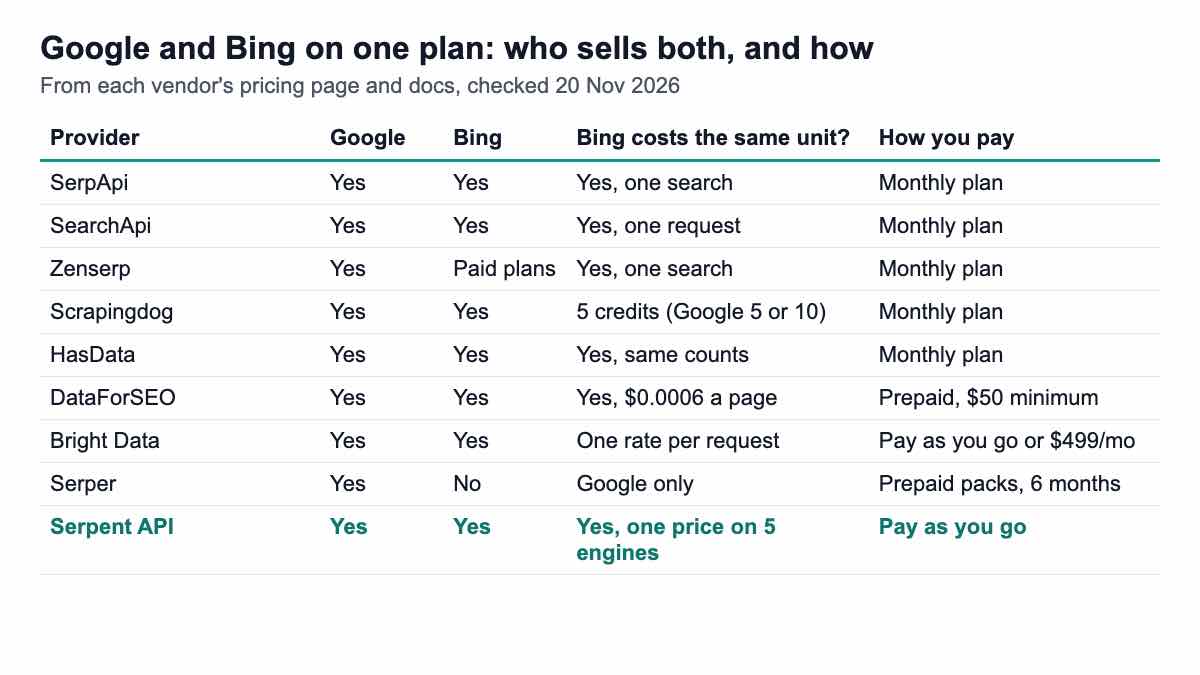
Engine coverage is the easy part. Here is what each vendor documents for Bing specifically, checked on 20 November 2026:
- SerpApi has a dedicated Bing Search API selected with
engine=bing, alongside Google and many others. Its pricing page sells "searches" with no separate Bing rate. - SearchApi documents
engine=bingplus Bing images, videos, news and shopping sub-APIs. Its pricing page also lists one rate per request. - Zenserp lists Google, Bing, Yandex and DuckDuckGo on every paid plan. Its free plan of 50 searches a month is Google only, according to the plan table on its pricing page.
- Scrapingdog sells a Google SERP API, a Bing Scraper API and a Universal Search API from the same credit pool.
- HasData prints the same included count for its Google SERP API and its Bing Search API on every plan.
- DataForSEO prices Google Organic and Bing Organic identically on separate rate pages.
- Bright Data names Google, Bing, DuckDuckGo, Yandex, Baidu, Yahoo and Naver in its SERP API documentation.
- Serpent API takes
engine=google,bing,yahoo,ddgorbraveon the same endpoint (see supported engines), and the pricing page says it plainly: "One price on all 5 engines — Google, Bing, Yahoo, DuckDuckGo and Brave."
What does each one cost at 10K, 100K and 1M searches?
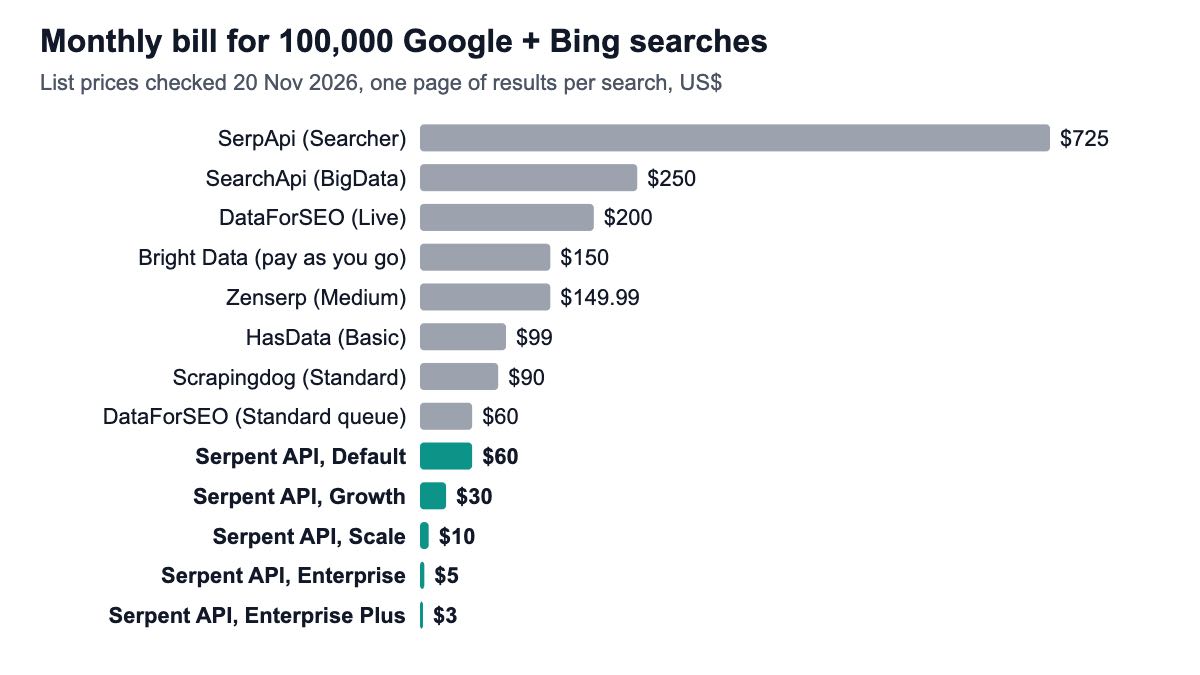
For the same mixed Google and Bing workload, the monthly bill at 100,000 searches ranges from $725 on SerpApi down to $60 on DataForSEO's standard queue, and starts from $3 on Serpent API — pay as you go, no subscription. At 10,000 searches a month most subscriptions cost $4 to $15 per 1,000 because you pay for the smallest plan that fits.
The rules behind the table, so you can redo it for your own volume:
- One search means one page of organic results (about 10 links), on Google or Bing, with no add-ons.
- Subscriptions: I picked the cheapest plan whose monthly allowance covers the volume, then divided the plan price by the searches you actually use. Unused allowance is wasted, which is why small volumes look expensive.
- Scrapingdog is priced with its Light Google API (5 credits) and its Bing API (5 credits). Its Advance Google API costs 10 credits, which doubles the Google half.
- Pay-as-you-go and prepaid prices are simply rate times volume. Free tiers are left out, because a production budget should not depend on them.
- Serpent API rows show every deposit tier. The deposit is credit you spend on calls, not a fee, and it never expires.
| Provider (plan picked) | 10,000 / month | 100,000 / month | 1,000,000 / month |
|---|---|---|---|
| SerpApi | $150 (Production) = $15.00/1K | $725 (Searcher) = $7.25/1K | $3,750 (Cloud 1M) = $3.75/1K |
| SearchApi | $40 (Developer) = $4.00/1K | $250 (BigData) = $2.50/1K | $1,500 (Octo 1M) = $1.50/1K |
| Zenserp | $49.99 (Small, 25K) = $5.00/1K | $149.99 (Medium) = $1.50/1K | $899 (Enterprise) = $0.90/1K |
| Scrapingdog (5 credits a search) | $40 (Lite) = $4.00/1K | $90 (Standard) = $0.90/1K | $350 (Premium) = $0.35/1K |
| HasData | $49 (Startup, 20K) = $4.90/1K | $99 (Basic) = $0.99/1K | Unverified (largest listed plan is 300K) |
| DataForSEO, standard queue | $6 = $0.60/1K | $60 = $0.60/1K | $600 = $0.60/1K |
| DataForSEO, live mode | $20 = $2.00/1K | $200 = $2.00/1K | $2,000 = $2.00/1K |
| Bright Data | $15 pay as you go = $1.50/1K | $150 pay as you go = $1.50/1K | $1,305 (Scale) = $1.31/1K |
| Serpent API, Default | $6 = $0.60/1K | $60 = $0.60/1K | $600 = $0.60/1K |
| Serpent API, Growth ($100 deposit) | $3 = $0.30/1K | $30 = $0.30/1K | $300 = $0.30/1K |
| Serpent API, Scale ($500 deposit) | $1 = $0.10/1K | $10 = $0.10/1K | $100 = $0.10/1K |
| Serpent API, Enterprise ($1,000 deposit) | $0.50 = $0.05/1K | $5 = $0.05/1K | $50 = $0.05/1K |
| Serpent API, Enterprise Plus ($1,250 deposit) | $0.30 = $0.03/1K | $3 = $0.03/1K | $30 = $0.03/1K |
Three things stand out. First, subscriptions punish the 10,000-search buyer: SerpApi's $150 Production plan holds 15,000 searches, so a month of 10,000 costs $15 per 1,000 actually used. Second, Bright Data's Scale plan only beats pay as you go once you pass about 333,000 searches a month, because $499 buys 332,667 searches at $1.50. Third, the two pay-per-use options with no plan to outgrow, DataForSEO and Serpent API, cost the same per 1,000 at every volume, so your bill tracks your traffic.
Does a Bing search cost the same as a Google search?
On most of these plans, yes: a Bing search uses the same unit as a Google search. The two exceptions to watch are Scrapingdog, where Google can cost twice as much as Bing depending on which Google API you call, and Zenserp, where Bing is not on the free plan at all.
Scrapingdog. Its pricing page lists the Bing Scraper API at 5 credits, the Google SERP Light API at 5 credits and the Google SERP Advance API at 10 credits. If your Google half needs the Advance endpoint, a 50/50 split costs 7.5 credits a search on average, not 5. At 100,000 searches that is 750,000 credits, which still fits the $90 Standard plan, but at 1,000,000 searches it is 7.5 million credits and pushes you from the $350 Premium plan to the $500 Business plan.
Zenserp. Paid plans include Google, Bing, Yandex and DuckDuckGo. The free plan includes Google only, so you cannot try Bing output before paying $49.99. An AI Overview costs 3 searches on Zenserp, but that is a Google feature and does not affect Bing.
DataForSEO. The Google Organic and Bing Organic rate pages are identical: $0.0006 per page of 10 results in the standard queue, $0.0012 in the priority queue and $0.002 in live mode. Each extra 10 results adds one more base price, rounded up.
SerpApi, SearchApi, HasData and Bright Data print one rate per search or request with no engine-specific line. That is the best evidence available that Bing and Google draw on the same allowance, but I could not find a sentence on SerpApi's or SearchApi's pricing pages saying so in words, so treat it as the reading of the price list rather than a quoted promise.
Serpent API states it on its pricing page: "Setting engine= never changes what you pay." A Bing call and a Google call for one page of organic results each cost one call at your tier's rate.
What does the per-1,000 price leave out?
The per-1,000 figure is only half the bill. The other half is what happens to unused allowance, how fast you are allowed to spend it, and what counts as a billable request. These rules decide whether a cheap plan stays cheap.
Unused searches and expiry
Monthly plans reset. If you buy SerpApi's Searcher plan for 100,000 searches and use 60,000, the other 40,000 are gone at renewal.
Scrapingdog is the friendliest subscription here: from its Standard plan upward, unused credits carry over to the next billing cycle. Serper's prepaid packs are valid for 6 months. DataForSEO says funds added to an account do not expire, and Serpent API's deposited credits never expire either. For a longer look at this one issue, see do SERP API credits expire.
Hourly caps
SerpApi limits throughput per hour by plan: 200 an hour on Starter, 3,000 on Production and 20,000 on Searcher. SearchApi says you can use "up to 20% of your plan's credits each hour", which means a 10,000-search Developer plan cannot send more than 2,000 in any hour. If you run a nightly rank check across both engines, these caps can matter more than the price.
What counts as a billable request
Nearly everyone on this list bills only successful requests. SerpApi says cached, errored and failed searches are not counted. SearchApi charges only 200-status responses.
Zenserp and Scrapingdog say failed requests are not billed. Bright Data's billing documentation adds one exception worth knowing: if you send custom headers or cookies, "all requests are billed, including failed or errored requests". Our guide to which SERP APIs bill failed requests covers each policy in detail.
Minimums
DataForSEO's minimum top-up is $50. Serpent API's minimum first deposit is $10, and the lower rates in the table above apply after one deposit of $100, $500, $1,000 or $1,250. The subscriptions have no minimum beyond the plan price itself.
Do you need both engines in a single call?
Usually not. Most providers return one engine per request, and you send two requests when you want both. Only Scrapingdog's Universal Search API returns a merged result from several engines in one call.
Scrapingdog's Universal Search API says it pulls organic results "from Google, Bing, Yahoo, and DuckDuckGo in one request" and merges duplicate links into a single entry. It costs 20 credits a request, four times a Bing call. That is good value if you want a de-duplicated list and do not care which engine ranked what. It is the wrong tool for rank tracking, where you need each engine's own positions.
For per-engine work, one request per engine is cleaner, and with a single price it costs the same as one Google search plus one Bing search. With Serpent API, the documented call is the same URL with a different engine value:
curl "https://apiserpent.com/api/search/quick?q=project+management+software&engine=google&country=us" \
  -H "X-API-Key: YOUR_API_KEY"

curl "https://apiserpent.com/api/search/quick?q=project+management+software&engine=bing&country=us" \
  -H "X-API-Key: YOUR_API_KEY"
Both calls return the same response shape, so one parser handles Google and Bing. You can also ask for up to 100 organic results in one call with num, which is a ceiling rather than a guaranteed count (Google calls often return 40 to 70 rows, and other engines can return fewer); the parameters are in the web search docs. If you want to merge and score results across engines yourself, the aggregator tutorial linked at the top of this page has working code.
What happened to Microsoft's own Bing API?
Microsoft retired the Bing Search APIs on 11 August 2025. Its lifecycle notice says existing instances were decommissioned and new sign-ups closed, and it points customers to Grounding with Bing Search inside Azure AI Agents instead.
That replacement feeds web results into an AI agent's answer. It is not a drop-in source of ranked Bing result lists for an SEO tool. So anyone who needs Bing positions, titles and URLs as JSON now buys them from a SERP API, and that is a big reason this question gets asked at all. Our list of Bing Search API alternatives goes through the migration in more depth.
Two other APIs often come up and do not fit this brief. Serper is a fast, cheap Google API (packs from $1.00 down to $0.30 per 1,000), but it does not sell Bing. The Brave Search API costs $5 per 1,000 and says every result comes from Brave's own index, so it gives you neither Google's nor Bing's rankings.
So which one should you pick?
Pick on billing model first, then on features. Here is how I would choose for the common cases:
- You want the lowest cost per search and no subscription: Serpent API. One price across Google, Bing, Yahoo, DuckDuckGo and Brave, from $0.03 per 1,000 — pay as you go, no subscription — and deposited credit never expires. Start with the 10 free API calls, then compare output against your current provider.
- Your jobs run overnight and can wait in a queue: DataForSEO's standard queue at $0.60 per 1,000 on both engines, with a $50 minimum top-up.
- You need a de-duplicated list from four engines in one response: Scrapingdog's Universal Search API, at 20 credits a request.
- You run about 100,000 searches a month and like a fixed monthly price: Scrapingdog Standard at $90 or HasData Basic at $99. Check Scrapingdog's Light versus Advance credit cost for your Google half.
- You want the broadest engine catalogue and a long track record, and volume is modest: SerpApi. It is the most expensive per search here, but it covers many engines and verticals under one plan.
- Procurement needs an enterprise contract and unlimited concurrency: Bright Data, which lists unlimited concurrency on pay as you go and Scale, and custom terms above that.
Whichever you choose, run the same 20 or 30 queries through Google and Bing on your shortlist and compare the parsed fields against what your product needs. Price per 1,000 is only a saving if the response answers the question your product asks. If you mostly need flexible monthly volume, our page on SERP APIs without a subscription compares the pay-per-use options further.
How we checked this
On 20 November 2026 I read the live pricing page of every provider in the tables (8 vendor pricing pages, 3 vendor rate or billing documentation pages, 4 product or engine documentation pages) plus Microsoft's retirement notice and Brave's and Serper's pages, 17 external sources in all. Our own prices come from our pricing page on the same day. The cost table is arithmetic on those list prices with the rules stated above it; no paid calls were made for this comparison and no output quality is compared. What I could not verify: a written statement from SerpApi or SearchApi that Bing and Google draw on the same allowance (their price lists show one rate, which is how the table reads them); HasData's price above 300,000 searches a month; Bright Data's Enterprise rates; and any discount codes or annual prices, which are left out.
Google and Bing on one key, one price
Serpent API returns Google, Bing, Yahoo, DuckDuckGo and Brave results as JSON from $0.03 per 1,000 — pay as you go, no subscription. Sign up and you get 10 free API calls to compare the output yourself.
Get Your Free API KeyExplore: SERP API · Playground · Docs · Pricing
FAQ
Is there a SERP API that covers both Google and Bing on one plan?
Yes. SerpApi, SearchApi, Zenserp (paid plans), Scrapingdog, HasData, DataForSEO, Bright Data and Serpent API all sell Google and Bing results under one plan or one prepaid balance, with a single API key. They differ in how you pay: monthly subscriptions with an allowance that resets, a prepaid balance with a minimum top-up, or pay as you go. At 100,000 searches a month, list prices for the same workload ranged from $3 to $725 when checked on 20 November 2026.
Does SerpApi charge more for Bing searches than Google searches?
SerpApi's pricing page sells plans by the number of searches and prints no separate rate for Bing, so a Bing search reads as one search from the same plan, the same as a Google search. Its plans run from $25 for 1,000 searches to $3,750 for 1,000,000, and only successful searches are counted. If Bing makes up half of your volume, size the plan on the total of both engines, not on Google alone.
What is the cheapest way to get Bing search results as JSON?
On list prices checked 20 November 2026, the lowest per-1,000 rates for Bing were Serpent API from $0.03 per 1,000 — pay as you go, no subscription — DataForSEO's standard queue at $0.60, and Scrapingdog from $1.00 per 1,000 on its $40 Lite plan to about $0.29 on its $350 Premium plan, and lower on its larger plans, when the plan is fully used. Microsoft's own Bing Search API is no longer an option, because it was retired on 11 August 2025.
Can one API call return Google and Bing results together?
Scrapingdog's Universal Search API does this: one request returns organic results from Google, Bing, Yahoo and DuckDuckGo, with duplicate links merged into one entry, for 20 credits. Most other providers, including Serpent API, return one engine per call. For rank tracking you want the separate calls; for a de-duplicated research list, the merged call can be simpler.
Do unused searches carry over to the next month?
It depends on the vendor. Monthly plans from SerpApi, SearchApi, Zenserp and HasData reset each month unless the vendor says otherwise.
Scrapingdog carries unused credits over from its Standard plan upward. Serper's prepaid packs last 6 months. DataForSEO funds and Serpent API deposited credits do not expire. If your volume swings from month to month, a balance that never expires usually costs less than a plan sized for your busiest month.
Sources
Official pricing pages (checked 20 November 2026):
- SerpApi pricing
- SearchApi pricing
- Zenserp pricing plans
- Scrapingdog pricing
- HasData prices
- DataForSEO pricing (top-up, trial and expiry)
- Bright Data SERP API pricing
- Serper (credit packs)
- Brave Search API plans
Rate pages and billing documentation (checked 20 November 2026):
- DataForSEO Google Organic SERP API rates
- DataForSEO Bing Organic SERP API rates
- Bright Data SERP API pricing and billing
Product and engine documentation (checked 20 November 2026):
- SerpApi Bing Search API
- SearchApi Bing engine docs
- Scrapingdog Universal Search API
- Bright Data SERP API introduction
Platform notices (checked 20 November 2026):