Cheapest Substack API in 2026

On public prices read on 23 November 2026, Serpent API is the cheapest Substack posts API among the sellers compared here with real usage: $0.148 per 1,000 posts at a full page, which is $3.70 per 1,000 calls of up to 25 posts. The lowest entry price I found from a seller with 50 or more monthly users is $0.30 per 1,000 posts, and the lowest volume price is $0.28 (until 27 November 2026). No subscription, and one call returns titles, links, dates, likes, comments and restacks.
Short answer: For a prototype or a few million posts, use Serpent’s pay-as-you-go rate of $3.70 per 1,000 calls: a million posts at full pages is $148.00. A deposit tier takes that to $0.70 per 1,000 calls, $28.00 for a million. If you need comments, full post text or subscriber lists, price an Apify actor instead, because Serpent returns post details and the public excerpt, not the body. If you already buy from Bright Data, check its Substack scraper before adding a vendor.
A Substack publication is a newsletter with its own archive of posts. Several sellers turn those archives into a data feed, and almost none of them bill the same thing: one charges per result, one per page load, one per run plus a fee for every post, and one sells credits for fetching any page at all. A price per 1,000 means something different at each.
So I read the public prices on 23 November 2026 and put them on one ruler, dollars per 1,000 posts, with the unit each seller really charges next to the number. Where a seller does not say how many posts one unit returns, the row says so and carries no per-post figure.
One rule decides who is on the ruler. I count a seller only if 50 or more people used it in the last 30 days, because a price that nobody pays is hard to trust. Sellers below that line are covered in their own section, and they change what “cheapest” can honestly mean.
What does a Substack post cost at each seller’s entry price?
Serpent’s entry price is $0.148 per 1,000 posts at a full page of 25. The next lowest counted price is $0.30, from an Apify actor with 57 monthly users. After that the entry prices climb to $1.15, $1.50 and $2.50 per 1,000 posts, and a general page-fetching service sits outside the ruler because it sells pages, not posts.
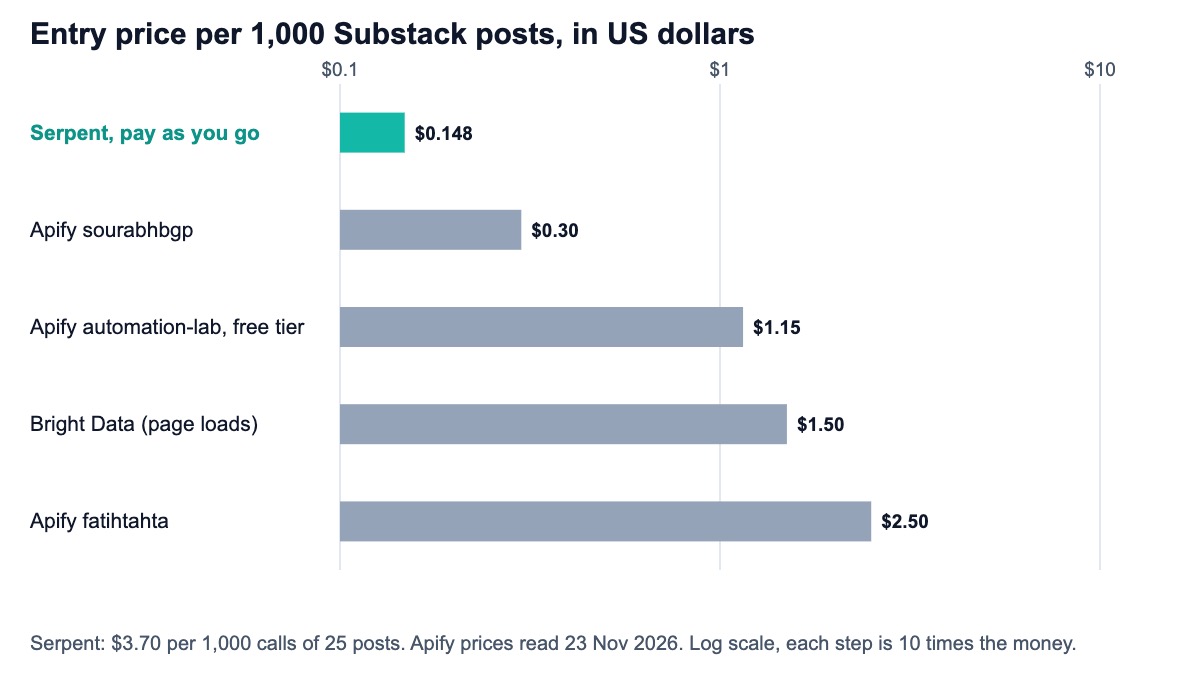
| Seller and plan | What one unit is | Entry price per 1,000 units | Posts per unit | Per 1,000 posts at a full page |
|---|---|---|---|---|
| Serpent API: pay as you go | 1 call | $3.70 | Up to 25 | $0.148 |
| Apify sourabhbgp, 57 monthly users | 1 result (a post) | $0.30 | 1 | $0.30 |
| Apify automation-lab, 189 monthly users, free-tier price | 1 post (metadata) | $1.15 | 1 | $1.15 plus $0.005 a run |
| Bright Data, pay as you go | 1 page load | $1.50 | Not stated | $1.50 if a load is one post |
| Apify fatihtahta, 50 monthly users, free-tier price | 1 result | $2.50 | 1 | $2.50 |
| ScrapingBee, Hobby ($19 a month) | 1 credit, more with extras | $0.253 per 1,000 credits | A page, not a post list | Not comparable |
How each row was built, so you can audit it:
- Serpent API. One call is one charge, however many posts it returns, so the price per 1,000 posts is the call price divided by 25 for a full page: $3.70 / 25 = $0.148. A small publication returns fewer than 25, and then the per-post price rises in proportion; a later section shows by how much.
- sourabhbgp. Its Apify page bills each dataset item at $0.0003, which is $0.30 per 1,000, plus $0.00005 when a run starts. The price is the same at every plan.
- automation-lab. Its Apify page bills post metadata at $0.00115 on the free tier, falling to $0.00028 at the top tier, and a post with its content at $0.0023 on the free tier. Every run adds $0.005.
- Bright Data. Its Substack scraper page lists “$1.5/1K page loads” pay as you go. It does not say how many posts a page load covers, so the per-post cell is conditional.
- fatihtahta. Its Apify page bills each result at $0.0025 on the free tier and $0.00199 on paid tiers.
- ScrapingBee. Its Substack page sells credits: Hobby is $19 for 75,000 credits, which is $0.253 per 1,000 credits. A request starts at 1 credit and costs 5 with JavaScript rendering. The page states no price per post.
Why is a price per 1,000 never the same thing twice?
Because the unit moves, and so does what you get for it. An Apify actor that bills “post metadata” is selling the title, date and counts; the same actor bills about twice as much for a post with its content. Serpent’s API returns the equivalent of metadata plus the public excerpt, so the like-for-like row at automation-lab is the metadata price, not the content price.
Bright Data bills a page load, and a start fee applies to some Apify runs. A run fee of $0.005 is nothing on a pull of 100,000 posts, and it adds about a sixth to the price of a pull of 25. The ruler I find fairest is the cost of one million posts, because it is what a monitoring job or a research pull really buys.
| Seller and plan | 100,000 posts | 1,000,000 posts | 10,000,000 posts |
|---|---|---|---|
| Serpent API: pay as you go | $14.80 | $148.00 | $1,480.00 |
| Apify sourabhbgp | $30.00 | $300.00 | $3,000.00 |
| Apify automation-lab, free-tier price | $115.00 | $1,150.00 | $11,500.00 |
| Bright Data, pay as you go (if a load is one post) | $150.00 | $1,500.00 | $15,000.00 |
| Apify fatihtahta, free-tier price | $250.00 | $2,500.00 | $25,000.00 |
Run fees are left out of the table, so the Apify rows are a little low for small runs. The ScrapingBee row is left out on purpose, for the reason in a later section.
What does an Apify actor really cost?
Apify is a marketplace where independent developers publish scrapers as “actors”. Each sets its own price and unit, and Substack has a crowd of them: 390 actors had “substack” in the name or title when I counted on 22 November. Most are tiny, and many scrape notes, leaderboards or email addresses rather than posts.
| Actor | Billed unit | Price per 1,000 posts | Other fees on the page | Monthly users |
|---|---|---|---|---|
| automation-lab/substack-scraper | Post (metadata) | $1.15 on the free tier, $0.28 at the top tier (from 27 Nov 2026: $1.00 free, $0.80–$0.90 paid tiers) | $0.005 run start | 189 |
| sourabhbgp/substack-scraper | Result | $0.30 at every plan | $0.00005 run start | 57 |
| fatihtahta/substack-scraper | Result | $2.50 on the free tier, $1.99 on paid tiers | None listed | 50 |
| digispruce, Substack Newsletter Scraper | Post | $1.00 on the free tier, $0.50 at Gold and above | Not read | 17 |
| scraper_guru, Substack Scraper | Post | $3.00 on the free tier, $2.40 at the top | Not read | 9 |
| easyapi, Substack Posts Scraper | Result | $4.99 | $0.09 per run | 22 |
Three things stand out. First, the busiest actor is not the cheapest: automation-lab has 189 users and charges $1.15 per 1,000 posts on the free tier. Its price falls tier by tier to $0.28 at the top; read its page for what each tier asks. Its pricing record also lists a new schedule from 27 November 2026: the free-tier price falls to $1.00 per 1,000 posts and the discounted tiers rise to $0.80–$0.90, so the $0.28 figure ends on 27 November.
Second, the cheapest counted actor, sourabhbgp, is flat at $0.30. That makes it the fair rival for Serpent’s entry price, which is half as much per post at a full page. Third, an actor is a job you start, not a request you make: you run it, wait for the dataset and read it back. For a one-off pull that is fine, and I did not compare run times.
Are there cheaper sellers that this table leaves out?
Yes, and you should know about them. On 22 November I noted small Apify actors with 0 to 2 monthly users each listed at $0.01 to $0.25 per 1,000 posts. I did not re-read them on 23 November and I did not try to judge whether they return working data. If you count them, Serpent is not the lowest sticker price on Apify.
I leave them out for one reason: nobody has shown that they work at volume, and a price you cannot rely on is not a price. If you want to try a tiny actor for a one-off pull, that is a fair bet, because you lose little if it fails. If a product depends on the feed, the usage line is a sensible filter, and it is the one I apply to the claim at the top of this page.
What do Bright Data and the page-fetch services charge?
Bright Data’s Substack scraper is the large-vendor option. Its page lists $1.50 per 1,000 page loads pay as you go, and a Scale plan at $499 a month that includes 383,000 page loads and then charges $1.30 per 1,000 more. The fields it names are the publication name, author, post title, subtitle, publish date, likes, comments and restacks, with paid or free status, subscription price and category also mentioned.
That is more than Serpent returns on one point: subscription price and category are fields I do not return. It also bills per page load, and the page does not say whether a load is one post or a list of them, so the price per post could be $1.50 or lower. A million page loads at the $1.30 add-on rate is about $1,300; at pay as you go it is $1,500.
ScrapingBee is a different kind of product. Its Substack page sells credits for fetching a web page: Hobby is $19 for 75,000 credits and its largest listed plan is $5,799 for 120,000,000 credits, about $0.048 per 1,000 credits. A request starts at 1 credit, costs 5 with JavaScript rendering and costs more with premium options. At 1 credit a request, that is cheaper than Serpent’s $3.70 per 1,000 calls, so I will not pretend otherwise.
What it hands you is a page, not a list of posts with counts. Your code has to read the page, find the posts and parse the numbers, and keep doing so when the layout changes. If you already run that parser, ScrapingBee may be the lower bill. If you want the list as fields, it is not the same product, and that is why it sits outside the ruler.
What do the five Serpent rates look like?
Serpent’s rate falls as your deposit tier rises. The deposit is spendable balance, not a fee, and there is no monthly plan. One call is one charge however many posts it returns, and a call that comes back with an empty list is not billed.
| Tier | Deposit | Per 1,000 calls | Per call | Per 1,000 posts at 25 a call | One million posts |
|---|---|---|---|---|---|
| Pay as you go | $10 minimum | $3.70 | $0.0037 | $0.148 | $148.00 |
| Growth | $100 | $2.40 | $0.0024 | $0.096 | $96.00 |
| Scale | $500 | $1.60 | $0.0016 | $0.064 | $64.00 |
| Enterprise | $1,000 | $1.10 | $0.0011 | $0.044 | $44.00 |
| Enterprise Plus | $1,250 | $0.70 | $0.0007 | $0.028 | $28.00 |
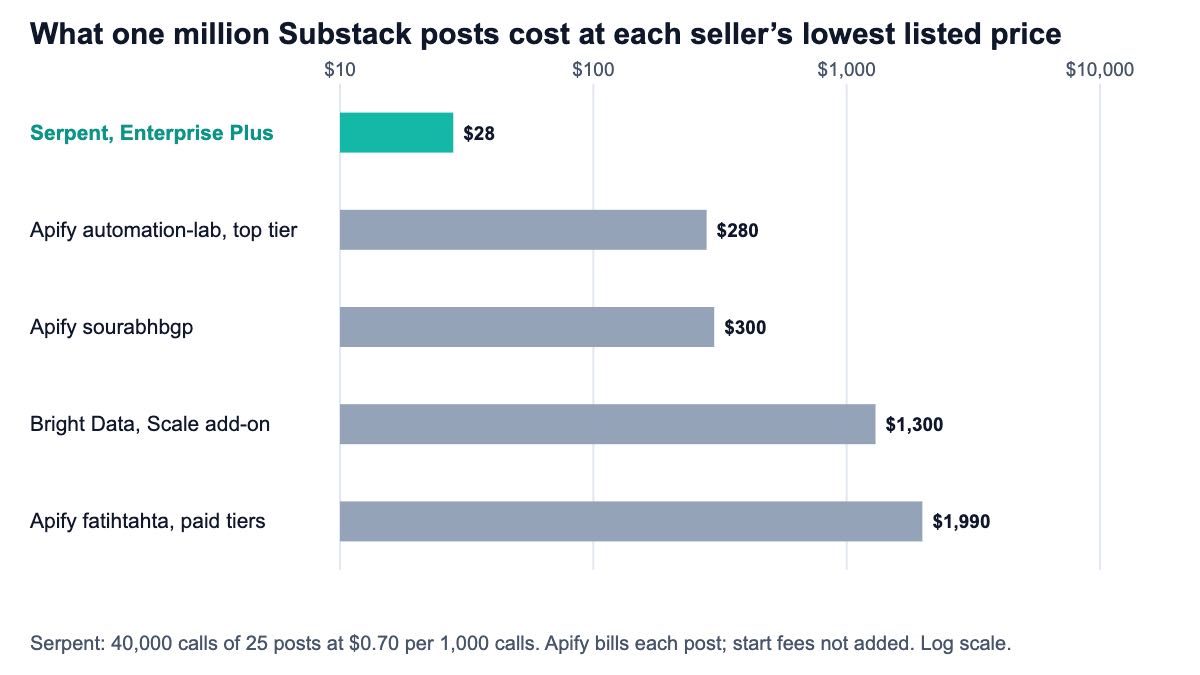
At the top tier the comparison with the busiest rival gets sharper. automation-lab’s best published price until 27 November 2026 is $0.28 per 1,000 posts, and Serpent’s is $0.028: ten times lower. Against Bright Data’s $1.30 add-on rate it is about 46 times lower, if a page load is one post. The honest point about the table is that the money is small at every row: a million posts costs between $28 and $148.
What happens when a publication has fewer than 25 posts?
The price per post rises, because a call is one charge whatever it carries. A publication with ten posts costs $0.37 per 1,000 posts at the pay-as-you-go rate, and one with a single post costs $3.70 per 1,000, which is $0.0037 for that post. That is the one place where a per-post seller can be cheaper than a per-call one.
| Posts in the call | Per 1,000 posts | Against sourabhbgp at $0.30 |
|---|---|---|
| 25 | $0.148 | Half the price |
| 23.4, the average of a real set | $0.158 | About half the price |
| 12 | $0.308 | Just above |
| 1 | $3.70 | 12 times the price |
Real data shows how much this matters. In a fixed set of 56 publications drawn before any request was made, 46 returned posts, and those 46 gave 1,075 posts between them: 23.4 a call. Forty-two of the 56 returned a full 25. In the three saved answers behind this site’s examples, two publications returned 25 posts and a small German newsletter returned one.
So the break-even against the $0.30 actor is about 12 posts a call. A job over large, active publications sits near the top of the table. A job that visits thousands of tiny newsletters sits nearer the bottom, and for that one you should price a per-post actor against your own list before you commit.
What do you get for the money?
With Serpent, one GET request to /api/substack/posts returns up to 25 posts of a public Substack publication. You name the publication as its Substack name, its substack.com address or its own domain. sort is new (the default) or top, and cursor takes the next_cursor of the previous answer to get the next 25. The answer is flat JSON in the same shape on every call.
Each post carries 17 fields: id, title, subtitle, url, publication date, audience (open to everyone, paid, subscribers or founding members), type (newsletter, podcast, thread or restack), word count, likes, comments, restacks, reactions with emoji and count, cover image, authors with name and handle, the public excerpt, section and tags. A field a post does not have comes back as null or an empty list.
Some honest edges. A paid post returns its public excerpt and never its paid text. A call returns the posts and nothing else: no comment text, no subscriber counts and no revenue. Paging works through the cursor only, and a cursor from one sort does not work with the other.
On the same fixed set of 56 publications, 46 returned posts and ten did not. Four of the ten were deliberate failures (two subdomains that do not exist, a publication that left Substack and a site that was never on it), and six were publications that did not return posts from the address given. Those counts come from a test run before launch, not from live calls.
Other sellers do more, and if you need these features you should price them instead of the cheapest row. Apify actors scrape comments and notes, and several return the full text of free posts. Bright Data lists a subscription price. None of that is in Serpent’s fields.
Which free tiers are worth using?
For a prototype, any of them. Serpent gives a new account 10 free API calls, which is up to 250 posts. Bright Data lists a free tier of 5,000 page loads, and ScrapingBee gives 1,000 free credits on signup. I did not read Apify’s free plan credit for this post.
Count requests and posts, not credits, before you decide what fits. If your prototype is a weekly digest of five newsletters, ten calls cover two weeks of it. The same key also works on Serpent’s other data endpoints, so a team already pulling search results does not need a second account, and the Reddit API, X API and social media APIs sit under the same key for the other half of a listening stack.
Which one should you pick?
Named picks by scenario, on the evidence I have:
- A prototype, or a few million posts: Serpent’s pay-as-you-go rate. A million posts is $148.00 at full pages and you start with 10 free API calls.
- A steady monitoring job on many publications: Serpent with a deposit tier once you spend it: Growth at $100 takes the rate to $2.40 per 1,000 calls and Enterprise Plus to $0.70.
- A list of thousands of tiny newsletters, one or two posts each: price a per-post actor such as sourabhbgp at $0.30 against your own list, because Serpent’s per-call price works against you there.
- Comments, notes, full free-post text or leaderboards: an Apify actor built for that, after reading its page. automation-lab prices comments and content separately.
- Subscription price or category, from a large vendor: Bright Data’s Substack scraper, at $1.50 per 1,000 page loads.
- You already parse pages yourself: ScrapingBee’s credits, which cost less per request than any row above.
The one situation where I would not choose on price is a product whose users wait on the result. Check hit rate and speed on your own list of publications before you commit. The Substack API page has the fields, the parameters and a live playground, the Python and Node guide has runnable code, and Substack data for newsletter research shows what the numbers can answer.
How we checked this
What I checked. On 23 November 2026 the pricing records of three Apify actors (automation-lab, sourabhbgp and fatihtahta) were read from Apify’s public actor listings, the Apify store listing for Substack was read for user counts and other sellers, and the Bright Data and ScrapingBee pages were read for their prices. A first read of the Apify market, with 390 Substack-named actors, was done on 22 November 2026. Sources are listed at the end, by type. I did not use Google results or aggregator blogs for any price.
Serpent’s own numbers. The five Serpent rates are the published rates. The 56-publication check is a fixed list drawn before any request was made, run on 22 November 2026; it covers the data read, not the deployed endpoint. The 23.4 posts a call is 1,075 posts over the 46 first pages that returned posts. The three examples are saved answers from 22 November 2026.
What I could not verify:
- Whether a Bright Data page load covers one post or several; its page does not say.
- The price of RapidAPI listings for Substack, which I could not read, and any Substack coverage at HasData, Outscraper, DataForSEO or SerpApi, which I did not check.
- Apify’s plan fees and the size of its free credit, and which plan unlocks each actor’s best tier.
- The small actors with fewer than 50 users that I noted on 22 November; I did not re-read their prices on 23 November.
- That a typical Serpent call returns 25 posts is the result of a fixed-set run, not a promise: a small publication returns fewer.
Prices change often, so re-check any seller within a week of buying.
Price your own volume
Serpent’s Substack API is $3.70 per 1,000 calls pay as you go, no subscription, with 10 free API calls to start. Try a real publication in the playground before you write any code.
Get Your Free API KeyExplore: Substack API · Playground · Docs · Pricing · SERP API pricing compared
FAQ
What is the cheapest Substack API?
On public prices read on 23 November 2026, Serpent API has the lowest price of the Substack posts APIs compared here with 50 or more monthly users: $0.148 per 1,000 posts at a full page, which is $3.70 per 1,000 calls of up to 25 posts, pay as you go. The cheapest counted Apify actor lists $0.30 per 1,000 posts, and the lowest volume price I found is $0.28 (until 27 November 2026). Small actors with fewer than 50 users list lower prices and are not counted.
How much does it cost to get a million Substack posts?
A full call returns 25 posts, so a million posts is 40,000 calls: $148.00 at Serpent's pay-as-you-go rate of $3.70 per 1,000 calls, and $28.00 at its highest tier. The Apify actor sourabhbgp comes to $300.00 for a million posts at its flat $0.30 per 1,000, automation-lab to $1,150.00 on its free tier, and Bright Data to $1,500.00 at pay as you go if a page load is one post.
Why do Apify and Serpent quote different units?
Apify actors bill each post or result, plus a small fee when a run starts. Serpent bills one call, which returns up to 25 posts, at $3.70 per 1,000 calls. Converted to posts at a full page they are $0.30 and $0.148 per 1,000, but a call that returns fewer than 25 posts costs more per post, and below about 12 posts a call the per-post actor is cheaper.
Are there cheaper Apify actors?
Some small ones list lower prices. On 22 November 2026 I noted actors with 0 to 2 monthly users priced from $0.01 to $0.25 per 1,000 posts, and I did not check whether they work at volume. Among actors with 50 or more monthly users, the lowest are sourabhbgp at $0.30 and automation-lab at $0.28 at its top tier until 27 November 2026, against Serpent's $0.148 to $0.028.
Is there a free way to read Substack posts?
A publication's feed is free and sits at the publication address followed by /feed, which makes it worth a look if you only need recent titles and links. Among paid sellers, Serpent gives a new account 10 free API calls, which is up to 250 posts, Bright Data lists a free tier of 5,000 page loads and ScrapingBee gives 1,000 free credits on signup.
How often do these prices change?
Often enough to matter. The prices here were read on 23 November 2026, and Apify actors can change a price overnight: automation-lab's pricing record lists a new schedule from 27 November 2026 in which its free-tier price falls to $1.00 per 1,000 posts and its discounted tiers rise to $0.80 to $0.90. Treat any price in a comparison, including this one, as a snapshot, and open the seller's pricing page within a week of buying.
Sources
Apify actor pages and pricing records (read 23 Nov 2026):
- automation-lab/substack-scraper and its public actor record
- sourabhbgp/substack-scraper and its public actor record
- fatihtahta/substack-scraper and its public actor record
- Apify store search for Substack and its listing data
Vendor pricing pages (read 23 Nov 2026):
Feeds (read 23 Nov 2026):