Cheapest Craigslist API in 2026: From $13 per 1K API Calls

On a full page of results, Serpent API has the lowest price per listing among Craigslist data sellers with 50 or more monthly users. It costs $75 down to $13 per 1K API calls of up to 100 listings each, which is $0.75 to $0.13 per 1,000 listings, against $1.30 to $6.00 at those rivals.
Short answer: For a first project or a few hundred thousand listings a month, use Serpent pay as you go: 100,000 listings on full pages is $75. At a million listings a month, move up the tiers; Enterprise Plus makes that $130. If you need each posting's full description text, a per-row seller such as solidcode returns it, at $1.30 to $1.80 per 1,000 listings.
Craigslist data is sold in three different units. Apify's Craigslist actors charge per row, one row for each listing, and Bright Data charges per record. Serpent charges per call; each call returns a search page of up to 100 listings. So every rate below is converted to the price of 1,000 Craigslist listings, with the conversion shown.
All rival prices were read from public pages on 24 November 2026; the sources are linked at the end.
How do you compare a per-call price with a per-listing price?
You divide the call price by the listings it returns. Serpent's Craigslist Search API is priced per call; each call returns up to 100 listings for one area and category, and a full page of 100 is the normal case for any search with more than 100 matches. At $75 per 1,000 calls, one call costs $0.075, so 100 listings cost $0.00075 each, or $0.75 per 1,000 listings.
The tier you are on depends on the size of your deposit, and the deposit is spendable balance rather than a fee. The table lists every tier.
| Serpent tier | Deposit for the tier | Per 1,000 calls | Per call | Per 1,000 listings, full page |
|---|---|---|---|---|
| Serpent API: Pay as you go | $10 minimum deposit | $75 | $0.075 | $0.75 |
| Serpent API: Growth | $100 | $48 | $0.048 | $0.48 |
| Serpent API: Scale | $500 | $31 | $0.031 | $0.31 |
| Serpent API: Enterprise | $1,000 | $20 | $0.020 | $0.20 |
| Serpent API: Enterprise Plus | $1,250 | $13 | $0.013 | $0.13 |
The price is per call, up to 100 listings, so a narrow search that returns 20 listings costs the same $0.075 and works out to $3.75 per 1,000 listings on pay as you go. The fix is cheap: search broadly (a category without a long query, or a wider price range) and filter on your side, or keep a page full by asking for the next one with the page parameter.
How often is a page full? In eight search answers saved before launch (22 and 23 November 2026, not live calls), seven of the eight searches had more than 100 matching listings, from 200 for "iphone 15" in New York to 4,805 apartments of two bedrooms or more under $3,000 in Miami.
What do 10,000, 100,000 and 1,000,000 listings a month cost?
On full pages, a million listings a month costs $750 pay as you go and $130 on Enterprise Plus. The cheapest rival rates among sellers with 50 or more monthly users come to $1,299.80 to $1,500 for the same million, and up to $6,000.
On full pages, 10,000 listings is 100 calls, 100,000 is 1,000 calls and 1,000,000 is 10,000 calls. At $75 per 1,000 calls that is $7.50, $75 and $750. At $13 per 1K API calls it is $1.30, $13 and $130. Every per-row rival is the same multiplication: memo23's $1.50 per 1,000 rows gives $15, $150 and $1,500.
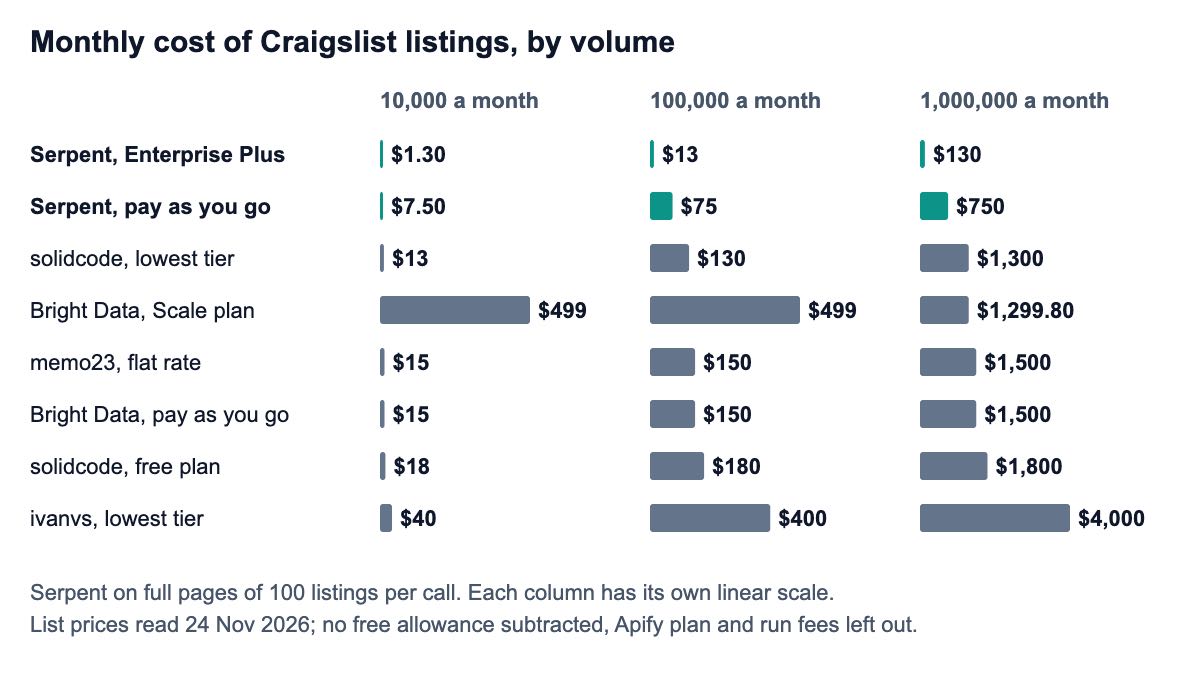
| Provider and plan | 10,000 a month | 100,000 a month | 1,000,000 a month |
|---|---|---|---|
| Serpent API: Pay as you go ($10 minimum deposit) | $7.50 | $75 | $750 |
| Serpent API: Growth ($100 deposit) | $4.80 | $48 | $480 |
| Serpent API: Scale ($500 deposit) | $3.10 | $31 | $310 |
| Serpent API: Enterprise ($1,000 deposit) | $2.00 | $20 | $200 |
| Serpent API: Enterprise Plus ($1,250 deposit) | $1.30 | $13 | $130 |
| Apify: solidcode, lowest tier ($1.30 per 1,000) | $13 | $130 | $1,300 |
| Bright Data: Scale plan ($499 a month, 384,000 records included) | $499 | $499 | $1,299.80 |
| Apify: memo23, flat ($1.50 per 1,000) | $15 | $150 | $1,500 |
| Bright Data: pay as you go ($1.50 per 1,000) | $15 | $150 | $1,500 |
| Apify: solidcode, free plan ($1.80 per 1,000) | $18 | $180 | $1,800 |
| Apify: ivanvs, lowest tier ($4.00 per 1,000) | $40 | $400 | $4,000 |
| Apify: ivanvs, free plan ($6.00 per 1,000) | $60 | $600 | $6,000 |
The rule behind each cell is the price of 1,000 listings times the number of thousands, at list price, before tax, with no free allowance subtracted. Here is how the rows were built, so you can audit them:
- Serpent API. Each call is one charge, for a page of up to 100 listings, so the table assumes full pages: 100 calls for 10,000 listings. A deposit of $100, $500, $1,000 or $1,250 sets the Growth, Scale, Enterprise or Enterprise Plus rate on that credit. The $10 pay-as-you-go minimum covers 133 calls, up to 13,300 listings on full pages.
- Bright Data Scale. $499 a month includes 384,000 records, which is $1.30 per 1,000, and extra records are $1.30 per 1,000. A million records is $499 plus 616,000 extra records at $1.30 per 1,000, or $800.80, for $1,299.80. Below 384,000 records a month you still pay $499, so pay as you go is cheaper there.
- Apify actors. Each actor sets a price per result for each Apify plan. "Free plan" is the rate a new Apify account pays; "lowest tier" is the best rate the actor publishes, which needs a larger Apify subscription. Apify's own monthly plan fee is not in these cells, and neither is the small per-run start fee, so a real Apify bill sits a little above them.
The pricing page lists every Serpent tier for every endpoint.
Who else sells Craigslist listings, and at what price?
Three Apify actors and one large data vendor sell structured Craigslist listings to more than a handful of buyers. A search of the Apify Store for "craigslist" returned 196 actors on 24 November 2026, but only three had 50 or more users in the last 30 days: solidcode (146), ivanvs (107) and memo23 (93). Bright Data sells a Craigslist scraper on its Web Scraper API and does not publish user counts.
| Seller and plan | Users, last 30 days | Per 1,000 listings | How it bills |
|---|---|---|---|
| Serpent API: Pay as you go | n/a | $0.75 | Per call, up to 100 listings ($75 per 1,000 calls) |
| Serpent API: Growth | n/a | $0.48 | Per call ($48 per 1,000 calls) |
| Serpent API: Scale | n/a | $0.31 | Per call ($31 per 1,000 calls) |
| Serpent API: Enterprise | n/a | $0.20 | Per call ($20 per 1,000 calls) |
| Serpent API: Enterprise Plus | n/a | $0.13 | Per call ($13 per 1K API calls) |
| Apify: solidcode, free plan | 146 | $1.80 | Per row; listing details on by default |
| Apify: solidcode, lowest tier | 146 | $1.30 | Per row |
| Apify: memo23, every plan | 93 | $1.50 | Per row, flat; $0.05 per e-mail found, extra |
| Apify: ivanvs, free plan | 107 | $6.00 | Per ad |
| Apify: ivanvs, lowest tier | 107 | $4.00 | Per ad |
| Bright Data: pay as you go | n/a | $1.50 | Per record |
| Bright Data: Scale plan | n/a | $1.30 | $499 a month for 384,000 records, then $1.30 per 1,000 |
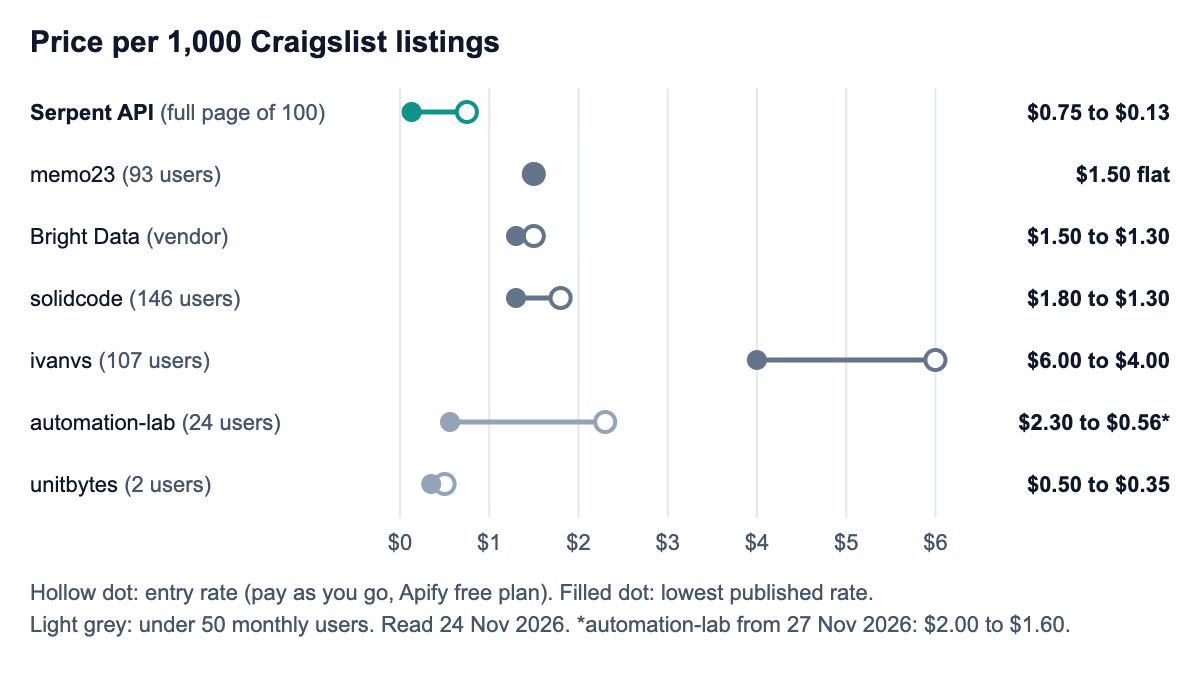
Read the comparison as like for like on price. Serpent's pay-as-you-go $0.75 is half of the cheapest entry rate here, the $1.50 that memo23 and Bright Data charge, and 2.4 times lower than solidcode's $1.80 on Apify's free plan. Serpent's Enterprise Plus rate of $0.13 is 10 times lower than the best volume rate, the $1.30 that solidcode and Bright Data's Scale plan reach, and about 31 times lower than ivanvs at its lowest tier of $4.00.
Bright Data's page has one wrinkle: its plan table says $1.5 per 1,000 records pay as you go, while its FAQ says prices "start from $0.001 per record", or $1.00 per 1,000. This post uses the more specific plan table; even at $1.00, Serpent's pay-as-you-go rate is lower.
Extra events can raise a rival's real cost. memo23 bills an "Email event" of $0.05 for each reply address it captures, which is $50 per 1,000 addresses, on top of the $1.50 per 1,000 rows. ivanvs charges a $0.003 start fee per run and memo23 $0.007, small amounts that only matter when you start many tiny runs.
Are there cheaper sellers with fewer users?
Yes, and they deserve a fair mention. About 190 more Craigslist actors sit in the Apify Store, almost all with fewer than 10 users in the last 30 days, and some list lower prices than the three leaders. Here are the ones most often compared, with their entry and lowest rates per 1,000 listings:
| Actor | Users, last 30 days | Free plan | Lowest tier |
|---|---|---|---|
| Serpent API (full page of 100), pay as you go to Enterprise Plus | n/a | $0.75 | $0.48 / $0.31 / $0.20 / $0.13 |
| automation-lab | 24 | $2.30 ($2.00 from 27 Nov) | $0.56 ($1.60 from 27 Nov) |
| lergassy | 20 | $1.26 | $0.91 |
| fatihtahta | 12 | $1.49 | $0.99 |
| azzouzana | 3 | $1.00 | $0.70 (full listing details $2.50 to $1.50 extra) |
| unbrowseai | 2 | $0.90 | $0.65 |
| unitbytes | 2 | $0.50 | $0.35 (search rows; detailed listings $1.50 to $1.05) |
Three of them (four until 27 November 2026) price a listing below Serpent's pay-as-you-go $0.75: unitbytes on every plan, and unbrowseai ($0.65) and azzouzana ($0.70) at their lowest tiers. automation-lab lists $0.56 until 27 November 2026; from that date Apify lists $2.00 on its free plan and $1.60 at its lowest tier, which puts it above Serpent's $0.75 pay-as-you-go rate. None of the six is below Serpent's Scale rate of $0.31.
Further down the list, an actor with a single user lists a lower number still: nice_dev at $0.032 per 1,000 basic listings. fetch_cat (also one user) shows about $0.036 per 1,000 items on the free plan until 27 November 2026, when Apify lists $0.99 on the free plan and $0.52 at its lowest tier. That is why the claim in this post is scoped to sellers with 50 or more monthly users: a price is only useful if the seller is still there next quarter, and user counts are the one public signal of that.
Why are ScrapingBee and Oxylabs not in the tables?
Because they sell pages, not listings. ScrapingBee's Craigslist scraper returns the Craigslist page as rendered HTML, or as JSON built from extraction rules you write yourself, and it bills in credits per request (from 1 credit, more with JavaScript rendering), on monthly plans from $19 for 75,000 credits. Oxylabs' Craigslist scraper returns the page HTML, with parsing as an option, and prices its Web Scraper API per 1,000 results rather than per listing. Neither page states how many listings a request yields, so neither fits a per-listing table; they suit teams that want to write and maintain their own parser.
What do you get for the money?
One GET request to https://apiserpent.com/api/craigslist/search with your key in the X-API-Key header returns up to 100 listings as JSON. You choose the area (such as sfbay, newyork or losangeles, or a pasted Craigslist link) and the category: for sale, cars, apartments, housing, jobs, gigs, services, electronics, furniture, bikes, computers, motorcycles, free stuff, tools, boats or events. Optional filters cover a search query, minimum and maximum price, bedrooms for housing, listings with pictures, listings posted today, and the sort order.
Each listing carries its id and link, title, price and currency, pay text for jobs and gigs, the location the poster gave, the posting time, a map point (latitude and longitude), the first picture and the picture count, and, where the category has them, bedrooms, square feet and odometer. This row is from an answer saved before launch, on 24 November 2026, for apartments in New York:
{"id":"uVxcE9cuWi5oCk5jgN916t","url":"https://www.craigslist.org/view/d/mount-vernon-spacious-bedroom-in-mount/uVxcE9cuWi5oCk5jgN916t","title":"Spacious 2-Bedroom in Mount Vernon with In-Unit Laundry","price":3950,"currency":"USD","compensation":null,"location":"Mount Vernon","posted_at":"2026-11-23T18:51:57.000Z","latitude":40.9086,"longitude":-73.8221,"image":"https://images.craigslist.org/00606_2ZvpEm8oUSt_0lM0t2_600x450.jpg","image_count":10,"bedrooms":2,"sqft":1300,"odometer":null}Fill rates matter more than field lists. In the eight search answers saved before launch, the title, link, posting time and map point were present on every listing. Every listing in a Seattle "honda civic" search had an odometer reading, every apartment in the Miami and Philadelphia searches had a bedroom count, and 98% of the Atlanta gig listings carried pay text. A bedroom count of 0 means 0 bedrooms as Craigslist classifies the posting, which is mostly studios.
The answer is listing facts only, with no contact details: no phone numbers, no e-mail or reply addresses, and phone numbers inside titles are masked. That is a deliberate choice, and it keeps the data suited to price research, inventory tracking and market maps rather than outreach. Serpent is not affiliated with Craigslist. Use the data for analysis; do not repost listings or message posters in bulk.
Rival rows can be richer: with details switched on, which is the default, solidcode returns each posting's full description, an attributes block (make, model, year, bedrooms and so on), update times, all image links and any phone numbers and e-mails in the text. memo23 and ivanvs return the full ad text too. If your job needs the body of every posting, those rows carry more per listing, at a higher price per listing. If your job is "what is listed, where, at what price, and since when", a Serpent call covers it.
For a walk-through in code, see how to scrape Craigslist listings with Python and Node, and for one use worked end to end, see Craigslist data for rental price research.
Which one should you pick?
Here are named picks by scenario:
- A prototype or up to about 100,000 listings a month: Serpent pay as you go. 100,000 listings on full pages is $75, against $150 at memo23 or Bright Data pay as you go.
- A million or more listings a month: Serpent on Enterprise or Enterprise Plus, $200 or $130 a month on full pages. The nearest rival rate is Bright Data's Scale plan at $1,299.80.
- Rent comps, used-car pricing or other market tracking: Serpent, because the job needs price, place, bedrooms, square feet, odometer and posting time across many searches, and broad searches keep every page full.
- Every posting's full description text: solidcode at $1.30 to $1.80 per 1,000, or memo23 at $1.50 flat.
- You want raw pages and will write your own parser: a page fetcher such as ScrapingBee or Oxylabs.
See every field and parameter on the Craigslist Search API page, or the documentation for the full reference.
How we checked this
What I checked. On 24 November 2026 I read the Apify Store's public listing for "craigslist" (196 actors returned), with each actor's users in the last 30 days and its price per result on every Apify plan; the Apify pages of solidcode, memo23 and ivanvs, the three actors with 50 or more users, for their billing units and output fields; Apify's pricing page; Bright Data's Craigslist scraper page and Web Scraper API pricing; ScrapingBee's Craigslist page and pricing; and Oxylabs' Craigslist scraper page. That is 20 sources in all, listed below. Every rival price above was read that day.
Serpent's own numbers. The five Serpent rates are the published rates. Listings per page and fill rates come from eight search answers saved on 22 and 23 November 2026 before launch, not live calls, plus the example row saved on 24 November.
How the rows were built. Rival rates are list prices with no free allowance subtracted; promotional codes are ignored. "Free plan" is the Apify rate for a new account, "lowest tier" the best rate the actor publishes. Serpent's per-listing figures assume full pages of 100 listings.
What I could not verify. Apify's pricing page names its plans' discount tiers up to Gold on the $999 Business plan; it does not say which plan reaches the Platinum and Diamond tiers that some actors price, including automation-lab's $0.56 (until 27 November 2026). Rival fill rates are unverified, since no rival actor was run, and Bright Data's page gives two entry prices ($1.50 and $0.001 per record). ScrapingBee does not state credits per Craigslist request, Oxylabs does not state which price row applies to Craigslist, and I found no Craigslist listing API on RapidAPI that I could price.
Price your own volume
Serpent's Craigslist Search API is from $13 per 1K API calls; it is priced per call, up to 100 listings in each, pay as you go with no subscription. Try a real search on the Craigslist Search API page before you write any code.
Get Your API KeyExplore: Craigslist Search API · Docs · Pricing · About
FAQ
What is the cheapest Craigslist API?
On a full page of results, Serpent API has the lowest price per listing among Craigslist data sellers with 50 or more monthly users. It costs $75 per 1,000 calls pay as you go and $13 on its top tier, and a call returns up to 100 listings, so a full page works out to $0.75 to $0.13 per 1,000 listings. The rivals with 50 or more monthly users charge $1.30 to $6.00 per 1,000. Prices read on 24 November 2026.
How much does it cost to get 1,000 Craigslist listings?
With Serpent, 1,000 listings is 10 full-page calls: $0.75 pay as you go, $0.48 on Growth, $0.31 on Scale, $0.20 on Enterprise and $0.13 on Enterprise Plus. At the Apify actors with 50 or more monthly users, the same 1,000 listings cost $1.30 to $6.00, and at Bright Data $1.30 to $1.50. A search that returns fewer than 100 listings still costs one call.
Why does Serpent charge per call instead of per listing?
Because one call is one search page, and a page holds up to 100 listings. Charging per call keeps the price fixed and predictable for every search. It does mean a narrow search costs more per listing: 20 listings for one call at $75 per 1,000 calls is $3.75 per 1,000 listings. Broad searches, filtered on your side, and the page parameter keep each call full.
Are there cheaper Craigslist scrapers than Serpent?
Among sellers with 50 or more monthly users, no, though some small Apify actors list lower prices than Serpent's $0.75 pay-as-you-go rate: unitbytes at $0.50, and unbrowseai and azzouzana at $0.65 and $0.70 on their lowest tiers, with 2 or 3 users each. automation-lab (24 users) lists $0.56 until 27 November 2026; from that date Apify lists $1.60 at its lowest tier, above Serpent's $0.75. One single-user actor lists under $0.05 per 1,000. None of the six named here is below Serpent's $0.31 Scale rate.
Does the Craigslist API return phone numbers or e-mail addresses?
No. Serpent returns listing facts only: title, price, location, posting time, map point, picture, and bedrooms, square feet or odometer where they apply. There are no phone numbers, e-mail or reply addresses, and phone numbers inside titles are masked. Some Apify actors do return contact data, and memo23 bills $0.05 for each e-mail it captures; Serpent's data is meant for research and tracking, not outreach.
Is there a free way to get Craigslist listing data?
For small tests, yes. Bright Data lists 5,000 free records a month, and Apify's free plan includes $5 of usage a month, about 3,300 listings at memo23's $1.50 per 1,000. Serpent's Craigslist Search API is paid per call, and the $10 pay-as-you-go minimum covers 133 calls, up to 13,300 listings on full pages.
Sources
Apify Store and actor pages (read 24 Nov 2026):
- Apify Store listing for “craigslist” (users in the last 30 days, price per result on each plan)
- solidcode Craigslist Scraper
- memo23 Craigslist Scraper
- ivanvs Craigslist Scraper
- automation-lab Craigslist Scraper
- lergassy Craigslist Scraper
- fatihtahta Craigslist Scraper
- azzouzana Craigslist scraper
- unbrowseai Craigslist Scraper
- unitbytes Craigslist Scraper
- fetch_cat Craigslist Classifieds Scraper
- nice_dev Craigslist listings scraper
- Apify pricing, plans and Store discount tiers
Other providers (read 24 Nov 2026):
- Bright Data Craigslist scraper, plans and FAQ
- Bright Data Web Scraper API pricing
- ScrapingBee Craigslist scraper API
- ScrapingBee pricing
- Oxylabs Craigslist scraper
Other comparisons read for this post (24 Nov 2026):