Airbnb Data for Short-Term Rental Pricing

To price a short-term rental from Airbnb data, search your area with your dates and guest count, turn each stay’s price into a price per night, and place your rate against the median and quartiles of those nights. In one saved search for Porto, 18 stays ran from $52 to $184 a night with a median of $100.00. A call costs a fraction of a cent, so you can repeat it for every date and party size that matters to you.
Short answer: For a new listing, run one search per guest count you expect and start your rate inside the middle half of the nightly prices. For a listing with bookings, watch the median once a week and move your rate when it moves. For your busy dates, search those exact dates instead of a flexible month. For a portfolio, run one search per area per week; a year of that for 20 areas is 1,040 calls. The middle-half rule is my own rule of thumb, not a finding.
A nightly rate is a guess until you see what stays like yours charge for the nights you want. Airbnb search results are the nearest thing to a public price list for that, and the Airbnb search endpoint turns them into rows you can sort and summarise.
Everything below is computed from three saved answers: Porto with no dates and Munich for two nights, both recorded on 23 November 2026, and Barcelona for a week with filters, recorded on 20 November 2026. Each answer is the 18 stays Airbnb shows first for that search, so every median here is a median of what a guest sees first, not of a whole city. The snippets are complete, and each figure says how it was worked out.
Which stays should you compare your rental with?
The ones a guest would weigh against yours: the same area, the same dates, the same party size and the same kind of place. Each of those is a search parameter, so the comparison set is whatever you put in the request.
| Search | Parameters | Price covers | Stays |
|---|---|---|---|
| Porto | location=Porto, no dates | 2 nights for each stay, the stay Airbnb picked | 18 |
| Munich | location=München, checkin=2027-01-07, checkout=2027-01-09 | 2 nights | 18 |
| Barcelona | Dates 2027-07-10 to 2027-07-17, adults=2, children=2, pets=1, room_type=entire_home, price_min=500, price_max=4000, min_bedrooms=2 | 7 nights | 18 |
Use room_type=entire_home if you rent the whole place, and min_bedrooms to match your size. Set pets=1 if your listing takes pets, because only pet-friendly stays then come back. Use price_min and price_max, which are per night, to cut stays priced far from yours. Write the area as narrowly as Airbnb lets you, such as a neighbourhood, and the answer’s location tells you which place was searched.
Then look at who is in the set. In the Munich answer, 10 of the 18 stays carry the Featured hotel badge, and they are cheaper: their median is $81.00 a night against $94.00 for the other 8. If you rent a flat, hotels are not your comparison, so filter on badges and drop them.
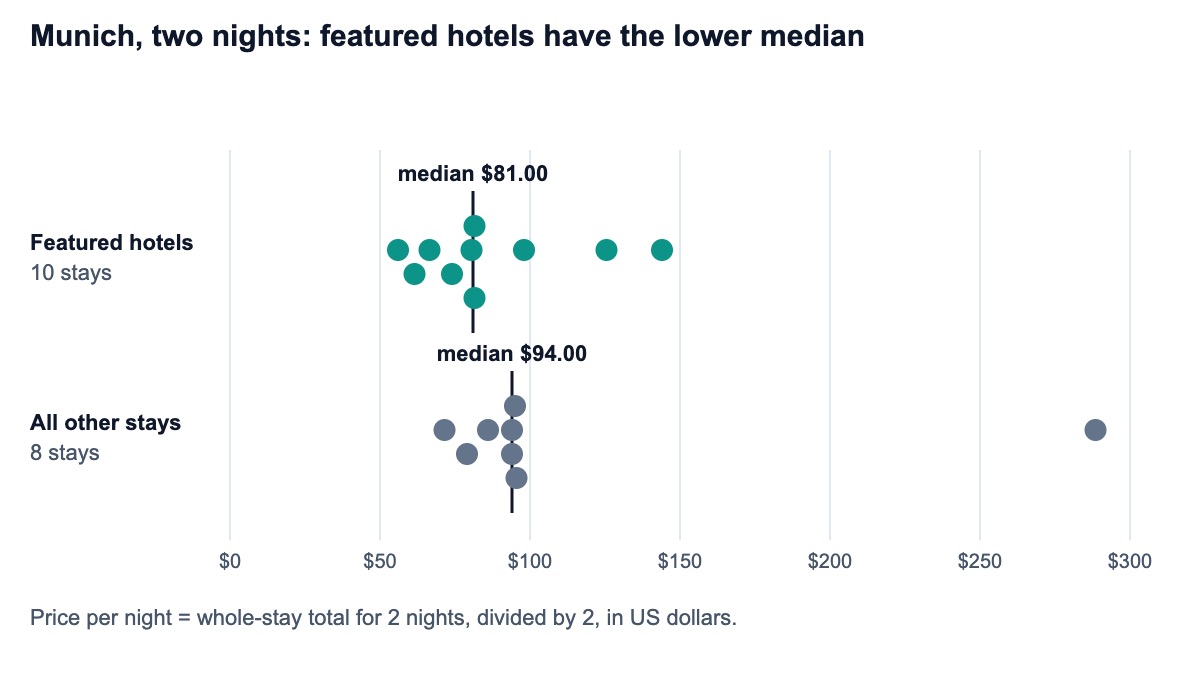
The nightly figure is the whole-stay total divided by 2, because a dated search returns the total. Medians use the stays that fall in each group, so a group of 10 or 8 is a small sample, and I read it as a direction and not as a rate card.
How do you turn a search into a price per night?
Divide each price by the number of nights it covers. In a dated search the price field is the price of the whole stay, and price_qualifier says so, for example “for 3 nights”. In a flexible search, with no dates, Airbnb picks a stay for each listing, so the length can differ from one listing to the next and price is the total for that stay. Each listing’s stay_nights gives its length, and the snippet below uses it, then works out the low, the high, the quartiles and the median, and places a rate of $80 among the stays. Save it as comps.py, because the later snippets import it:
import re
import statistics as st
from datetime import date

import requests

API_KEY = "sk_live_your_api_key"
URL = "https://apiserpent.com/api/airbnb/search"


def search(location, checkin=None, checkout=None, **filters):
    """One GET request = one search = one charge. Leave both dates out for a flexible search."""
    params = {"location": location, **filters}
    if checkin and checkout:
        params["checkin"], params["checkout"] = checkin, checkout
    r = requests.get(URL, params=params, headers={"X-API-Key": API_KEY}, timeout=60)
    r.raise_for_status()
    return r.json()


def nights_of(stay, data):
    """Nights this stay's price covers. A flexible search can mix stay lengths, so use the stay's own length."""
    if stay.get("stay_nights"):
        return stay["stay_nights"]
    if data["checkin"] and data["checkout"]:  # stay_nights is null: use the search dates
        return (date.fromisoformat(data["checkout"]) - date.fromisoformat(data["checkin"])).days
    m = re.search(r"(\d+) nights?", stay.get("price_qualifier") or "")  # last resort: "for 5 nights"
    if m:
        return int(m.group(1))
    raise ValueError("Airbnb did not say how long this stay is; drop it from the comparison")


def nightly(data, list_price=False):
    """Price per night for every stay. list_price=True uses the amount before a discount where there is one."""
    return [((s["price_original"] or s["price"]) if list_price else s["price"]) / nights_of(s, data) for s in data["listings"]]


def band(prices):
    q1, med, q3 = st.quantiles(prices, n=4, method="inclusive")
    return {"stays": len(prices), "low": min(prices), "q1": q1, "median": med, "q3": q3, "high": max(prices)}


if __name__ == "__main__":
    data = search("Porto")
    if not data["listings"]:
        print("No stays came back for this search")
    else:
        prices = nightly(data)
        b = band(prices)
        print(f'{data["location"]}: {b["stays"]} stays, price per night')
        print(f'  low ${b["low"]:.2f}  Q1 ${b["q1"]:.2f}  median ${b["median"]:.2f}  Q3 ${b["q3"]:.2f}  high ${b["high"]:.2f}')
        mine = 80
        print(f"  a rate of ${mine} is above {sum(p < mine for p in prices)} of {len(prices)} stays")
        listed = st.median(nightly(data, list_price=True))
        print(f'  median shown ${b["median"]:.2f}, median before discounts ${listed:.2f}')
The output for the Porto answer:
Porto, Portugal: 18 stays, price per night
  low $52.00  Q1 $81.12  median $100.00  Q3 $147.25  high $184.00
  a rate of $80 is above 5 of 18 stays
  median shown $100.00, median before discounts $139.75
The quartiles come from Python’s statistics.quantiles with the inclusive method: Q1 is the price a quarter of the stays are under, Q3 the price three quarters are under, and the median is the middle one. A rate of $80 is above 5 of the 18 stays, which is the count of stays priced below $80.
| Search | Nights | Low | Q1 | Median | Q3 | High |
|---|---|---|---|---|---|---|
| Porto | 2 | $52.00 | $81.12 | $100.00 | $147.25 | $184.00 |
| Munich | 2 | $56.00 | $75.25 | $83.75 | $95.38 | $288.50 |
| Barcelona | 7 | $516.71 | $572.54 | $646.79 | $763.14 | $1,018.43 |
The spread is the point. In Porto the dearest stay costs 3.5 times the cheapest, and in Munich 5.2 times. Barcelona is narrower, about 2.0 times, because the price_min filter already cut the cheap end: its cheapest stay is $516.71 a night, just over the $500 floor. A single “average price for the area” hides a spread like that, and the quartiles show how much room you have on either side of the median.
My rule of thumb is to price inside Q1 to Q3 unless you have a reason to be outside it, and to let your own rating, size and reviews decide where in that band you sit. That rule is a starting point and not something these three searches prove.
Is the price you see the price to compare?
Compare the price the guest pays, but read the pre-discount price too. Many stays show a lower price next to a crossed-out higher one, and price_original carries that higher amount. In the Porto answer, 14 of the 18 stays show one and the other 4 do not, and the shown price is 32.3 percent below the original on average, worked out as 1 minus price divided by price_original, averaged over those 14.
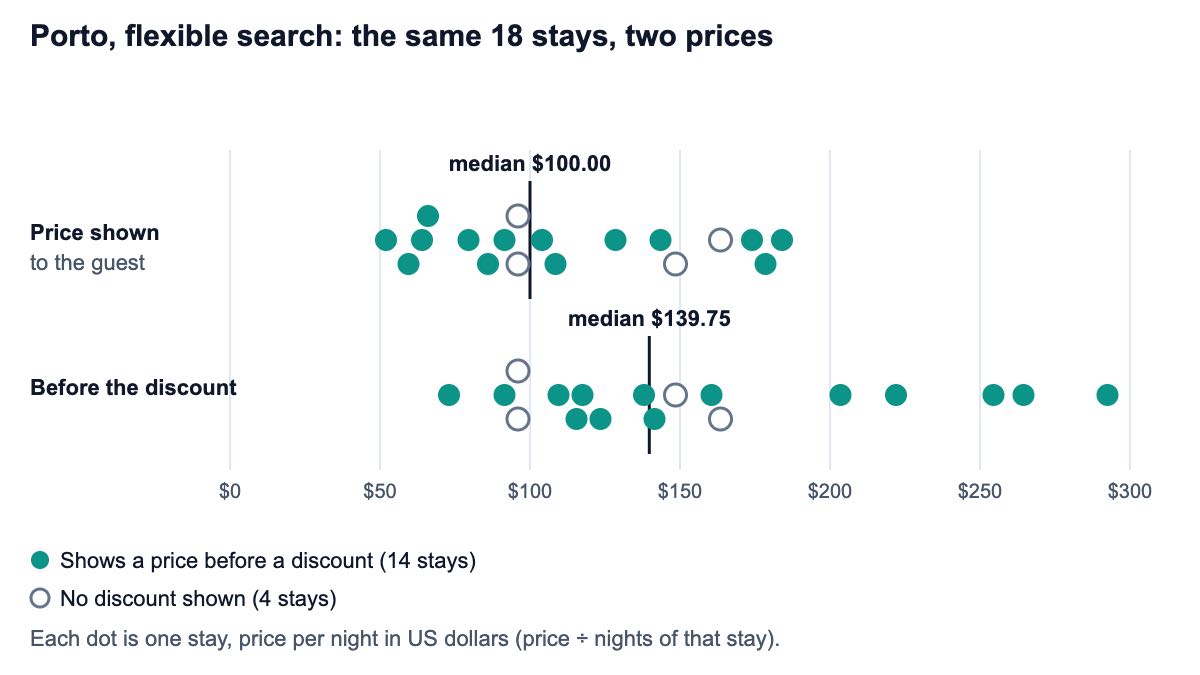
The effect on the median is large. Using price, the Porto median is $100.00 a night. Using price_original where a stay has one, and price where it does not, the median is $139.75, which is $39.75 higher. The snippet above prints both. The two answers say different things: $100.00 is where guests actually pay, and $139.75 is where those hosts list their rate before the discount.
Discounts are not equally common. The Munich answer has none with a price before a discount, 0 out of 18, and the Barcelona answer 2 out of 18. I cannot tell from the data why a stay is discounted, whether it is a weekly rate, a promotion or an early-booking offer, so treat the gap as a fact about displayed prices only.
Does a better rating mean a higher price?
A little, in these three searches, and not reliably. Splitting each answer at a rating of 4.9 works in only two of them: in Barcelona the better-rated stays have the higher median nightly price, in Munich the two stays rated 4.9 or more are cheaper than the eleven below that line, and in Porto every stay is rated 4.9 or more, so there is no second group to compare. The correlation between rating and nightly price is positive in two searches and about zero in the third.
| Search | Rated 4.9+ | Rated below 4.9 | Correlation r |
|---|---|---|---|
| Porto | 18 stays, $100.00 | 0 stays, none | 0.55 |
| Munich | 2 stays, $78.75 | 11 stays, $94.00 | 0.27 |
| Barcelona | 9 stays, $697.29 | 9 stays, $644.00 | -0.06 |
The 4.9 line is my own choice, and moving it changes the numbers. The correlation r is the Pearson correlation from statistics.correlation: 1 means price rises exactly with rating, 0 means no straight-line link and -1 the reverse. With 13 to 18 stays per search, an r of 0.3 is a hint. In the Munich answer, the five stays with no rating yet are all hotels, so they are left out of that row.
What I take from it is practical: a high rating is at most a mild advantage, and the two searches that can show it disagree, so it is not a reason to price far above the median. Your own reviews count more than the table does.
Does being near the middle cost more?
In all three searches, stays closer to the middle of the result set tended to cost more per night. “The middle” here is the median latitude and median longitude of the 18 returned stays, not a city centre I chose, and the distance is the straight-line distance in kilometres from it, worked out with the haversine formula. The snippet computes both the rating split from the last section and this distance split. Save it as drivers.py, next to comps.py, which it imports:
import math
import statistics as st

from comps import search, nightly


def km(lat1, lon1, lat2, lon2):
    """Great-circle distance in kilometres (haversine)."""
    p = math.pi / 180
    a = math.sin((lat2 - lat1) * p / 2) ** 2 + math.cos(lat1 * p) * math.cos(lat2 * p) * math.sin((lon2 - lon1) * p / 2) ** 2
    return 12742 * math.asin(math.sqrt(a))


def med(xs):
    """Median, or None when a group is empty."""
    return st.median(xs) if xs else None


def cell(group):
    n, m = group
    return f"{n:>3} stays " + (f"${m:>7.2f}" if m is not None else f"{'none':>8}")


def drivers(data):
    stays, price = data["listings"], nightly(data)
    # "The middle" is the median latitude and longitude of the stays this search returned.
    clat = st.median(s["latitude"] for s in stays)
    clon = st.median(s["longitude"] for s in stays)
    dist = [km(clat, clon, s["latitude"], s["longitude"]) for s in stays]
    rated = [(s["rating"], p) for s, p in zip(stays, price) if s["rating"] is not None]
    high = [p for r, p in rated if r >= 4.9]
    rest = [p for r, p in rated if r < 4.9]
    near = [p for p, d in zip(price, dist) if d <= 1]
    far = [p for p, d in zip(price, dist) if d > 1]
    return {
        "place": data["location"],
        "r_rating": st.correlation([r for r, _ in rated], [p for _, p in rated]),
        "r_distance": st.correlation(dist, price),
        "high": (len(high), med(high)),
        "rest": (len(rest), med(rest)),
        "near": (len(near), med(near)),
        "far": (len(far), med(far)),
    }


if __name__ == "__main__":
    searches = [
        ("Porto", None, None, {}),
        ("München", "2027-01-07", "2027-01-09", {}),
        ("Barcelona", "2027-07-10", "2027-07-17", {"adults": 2, "children": 2, "pets": 1, "room_type": "entire_home", "price_min": 500, "price_max": 4000, "min_bedrooms": 2}),
    ]
    rows = [drivers(search(loc, cin, cout, **extra)) for loc, cin, cout, extra in searches]
    print(f'{"place":<17}{"r rating":>9}  rated 4.9+ (median)   below 4.9 (median)')
    for d in rows:
        print(f'{d["place"]:<17}{d["r_rating"]:>9.2f}  {cell(d["high"])}   {cell(d["rest"])}')
    print()
    print(f'{"place":<17}{"r distance":>11}  within 1 km (median)   beyond 1 km (median)')
    for d in rows:
        print(f'{d["place"]:<17}{d["r_distance"]:>11.2f}  {cell(d["near"])}    {cell(d["far"])}')
The output for the three saved answers:
place             r rating  rated 4.9+ (median)   below 4.9 (median)
Porto, Portugal       0.55   18 stays $ 100.00     0 stays     none
Munich, Germany       0.27    2 stays $  78.75    11 stays $  94.00
Barcelona, Spain     -0.06    9 stays $ 697.29     9 stays $ 644.00

place             r distance  within 1 km (median)   beyond 1 km (median)
Porto, Portugal        -0.56   18 stays $ 100.00      0 stays     none
Munich, Germany        -0.36    9 stays $  95.50      9 stays $  81.50
Barcelona, Spain       -0.17   11 stays $ 697.29      7 stays $ 588.29
The distance correlations are -0.56, -0.36 and -0.17, so a longer distance goes with a lower price in every search, most clearly in Porto. Within 1 km of the middle, Munich stays have a median of $95.50 a night against $81.50 beyond it, and Barcelona $697.29 against $588.29. In Porto, all 18 stays sit within 1 km, so that split has nothing to compare and the correlation is the only distance figure for it.
You can use this directly. Add latitude and longitude to your own rows, mark the stays that are closest to yours, and compare your rate with theirs and not with the whole set. For neighbourhood-level work, the title field names the area, such as “Room in Maxvorstadt”, so you can group by it.
How do you watch your market over time?
Save the price band of the same search on a schedule and compare the runs. One call gives one snapshot, so a weekly job gives you a weekly series. This snippet appends one row per run to a CSV, with the date, the place, the dates searched, the number of stays and the quartiles, and tells you how far the median moved since the last run. It imports comps.py:
import csv
import os
from datetime import date

from comps import band, nightly, search


def snapshot(path, location, checkin=None, checkout=None, **filters):
    """Append one row: today's date and the price band of this search. Returns the new row, or None for an empty answer."""
    data = search(location, checkin, checkout, **filters)
    if not data["listings"]:
        return None
    b = band(nightly(data))
    row = [date.today().isoformat(), data["location"], checkin or "", checkout or "", b["stays"],
           round(b["q1"], 2), round(b["median"], 2), round(b["q3"], 2)]
    is_new = not os.path.exists(path)
    with open(path, "a", newline="") as f:
        w = csv.writer(f)
        if is_new:
            w.writerow(["run_date", "place", "checkin", "checkout", "stays", "q1", "median", "q3"])
        w.writerow(row)
    return row


def change_since_last(path, place):
    rows = [r for r in csv.DictReader(open(path)) if r["place"] == place]
    if len(rows) < 2:
        return None
    return float(rows[-1]["median"]) - float(rows[-2]["median"])


if __name__ == "__main__":
    row = snapshot("porto-weekly.csv", "Porto")
    print("saved:", row)
    delta = change_since_last("porto-weekly.csv", "Porto")
    print("first snapshot, nothing to compare yet" if delta is None else f"median moved by ${delta:+.2f} since the last run")
On the first run, it prints:
saved: ['2026-11-23', 'Porto, Portugal', '', '', 18, 81.12, 100.0, 147.25]
first snapshot, nothing to compare yet
That is one snapshot, so there is nothing to compare yet. From the second run on, the last line shows the change in the median. Run it from cron or any scheduler, and keep the search the same from week to week: same place, same guests, and dates that are a fixed number of days ahead.
To see how guests and dates move the answer, run the same place with different values. This Node snippet asks for the same place and dates with one, two and four adults and prints the median nightly price for each:
const API_KEY = "sk_live_your_api_key";
const ENDPOINT = "https://apiserpent.com/api/airbnb/search";

const median = (xs) => {
  const s = [...xs].sort((a, b) => a - b);
  const m = s.length >> 1;
  return s.length % 2 ? s[m] : (s[m - 1] + s[m]) / 2;
};

async function medianNightly(params) {
  const res = await fetch(`${ENDPOINT}?${new URLSearchParams(params)}`, {
    headers: { "X-API-Key": API_KEY },
    signal: AbortSignal.timeout(60_000),
  });
  if (res.ok === false) throw new Error(`HTTP ${res.status}`);
  const data = await res.json();
  if (data.listings.length === 0) return null;
  const searchNights = data.checkin && data.checkout ? (Date.parse(data.checkout) - Date.parse(data.checkin)) / 86_400_000 : null;
  const nightsOf = (s) => s.stay_nights ?? searchNights; // a flexible search can mix stay lengths
  return median(data.listings.filter((s) => nightsOf(s) > 0).map((s) => s.price / nightsOf(s)));
}

// Same place and dates, three party sizes: one search each, one charge each.
for (const adults of [1, 2, 4]) {
  const m = await medianNightly({ location: "Porto", checkin: "2027-05-14", checkout: "2027-05-17", adults: String(adults), room_type: "entire_home" });
  console.log(`${adults} adults: median ${m === null ? "no stays" : "$" + m.toFixed(2)} a night`);
}
This snippet was executed only to check that it runs, against a stand-in that returns the same saved answer for every request, so the three lines it printed were identical and say nothing about guests. Run it on your own place and the three medians will differ.
What does a year of watching cost?
Very little. One call is one search and one charge. The rates run from $0.50 down to $0.087 per 1,000 calls, which is $0.0005 down to $0.000087 a call, depending on the deposit tier. Running the three searches behind this guide would cost $0.0015 at the pay-as-you-go rate.
A weekly search for each of 20 areas is 20 times 52, or 1,040 calls a year: $0.52 at $0.50 per 1,000 calls and about $0.09 at $0.087. If you check five party sizes for each area, that is 5,200 calls: $2.60 at the pay-as-you-go rate and about $0.45 at the lowest. The pricing page shows how a deposit sets the rate, and the Airbnb API price comparison sets those rates against other Airbnb APIs.
Which workflow should you pick?
- You are about to list a place: one dated search per guest count you expect, with your bedrooms and room type, then start inside the Q1 to Q3 band.
- You already have bookings: the weekly snapshot, and a look at the median whenever your own occupancy changes.
- You care about particular weekends or holidays: search those exact dates and compare them with an ordinary week, and do not use a flexible search for them.
- You manage several properties: one search per area and room type, with the same parameters each week, and a table of medians.
- You are scouting where to buy: a flexible search per candidate area, with
room_type=entire_home, and a comparison of medians and ratings. See also ecommerce price intelligence for the same idea applied to products.
If you want the code details of a request in Python and Node, how to scrape Airbnb listings with Python and Node walks through each field. The Airbnb API page lists the fields and the playground lets you try a place before you write any code.
How we checked this
Data. The three answers are real responses: Porto with no dates and Munich searched as München for 2 nights, both recorded on 23 November 2026, and Barcelona for 7 nights with all the filters, recorded on 20 November 2026. Each has 18 stays, so 54 in all. The Barcelona figures and the snippets were checked on Python 3.14.4 and Node 26.5.0, run on 21 November 2026 against a local stand-in server that returned the saved answers. The Porto and Munich figures were recomputed on 23 November 2026 from the new answers with the same arithmetic as the snippets, without re-running the snippets against a server. No live call to the endpoint was made while this guide was written.
Method. Nightly price is price divided by the nights it covers: the listing’s stay_nights, or where that is missing the nights between check-in and check-out, or the count in price_qualifier. Quartiles use statistics.quantiles with the inclusive method. Correlations use statistics.correlation. The rating threshold of 4.9, the 1 km distance split, and the use of the median position of the returned stays as “the middle” are my choices.
What I could not verify:
- Which fees a displayed price includes. The price text says only “for 2 nights” and does not say what taxes or cleaning fees are in it, so compare like with like and check a few stays on Airbnb.
- Why a stay shows a discount.
- Whether stays book at the prices they show. The data holds asked prices, not booked prices or occupancy.
- Anything about a market beyond these three searches. Each answer holds 18 stays, in the order Airbnb shows them, so every statistic here describes a small sample, and none is a market-wide average.
- The rule of thumb to price inside Q1 to Q3: it is my judgment and no test supports it.
Run the same snippets on your own place and dates before you change a rate.
Price your own listing against real searches
Serpent’s Airbnb Search API is from $0.087 per 1,000 calls — pay as you go, no subscription, with 10 free API calls to start. Search your own area and dates in the playground before you write any code.
Get Your Free API KeyExplore: Airbnb API · Playground · Docs · Pricing
FAQ
How do I price my Airbnb listing against similar listings?
Search your area with your dates, guest count, room type and bedroom count, turn each stay's price into a price per night, and compare your rate with the median and the quartiles. In the saved Porto search, 18 stays ran from $52 to $184 a night with a median of $100.00 and quartiles of $81.12 and $147.25. Starting inside the quartile band is a rule of thumb, not a guarantee.
Should I compare the discounted price or the original price?
Compare the price the guest pays first, and read the original price as a signal of where hosts list. In the Porto answer, 14 of 18 stays showed a price before a discount, and the shown price was 32.3 percent below the original on average. The median was $100.00 with the shown prices and $139.75 with the pre-discount prices, so the choice moves your benchmark by $39.75 a night.
Does a higher Airbnb rating mean a higher nightly price?
A little, and not reliably. Across three saved searches, the correlation between rating and nightly price was 0.55, 0.27 and -0.06, and stays rated 4.9 or more had the higher median in only one of the two searches that had stays on both sides of that line. With 13 to 18 stays per search, treat that as a hint. Your own reviews, size and location matter more than the gap in a table.
How many comparable listings does one search give me?
Up to 18, in the order Airbnb shows them. That is enough for a first look at an area, and a small sample for anything larger. To widen the picture, run several searches with different guest counts, room types, bedroom counts or dates, and keep each search the same from week to week so the numbers stay comparable.
How often should I check market prices?
Weekly is a sensible starting point for a listing with bookings, and you can run extra searches for the exact dates that matter most. Each search is one call, so more checks add very little cost. Keep the parameters the same from one run to the next, and save each run as a row so you can see the median move.
How much does it cost to monitor my market for a year?
A weekly search for 20 areas is 1,040 calls a year, which is $0.52 at the pay-as-you-go rate of $0.50 per 1,000 calls and about $0.09 at the lowest rate of $0.087. Checking five party sizes for each area is 5,200 calls, about $2.60 at the pay-as-you-go rate. One call is one search and one charge.
Sources
Language references: