AI Visibility Reporting for Agencies: What to Measure and What It Costs per Client

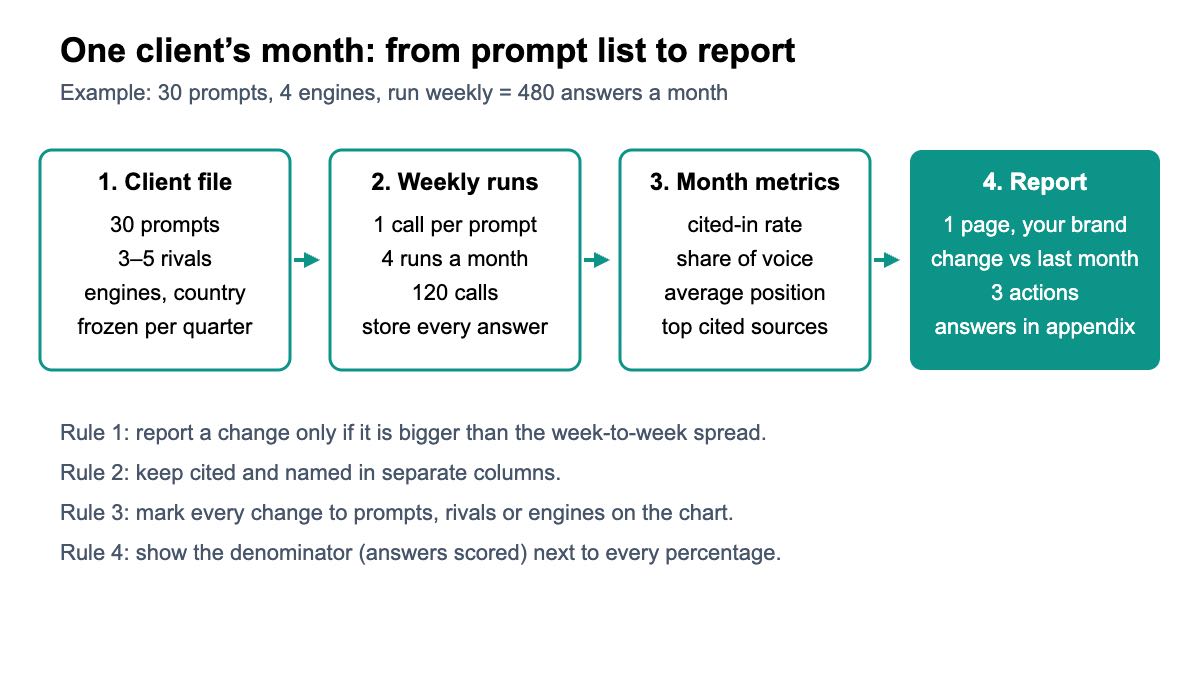
An AI visibility report for agency clients needs four numbers per month: how often the client is cited, its share of voice against named rivals, its average position, and which sources the answers lean on. Build them from a fixed prompt set per client, run weekly, and report change only when it beats the noise.
Short answer: If you already report through AgencyAnalytics, add its AI Tracker ($20.83 a month per 250 prompt checks, billed annually) and keep one tool. If you already pay for Ahrefs, Brand Radar prompt packages are the cheapest dashboard route. If you want the numbers in your own branded template at the lowest cost per client, feed the report from an API: Serpent’s AI Rank runs from $0.70 per 1,000 — pay as you go, no subscription (pricing) — and the code below turns its responses into the month’s numbers.
What should an AI visibility client report contain?
One page of numbers the client can act on, and an appendix that proves them. Agency guides converge on the same core: Search Atlas lists mention rate, citation rate, share of voice, sentiment and position, and Metehan Yesilyurt adds a prompt-category breakdown and recommendations. Here is the version I would send, in order:
- Cited-in rate: the share of AI answers whose sources include the client’s site, with the number of answers scored next to it.
- Share of voice: the client’s slice of all appearances by the client and its named rivals.
- Average position among the cited sources, when the client is cited.
- Sources to pitch: the third-party sites the answers cite most, such as review sites, directories and forums. These are the outreach list.
- Change since last month, marked as real or within noise.
- Three actions for next month, each tied to a number above.
The appendix holds the raw answers behind each number. Clients rarely read it, but the one time a number is challenged, it saves the account. Keep “cited” and “named in the text” in separate columns; our citations versus recommendations study found that most cited domains are never named in the answer itself. For fuller definitions, see AI search visibility metrics.
How many prompts and rivals per client?
Start with 20 to 30 non-branded prompts and three to five rivals per client. That matches Metehan’s “20 to 30 high-intent prompts per client” and Search Atlas’s three to five competitors, and it keeps costs and reading time sane.
- Write prompts the way buyers ask. “Best dental implants clinic in Denver”, not “dental implants”. Leave out prompts that name the client; they inflate every number.
- Group prompts by intent (comparison, problem, local, price) so the report can say where the client is strong.
- List every domain per brand, including booking subdomains and regional sites. A client cited on
book.example.comshould count. - Freeze the set for a quarter. Changing prompts or rivals mid-quarter breaks the trend line; mark any change on the chart.
- Set the market. Run each country as its own report; answers differ by market.
How often should you run and report?
Run weekly, report monthly, review the prompt set quarterly. Search Atlas suggests the same rhythm: weekly internal checks, a monthly client report and a quarterly review. Weekly runs give you four samples per prompt per month, which smooths out answers that change from one run to the next, and a monthly report is what clients already expect from SEO.
Thirty prompts on four engines run weekly is 30 × 4 × 4 = 480 answers per client per month. That number drives both the cost section and the noise rule below.
How do you build the month’s numbers from an API?
With one call per prompt per run, and about sixty lines of Python. AI Rank tracks brand citations and positions across ChatGPT, Claude, Gemini and Perplexity as JSON. Send the client’s domain in domain and each engine returns target_found and target_position for the client, plus every cited source in citations, so rivals and pitch targets come from the same response. The AI Rank docs list every field.
The script below computes last month and this month for one fictional client with two prompts. It runs on Python 3.15.2 with requests 2.34.2 (20 Nov 2026). For this page the HTTP call was replaced by a stub (the SERPENT_STUB branch), so the response is the documented shape with illustrative data, not a real answer.
import csv
import os
from collections import Counter

import requests

API_KEY = os.environ.get("SERPENT_API_KEY", "sk_live_your_api_key")
CLIENT = {
    "name": "Smile Denver",
    "domain": "smiledenver.com",
    "rivals": ["bracesplus.com", "mountaindental.com"],
    "country": "us",
    "prompts": ["best dental implants clinic denver", "same day crowns denver"],
}


def ai_rank(month, keyword, domain, country):
    if os.environ.get("SERPENT_STUB") == "1":
        from stub import stub_response
        return stub_response(month, keyword, domain)
    resp = requests.get(
        "https://apiserpent.com/api/ai/rank",
        headers={"X-API-Key": API_KEY},
        params={"keyword": keyword, "domain": domain, "country": country},
        timeout=120,
    )
    resp.raise_for_status()
    return resp.json()


def owns(domain, site):
    d = domain.lower().removeprefix("www.")
    return d == site or d.endswith("." + site)


def month_metrics(month, client):
    answers, found, positions, sources = 0, 0, [], Counter()
    rival_hits = Counter()
    for prompt in client["prompts"]:
        data = ai_rank(month, prompt, client["domain"], client["country"])
        for engine, row in data["results"].items():
            if row.get("error"):
                continue
            answers += 1
            if row["target_found"]:
                found += 1
                positions.append(row["target_position"])
            cited = [c["domain"] for c in row["citations"]]
            sources.update(cited)
            for rival in client["rivals"]:  # one count per answer, however often it is cited
                if any(owns(d, rival) for d in cited):
                    rival_hits[rival] += 1
    brands = {client["domain"]: found, **{r: rival_hits[r] for r in client["rivals"]}}
    total = sum(brands.values()) or 1
    return {
        "answers": answers,
        "presence": found / answers,
        "avg_position": sum(positions) / len(positions) if positions else None,
        "share_of_voice": found / total,
        "brands": brands,
        "top_sources": [d for d, _ in sources.most_common()
                        if not any(owns(d, b) for b in [client["domain"], *client["rivals"]])][:3],
    }


if __name__ == "__main__":
    last, this = month_metrics("2026-10", CLIENT), month_metrics("2026-11", CLIENT)
    print(f"AI visibility report: {CLIENT['name']} ({CLIENT['domain']}), November 2026")
    print(f"answers scored: {this['answers']} (last month {last['answers']})")
    for key, label in (("presence", "cited in"), ("share_of_voice", "share of voice")):
        change = (this[key] - last[key]) * 100
        print(f"{label:<15}{this[key]:>6.0%}   last month {last[key]:>4.0%}   change {change:+.0f} pts")
    print(f"{'avg position':<15}{this['avg_position']:>6.1f}   last month {last['avg_position']:>4.1f}")
    print("brand citations this month:", this["brands"])
    print("sources to pitch:", ", ".join(this["top_sources"]))
    with open("smile-denver-2026-11.csv", "w", newline="") as f:
        w = csv.writer(f)
        w.writerow(["month", "answers", "presence", "share_of_voice", "avg_position"])
        for m, r in (("2026-10", last), ("2026-11", this)):
            w.writerow([m, r["answers"], round(r["presence"], 3), round(r["share_of_voice"], 3), r["avg_position"]])
Output with the stubbed responses:
AI visibility report: Smile Denver (smiledenver.com), November 2026
answers scored: 8 (last month 8)
cited in          62%   last month  25%   change +38 pts
share of voice    56%   last month  33%   change +22 pts
avg position      1.6   last month  2.0
brand citations this month: {'smiledenver.com': 5, 'bracesplus.com': 3, 'mountaindental.com': 1}
sources to pitch: yelp.com, healthline.com, reddit.com
Three things in that output are worth copying into your own pipeline. The client was cited in 5 of 8 answers, and one of those came from book.smiledenver.com, which the subdomain rule counted. Rivals are counted once per answer, however many of their pages are cited, so share of voice compares like with like. And the pitch list excludes the client and its rivals, leaving the third-party sites worth earning a mention on.
The script also writes a two-row CSV for the trend chart. To store every run and schedule it, the AI citation tracker tutorial adds SQLite and cron around the same call.
Do not report that +38 points. Eight answers is a demonstration, not a sample, which is the next section.
When is a change real?
When it is bigger than the spread you would see by chance at your sample size. AI answers vary between runs, so a client’s cited-in rate moves even when nothing changed. At 480 answers a month and a true rate of 30%, the standard 95% Wilson interval runs from 26.1% to 34.2%, about plus or minus 4 points. A single week of 120 answers spreads plus or minus 8 points.
So the house rule is simple: report a monthly move of more than about 5 points as a change, and anything smaller as “stable”. Put the denominator next to every percentage so the client sees why. If a client needs finer resolution, add prompts before you add reruns: different prompts carry more information than repeats of the same one.
What does AI visibility reporting cost per client?
At 480 answers per client a month, the data cost ranges from cents to about sixty dollars per client depending on the route. The table prices three portfolio sizes from each vendor’s live pricing page on 20 November 2026.
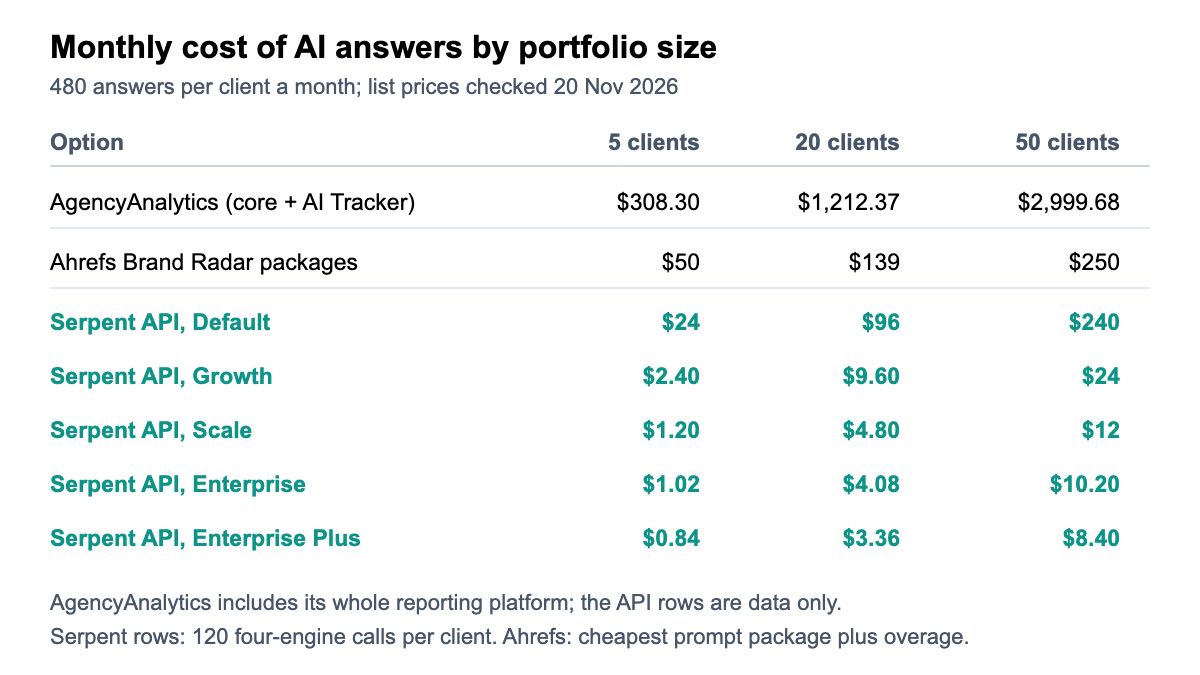
| Option and plan rule | 5 clients (2,400 answers) | 20 clients (9,600 answers) | 50 clients (24,000 answers) |
|---|---|---|---|
| AgencyAnalytics ($20 per client core + AI Tracker $20.83 per 250 checks, billed annually) | $308.30 | $1,212.37 | $2,999.68 |
| Ahrefs Brand Radar packages (cheapest of Basic $50, Growth $100, Scale $250, plus overage) | $50 | $139 | $250 |
| Serpent API — Default (four-engine call, $40 per 1,000 calls) | $24 | $96 | $240 |
| Serpent API — Growth ($100 deposit; $4 per 1,000 calls) | $2.40 | $9.60 | $24 |
| Serpent API — Scale ($500 deposit; $2 per 1,000 calls) | $1.20 | $4.80 | $12 |
| Serpent API — Enterprise ($1,000 deposit; $1.70 per 1,000 calls) | $1.02 | $4.08 | $10.20 |
| Serpent API — Enterprise Plus ($1,250 deposit; $1.40 per 1,000 calls) | $0.84 | $3.36 | $8.40 |
How the rows were built. AgencyAnalytics charges $20 per client a month for its core plan and sells AI Tracker credits at $20.83 a month per 250, both billed annually, where one credit is one prompt checked once on one platform in one location; the three portfolios need 10, 39 or 96 packs. Its page offers discounted volume pricing from 25 clients, so the 50-client figure is list price, not a quote. Ahrefs counts checks the same way (9,600 checks is Growth’s 7,000 plus 2,600 at $0.015), and Serpent rows are 120 four-engine calls per client.
The comparison is not like for like, and it should not pretend to be. AgencyAnalytics’ price includes its whole reporting suite, client portal and 90+ integrations, which an agency would otherwise build or buy. The API rows buy data, and your team builds the report. For an agency that already has a reporting stack, as many do from classic SEO work, that trade usually favours the API; our guide to automating SEO reports shows that side.
Dashboards priced per prompt fit a smaller portfolio. Peec AI’s Pro plan at $245 covers 150 prompts, which is five clients at 30 each, with unlimited users. Semrush’s AI Visibility Toolkit is $99 a month per domain with 25 prompts, and each extra Brand Performance domain is another $99.
How do you deliver it under your own brand?
Either buy white-label from the tool or own the template. Tools that sell it: AgencyAnalytics describes branded AI visibility reports on its AI Tracker page; Semrush sells a Pro Report add-on with branding and white-labelling at $20 a month on its AI pricing page; and Rankscale includes white-label links on its Growth plan at $385.
With an API, the data is yours, so white-label is just your template. Write the month table to a sheet or a database, chart it in Looker Studio or your own app next to the client’s organic positions, and export the page as PDF. The SERP API guide for agencies covers the search-ranking half of the same report.
Two delivery habits matter more than the logo. Send the report on the same day each month, and lead with the three actions, not the charts. A client remembers what you will do next more than last month’s share of voice.
Which setup should your agency pick?
- You already report everything in AgencyAnalytics: add AI Tracker and keep one login for the client.
- You run on Ahrefs: Brand Radar prompt packages, the cheapest dashboard per answer at volume.
- A few premium clients who want sentiment and narrative: Semrush’s toolkit with the Pro Report add-on.
- Up to about five clients, and you want a dashboard to share: Peec AI Pro.
- Many clients, your own template, lowest cost per client: an API feeding your report; AI Rank is one option.
Whatever you choose, ask the vendor how its numbers are built before you put them in front of a client; our audit of 14 AI rank trackers lists the questions.
How we checked this
On 20 November 2026 I opened the top-ranking guides for “AI visibility reporting for agencies” (Search Atlas, Metehan Yesilyurt and AgencyAnalytics’ AI Tracker page) and the pricing pages of AgencyAnalytics, Ahrefs, Semrush, Peec AI and Rankscale. AgencyAnalytics’, Ahrefs’ and Rankscale’s prices were read from the pages’ raw text. That is 9 linked sources, 7 of them official vendor pages. Costs and the Wilson intervals are my arithmetic, logged with this post’s evidence.
The report script was executed locally against a stub that returns the documented response shape with a fictional client; no live API was called for this page.
What I could not verify: whether Ahrefs’ prompt packages are per account or per project; per-client limits on Peec AI and Otterly beyond their prompt counts; and AgencyAnalytics’ month-to-month price for AI Tracker credits, since its page shows annual billing.
Feed your client reports from one API
Each client’s prompts across ChatGPT, Claude, Gemini and Perplexity, with positions and every cited source as JSON. From $0.70 per 1,000 — pay as you go, no subscription — and every account starts with 10 free API calls.
Get Your Free API KeyExplore: AI Rank API · Playground · Docs · Pricing
FAQ
What metrics belong in an AI visibility report for clients?
Four numbers per month: the share of AI answers that cite the client, its share of voice against three to five named rivals, its average position among cited sources, and the third-party sites the answers cite most. Add the change since last month, marked as real or within noise, and three actions. Keep cited and named-in-text counts separate, and show how many answers each percentage is based on.
How many prompts should an agency track per client?
Start with 20 to 30 non-branded prompts per client, grouped by intent, and three to five rivals. On four engines run weekly, 30 prompts give 480 answers a month, enough to pin a 30% rate to within about plus or minus 4 points. Freeze the set for a quarter so the trend line means something.
Can I white-label AI visibility reports?
Yes. AgencyAnalytics offers branded AI visibility reports, Semrush sells a $20-a-month Pro Report add-on with white-labelling, and Rankscale includes white-label links on its $385 Growth plan. If you pull the data through an API instead, it is yours to put in any template, so white-label costs nothing extra beyond building the report.
How often should agencies report AI visibility?
Monthly to the client, with weekly runs behind it and a quarterly review of prompts and rivals. AI answers change between runs, so weekly sampling smooths the monthly number. Report a monthly move of more than about 5 points as a change at 480 answers per client, and anything smaller as stable.
What does AI visibility tracking cost per client?
For 480 answers a month per client, list prices on 20 November 2026 ranged from about $60 per client on AgencyAnalytics (including its reporting suite) to $5 to $10 on Ahrefs prompt packages at volume, and from $4.80 per client down to $0.17 through a per-call API such as Serpent’s AI Rank, which includes no dashboard.
Sources
Official pricing and product pages (checked 20 November 2026):
- AgencyAnalytics pricing
- AgencyAnalytics AI Tracker
- Ahrefs pricing (prompt packages)
- Semrush AI Visibility Toolkit help article
- Semrush AI pricing (Pro Report add-on)
- Peec AI pricing
- Rankscale pricing
Agency reporting guides (read 20 November 2026):