Local pack vs Google Maps rankings: what is known
No source I could open shows that the local pack and Google Maps rank businesses by different rules. Google's help page gives one set of factors for both. Agencies claim opposite things without data, and the one measured test compared Maps with the Local Finder, not the 3-pack. So measure your own queries.
Short answer: If you are an agency reporting to a client, report the surface the client actually sees and label it "3-pack" or "Maps"; never write "local rank" without one. If you are building a tracker, store the surface as its own column and keep two separate series. If you are #1 in Maps and missing from the pack, do not conclude "different algorithms" yet; rule out location and list length first.
What are the three local result types?
There are three, not two: the local pack, the Local Finder and Google Maps. Most "pack vs Maps" arguments skip the middle one.
The local pack (also called the 3-pack, Map Pack or Snack Pack) sits inside an ordinary Google search. Semrush describes it as "a separate Google Search result type from Local Finder", and says you reach the Finder by "clicking “more places” on the Local Pack". Google Maps is the separate map app and site.
This matters for measurement. Local Dominator's own help page says that when your business is not in the visible 3-pack, its tracker "looks at the “Local Finder”" and that "Ranking #9 means you are the 9th result in that expanded list." So a "pack rank of 9" in a tracker is a Finder position; only positions 1 to 3 are pack positions.
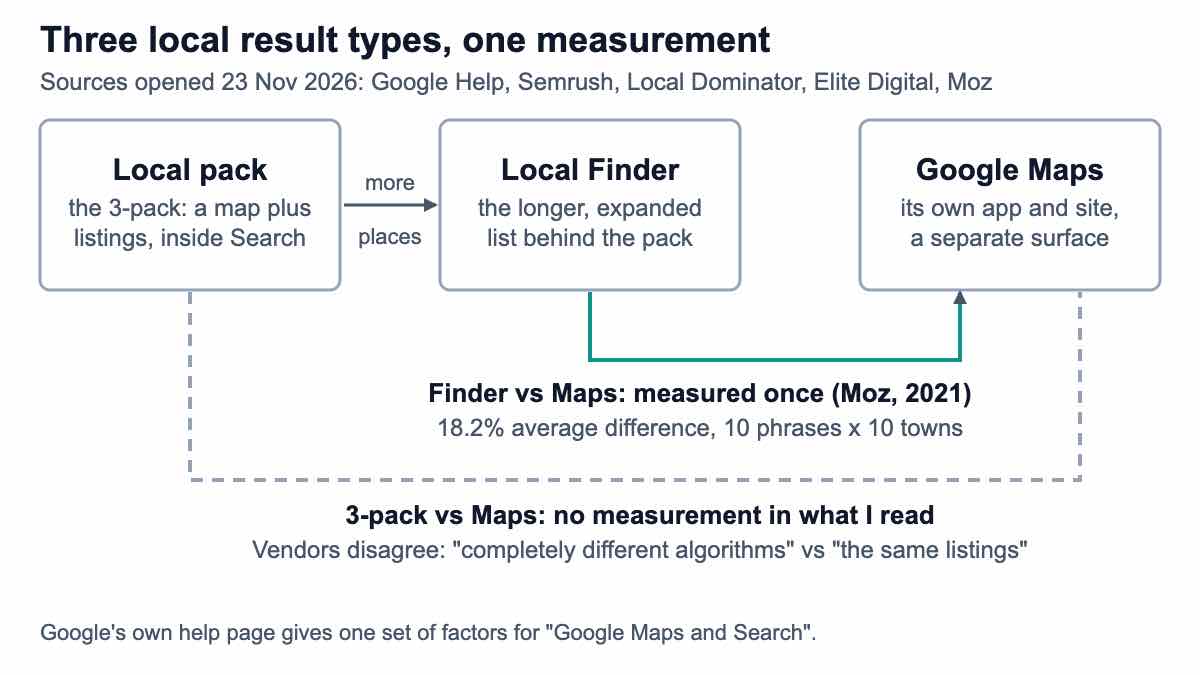
How much do the surfaces overlap? Semrush says "Local Pack results are very often the top 3 you will find in Local Finder. However, this is not always the case". It also says "The way businesses rank in Google Maps results and Local Finder are similar." Neither comes with a rate or a sample, so treat them as a vendor's impression.
What does Google itself say?
Google gives one set of factors and does not describe separate rules for the pack, the Finder or Maps. Its Business Profile help page says: "When a customer searches for a business or place near their location, they’ll find local results on Google Maps and Search." and "Local results are mainly based on relevance, distance, and popularity."
It defines distance as how far each business is from the person searching, and for prominence it points to "how many websites link to your business and how many reviews you have."
Two limits on reading this. First, silence is not proof that the surfaces are identical. The same page says Google tries "to keep the search algorithm details confidential", so a missing description of a difference tells you little either way. Second, it contains the one line every local SEO should keep handy: "There's no way to request or pay for a better local ranking on Google."
What do agencies and vendors claim?
They claim opposite things, and none of the pages I opened shows data for its claim. Each of these vendors sells something related, which is worth knowing when you weigh the wording.
| Who | What the page says | Evidence shown |
|---|---|---|
| Local Dominator (rank tracker vendor, help page updated 2 Sep 2026) | "The “Local Pack” (the top 3 results on Google Search) and the “Google Maps App” run on completely different algorithms." Also: "It is very common to rank #1 on Google Maps but #10 in the Local Pack for the same keyword." | None on the page |
| Elite Digital (UK agency blog) | "The same listings drive Google Maps results." | None on the page |
| Semrush (sells Semrush Local) | Maps and Local Finder rank in a "similar" way; pack and Finder top 3 are "very often" the same, "not always". | No rate given |
| r/localseo thread; Search Engine Land guide | Search snippets only: "It is a completely different ball game." and "Google Maps + Local Search rankings are NOT the same". | Not verified: I did not open the thread, and the Search Engine Land page showed a security check |
Look at the Local Dominator example again. By its own help page, "#10 in the Local Pack" is a position in the Local Finder list. So the headline example, rank #1 in Maps and #10 in the pack, is a Maps-versus-Finder comparison. That is the same pair Moz measured, which is the next section.
Local Dominator also sells the two views separately, at "1 Credit per point" for Maps and "2 Credits per point" for the pack. On its 13 by 13 grid example that is 169 points: 169 credits for Maps, 338 for the pack, 507 for both (my arithmetic). That is a price list, not evidence about how Google ranks. Neither "completely different algorithms" nor "the same listings" has a test behind it on the page that makes the claim, so I would not repeat either to a client as settled.
What has actually been measured?
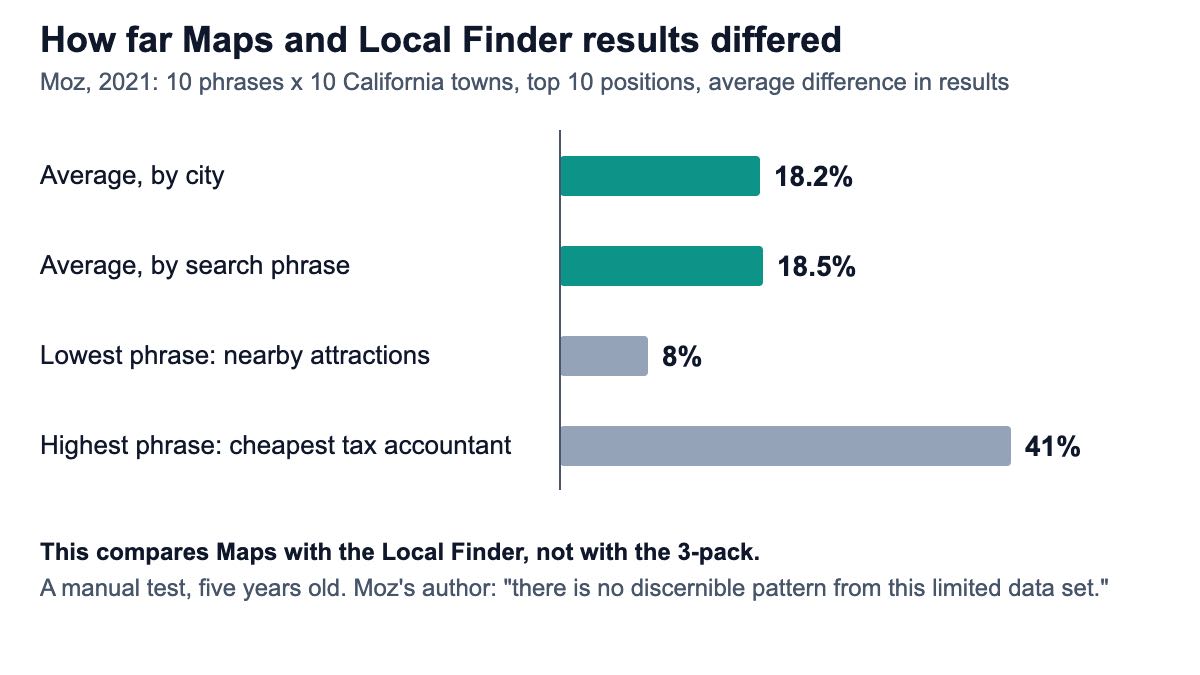
One test, five years old, and it compared Maps with the Local Finder rather than the 3-pack. Moz's Miriam Ellis ran it by hand: ten search phrases in ten California towns, using "remote" queries "to remove the influence of proximity", and looked at the top 10 positions on each surface.
The result in her words: "the average difference in Local Finder vs. Maps results was 18.2% across all cities. The average difference was 18.5% across all search phrases." Across phrases the page quotes a range from 8% ("nearby attractions") to 41% ("cheapest tax accountant"). She also writes that "there is no discernible pattern from this limited data set."
What that does and does not tell you:
- It does show that two Google local surfaces can return noticeably different top-10 lists for the same phrase and town, by roughly one in five on average in that sample.
- It does not show that the 3-pack differs from Maps by that much. The pack is three listings, the Finder is a longer list, and a short list can behave differently from a long one.
- It does not show that the cause is a different algorithm. Moz quotes three local-SEO practitioners with three different explanations: the size of the map view-port (Mike Blumenthal), searcher intent (Krystal Taing) and different listing features plus separate reporting (Joy Hawkins). They are opinions, not experiments.
- It is small and old: manual, 100 phrase-and-town combinations, in one state, in 2021. Moz also sells local SEO tools.
I did not open a 2024 to 2026 study from BrightLocal, Whitespark or Sterling Sky, so I cannot say whether a newer measurement exists. If you find one, ask the same questions: which surfaces, how many queries, run from where, and when.
Does where you search from change the answer?
Yes, and it is the first thing to hold constant. Google's distance factor is relative to the searcher, and Moz used remote queries to take proximity out of its comparison. If your two checks are run from different places, you are measuring distance, not the pack-versus-Maps difference.
Region matters too. Semrush reports, from its own experiment, that in the US the Local Finder shows details on the left and a map on the right, while the same search in Madrid "essentially resulted in a longer version of the Local Pack. So in essence, Google Maps doesn’t appear in Europe for search anymore." Semrush ties this to the Digital Markets Act. It is one vendor's test of one search that I could not confirm elsewhere, so say which country you measured in.
How do you measure the difference for your own business?
Track the same keyword in the 3-pack and in Maps, from the same location, at the same time, for several days, and compare. It costs pennies and gives you data for your own queries, which is the one thing the web lacks.
Step 1: pick the queries and the place
Choose 5 to 10 queries a customer would really type, such as the service plus the city. Write the place as one text string, such as "Austin, TX", and use that exact string on both surfaces. For a grid of points instead of one place, see the geo-grid post.
Step 2: pull both surfaces in the same minute
I run Serpent, the API this site sells, so the example below uses it. On the search side, call the web search endpoint with the city in location (it needs an explicit country). The 3-pack comes back in results.localPack, an array that is empty when the page had no pack, and metadata.hasLocalPack tells you whether this response carried one. The fields inside each pack entry are not documented, so look at one real response for your own query before you write a parser.
curl --get "https://apiserpent.com/api/search" \
  -H "X-API-Key: sk_live_your_api_key" \
  --data-urlencode "q=dentist" \
  --data-urlencode "country=us" \
  --data-urlencode "location=Austin, TX"
On the Maps side, call Maps List (/api/maps/search with detail=0), which returns the ranked list of places alone. Each place record carries a rank, plus place_id, name and address to match businesses between the two lists. This is the request from our docs.
curl --get "https://apiserpent.com/api/maps/search" \
  -H "X-API-Key: sk_live_your_api_key" \
  --data-urlencode "q=dentist" \
  --data-urlencode "location=Austin, TX" \
  --data-urlencode "detail=0" \
  --data-urlencode "limit=20"
Pricing, checked 23 November 2026 on the pricing page: a search is from $0.03 per 1,000 searches and Maps List calls are from $0.05 per 1,000 calls, pay as you go, no subscription. A city-level search counts as two searches and needs a paid balance. Ten queries a day for a week is 70 calls per side, well under a dollar at those rates. The free tier gives 10 free calls, enough to look at the response shapes before you build anything.
Step 3: repeat at the same time for a week
Run the same queries once a day for at least a week, at the same hour. I have no source for how many samples are enough, but 35 to 70 pairs per surface beats judging from one afternoon. Store the query, the place string, the UTC timestamp, the surface, and the business's position, or "absent".
Step 4: compare the lists, not just your own rank
Moz compared lists, so do the same. Two small functions are enough: how many of the pack's top three are also in Maps' top three, and where a given business sits on each side. The code below is plain Python with no dependencies and invented business names; it shows the arithmetic, not real results. The two name lists are the ones you extract from your own responses.
def norm(name):
    return " ".join(name.lower().split())

def overlap(pack_names, maps_names, k=3):
    """Share of the pack's top k that also sits in Maps' top k."""
    pack = {norm(n) for n in pack_names[:k]}
    maps = {norm(n) for n in maps_names[:k]}
    return len(pack & maps) / k

def position(name, ranked_names):
    """1-based position of a business in a list, or None."""
    target = norm(name)
    for i, n in enumerate(ranked_names, start=1):
        if norm(n) == target:
            return i
    return None

pack = ["Acme Dental", "Birch Street Dentists", "Cedar Smiles"]
maps = ["Birch Street Dentists", "Delta Dental Care", "Acme Dental", "Cedar Smiles"]
print(round(overlap(pack, maps), 2))        # 0.67
print(position("Cedar Smiles", pack))       # 3
print(position("Cedar Smiles", maps))       # 4
print(position("Delta Dental Care", pack))  # None
I ran that snippet locally with Python 3 on 23 November 2026 against the invented lists, with no network call; the output matches the comments. Matching on name alone can fail for chains with several branches, so confirm with the address.
Step 5: read the results carefully
| What you see over the week | A reasonable reading |
|---|---|
| Pack top 3 and Maps top 3 match on almost every run | For these queries the two views agree. Track one and label it. |
| Your business is Maps #1 and absent from the pack on most runs | A real difference for that query and place. The test cannot say why. Report both numbers. |
| Results flip between runs with no pattern | Noise. Collect more days before concluding anything. |
hasLocalPack is false on many runs | Those responses carried no pack. "Not in the pack" and "no pack shown" are different findings. Keep them apart. |
Compare like with like: top 3 against top 3, and the longer lists only with the same kind of list on both sides.
What should you track and report?
Report the surface the customer actually uses, name it, and do not blend the numbers into one "local rank". Beyond that, pick by scenario:
- Service business where customers search on a phone and tap a result: track the 3-pack and Maps separately. Your own week of data will show how far apart they sit.
- Multi-location brand: run the test above for one location per region before you standardise on one report. Location-by-location tracking is covered in this multi-city guide, and the API route in this tutorial.
- Developer building a tracker: keep
surfacein the schema from day one, and never store a Finder position under a pack label. There is a worked Python tutorial, and a no-cost starting point in the free local rank tracker post. - Client who only cares about calls: rank is only an indirect measure. Maps business data is covered in the Maps business-data post and on the Google Maps API page.
Two neighbouring topics: why a position number can disagree with what a searcher sees is in pixel position versus SERP features, and local answers from AI assistants are in AEO for local businesses.
How we checked this
I checked six pages on 23 November 2026: Google's Business Profile help page, the Semrush Local Finder article, the Local Dominator help page, the Elite Digital explainer, the Moz study and the Google results page for this keyword. I made no API calls and ran no ranking test of my own. What I could not verify: the Search Engine Land guide (it showed a security check, so I stopped there), the r/localseo thread and a YouTube video (search snippets only), any 2024 to 2026 study of how often the pack, Finder and Maps differ, whether they apply different ranking weights (only vendor assertions exist), and Semrush's Europe finding (one vendor test). The fields inside our local pack entries are not documented, which is why this post does not list them.
Compare your own pack and Maps results
Searches from $0.03 per 1,000, pay as you go, no subscription, and 10 free calls to look at the response shapes first.
Get Your Free API KeyExplore: Google Maps API · Playground · Docs · Pricing
FAQ
Are local pack and Google Maps rankings the same?
Nobody has shown that they are, or that they are not. Google's help page gives one set of factors for results on "Google Maps and Search". Vendors split between "completely different algorithms" and "the same listings", with no data. The one measured test, from Moz in 2021, found Maps and Local Finder results differed by 18.2% on average, but it did not test the 3-pack.
Why am I #1 on Google Maps but not in the 3-pack?
Several ordinary explanations come before any "different algorithm" theory. The pack holds only three listings and Maps holds a long list, so a Maps #5 is simply outside it. The two checks may have been run from different locations, and Google says distance depends on where the searcher is. Run both from one place at one time for a week to see whether the gap is stable.
What is the Local Finder, and is it the same as Maps?
The Local Finder is the longer list you reach from the pack by clicking "more places". Semrush says it ranks businesses in a way that is "similar" to Maps, and Moz measured an 18.2% average difference between the two in 2021. So they are related but not identical. A tracker's "pack rank 9" is a Finder position.
Which should I track, the 3-pack or Maps?
Track the one your customers use, and label it. If you cannot tell, track both as separate series for a week. Do not merge them into one number, because a Finder position reported as a pack rank misleads a client.
Does Google use different ranking factors for Maps and Search?
Google's page lists relevance, distance and prominence for local results on Maps and Search and does not describe a separate set for either. It also says it keeps algorithm details confidential, so the page cannot rule a difference in or out. Claims that the weights differ come from vendors, not Google.
Sources
Official (checked 23 November 2026):
Study (checked 23 November 2026):
Vendor and agency pages (checked 23 November 2026; each sells something related):
- Google Local Finder vs Google Maps (Semrush)
- Google Maps vs Local Pack tracker difference (Local Dominator help)
- What is the Google Local Pack (Elite Digital)
Not verified (search snippet only; page not read):